Monastery of the Holy Cross: A Georgian Religious and Cultural Center in Jerusalem
Site at a Glance
- Rating
- 4.6
- Popularity
- Low
- Country
- Israel
- Primary era
- Medieval
- Eras represented
- Classical, Medieval, Modern
- Civilizations
- Byzantine, Georgian
- Site type
- Religious
- Remains
- Fortified Monastery
On this page14 sections
History
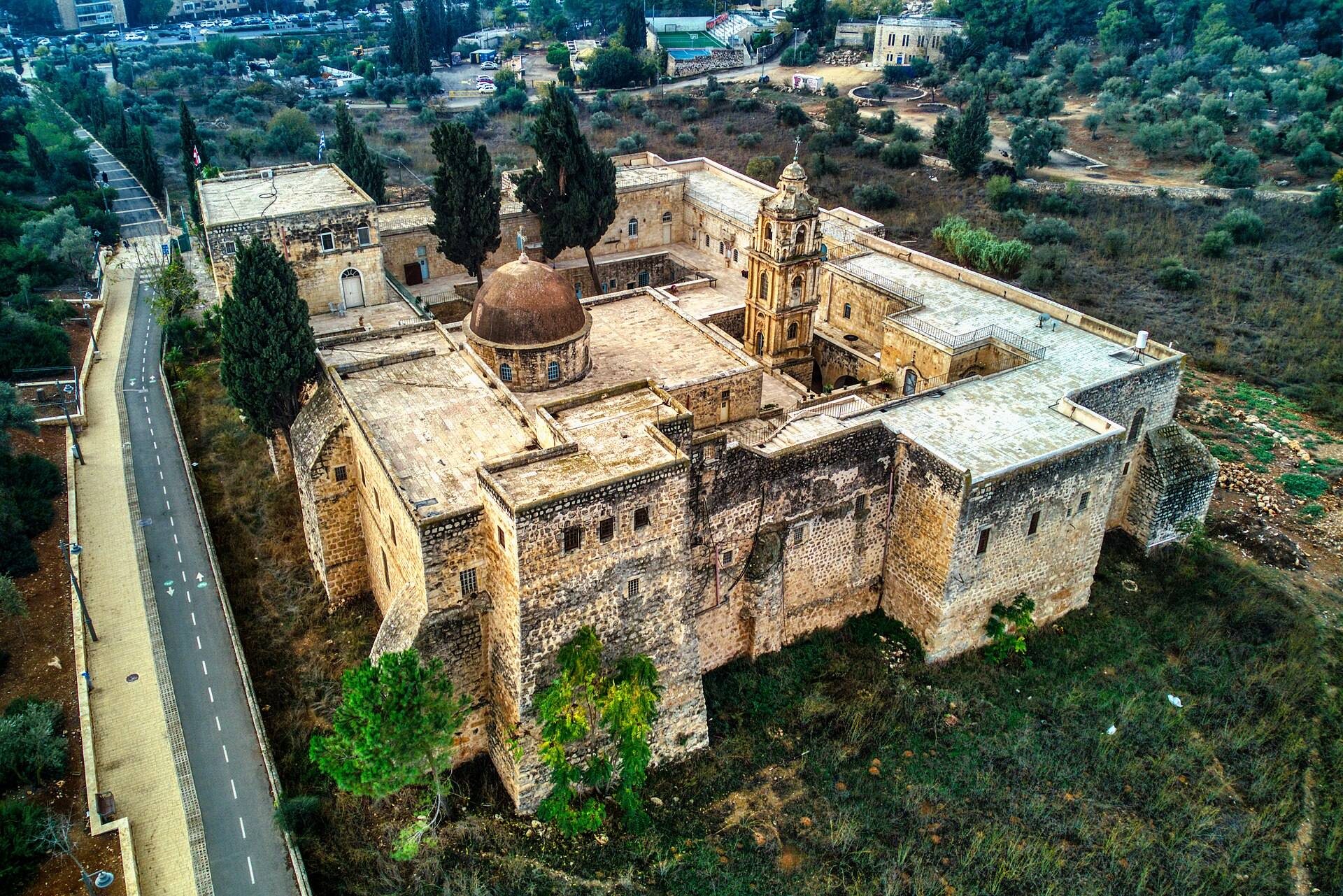
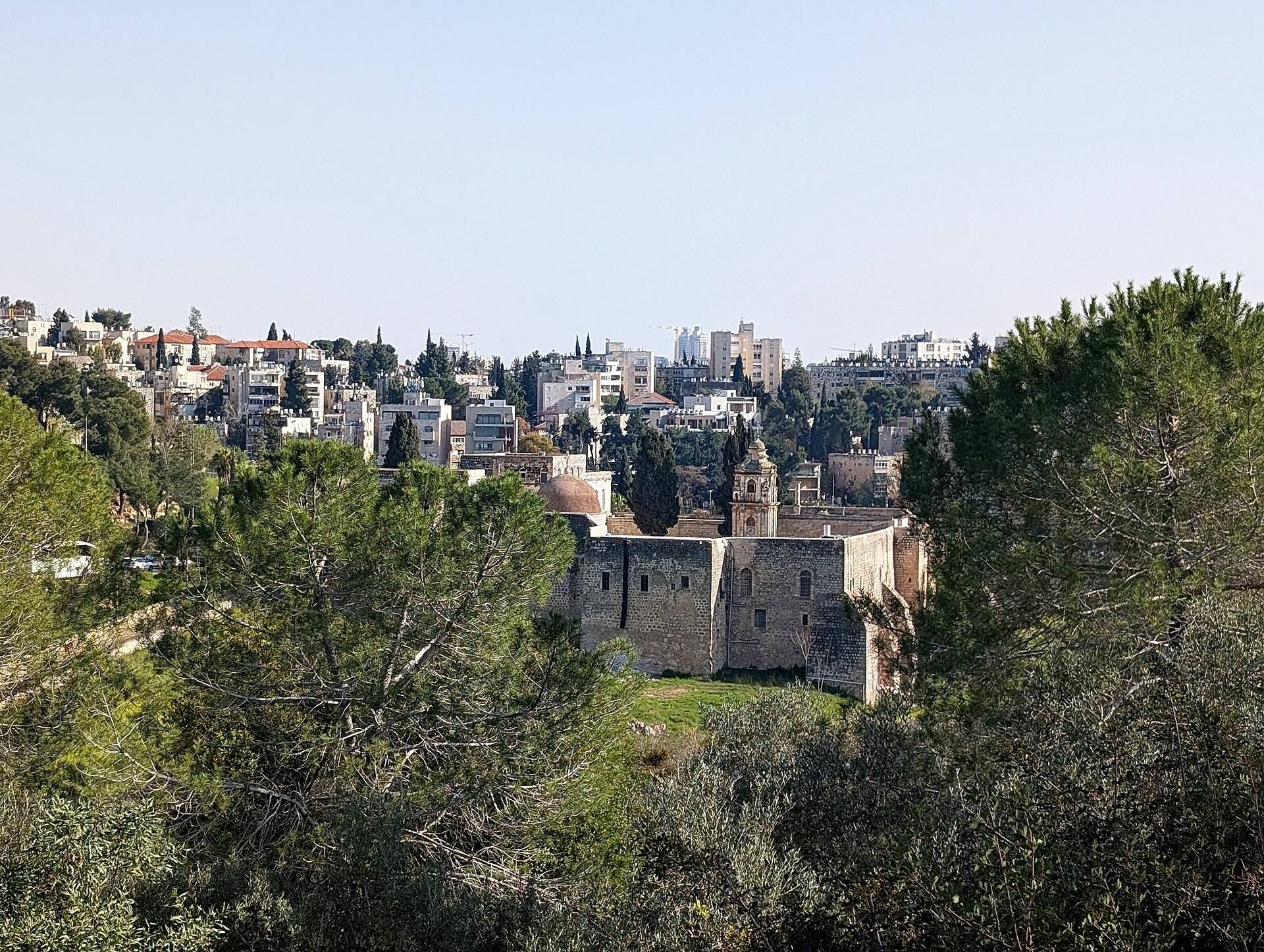
The Monastery of the Holy Cross is a medieval Georgian religious, cultural, and educational center in Jerusalem, Israel. Its principal rebuilding took place in 1038, within a complex that combines early Christian, Byzantine, Romanesque, Crusader-period, and later Georgian traditions. The monastery stands in the Valley of the Cross, in the present-day Nayot area, on land that formerly lay outside Jerusalem’s Old City.
Early Christian Foundations
The origin of the monastery is associated with several traditions rather than a securely identified founder. Georgian tradition connects the acquisition of the land with King Mirian III, the first Christian king of Iberia, after the conversion of his kingdom in the fourth century. Another Georgian account associates the site with Vakhtang Gorgasali, a fifth-century king of Iberia. Christian traditions outside Georgia attribute the foundation to Helena, the mother of Constantine the Great, or to the Byzantine emperor Heraclius.
Archaeological investigation carried out between 1969 and 1973 established that a first basilica stood on the site during the last quarter of the fourth century. Bakur, an Iberian prince and Dux Palestinae, a senior military official in Roman Palestine, has been proposed as the founder or principal figure connected with this early church. A Byzantine church stood here by the sixth century and was later enlarged under Emperor Justinian.
The monastery’s name derives from the Christian belief that the tree used to make the Cross of Christ grew at this location. Related traditions describe the tree as developing from three branches or seeds associated with Abraham, Lot, or Seth. In the story, the wood was rejected during the construction of Solomon’s Temple and later used for the Cross. The monastery preserves the traditionally identified place where the tree grew.
Georgian Renewal and Intellectual Life
The monastery was substantially rebuilt in 1038 by the Georgian monk Giorgi Prokhore, with the support of King Bagrat IV and his mother, Maria. Prokhore came from Tao-Klarjeti, a historic Georgian region, and renewed the Georgian monastic community in Jerusalem. Georgian peasants and monks were settled in the nearby village of Malha to support the institution.
From the eleventh century onward, the monastery became a major Georgian spiritual, pilgrimage, literary, and educational center in the Holy Land. Scribes and calligraphers including John Dvali, John Shavi, Michael Dvali, Gabriel the Beloved, and Michael, son of Crown, copied theological works, hymn collections, books of saints’ lives, liturgical texts, and other religious writings.
The monastery produced or preserved works of Georgian religious literature, including the Life of Prokhorus, the Martyrdom of Luke, and the Martyrdom of Nicholas Dvali. It was also connected with translations by Euthymius and George of Mount Athos and by Ephrem the Minor. Georgian manuscripts once associated with the monastery are now held in the Jerusalem Patriarchal Library and collections in Sinai, Tbilisi, Kutaisi, Saint Petersburg, Vienna, Paris, London, Washington, and elsewhere. An important manuscript of the Life of Gregory of Khandzta remains at the monastery.
During the reign of David IV, the monastery received substantial royal donations and underwent further renewal. Georgian rulers and nobles continued to support it, including George the Brilliant, Bagrat V, George Dadiani, Zaza Panaskerteli-Tsitsishvili, and Mzechabuk Atabeg. These connections sustained the monastery as a Georgian institution and strengthened its place within the religious life of Jerusalem.
Conquest, Recovery, and Mamluk Rule
In 1187, after Saladin captured Jerusalem, the monastery was seized. Georgian tradition states that Queen Tamar sent an envoy in 1192 and offered 200,000 dinars to recover the monastery and the relic of the True Cross. The tradition reflects the importance that the institution held for the Georgian monarchy and church.
In 1273, Sheikh Khidr ordered the monastery’s conversion into a mosque. After the Mongol khan Ghazan captured Jerusalem in 1299 with the assistance of a Georgian army commanded by Vakhtang III, Christians were permitted to celebrate Easter there. King David VIII later negotiated with the Egyptian sultan, and the monastery was restored to the Georgian Church in 1305. During this period, the Mamluks, the military ruling elite of Egypt and much of the eastern Mediterranean, governed Jerusalem.
The monastery was again associated with a mosque and a residence for dervishes under Sultan Baybars. The Georgian abbot Luca Muhisvili-Abashidze was killed after refusing to convert to Islam. In 1305, a Georgian delegation supported by the Byzantine emperor Andronikos II secured the monastery’s return to the Georgian Orthodox Church. The building was raided again in 1400.
Ottoman Period and Georgian Decline
After the Ottoman conquest of Palestine in the sixteenth century, the monastery’s privileges were reduced. Georgian monks removed Arabic inscriptions and destroyed a surviving prayer niche when Muslims renewed claims to the building on the grounds that it had formerly been a mosque.
The seventeenth century brought another period of Georgian restoration. Beena Cholokashvili arrived in 1515, and Serapion of Kumurdo began rebuilding work in 1516. Nicholas Cholokashvili, also known as Nikifore Irbakhi, carried out major repairs in the 1640s with financial support from Levan II Dadiani. He repaired the principal church and commissioned the repainting of its walls and dome. King George XI of Kartli later redeemed the monastery’s debts in 1684.
Georgian control and influence declined during the late seventeenth century. Heavy taxation and financial difficulties led the Georgian community to transfer or sell the monastery to the Greek Orthodox Patriarchate of Jerusalem in 1685. Georgian monks retained a special status for some time, but the monastery ultimately became part of the Greek Orthodox institutional network. A Greek Orthodox theological seminary operated there from 1855 to 1908.
Modern Investigation and Conservation
Archaeological and scholarly interest increased during the late nineteenth and twentieth centuries. An expedition in 1891 and 1892 photographed the monument, while a Georgian Academy of Sciences expedition visited in 1960. The 1960 team photographed the murals and rediscovered the portrait of Shota Rustaveli, although it did not locate his grave.
From 1948 to 1958, part of the Israeli army was stationed on the monastery grounds. During the Israeli War of Independence, the site was also used as a Gadna military training base after the last resident monk had left or died. It was later returned to the Greek Orthodox Patriarchate.
The monastery underwent major restoration in 1972. During cleaning work in the 1970s and 1980s, several Georgian inscriptions were revealed beneath later Greek inscriptions. In June 2004, unknown vandals damaged the fresco portrait of Shota Rustaveli, leading to an official Georgian protest and subsequent restoration. Further vandalism affected the monastery walls in 2012.
Shota Rustaveli, the medieval Georgian poet traditionally identified as the author of The Knight in the Panther’s Skin, is believed to have spent the last part of his life at the monastery and to have helped embellish the church. His portrait appears beside images of John of Damascus and Maximus the Confessor, major Byzantine Christian theologians, and carries a Georgian inscription. The tradition that Queen Tamar’s grave may be hidden at the monastery remains unverified.
Remains
Fortified Monastic Enclosure
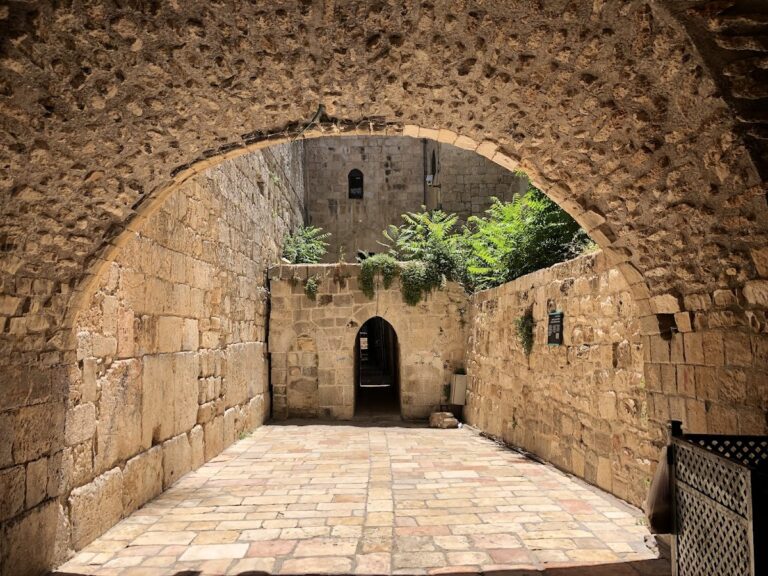
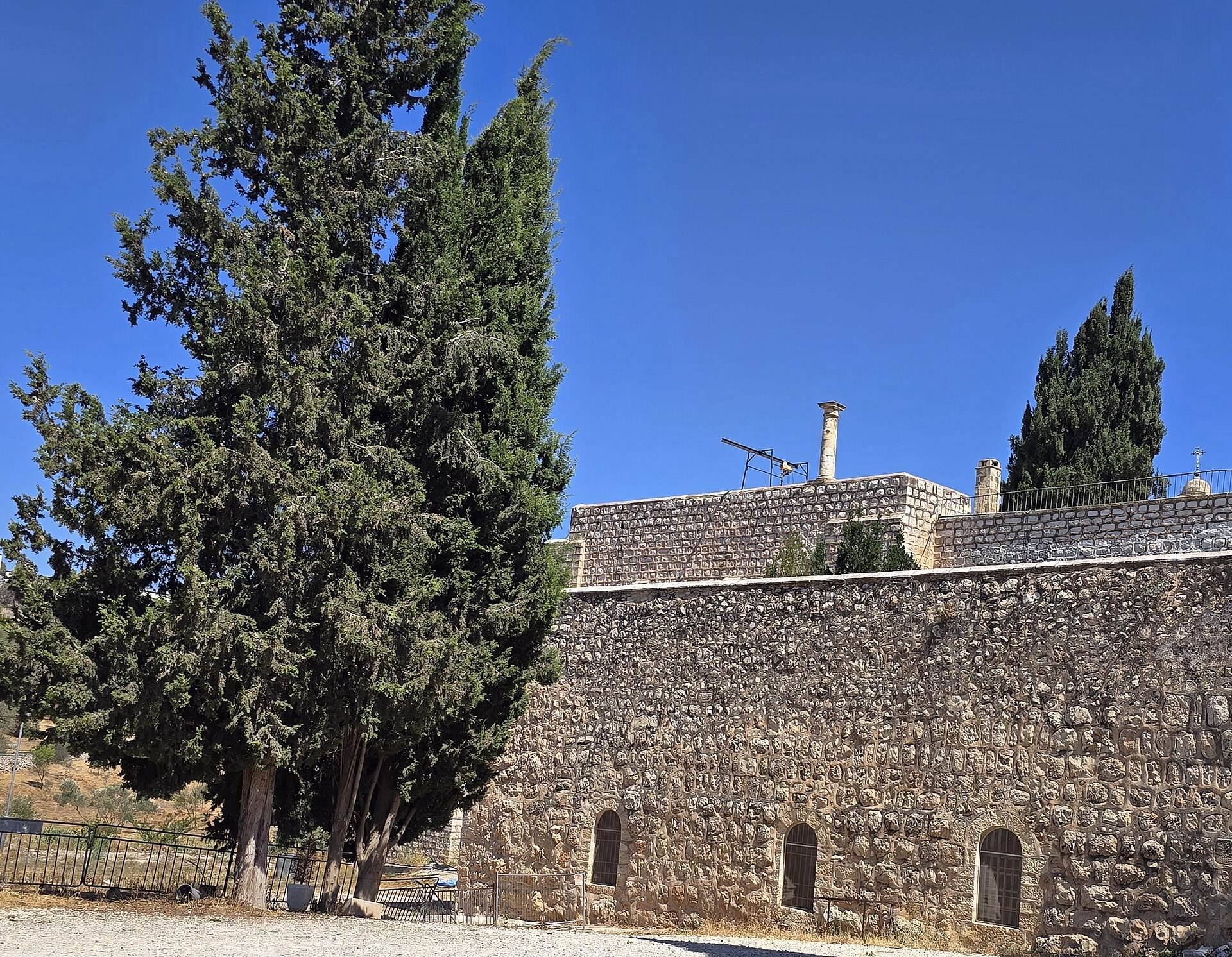
The monastery is arranged within a fortified enclosure bounded by high walls and buttresses. A single low, narrow entrance leads into a small vestibule, where a Georgian inscription invokes forgiveness for the builder’s soul. Courtyards and passages connect the entrance with the central church, residential quarters, and service buildings. The complex has been described as containing approximately 270 rooms and auxiliary spaces. Earlier descriptions mention as many as 365 monastic cells in the sixteenth century and about 200 in the eighteenth.
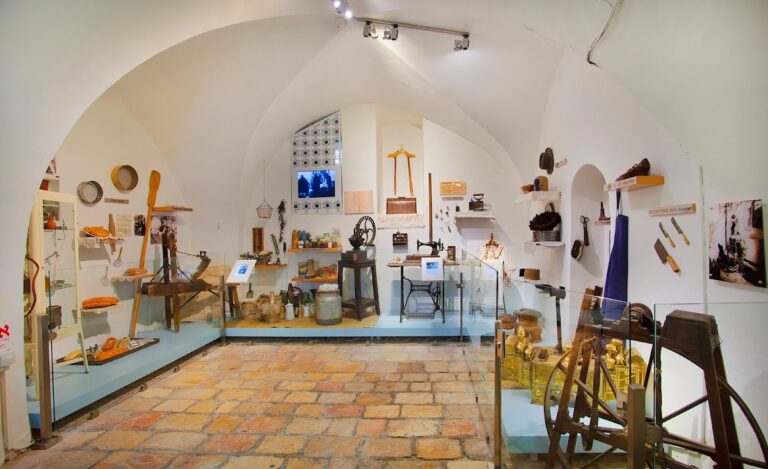
The enclosure contains living quarters, a library, a refectory, a lower-floor museum, and numerous former service spaces. The museum holds clerical vestments, liturgical vessels, large copper cooking pots, wooden fragments from dismantled church decoration, icons, an old telescope, and a large triangular wooden map of holy places. The grounds also include two old cypress trees associated with the character of the complex, as well as a large cypress and a lemon tree in the courtyard. Former agricultural surroundings included olive groves and vineyards.
Principal Church
Plan and Early Surfaces
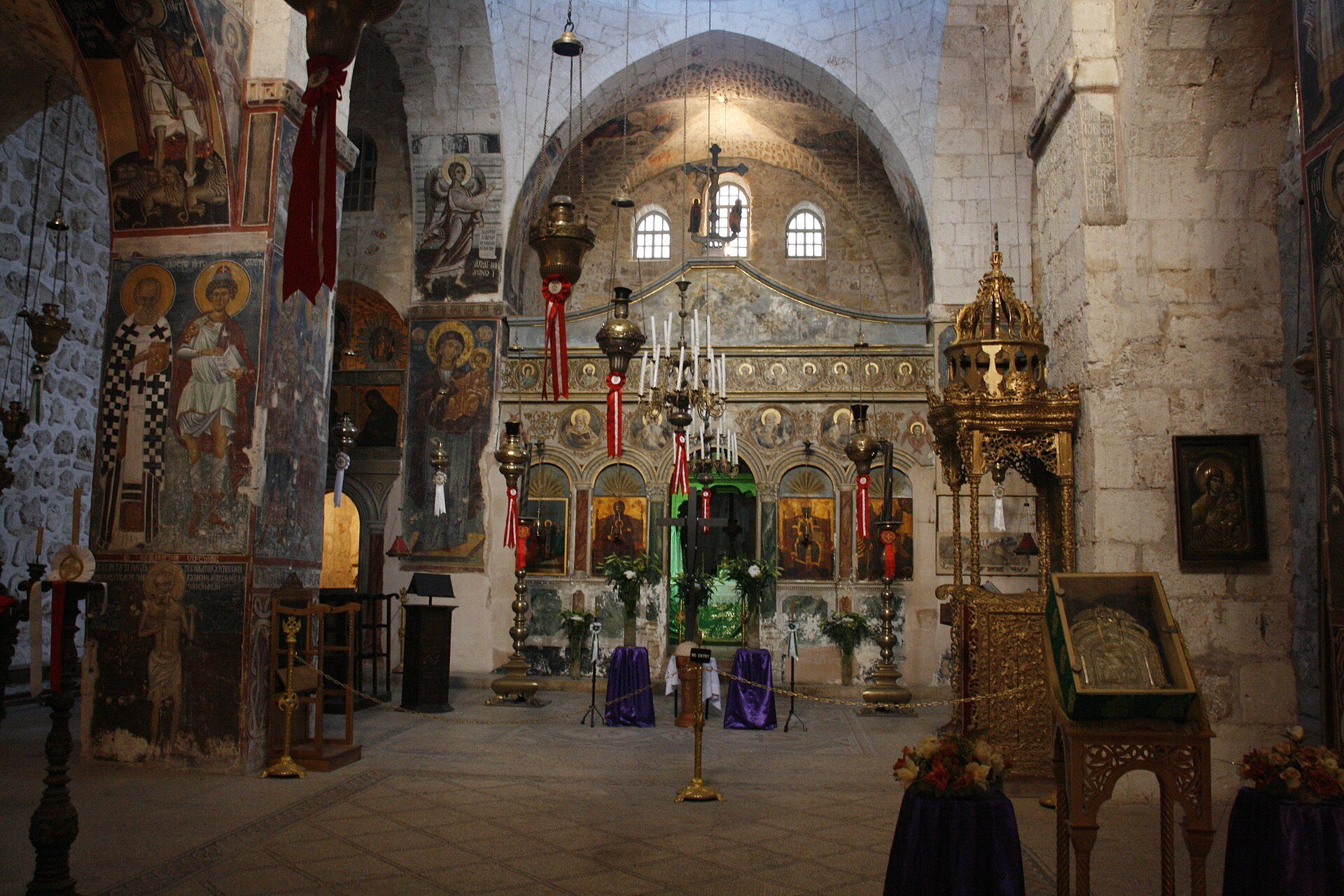
The principal church occupies the center of the enclosure. Its domed plan follows a basilican arrangement, with a central nave, side aisles, eastern apses, and a central dome carried by four columns. Its architectural vocabulary combines local early Christian and Byzantine traditions with Romanesque and Crusader-period forms. The church contains Byzantine and eleventh-century mosaic pavements and fragments, linking its visible medieval fabric with the earlier phases of the site.
A bronze disk measuring 55 centimeters across was once set into the mosaic floor directly beneath the dome. Its Georgian inscription commemorated Nikifore Cholokashvili and gave the date 1643. During the 1969 to 1973 restoration, the disk was removed and was later transferred to the monastery museum in 2002.
Holy Tree Chamber
A chamber beside the altar contains a floor opening marking the place where the sacred tree was traditionally believed to have grown. A decorated copper or metal plaque marks the opening, while images on the chamber walls illustrate the tree’s history and its connection with the Cross.
A related side chapel or chamber dedicated to the Holy Tree has a central dome and three lower domes. Its internal dimensions are approximately 15.50 by 14.24 meters. The paintings show episodes including Abraham’s encounter with the angels, the gift of the branches to Lot, the planting and growth of the tree, its cutting, and the Crucifixion. This arrangement has been described as unique among chapels in Israel and Palestine.
Murals and Inscriptions
The church was decorated with Georgian wall paintings and numerous Georgian and Greek inscriptions. Surviving murals belong to several chronological groups, including fourteenth-century paintings associated with the Palaiologan period, probably sixteenth-century votive paintings, and extensive seventeenth-century decoration. A votive portrait is an image offered in connection with prayer, dedication, or patronage.
The surviving painting is concentrated in the apse, the bema, the raised sanctuary area of an Orthodox church, the piers, the undersides of the arches, and the lower part of the west wall. Scenes include the lives of the Virgin Mary, the Annunciation, the Presentation in the Temple, the Glory of Mary, the Temptation of Christ, the Adoration of the Magi, Daniel in the Lions’ Den, the Meeting of Mary and Elizabeth, the Council of the Archangels, and the Sacrifice of Abraham.
Figures represented in the surviving and documented paintings include the Virgin Hodegetria, Christ Pantocrator, Saints Saba and Euthymius, Gregory Arsenavri with his son, Basil the Great, John Chrysostom, Luke, Prokhorus, Sebastian, Peter, Paul, Gabriel Pataridze, Markellos, James the Persian, Artemius, Theodosius of Manglisi, Maximus the Confessor, John of Damascus, Cyril of Alexandria, Athanasius the Great, Pachomius, Serapion, Gregory the Theologian, Daniel, David, Solomon, Athanasius of Athos, Isidore of Pelusium, George, Theodore, Demetrius, and Nestor.
Several mural fragments were detached or relocated. A fragment showing Saints Saba and Euthymius was transferred to a new support and displayed on the south wall. Other paintings, including images of Saints Luke and Prokhorus, were transferred to the Svetitskhoveli Cathedral or to churches in Tbilisi. Some fragments entered private collections, while others were acquired by a Boston museum or returned to the Georgian Orthodox Church.
Rustaveli Portrait and Donor Images
A Georgian inscription and portrait associated with Shota Rustaveli appear on a column near images of John of Damascus and Maximus the Confessor. The image is regarded as the only surviving medieval portrait of Rustaveli. The west wall formerly displayed a cycle of Georgian donor portraits, including Kings Mirian III, Vakhtang Gorgasali, and Bagrat IV, together with Giorgi Prokhore, the builder of the church. Portraits of Levan II Dadiani and members of the Tsulukidze family were also present.
The church’s decorative program was repeatedly altered. Georgian inscriptions visible in a 1901 photograph were covered by Greek inscriptions by 1960, while cleaning later revealed earlier Georgian texts. Similar Georgian traces survive beneath later Greek lettering in the image of Christ Anapeson.
Bell Tower, Collections, and Former Landscape
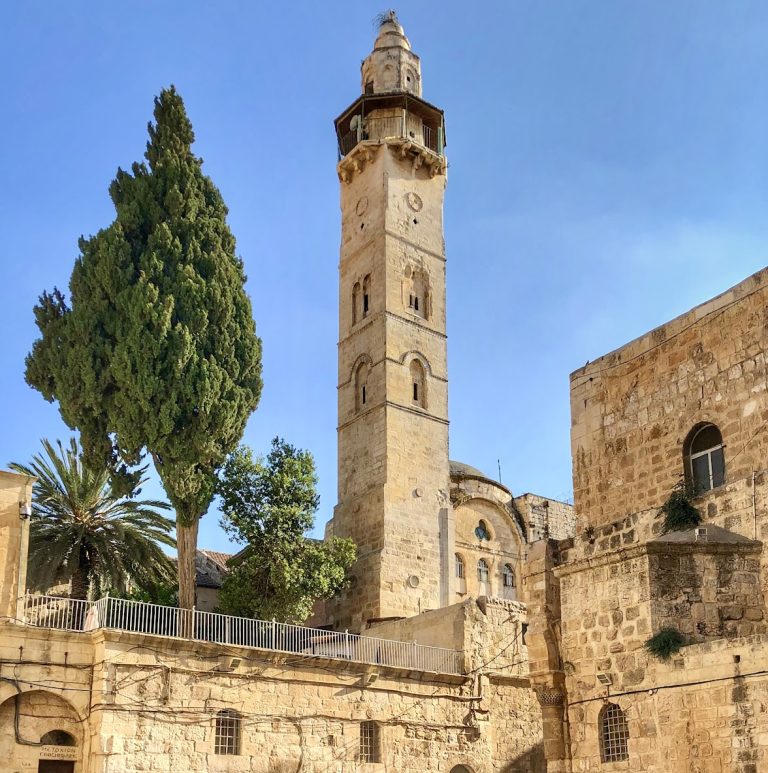
The monastery includes a nineteenth-century square bell tower. Its second floor contains an oven, kitchen, and refectory, while a small chapel dedicated to Saint Barbara occupies an upper floor. The monastery’s library and other collections preserve Georgian manuscripts, clerical garments, old wine jars, icons, and material associated with Georgian religious life.
A traditionally associated grotto of Lot stood in the garden about 150 meters from the monastery, near the cemetery, and was formerly connected with a chapel of the Holy Tree. Together with the church, courtyards, service buildings, and agricultural surroundings, these features form the physical setting of a monastery whose medieval fabric incorporates earlier Byzantine remains, later Crusader-period elements, seventeenth-century rebuilding and painting, nineteenth-century additions, and twentieth-century restoration.