Church of the Intercession of the Mother of God at Medvedkovo: A Russian Orthodox Monument
Site at a Glance
- Rating
- 4.9
- Popularity
- Low
- Country
- Russia
- Primary era
- Early Modern
- External website
- Open
- Eras represented
- Early Modern, Modern
- Civilizations
- Russian
- Site type
- Religious
- Remains
- Church
On this page9 sections
History
The Church of the Intercession of the Mother of God at Medvedkovo is a Russian Orthodox church in Russia, built in 1635 in the Russian ornamental architectural tradition. It was commissioned by Prince Dmitry Pozharsky at his ancestral estate of Medvedkovo after the liberation of Russia associated with the Russo-Polish War. As one of the last Moscow churches crowned by a tent roof, it preserves an architectural tradition later restricted by the reforms of Patriarch Nikon.
Pozharsky Foundation
A wooden Church of the Intercession stood on the site by 1623 or 1624, with a side chapel dedicated to Peter of Alexandria. Pozharsky founded the church in Medvedkovo and ordered a special bell commemorating the liberation of Moscow from Polish forces. When the stone church was built in 1635, it contained four side chapels dedicated to the Icon of the Mother of God of the Sign, Peter of Alexandria, Varlaam of Khutyn, and Anthony of Rome. Their dedications reflected Pozharsky’s period as governor of Veliky Novgorod from 1628 to 1630, as well as the religious importance of Novgorodian shrines and ascetics. The Icon of the Mother of God of the Sign is an Orthodox image type especially associated with Novgorod.
In 1652, ten years after Dmitry Pozharsky’s death, Ivan Dmitrievich Pozharsky received permission to consecrate another side chapel to the Nine Martyrs of Cyzicus. After the death of the last Pozharsky, Boyar Yuri Ivanovich, in 1685, Medvedkovo passed to Prince Vasily Vasilyevich Golitsyn. Golitsyn was the chief political adviser and favorite of Regent Sophia, who governed during the minority of Tsar Peter I. He reorganized the church’s side chapels, leaving three dedicated to the Intercession, the Icon of the Mother of God of the Sign, and the Nine Martyrs of Cyzicus. A fourth chapel, dedicated to Sergius of Radonezh, was added in 1690.
Later History and Restoration
Golitsyn commissioned the principal iconostasis, the screen of icons and doors separating the sanctuary from the worship space, in 1687 and 1688. The church has remained open throughout its history and is now affiliated with the Sergius Deanery of the Moscow Diocese of the Russian Orthodox Church. During the 1930s, it stood outside Moscow’s administrative territory, which helped explain its continued operation. During the Second World War, services were held only in the heated lower church. Repairs after the war made it possible to resume worship in the upper church as well.
Restoration in the 1970s, directed by the architect Nikolai Nedovich, removed the metal roofing and the windows in the tent, restoring an earlier appearance. A large marble cross found in the Medvedkovo Cemetery was placed at the entrance during the same decade. Its inscription means “The Cross is victory over death.” The church remains a functioning Orthodox parish and is a federally significant cultural-heritage monument of the Russian Federation.
Remains
Setting and Main Structure
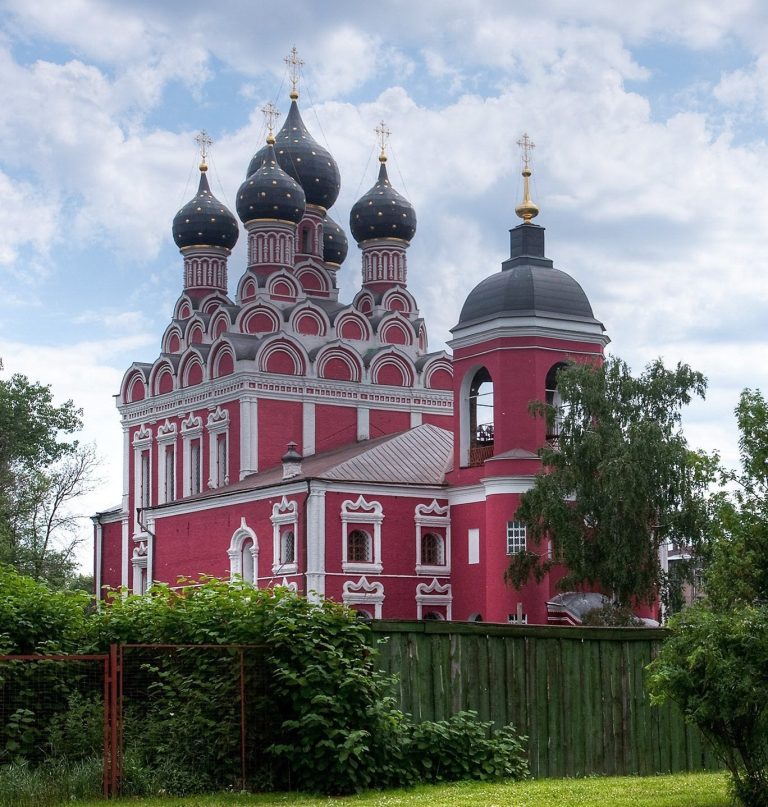
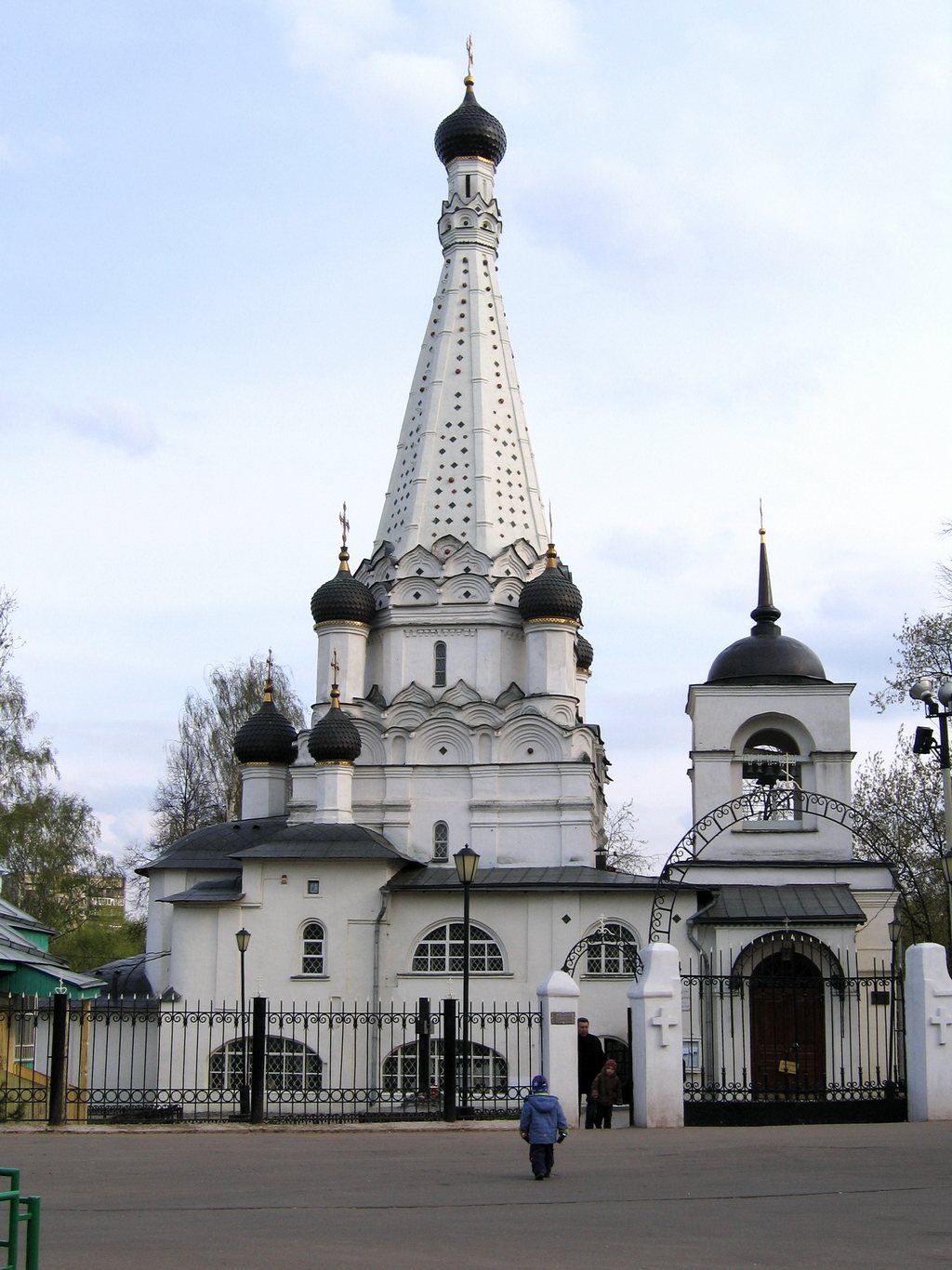
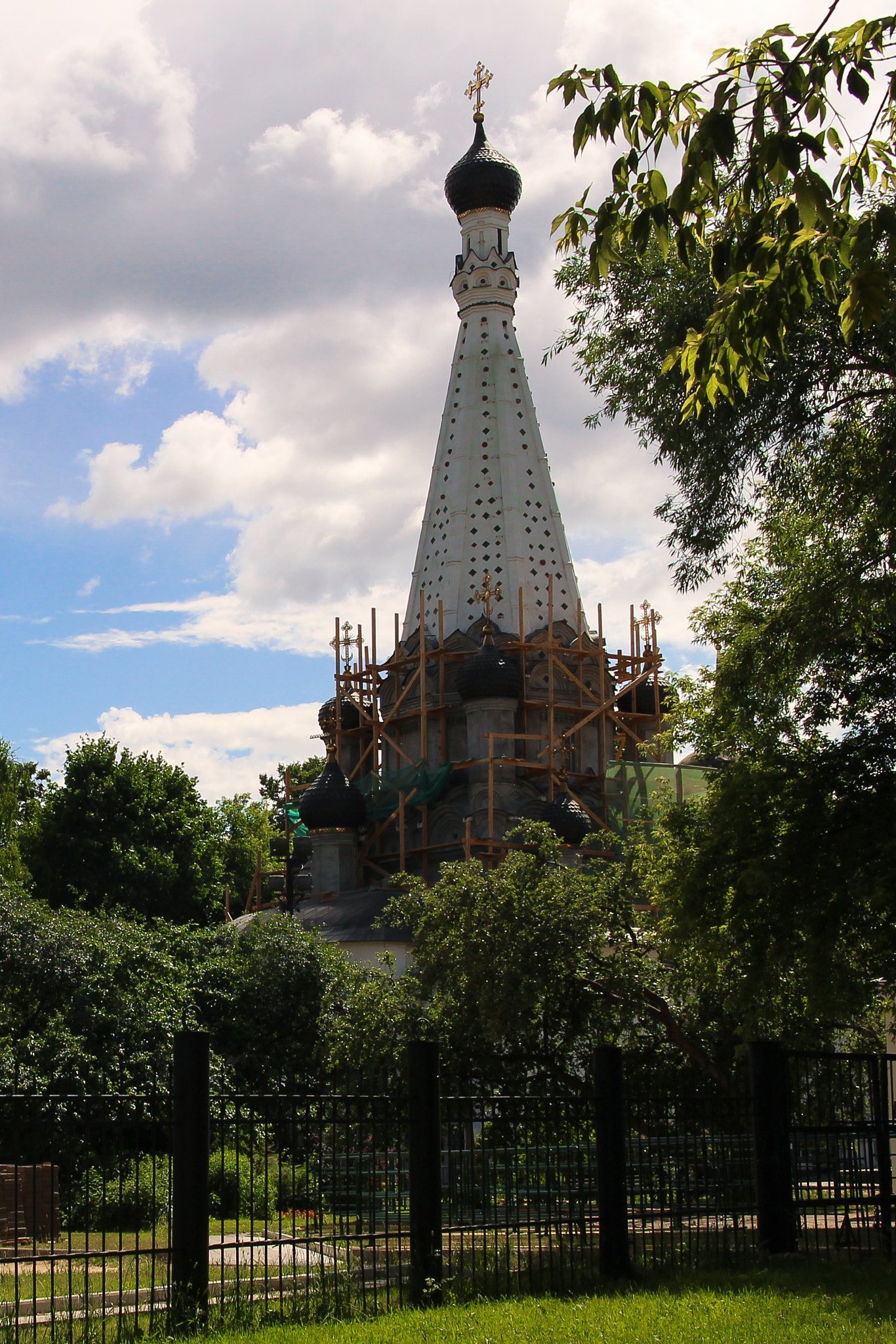
The church stands on the right bank of the Yauza River, slightly above its confluence with the Chermyanka, and is associated with a cemetery. Its low, slightly broad main block is decorated with four small cupolas and a three-tiered pyramid of kokoshniks, ornamental arched or gabled forms arranged between the main body and the roof. An octagonal drum rises above this base and supports a tall, slender tent roof. The tent is approximately as high as the lower part of the building. This compact composition is an architectural variant of the Cathedral of the Intercession on the Moat, commonly called Saint Basil’s Cathedral, although the Medvedkovo church has a distinctly different plan.
The building has two levels and a two-level outer porch extending along three sides. Its tent roof, a steep pyramidal roof rising from an octagonal base, belongs to a conservative early-seventeenth-century preference for established forms of Orthodox church architecture. The church’s richly patterned decoration reflects Russian ornamental architecture, a seventeenth-century style noted for elaborate forms, patterned masonry, and ornamented façades. The building’s present appearance also reflects the 1970s restoration, including the removal of the later metal roofing and the windows in the tent.
Interior and Furnishings
Winter and Summer Churches
The lower level contains the heated winter church dedicated to the Icon of the Mother of God of the Sign. The upper level was originally unheated and serves as the summer church, with its principal altar dedicated to the Intercession of the Mother of God and two side chapels. The arrangement explains why worship could continue in the lower church during the Second World War before repairs returned the upper church to use.
Iconostasis and Liturgical Objects
The principal iconostasis was made in 1687 and 1688 at Golitsyn’s commission. Its icons were produced with the participation of Karp Zolotaryov, a leading master of the Kremlin Armoury, who also supplied carved decoration. Much of the iconostasis was rebuilt in the nineteenth century. Later fragments supplemented lost carving, while newly painted icons replaced missing works in the festal tier. The church also houses a copy of the Częstochowa Icon of the Mother of God, venerated by both Catholics and Orthodox Christians in Poland.
The church’s seventeenth-century royal doors, the central doors of an iconostasis leading toward the altar, have been lost. They may have been transferred to the palace of Grand Duke Sergei Alexandrovich in Saint Petersburg. The Medvedkovo Gospel, a liturgical book from 1681 with miniatures traditionally attributed to Regent Sophia, remained in the sacristy until 1919; its subsequent location is unknown.
Bell Tower and Memorial Cross
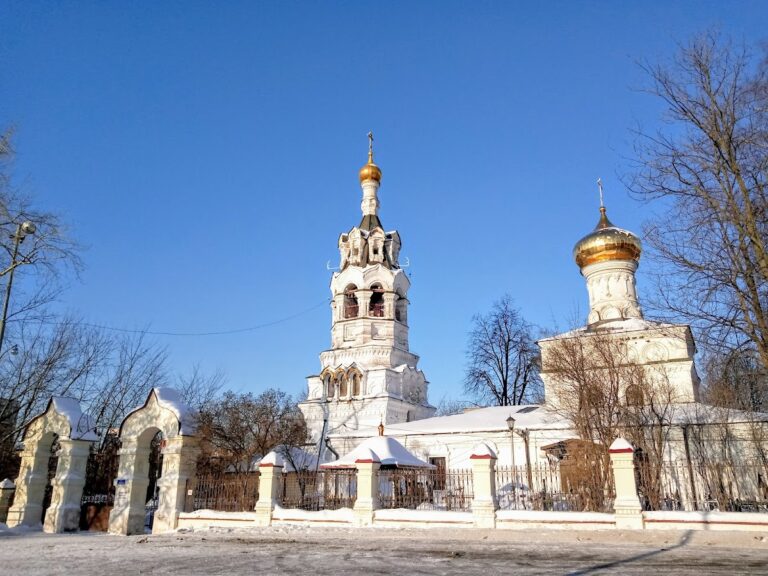
A new bell tower in the Classical style of the nineteenth century replaced the earlier belfry. At the entrance, the large marble cross recovered from Medvedkovo Cemetery bears the inscription “The Cross is victory over death,” providing a visible memorial element within the church’s associated grounds.