Church of Elijah the Prophet in Cherkizovo: An Orthodox Church in Moscow


Site at a Glance
- Rating
- 4.8
- Popularity
- Low
- Country
- Russia
- Primary era
- Early Modern
- External website
- Open
- Eras represented
- Early Modern, Modern
- Civilizations
- Russian
- Site type
- Religious
- Remains
- Church
On this page10 sections
History
Fourteenth-century origins
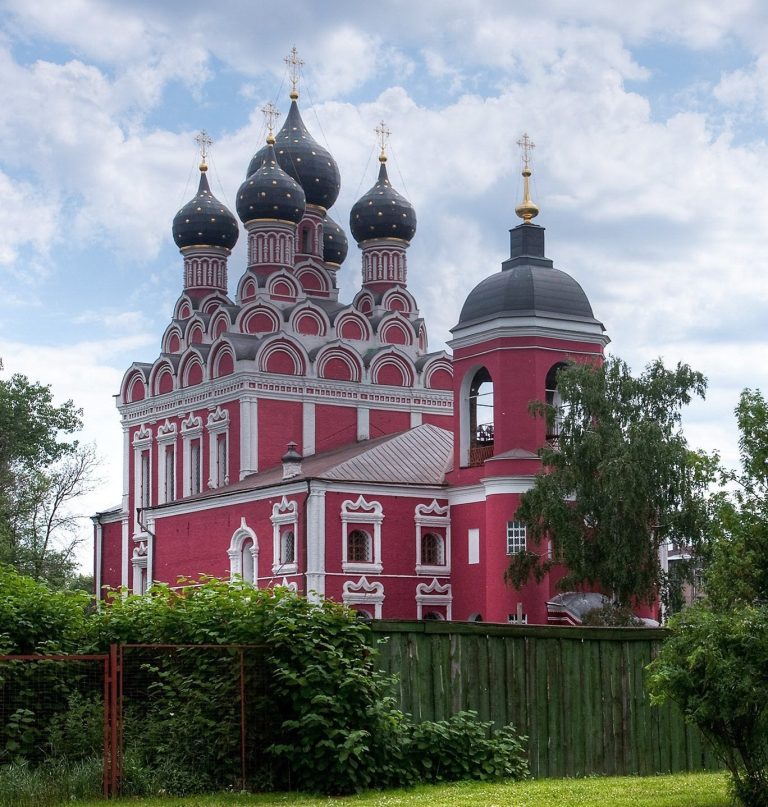
The Church of Elijah the Prophet in Cherkizovo is an Orthodox church in Moscow, Russia, built in the Old Russian architectural style in its present stone form in 1689–1690. Its origins reach back to a sanctuary founded in the fourteenth century, around 1370, and it remains associated with the history of the former village of Cherkizovo.
The village took its name from its owner, the Golden Horde prince Serkiz, who became Ivan Serkizov after baptism. He later sold Cherkizovo to Ilya Ozakov, a baptized Tatar and devout Christian. Ozakov established a church there in honor of his patron, the Prophet Elijah, a major biblical prophet honored in both Judaism and Christianity.
The Moscow metropolitan estate
Ilya Ozakov and his brother Sergei were close servants of Alexy, the metropolitan of Moscow from 1354 to 1378. A metropolitan was the senior bishop governing a major ecclesiastical province. In 1378, Alexy bought Cherkizovo from Ozakov with his personal funds and left it by testament to the Moscow Metropolitanate, under the authority of the Chudov Monastery in the Kremlin. This important Orthodox institution was a major ecclesiastical center of medieval Moscow. Grand Prince Vasily II, known as Vasily the Dark, later confirmed the acquisition by charter.
Cherkizovo subsequently served as a summer residence for the metropolitans of Moscow, later for the patriarchs, and again for the metropolitans. The residence expanded particularly during the tenure of Innokenty (Veniaminov), a nineteenth-century Russian Orthodox missionary and church leader who later became a metropolitan. In the twenty-first century, the church again forms part of a summer residence of the Patriarchs of Moscow and All Rus.
Stone rebuilding and nineteenth-century changes
The wooden church on the site was destroyed by fire. A stone replacement was built in 1689–1690 and consecrated on 18 June 1690. Its original complex included the chapel of Alexy, Metropolitan of Moscow, a refectory, or dining hall attached to the church complex, and a bell tower.
The building was remodeled twice during the nineteenth century. Reconstruction in 1821–1825 temporarily gave the church five cupolas. A more extensive rebuilding followed later in the century, initiated by the rector Father Pavel and the churchwarden, the merchant Alexander Zelenyaev. Architect Egorov’s project was approved in 1888, and after the work was completed in the 1890s, the church was reconsecrated. The rebuilding included a new bell tower.
Continuous religious use
The church remained in use throughout the Soviet period and was not closed. During the mid-twentieth century, icons from neighboring churches threatened with demolition were transferred to Cherkizovo. The rector at that time was Pavel Ivanovich Tsvetkov.
During the Second World War, the parishioners and clergy collected one million rubles for the construction of aircraft and sent the money to Joseph Stalin. Stalin answered with a telegram of thanks. The church later received federal-level cultural-heritage protection as a monument of the cultural heritage of the peoples of the Russian Federation.
On 30 December 2011, Archimandrite Savva (Tutunov) became rector. He later became Bishop of Zelenograd and served as deputy head of the administrative office of the Moscow Patriarchate.
Cherkizovo Cemetery
Cherkizovo Cemetery was established near the village in 1380. It is one of Moscow’s oldest and smallest cemeteries and entered the city’s municipal cemetery system in 1960. A burial archive has been maintained there since 1998, and family burials continue.
The cemetery survived the Soviet period without devastation. Ivan Koreisha, a famous Moscow holy fool and ascetic who was long venerated locally as a saint, was buried there in 1861. His image appears in works by Nikolai Leskov and Fyodor Dostoevsky. The cemetery also contains the graves of church rectors Nikolai Ilyin (1877–1940) and Alexei Glushakov (1923–1994), as well as the priests Pavel Smirnov (1831–1903) and Alexy Sokolov (1880–1949).
Remains
Church complex
The surviving church is a small, single-domed stone building with one bell tower, one iconostasis, and three altars. Its compact form belongs to the Old Russian architectural tradition. The present structure stands on the site of the earlier wooden sanctuary and retains the arrangement of a principal church accompanied by a refectory and bell tower, although the bell tower was rebuilt during the late nineteenth-century reconstruction.
Altars and interior organization
The main altar is dedicated to the Exaltation of the Cross. Two side chapels, secondary worship spaces with their own altars, are dedicated to the Prophet Elijah and Alexy, Metropolitan of Moscow. The chapel dedicated to Alexy formed part of the complex when the stone church was consecrated in 1690. The church has one iconostasis, the screen separating the altar area from the main worship space.
Pond, river channel, and historic necropolis
The church stands beside Cherkizovo Pond on the former bank of the Sosenka River, a right-bank tributary of the Khapilovka. The Sosenka once ran above ground for almost 9 kilometers, while most of its channel is now enclosed in a conduit, including the section along the pond’s eastern shore.
A cemetery surrounds the church and forms a surviving historic necropolis directly associated with it. Its burials include clergy and Ivan Koreisha, linking the physical setting of the church with the religious community that developed around Cherkizovo over many centuries.