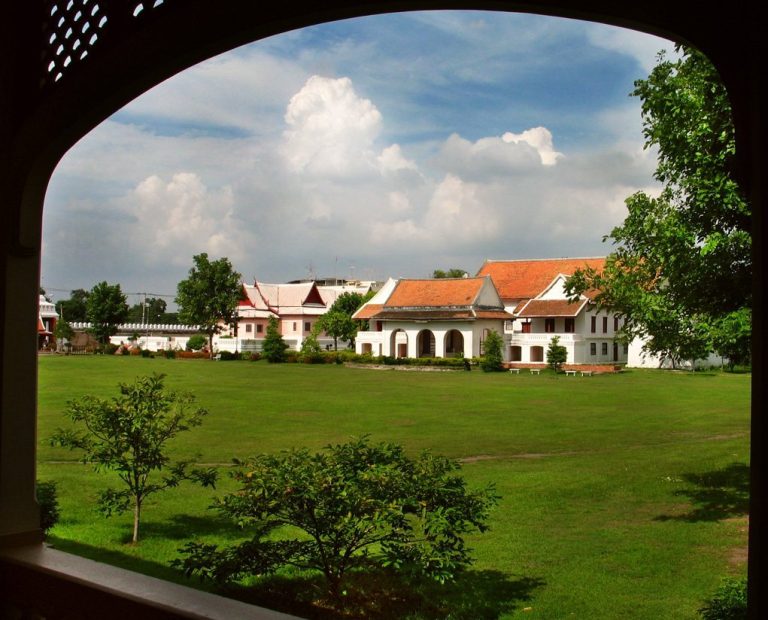
Phra Ratchawang Boran: The Old Royal Palace of Ayutthaya
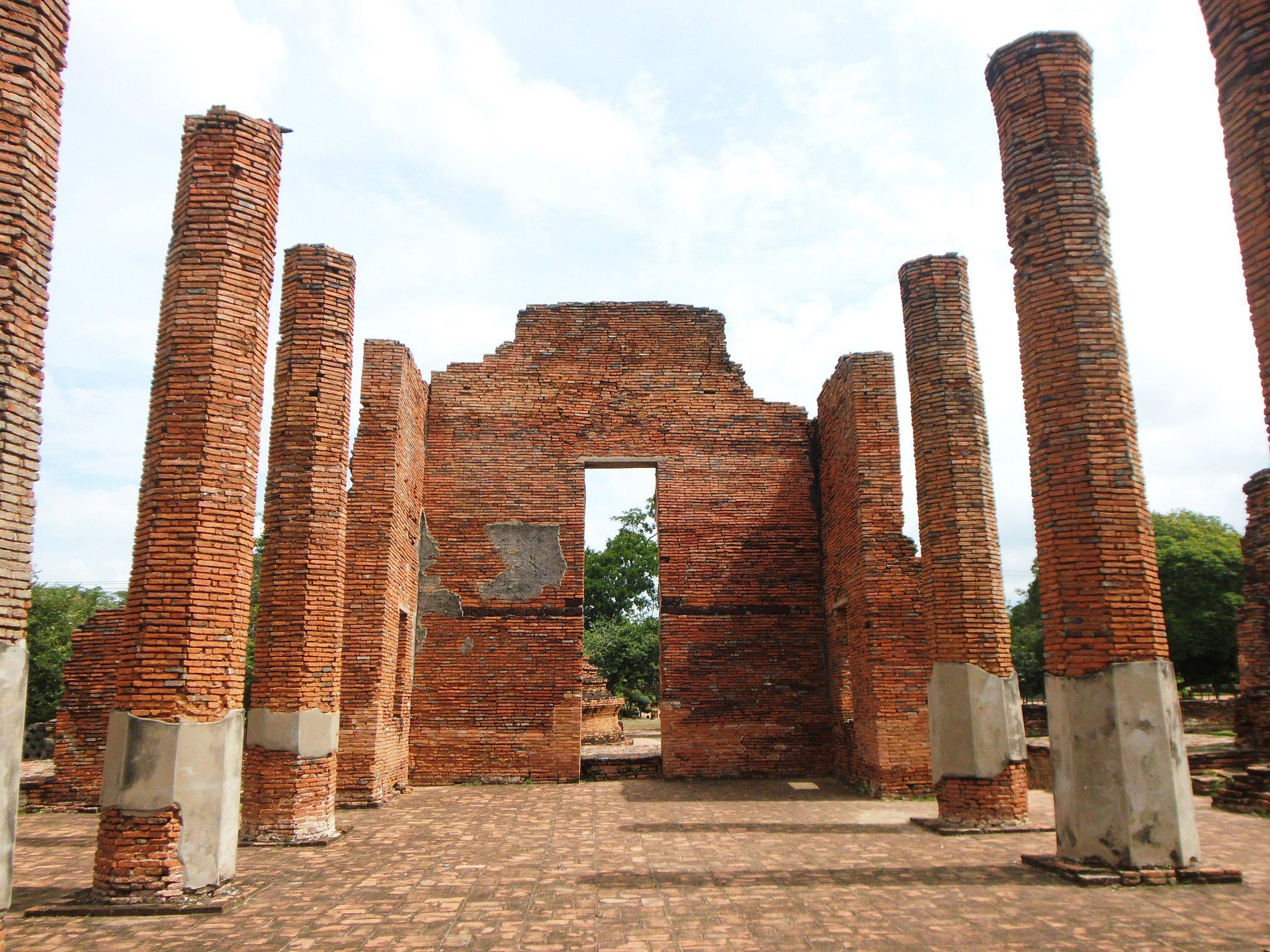
Site at a Glance
- Rating
- 4.5
- Popularity
- Low
- Country
- Thailand
- Primary era
- Medieval
- Eras represented
- Medieval
- Civilizations
- Unclassified
- Site type
- Domestic
- Remains
- Palace
On this page14 sections
History
Phra Ratchawang Boran, also called the Old Palace, is the former royal palace of Ayutthaya in Thailand and the residence of the Siamese kings. It was established after King U Thong, traditionally regarded as the founder of Ayutthaya and its first king, made the city the capital of his new kingdom. The palace developed as a major royal and administrative centre on the island formed by the Mae Nam Chao Phraya, Mae Nam Pa Sak, and Mae Nam Lop Buri, together with a later canal.
Royal foundation and relocation
During the reign of King Borommatrailokanat, from 1448 to 1488, the palace was moved northward to the bank of the Lop Buri River. This relocation made room for Wat Phra Sri Sanphet and led to a division between the Inner Area and the Outer Area. Borommatrailokanat commissioned the Sanphet Prasat Hall as a throne hall. In 1448, the hall also became a royal residence and a setting for state ceremonies. King Narai later received an embassy from the court of Louis XIV of France there. A replica was eventually built at the Mueang Boran open-air museum outside Bangkok.
Borommatrailokanat’s successor probably built the Mangkhala-Phisek Hall. King Naresuan received the ruling prince of Chiang Mai there after the prince agreed to pay tribute to Ayutthaya, linking the palace with the kingdom’s regional power.
Expansion under the later kings
During the reign of King Prasat Thong, lightning set fire to the Mangkhala-Phisek Hall and 110 other buildings in the palace district. They burned completely. Prasat Thong rebuilt the hall as the Viharn Somdet Prasat Hall, expanded the palace, and surrounded the whole area, including Wat Phra Sri Sanphet, with a high wall.
Prasat Thong also added the Suriyart Amarin Hall and the Chakrawat Phaichayon Hall. The latter was intended for viewing processions and parades on the Sanam Chai, the principal square in the palace’s Outer Area. In 1687, King Narai built the Banyong-Rattanat Pavilion on a small island in Ang Kaeo, an artificial pond within the Inner Area. King Phetracha, who ruled from 1688 to 1702, lived at the palace and completed the building begun under Narai.
Destruction and later royal memory
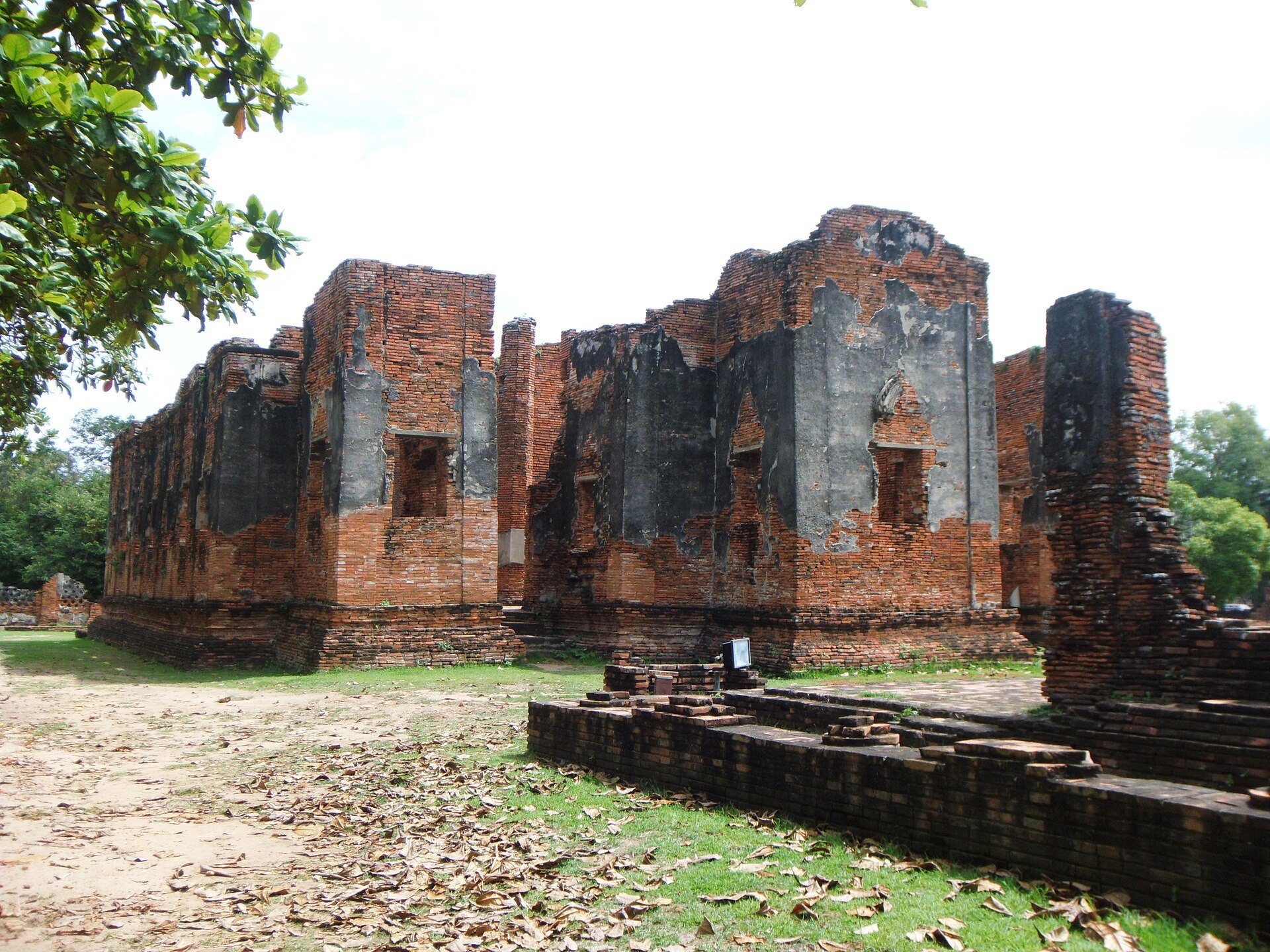
In 1767, Burmese forces plundered and burned the Old Palace, along with many other structures in Ayutthaya. After the establishment of Bangkok as the new capital, King Phra Phutthayotfa Chulalok, also known as Rama I and the first king of the Chakri dynasty, ordered bricks from the ruined palace buildings to be carried by boat to Bangkok for construction. The destroyed palace consequently served briefly as a model for the new royal complex.
During the reign of King Chulalongkorn, the foundations of the Trimuk Pavilion were found in 1907. A new pavilion was erected on them for his visit in 1908. Later kings, including Bhumibol Adulyadej, also known as Rama IX, held ceremonies there in honour of Ayutthaya’s former rulers.
Remains
Layout and surviving fabric
The former palace occupies the northwestern part of Ayutthaya’s old city, along U Thong Road near Khlong Khu Mueang, the former course of the Lop Buri River and originally the city moat. In its final expanded form, the palace had eight forts along its walls and 21 entrance gates, including two gates opening directly onto the river. The walls also enclosed Wat Phra Sri Sanphet.
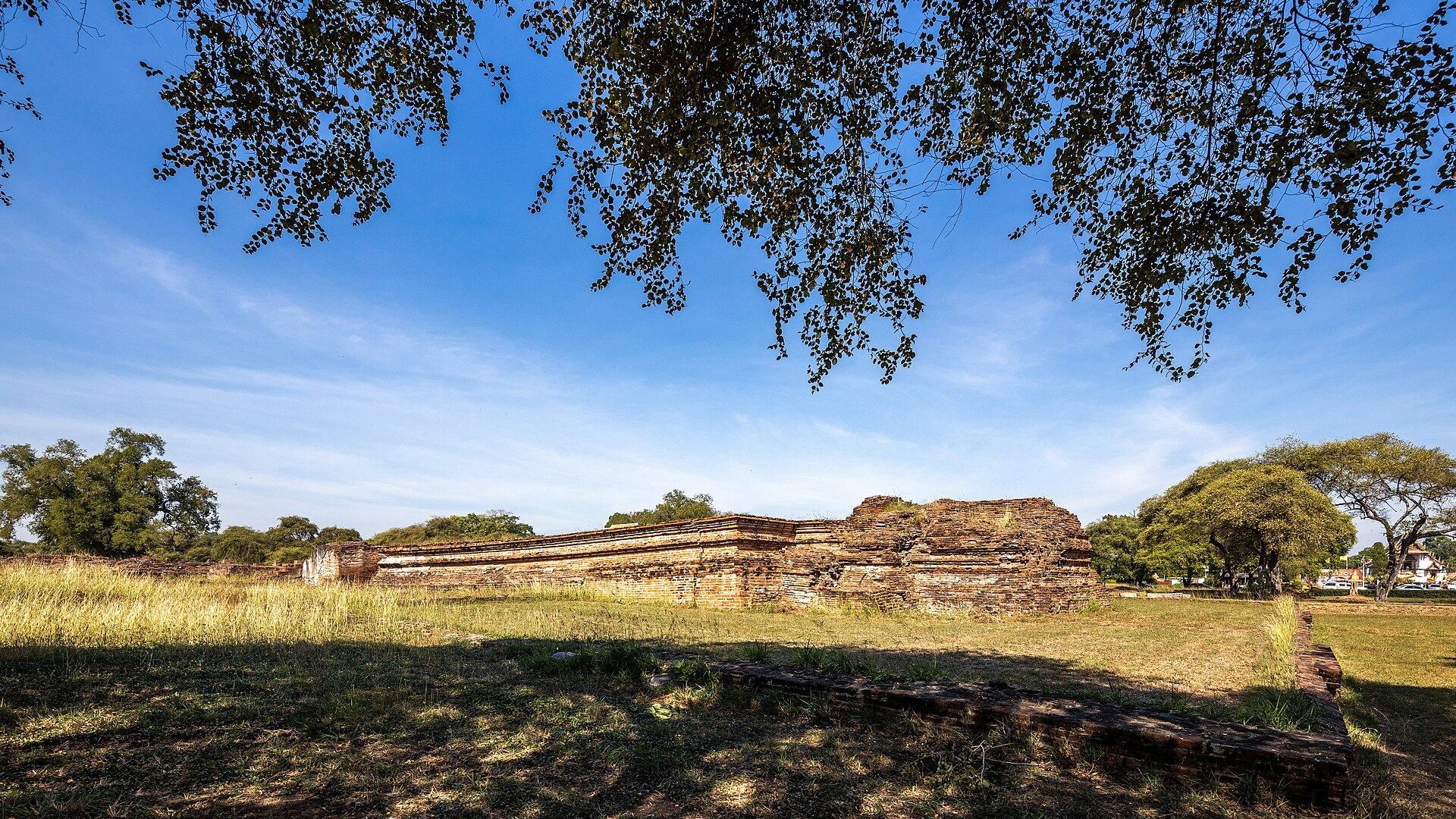
The Outer Area contained administrative buildings and the Chakrawat Phaichayon Hall. The Middle Area held the Viharn Somdet, Sanphet Prasat, and Suriyart Amarin throne halls, together with the royal elephant stables. The Inner Area contained the Banyong Rattanat Pavilion, residential buildings, and gardens called Suan Angun, or Grape Garden, and Suan Kratei, or Rabbit Garden. Across the former palace district, foundations generally survive only a few centimetres above ground. The Trimuk Pavilion rises above these remains.
Principal halls and pavilions
Sanphet Prasat Hall
Built in 1448 on the orders of King Borommatrailokanat, the Sanphet Prasat Hall was the largest and most important hall in the palace. It served for state ceremonies and as a royal residence. Its historical form is also represented by a later replica at the Mueang Boran open-air museum outside Bangkok.
Viharn Somdet Hall
King Prasat Thong built the Viharn Somdet Hall in 1643. Its roof was shaped like a prang, a tall temple tower form associated with Khmer and Khmer-influenced architecture in mainland Southeast Asia.
Suriyart Amarin Hall
The Suriyart Amarin Hall stood near the northern city wall. It is attributed either to King Prasat Thong or to King Narai. The hall had a fourfold Siamese-style gable and stood high enough for the king to watch boats on the Lop Buri River.
Chakrawat Phaichayon Hall
Built in 1632 beside the palace wall facing Wat Phra Sri Sanphet, the Chakrawat Phaichayon Hall had a triple gable. The king used it to watch military exercises and parades held on the Sanam Chai.
Banyong Rattanat Pavilion
The Banyong Rattanat Hall stood on a small island in the middle of Ang Kaeo, the palace lake. It had four gables and was particularly favoured by the later kings of Ayutthaya. King Narai began the building in 1687, and King Phetracha completed it.
Trimuk Pavilion
The Trimuk Pavilion is a wooden structure set on a brick foundation. King Chulalongkorn erected a new pavilion on foundations discovered in 1907, while the present structure is a replica of the earlier architectural form.
Weapons Pavilion
The Weapons Pavilion had a rectangular plan and stood at the western end of Ang Kaeo, near the Banyong Rattanat Pavilion. It was probably used for weapons exercises and later served for royal audiences after the Banyong Rattanat Pavilion became a residence.