Ebara-ji Temple: A Buddhist Temple of Wisdom in Sakai
Site at a Glance
- Rating
- 3.5
- Popularity
- Low
- Country
- Japan
- Primary era
- Unclassified
- External website
- Open
- Eras represented
- Unclassified
- Civilizations
- Unclassified
- Site type
- Religious
- Remains
- Temple
On this page11 sections
History
Ebara-ji Temple is a Buddhist temple in Sakai, Japan, traditionally founded in 704 when the monk Gyōki converted his birthplace into a religious establishment. Gyōki was an eighth-century Buddhist monk known for religious activity and public works. The temple venerates Monju Bosatsu, the Buddhist bodhisattva associated with wisdom, and is locally known as the “Monju of Wisdom.”
Foundation and revival
The foundation date and connection with Gyōki belong to the temple’s tradition. Eison, a thirteenth-century Buddhist monk and reformer, revived Ebara-ji in 1245. The temple later developed numerous subsidiary compounds, but warfare and fires contributed to its decline.
Early modern and modern changes
During the Edo period, the era of Tokugawa rule in Japan, the Tayasu family supported Ebara-ji and donated temple lands. The Tayasu family was a branch of the Tokugawa ruling house. The temple then suffered neglect during the anti-Buddhist movement of the early Meiji period, which followed the political transition of 1868 and included policies and actions directed against Buddhist institutions and objects.
Ebara-ji was formerly a special head temple of Kōyasan Shingon-shū, a Japanese branch of Shingon Buddhism. In 2018, it became independent and adopted the designation Gyōki-shū. The temple precincts are designated a historic site by Osaka Prefecture.
Religious associations
Ebara-ji is associated with several Buddhist pilgrimage circuits. It is site 15 of the Saigoku Yakushi Forty-Nine Sacred Sites, a circuit devoted to Yakushi, the Buddha of healing; site 3 of the Thirteen Buddhist Sites of Osaka; site 1 of the Eighteen Ancient Pagodas pilgrimage; and site 1 of the Izumi Eighty-Eight Sacred Sites.
The temple has long been connected with prayers for success in examinations. Worshippers once wrote their wishes directly on the main hall walls. The custom later changed to writing them on handkerchiefs and attaching the handkerchiefs to the building’s exterior, giving Ebara-ji the alternate name “Handkerchief Temple.” An earlier nickname was “Graffiti Temple.”
Remains
Principal buildings
Three-story pagoda
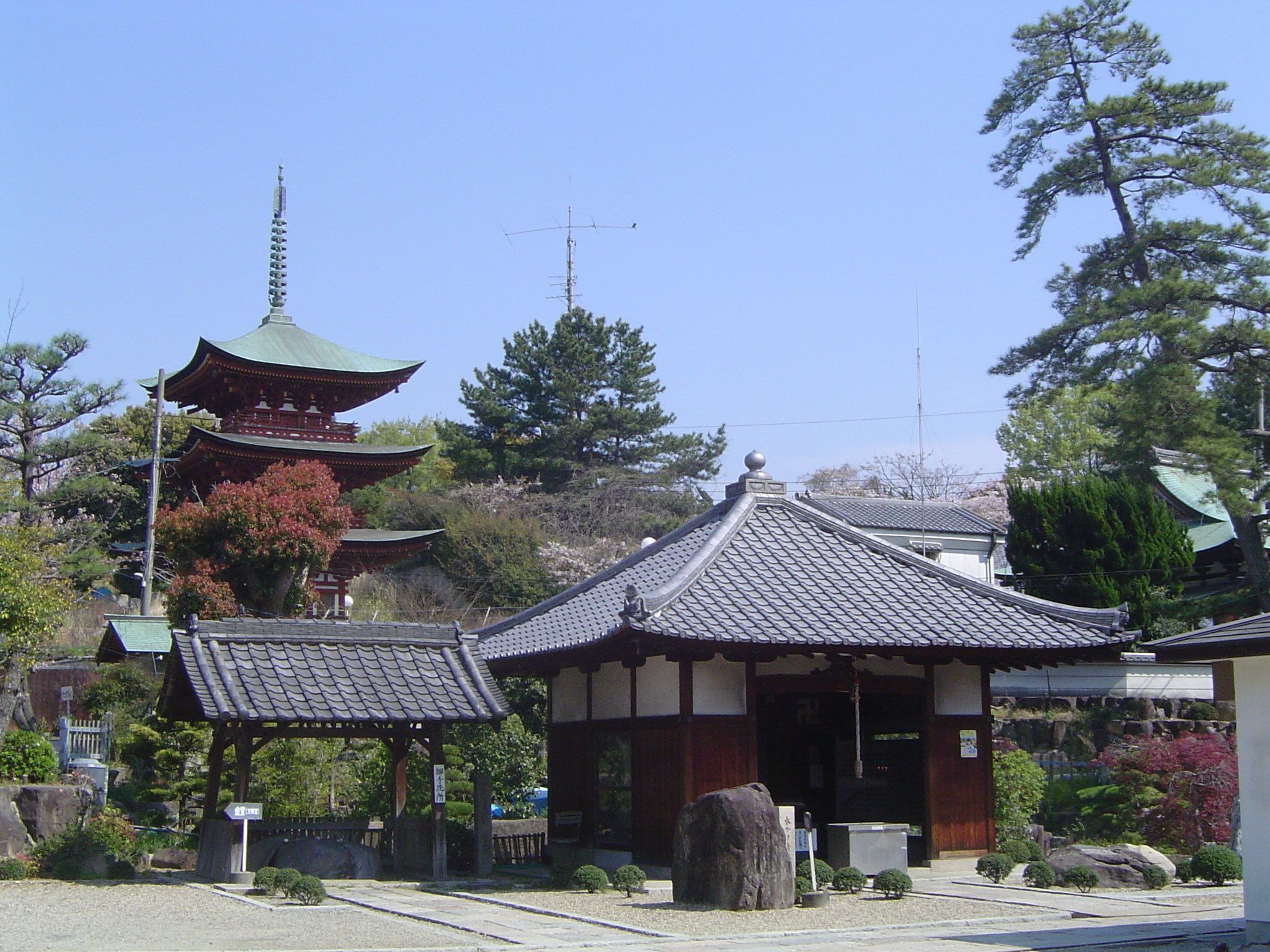
A three-story pagoda forms part of the temple complex. The present pagoda was reconstructed in 1989.
Main hall
The main hall has exterior walls where handkerchiefs bearing wishes for examination success are attached. This physical feature reflects the temple’s long-standing association with prayers for wisdom and academic achievement.
Associated cultural properties
Gyōki scrolls and memorial stele
Associated with Ebara-ji are a triptych of painted silk hanging scrolls depicting the life of Gyōki and a stone memorial stele. The scrolls are designated an Important Cultural Property, while the stele is an Osaka Prefectural tangible cultural property.
Former guardian statues
A former pair of Nio, temple guardian statues traditionally placed at a gate, came from the temple gate. During the Meiji-period anti-Buddhist movement, villagers sold the statues to a French art dealer. They are now held by the Freer Gallery of Art in Washington, D.C.