Changgyeonggung: A Joseon Royal Palace in Seoul
Site at a Glance
- Rating
- 4.6
- Popularity
- Medium
- Country
- South Korea
- Primary era
- Early Modern
- External website
- Open
- Eras represented
- Medieval, Early Modern, Modern
- Civilizations
- Chinese, Japanese, Joseon
- Site type
- Domestic
- Remains
- Palace
On this page29 sections
History
Changgyeonggung is a royal palace of the Joseon dynasty in Seoul, South Korea, developed through major phases from the Goryeo period to the twentieth century. The site had already served palace purposes in 1104, when Goryeo King Sukjong built a palace there. Joseon, Korea’s ruling dynasty from 1392 to 1910, later made the location part of its capital complex.
Goryeo origins and Joseon establishment
King Taejo established the Joseon capital at Seoul in 1394. Before Gyeongbokgung was complete, he used the area of present-day Changgyeonggung as a royal residence. In 1418, King Sejong built another palace on the site for his father, the abdicated King Taejong. It was first known as Suganggung or Sungang rather than Changgyeonggung.
King Seongjong enlarged and renovated the palace in 1483 and 1484. It was then renamed Changgyeonggung and intended to house the widows of King Sejo. The palace became one of the five principal palaces of the Joseon capital, combining residential, ceremonial, administrative, educational, agricultural, and scientific functions.
Fires, rebuilding, and royal use
During the Japanese invasion of 1592, known as the Imjin War, Changgyeonggung was burned. Reconstruction was completed in 1616. Another fire in 1830 destroyed most of the buildings, and rebuilding followed in 1834, generally preserving the earlier architectural character. Myeongjeongjeon survived the 1830 fire.
The palace was closely connected with the political and family history of the Joseon court. Honghwamun served as the principal entrance and as a place where the king met his subjects. King Yeongjo gathered public opinion there before announcing the Gyunyeok reform. In 1795, King Jeongjo distributed rice to poor people at the gate while commemorating the sixtieth birthday of his mother, Princess Hyegyeong.
Munjeongjeon’s courtyard was the setting for the death of Crown Prince Sado on May 13, 1762. King Yeongjo ordered Sado to be sealed inside a large rice chest, where he died eight days later at the age of twenty-seven. Yeongjo later gave him the posthumous name Sado, meaning “thinking in sorrow.” The interpretation that Sado was the victim of a political conspiracy remains contested by the memoirs of his wife, Lady Hyegyeong.
Several buildings preserve associations with royal births, deaths, study, and residence. Hwangyeongjeon served as private quarters for the king or crown prince, and King Jungjong was born there. Crown Prince Sohyeon died there, and the building also functioned as a honjeon, a place for royal ancestral tablets, and a binjeon, a temporary mortuary building for a royal body or coffin. Haminjeong was used for royal study and lectures on the Confucian classics. Sungmundang was another study hall where the king received instruction, and King Yeongjo personally wrote the passage from the Book of Odes displayed on its inner wall.
Yeongchuneon became King Jeongjo’s library and private study, while the adjoining Jipbokeon was the birthplace of Crown Prince Sado and King Sunjo. Yanghwadang normally served as private quarters for the king or queen. In 1636, King Injo received Qing envoys there after the Qing invasion.
Colonial transformation and restoration
During the Japanese colonial period, Changgyeonggung lost its status as a royal palace. In April 1911, its name was changed to Changgyeongwon, replacing gung, meaning “palace,” with won, meaning “garden” or “park.” The grounds were converted into a museum, zoo, and botanical garden, while the colonial authorities systematically altered the palace landscape to create a modern park.
After Korean independence in 1945, the zoo was restocked through donations from wealthy Koreans and gifts from foreign zoos. The zoo and botanical garden were moved to present-day Seoul Grand Park in 1983. From December 1983 to August 1986, Changgyeonggung was restored, the zoo was removed, and the site was returned to its palace status and former name. The work also removed or reversed major colonial-period alterations.
Changgyeonggung was designated Historic Site No. 123 on January 18, 1963. Individual features, including Okcheongyo, Myeongjeongjeon, the wind-measuring pedestal, Gwancheondae, and the main greenhouse, also received national cultural-property designations.
Remains
Changgyeonggung retains an unusual east-facing orientation, with Myeongjeongjeon facing east rather than south. Its surviving layout brings together ceremonial spaces, royal residences, study halls, gardens, ponds, gates, walls, service areas, and scientific installations. Buildings and grounds reflect both Joseon palace planning and later reconstruction after the fires of 1592 and 1830.
Entrance and ceremonial court
Honghwamun and Okcheongyo
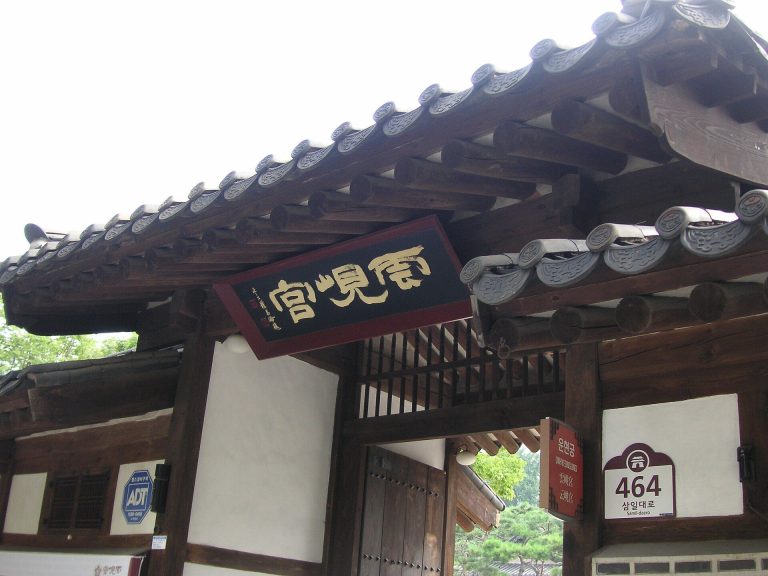
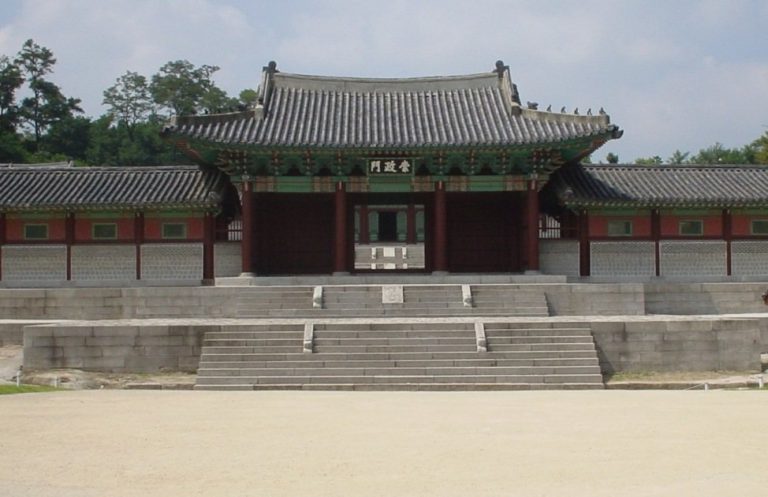
Honghwamun is the principal entrance gate. Its name means “promoting harmony” or “inspiring the people through virtue.” Built with the palace, it was destroyed during the 1592 invasion and rebuilt in 1616. Beyond it, Okcheongyo crosses water associated with clear streams from Mount Eungbongsan. Built in 1484, the intact stone bridge has a carved dokkaebi, a Korean supernatural guardian figure, beneath its arch. The fierce face was intended to protect the palace from evil spirits carried by the water. Okcheongyo is National Treasure No. 386.
Myeongjeongmun
Myeongjeongmun is the inner gate beyond Honghwamun. It has three entrances of equal height, measures three kan by two kan, and carries a gabled roof supported by a complex column system. The gate stands on a circular stone foundation, with two wooden doors on each front side. Its form suggests reconstruction during the reign of King Gwanghae.
Myeongjeongjeon
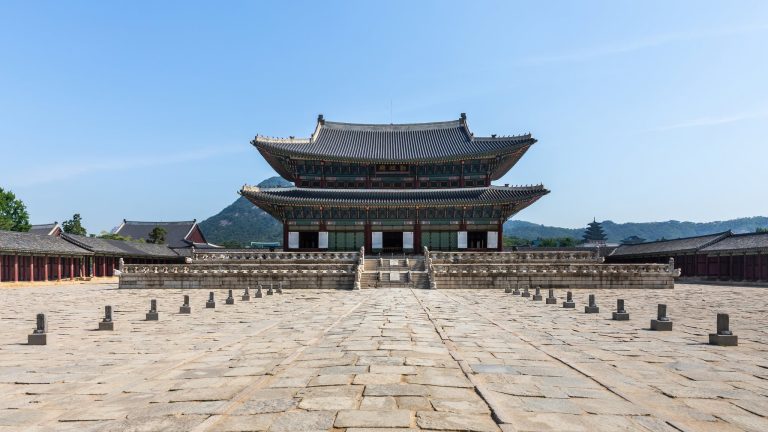
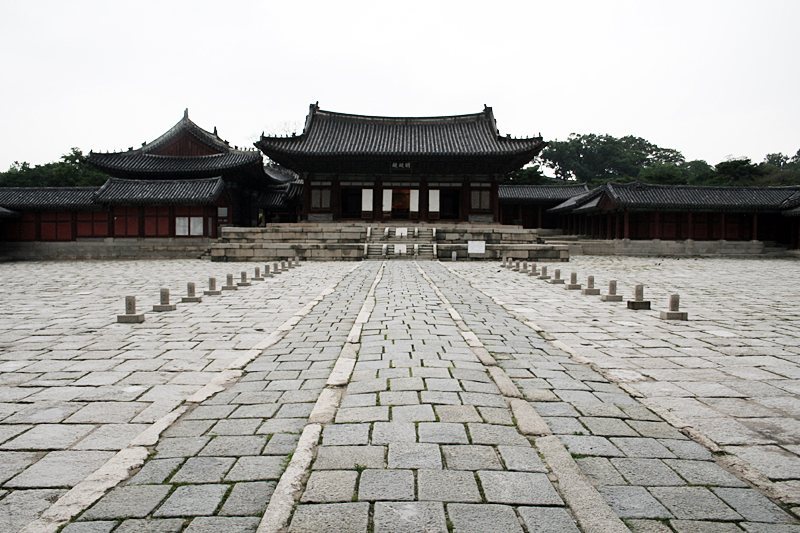
Myeongjeongjeon is the principal ceremonial hall, used for royal rituals, coronations, state examinations, official events, and royal receptions. Built in 1484 and reconstructed in 1616 after the Imjin War, it is regarded as the oldest surviving throne hall of its type in South Korea. Its relatively small scale reflects its original role as accommodation for the queen.
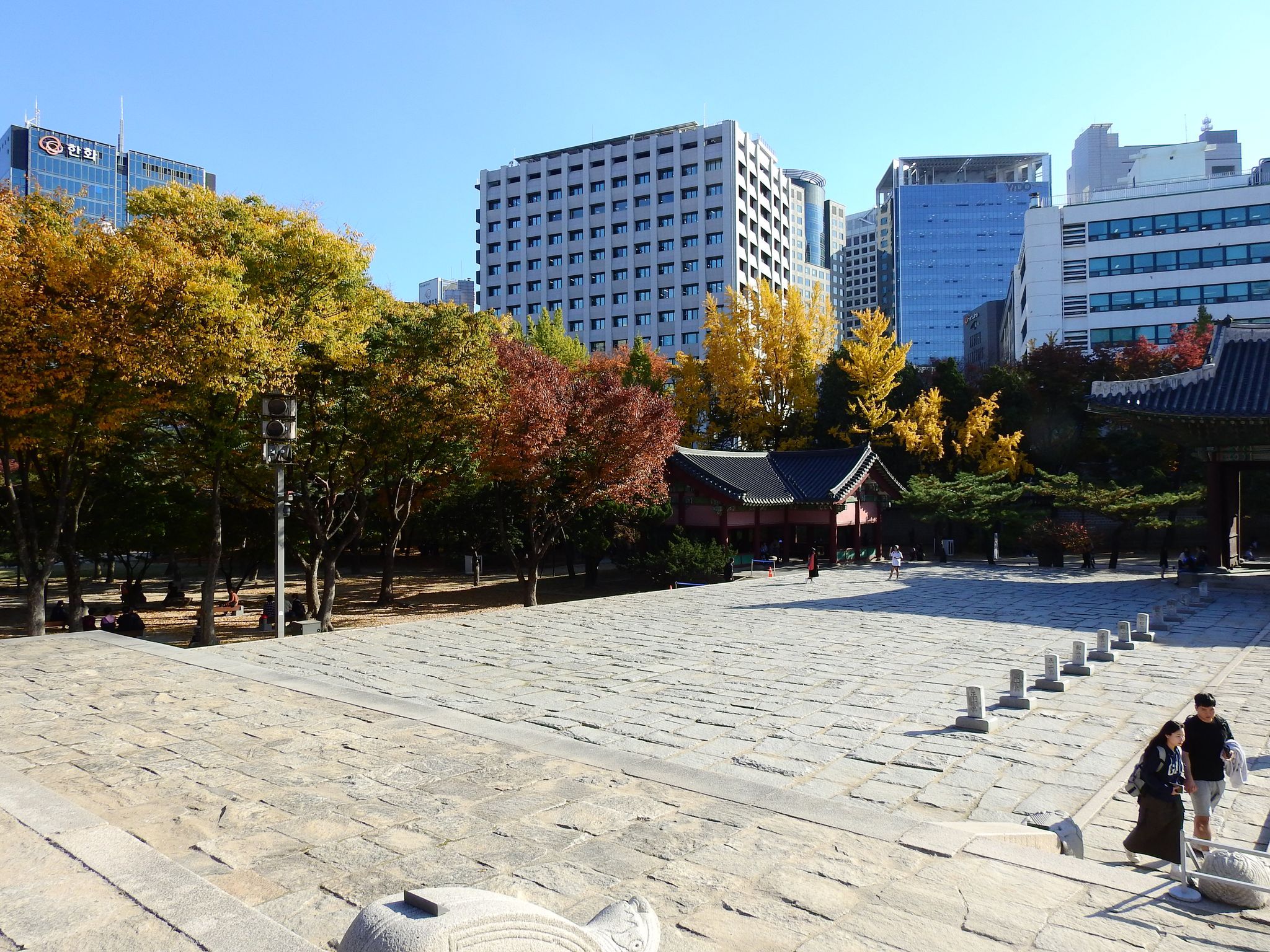
The hall stands on a two-level stone terrace. A broad pavement extends across the forecourt, with a central samdo, or three-part ceremonial path, reserved in its middle section for the king. Rows of rank stones, called pumgyeseok, marked the positions of officials according to rank. Inside, the throne stands before an irworobongdo, a formal royal screen showing the sun, moon, five peaks, and related landscape imagery. Myeongjeongjeon is National Treasure No. 226.
Munjeongjeon and Binyangmun
Munjeongjeon was used for official work with ministers and for major political decisions. Rebuilt in 1616 after the Imjin War, it was destroyed again during the colonial period and reconstructed in 1986. It also served as a honjeon for the deceased queen consorts of King Yeongjo and King Cheoljong. Binyangmun stands behind Myeongjeongjeon and links the formal area with the king’s private quarters. Passage was strictly restricted because it led to the royal residence. The present gate was reconstructed in 1986 after colonial-period destruction and archaeological investigation in 1984.
Royal residences and study buildings
Hwangyeongjeon
Hwangyeongjeon was first built in 1484, rebuilt in 1616, destroyed in the fire of 1830, and rebuilt in 1834. It served as private quarters for the king or crown prince and also accommodated royal ancestral tablets and royal remains during the associated rites.
Haminjeong
Haminjeong was built in 1633 and rebuilt in 1834 after the 1830 fire. It served for royal study and lectures by officials versed in the Confucian classics. The present building is open-sided, while the nineteenth-century painting Donggwoldo shows it as a pavilion with three walls. Four signs, one on each side, contain different sections of the poem “Four Seasons” by Gu Kaizhi.
Sungmundang
Sungmundang was a royal study hall where the king received instruction in the Confucian classics. Its exact foundation date is unknown, but it was rebuilt in 1834 after the fire of 1830. King Yeongjo personally wrote the excerpt from the Book of Odes displayed on the inner wall.
Tongmyeongjeon
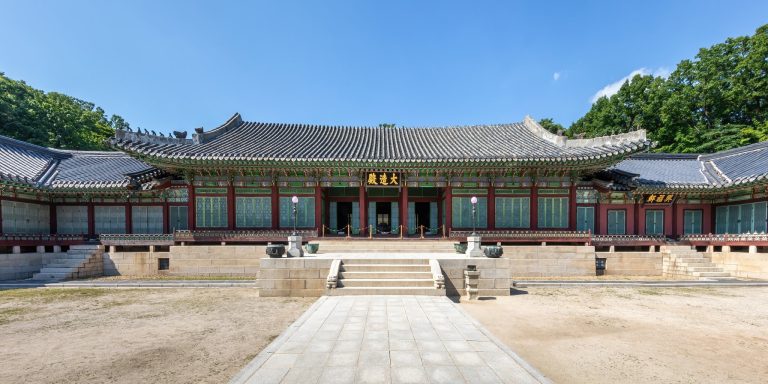
Tongmyeongjeon occupies a secluded part of the palace and was primarily the queen’s private residence. It faces south and stands on a raised stone platform called a gidan. Paving surrounds the building and was suitable for royal events and rituals.
Yeongchuneon and Jipbokeon
Yeongchuneon faces south and was chiefly used as the queen’s private residence. Jipbokeon is connected to it on the west. Both buildings were rebuilt in 1834 after the 1830 fire, although their original construction dates are unknown. Yeongchuneon was also selected by King Jeongjo as his library and private study, while Jipbokeon was the birthplace of Crown Prince Sado and King Sunjo.
Yanghwadang
Yanghwadang was normally used as private quarters for the king or queen. It was rebuilt in 1834 after the fire of 1830.
Gardens, agriculture, and scientific installations
Chundangji
Chundangji consists of a larger lower pond and a smaller upper pond. The upper section occupies the location of the original water surface. The lower section was once a naenongpo, where eunuchs grew vegetables as tribute for the king, and the king performed a ritual in which he personally tended the crops. Japanese authorities altered the pond in 1909, and it was restored in 1986 to a traditional Korean form.
Seven-story stone pagoda
A seven-story octagonal stone pagoda stands beside Chundangji. Its double octagonal base rests on a larger square base, and its form is described as Tibetan in style. An inscription on the body states that it was made in 1470 during China’s Ming dynasty. A merchant acquired it in Manchuria and later donated it to the Yi royal-family museum, founded during the colonial period.
Main greenhouse
The main greenhouse opened in 1909 and was the first Western-style greenhouse built in Korea. Designed by a Japanese designer and constructed by a French company, it has an iron-and-wood frame and an entirely glass exterior. Rare and tropical plants were initially displayed inside. After the 1986 restoration, native Korean plants replaced them. The greenhouse is National Treasure No. 83.
Chimijeong
Chimijeong was built in 1624 in an area intended for raising silkworms. The adjacent large tract was used by soldiers for archery and horsemanship exercises. In 1664, the pavilion was temporarily renamed Gwandeokjeong. It stands beside the main greenhouse.
Wind-measuring pedestal
The wind-measuring pedestal stands on a hill behind Yeongchuneon and Jipbokeon. Traditionally dated to 1770, it was erected together with a rain gauge and supported a flag used to determine wind direction and strength. It was originally located near Tongjemun and moved before Korean independence. The pedestal is included among the national treasures.
Gwancheondae
Gwancheondae stands opposite Munjeongjeon. It was probably used to observe celestial bodies with a soganui, a small simplified armillary sphere. It is also known as Soganuidae. Recent studies suggest that an ilseongjeongsiui, an instrument associated with measuring time through celestial movements, may also have been present there. Gwancheondae was designated a national treasure in 1985.
Gates, routes, and royal memorial features
Seoninmun
Seoninmun stood on the southeastern side of the palace walls together with Honghwamun. It was originally called Seolinmun and served as the principal entrance for officials. Created during the reign of King Seongjong, it was destroyed during the Imjin War, rebuilt during the reign of King Gwanghae, and destroyed again during the reign of King Gojong.
Wolgeunmun
King Jeongjo built Wolgeunmun in 1779 as a direct route to Gyeongmogung, where his father, Crown Prince Sado, was buried. Its name refers to Jeongjo’s visits on the first day of each month.
Jipchunmun
Jipchunmun is set in the northeastern perimeter wall opposite Seoul’s Confucian shrine, Munmyo. It was associated with the eastern entrance to the secret garden and with the king’s route to Sungkyunkwan. Traditionally believed to have first been built during King Seongjong’s reign, the present structure dates from the late Joseon period.
Placenta chamber and stele
The placenta chamber and stele of King Seongjong concern the royal preservation of an umbilical cord. The cord was placed in a container and buried at a propitious location, while the stele records the chamber’s construction and restoration. The chamber was moved from Gwangju in Gyeonggi Province to Changgyeonggung in 1928. Between 1928 and 1930, many royal placenta chambers from across Korea were consolidated at Seosamneung in Goyang, while Seongjong’s chamber was transferred to the palace.