Changdeokgung: A Joseon Royal Palace in Seoul
Site at a Glance
- Rating
- 4.6
- Popularity
- High
- Country
- South Korea
- Primary era
- Early Modern
- External website
- Open
- Eras represented
- Medieval, Early Modern, Modern
- Civilizations
- Joseon
- Site type
- Domestic
- Remains
- Palace
On this page23 sections
History
Changdeokgung is a Joseon royal palace in Seoul, South Korea, established in 1404 after the capital returned from Kaesong to Hanyang. King Taejong, the third king of Joseon, ordered its creation as a separate palace from Gyeongbokgung, the dynasty’s legally designated main palace. The site was selected and construction began in 1404 under Yi Chik, with artisans, soldiers, monks, and local residents taking part. The first building phase ended in 1405, when Taejong entered the palace and held a banquet there.
Foundation and Early Joseon Use
Changdeokgung was initially intended as a secondary royal residence, but Taejong spent most of the rest of his reign there. Later kings also frequently preferred it as a place of residence. By 1418 the palace was considered suitable for major ceremonies, although Sejong the Great later emphasized Gyeongbokgung and moved between the two complexes. Construction continued after the first phase. Insojeon, a Buddhist shrine, and Gwangyeollu were completed in 1406, a pond was dug in 1408, and another pavilion was finished in 1411. Former King Taejo died at Changdeokgung in 1408.
After Taejong abdicated, he lived at nearby Suganggung and continued to influence the reign of Sejong. Sejong ordered many palace buildings to receive names in 1426 and moved primarily to Gyeongbokgung in 1427. King Sejo later expanded Changdeokgung northward and eastward, using approximately 19,000 people from the Hanyang region. King Seongjo enlarged the palace further, lived there throughout his reign, and named its 29 gates in 1475. Because the complex could not house all the royal women, neighboring Changgyeonggung was expanded for them. The two palaces became closely connected and were often treated as a single functional complex.
Destruction and Reconstruction
In 1592, during the Imjin War, Japan’s invasion of Korea, Changdeokgung and Seoul’s other palaces were burned. Responsibility for the fires remains uncertain. Korean texts preserve hearsay that commoners burned the palaces to destroy official records, while Japanese forces also burned buildings and killed inhabitants after military defeats. Changdeokgung was restored instead of Gyeongbokgung because Joseon’s finances had been severely damaged by the war and some contemporaries regarded Gyeongbokgung as inauspicious. The first restoration phase was completed during King Gwanghaegun’s reign in 1610.
The palace suffered another major destruction during the 1623 coup that brought King Injo to power. Rebels burned almost every building at Changdeokgung, although Injeongjeon, the palace pharmacy, several administrative buildings, Biseunggak, and Sujeongjeon survived. Injo dismantled other royal palaces and reused their materials to repair Changdeokgung and Changgyeonggung. Repairs were delayed after the 1624 Yi Kwal Rebellion and the 1636 Qing invasion. Major work resumed in 1647 and was completed in 1648, using materials from In’gyeonggung. The rebuilt complex contained about 735 rooms and received government offices transferred from unrestored Gyeongbokgung.
After this seventeenth-century reconstruction, Changdeokgung served as Joseon’s effective main palace for several centuries. Fires in 1671, 1687, and 1702 caused further damage, and later rulers continued to expand and repair the buildings. Several fires occurred during King Sunjo’s reign, including a major conflagration in 1833 that led to extensive rebuilding and maintenance. In the nineteenth century Changdeokgung and Changgyeonggung shared or overlapped some facilities and government offices. Their separation was formalized by a boundary wall during the colonial period and by a legal boundary in 1963.
Late Joseon and Colonial Transformation
Restoration of Gyeongbokgung began in 1865. King Gojong and his family moved there from Changdeokgung in 1868, but returned after a major fire at Gyeongbokgung in 1876. They did not return permanently until 1885. Maintenance at Changdeokgung was interrupted by the 1882 Imo Incident, and several buildings were dismantled and moved to Gyeongbokgung in 1891. After the assassination of Empress Myeongseong in 1895 and Gojong’s departure from Gyeongbokgung, Gyeongungung became his official palace. Gojong established the Korean Empire and proclaimed himself emperor, while Changdeokgung received only limited new construction.
Japan forced Gojong to abdicate in 1907, and his son, Emperor Sunjong, made Changdeokgung his principal residence later that year. The Japanese Residency-General oversaw the demolition of large parts of the palace between 1907 and 1909, an action interpreted as an attempt to weaken a visible symbol of Korean sovereignty. After Korea became a Japanese colony in 1910, the Office of the Yi Dynasty represented the former royal household and was recorded as owning the palace. Dozens of buildings were subsequently demolished, although the outer boundary and rear garden remained largely intact.
A fire began in Daejojeon at about 5 p.m. on November 10, 1917, and destroyed the palace’s private residential area. It was extinguished three hours later, but valuables and historical relics were lost. Reconstruction continued for years and was delayed by the March First Movement of 1919. Materials recycled from demolished buildings at Gyeongbokgung were used, and Daejojeon was rebuilt by 1920. Sunjong died at Changdeokgung on April 25, 1926. The construction of Yulgok-ro in either 1927 or 1931 separated Changdeokgung from the neighboring Jongmyo ancestral shrine, disrupting their formerly direct physical connection.
Royal Residence and Heritage Status
Parts of Changdeokgung, especially the Nakseonjae complex, continued to house members of the former royal family until 1989. Residents included Empress Sunjeong, Crown Prince Yi Un, Yi Ku, Julia Mullock, Princess Deokhye, and Crown Princess Bangja. Their return after liberation in 1945 depended partly on presidential policy. Changdeokgung was designated a Historic Site of South Korea in 1963 and inscribed on the UNESCO World Heritage List in 1997. The designation recognizes the way its buildings and gardens adapt to local topography and retain indigenous tree cover. The complex covers approximately 57.9 hectares.
Remains
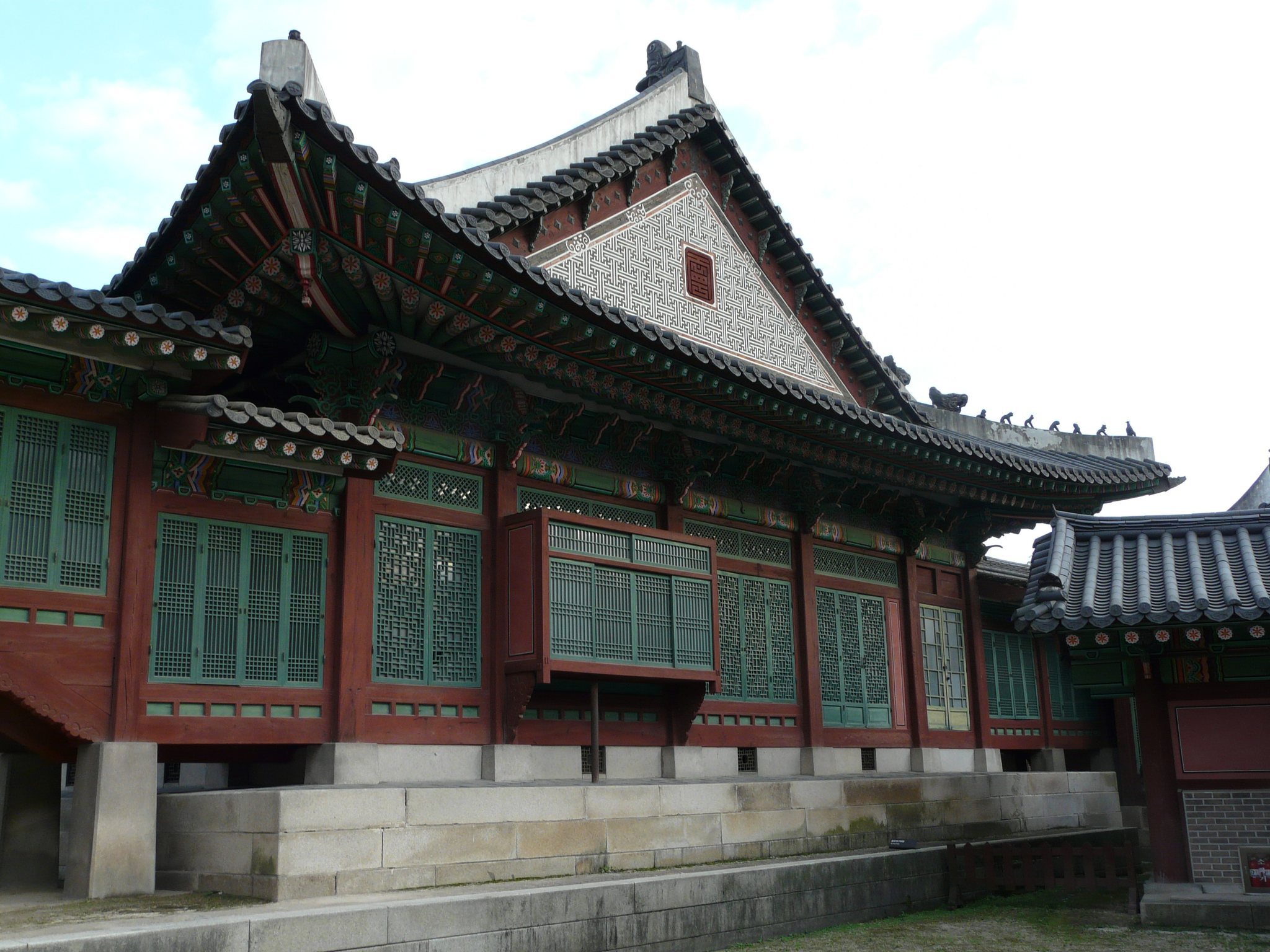
Changdeokgung is organized along a west-to-east axis, unlike Gyeongbokgung’s south-to-north arrangement. Its buildings follow the slope and contours of the site rather than forming a rigid geometric grid. The palace traditionally comprises the oejon, the public and administrative section, the naejon, the private residential section, the East Palace for the crown prince, government offices, and the rear garden. The principal route follows three gates and three courtyards, moving from Donhwamun and the outer court through Jinseonmun and the political court to Injeongmun and the residential court.
Gates, Courts, and State Buildings
Donhwamun and Geumcheongyo
Donhwamun, the main southern gate, was completed in 1412 and is the oldest surviving gate of a Joseon palace. It was burned in 1592 and rebuilt in 1607 or 1608. A woldae, an elevated stone platform before an important palace building, once stood in front of it. The platform was demolished in the early twentieth century and restored in 1997. Nearby Geumcheongyo crosses the former Geumcheon stream. Completed in 1411, it has two arches and stone figures of protective creatures, including a Black Turtle-Snake, Bai Ze, four Xiezhi figures, and dokkaebi motifs.
Jinseonmun and Injeongmun
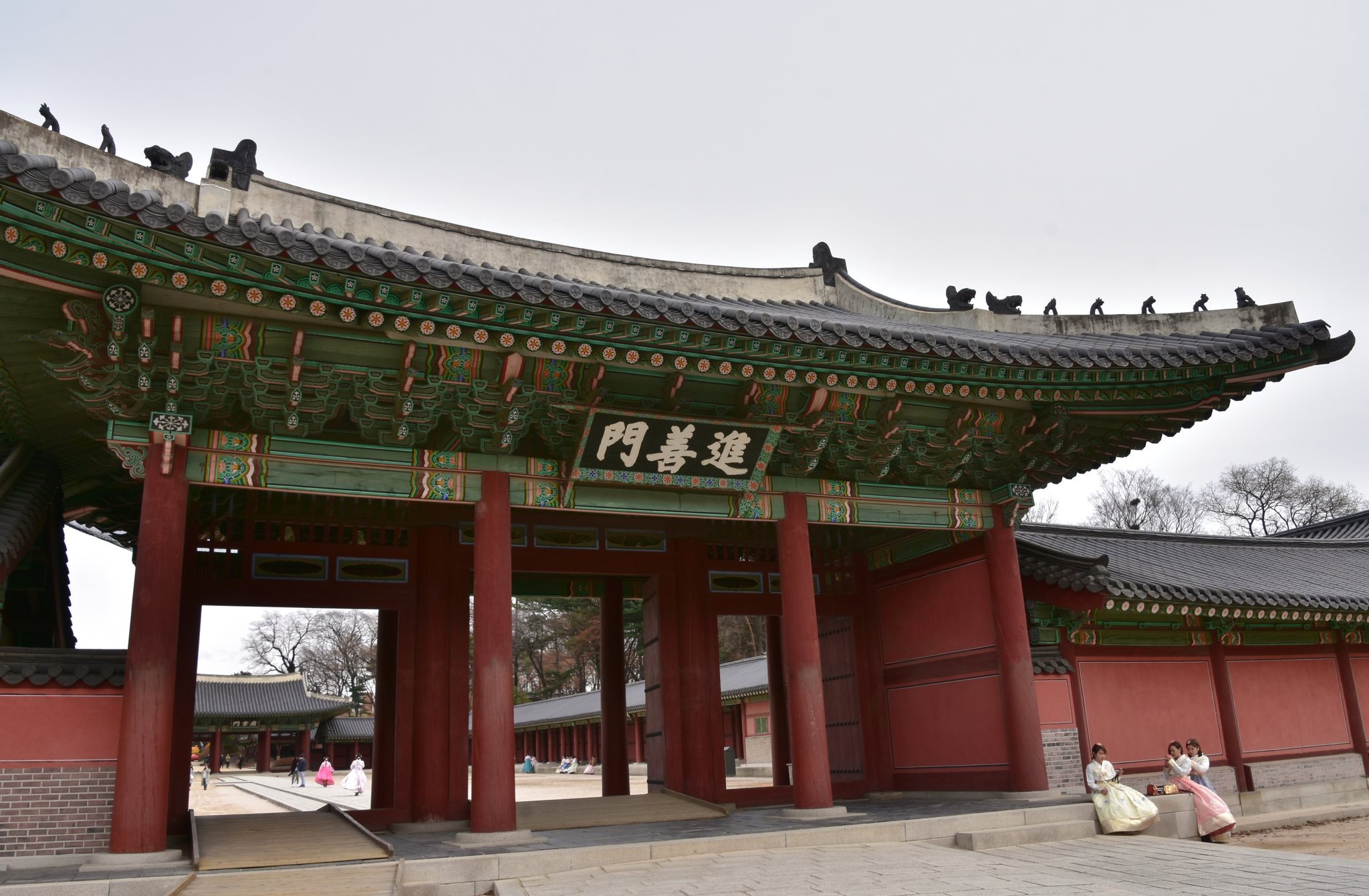
Jinseonmun was completed in 1411 and may originally have been the palace’s outermost gate. It was demolished in 1908 and reconstructed in 1999. Injeongmun gives access to Injeongjeon and was probably completed near the palace’s foundation. It was destroyed in 1592, rebuilt during Gwanghaegun’s reign, burned in 1744, and rebuilt the following year. Its corridors were restored between 1992 and 1996 to reflect a precolonial appearance. Sukjangmun, a large gate leading toward the residential area, had side annexes destroyed during the Imjin War and rebuilt in 1647; the gate itself was reconstructed in 1996.
Injeongjeon
Injeongjeon is the throne hall and a National Treasure. Probably built around 1405, it was destroyed in 1592, rebuilt during Gwanghaegun’s reign, destroyed again in 1803, and rebuilt in 1804. The hall stands on a raised stone platform, and its front court was used for enthronements and other major state ceremonies.
Seonjeongmun and Seonjeongjeon
Seonjeongmun leads to Seonjeongjeon, rather than to Injeongjeon. The gate was probably completed near the palace’s foundation, destroyed in 1592, rebuilt under Gwanghaegun, burned in 1744, and rebuilt in 1745. Seonjeongjeon is a single-story hall where the king received officials, held councils, and conducted political business. Built in 1405 as Jogyecheong and renamed in 1461, it was destroyed in 1592, rebuilt in 1608, destroyed again in 1623, and rebuilt in 1647 with materials from In’gyeonggung. It is the oldest surviving building at Changdeokgung and the only surviving Joseon palace building with blue roof tiles. Its windows were fitted with glass during the colonial period and restored to a precolonial appearance in 1996.
Administrative and Residential Areas
Government Offices and Royal Library
The palace offices, known as kwollaegaksa, supported the king’s daily work, while the major ministries stood outside the palace. Destroyed in 1592, they were rebuilt in 1647, and offices formerly located at Gyeongbokgung were transferred there. All the office buildings in front of Seonjeongjeon and Huijeongdang were demolished between 1907 and 1909. The royal library complex, Kyujanggak, included Imunwon, completed in 1781 after the royal collection was moved from Juhamnu. A Kyujanggak building constructed in 1783 was demolished between 1911 and 1921. Hongmungwan, also called Okdang, preserved palace records and advised the king before its demolition during the same period. Naeuiwon, the palace pharmacy, included a medicine store and survived the 1623 coup; Injo temporarily lived there while the palace was repaired.
Huijeongdang and Daejojeon
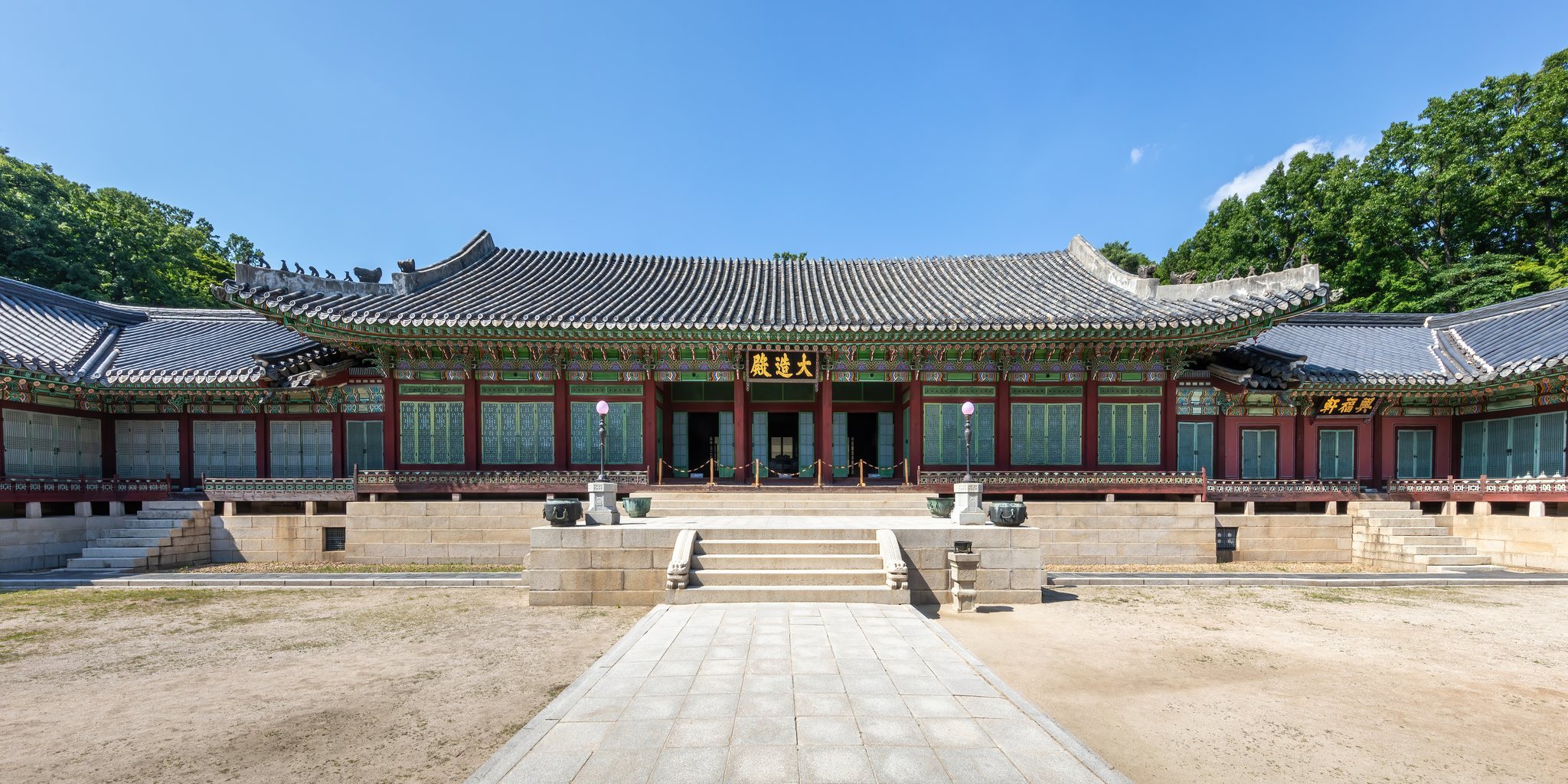
Huijeongdang began as the king’s bedchamber and later became a council hall. It was destroyed in 1592, rebuilt in 1608, destroyed and rebuilt several more times, and reconstructed in its present form in 1920. Daejojeon served as the king’s principal living quarters and the queen’s office. Destroyed in 1592 and rebuilt in 1608, it underwent further rebuilding before its reconstruction in 1920 after the fire of 1917. Its attached hall, Heungbokheon, hosted the final cabinet meeting before Korea’s annexation in 1910. Sunjong died in Daejojeon in 1926.
Gyeonghungak and the East Palace
Gyeonghungak was originally a two-story leisure annex behind Daejojeon, with an upper floor called Jinggwangnu. The 1917 fire destroyed it, and it was rebuilt in 1920 as a single-story structure using materials from Mangyeongjeon at Gyeongbokgung. The East Palace served as the crown prince’s residence, study area, and office. Before the Imjin War it stood outside Changdeokgung; after reconstruction it was moved closer to the residential area, with its main gates facing east toward Changgyeonggung. Many of its buildings have disappeared. Seongjeonggak, used to educate the king and crown prince, later became a pharmacy warehouse. Junghuidang, built in 1782 as the East Palace’s main hall and the crown prince’s residence, became a council hall after the death of Crown Prince Munhyo and was relocated in 1891.
Rear Garden
The rear garden, historically called Huwon, lies behind Changdeokgung and Changgyeonggung and is shared by both palaces. It contains ponds, pavilions, streams, and more than 160 tree species, including more than 70 trees over 300 years old. Its highest ground is central, with slopes extending east and west. The garden served leisure, ceremonies, political activities, military training, civil-service and military examinations, hunting, banquets, and martial-arts practice. Its buildings are placed within the terrain, while the surviving tree cover forms part of the physical relationship between architecture and landscape.
Buyongji and Juhamnu
Buyongjeong stands beside Buyongji, a pond dug in 1707. The adjacent Taeksujae was built that year, replaced in 1792, and renamed Buyongjeong in either 1776 or 1792. King Jeongjo fished there in 1795. Juhamnu is a large two-story building completed in 1776 on a hill. Its upper floor carried the name Juhamnu, while the lower floor housed Kyujanggak and the royal library until the collection moved to Imunwon in 1781. A nearby leisure pavilion, rebuilt in 1692, was used for poetry reading and viewing flowers.
Ongnyucheon and the Three Pavilions
Ongnyucheon, or Jade Stream, was created in 1636 and flows through the northern garden. Its area includes Soyojeong, Taegeukjeong, and Cheonguijeong, collectively known as the Three Pavilions of the Royal Grove. Soyojeong was built in 1636 and included a kitchen for royal visits. Taegeukjeong, completed that year as Unyeongjeong, stands near a cistern bearing a taegeuk symbol. Cheonguijeong, also built in 1636, is the palace’s only surviving thatched-roof building. Its round roof and square floor express Taoist symbolism, and it was associated with agricultural rites involving the king’s participation in farming.
Garden Pavilions and Studies
Chwihangjeong began as a thatched pavilion in 1645 or 1646 and received its present name in 1690. Aeryeonjeong and the pond Aeryeonji were first built in 1692; the pavilion was originally placed on an islet and later rebuilt at its present location. Uiduhap is a study hall with associated small buildings, while Gwallamjeong is a fan-shaped pavilion beside Bandoji, or Peninsula Pond. Jondeokjeong, built in 1644 as Yukmyeonjeong, is an elaborately painted hexagonal pavilion with a two-tiered roof and calligraphy by King Jeongjo. Other small pavilions and study structures were built, moved, or altered between the seventeenth and twentieth centuries.
Yeongyeongdang and Nakseonjae
Yeongyeongdang was built in 1828 for ceremonies and events. It includes an inner residence, a separate reception or men’s quarter, and a kitchen building, all designed to resemble an unpainted nobleman’s house. King Sunjo used it as a place for simple living, Gojong sought refuge there during the 1884 Kapsin Coup, and Sunjong temporarily resided there after the 1917 fire. The Nakseonjae complex includes Nakseonjae, Seokbokheon, Sugangjae, a hexagonal pavilion, and later annexes. Nakseonjae was built in 1847 on the former site of Nakseondang and was used by members of the former royal family. Princess Euimin lived there from her return to Korea in 1963 until her death in 1989, and Yi Un died there in 1970. Seokbokheon, built in 1848 for palace women, housed Empress Sunjeonghyo, while Sugangjae, built in 1785 as a royal study, later housed Queen Sunwon and Princess Deokhye.
Portrait Halls and Former Palace Areas
Seonwonjeon
Old Seonwonjeon was built in 1695 as a royal portrait hall, or jinjeon, where portraits of former monarchs were enshrined for ancestor worship. It was dedicated to the Wanli Emperor in gratitude for Chinese assistance during the Imjin War, enlarged several times, and used in 1749 to enshrine spirit tablets of the first and last Ming emperors. The hall was vacated during the early colonial period, and its portraits were moved to New Seonwonjeon. Completed in 1921 far north of the main palace, New Seonwonjeon was the last portrait hall constructed in Korea. Most of the portraits formerly kept there were destroyed in the 1954 Busan Yongdusan fires.
Other Surviving and Former Features
Uihyojeon, an annex associated with New Seonwonjeon, was moved from Gyeongbokgung to Gyeongungung in 1904 and then to Changdeokgung in 1921 for the keeping of spirit tablets. Eochago, also called Bincheong, is an eight-room guesthouse and meeting hall that became a garage in 1910. Other surviving features include a pavilion associated with a dream of King Sukjong, an archery-practice pavilion, and Geumcheon, the former palace stream. Former structures included Jinggwangnu, Yeonghuidang, Yeonyangnu, Okhwadang, and several halls and pavilions destroyed by fire, demolition, or relocation. Together, these remains preserve the successive functions, rebuilding phases, and landscape-based organization of Changdeokgung.