Church of the Nativity of the Virgin Mary in Smolnica: A Medieval Parish Church in Poland
Site at a Glance
- Rating
- 4.5
- Popularity
- Very Low
- Country
- Poland
- Primary era
- Medieval
- Eras represented
- Medieval, Modern
- Civilizations
- German, Holy Roman Empire, Kingdom of Prussia, Margraviate of Brandenburg
- Site type
- Religious
- Remains
- Church
On this page9 sections
History
Medieval origins
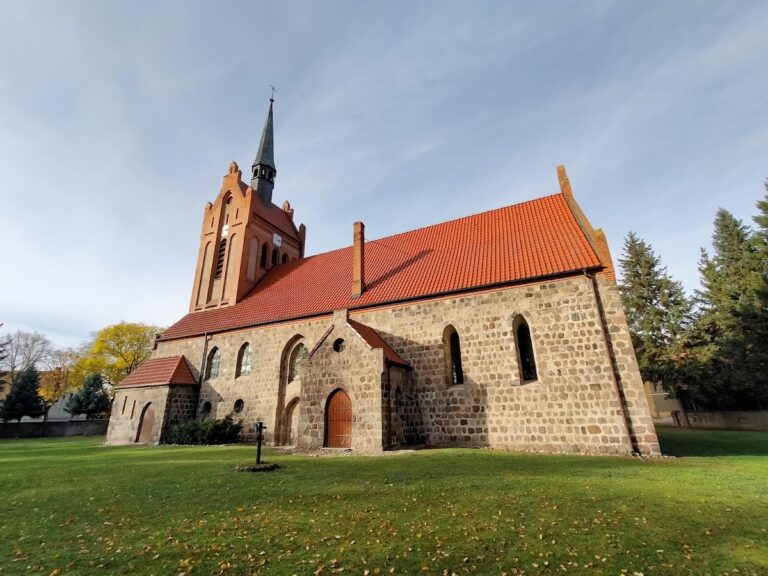
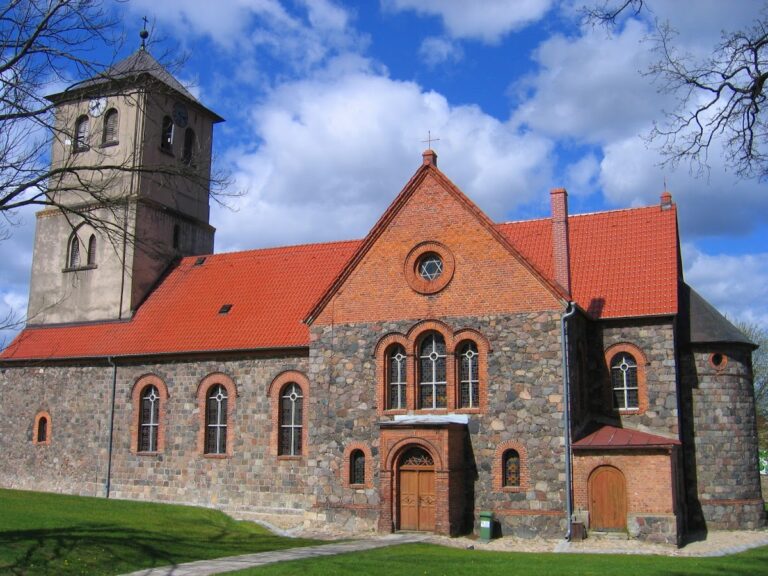
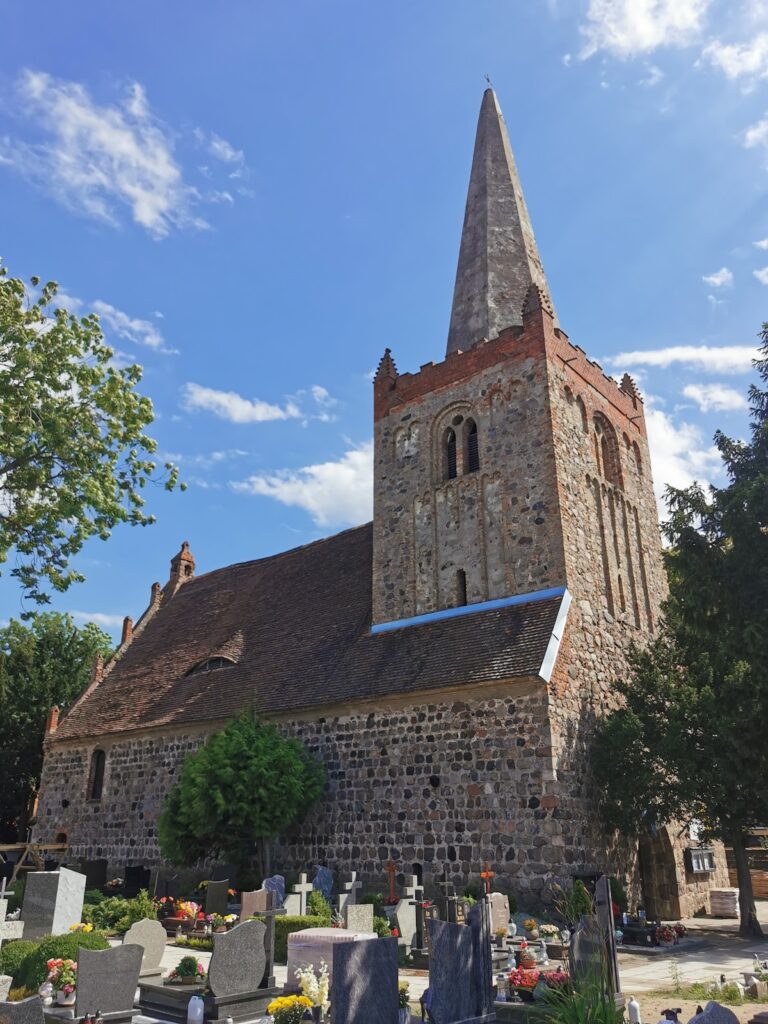
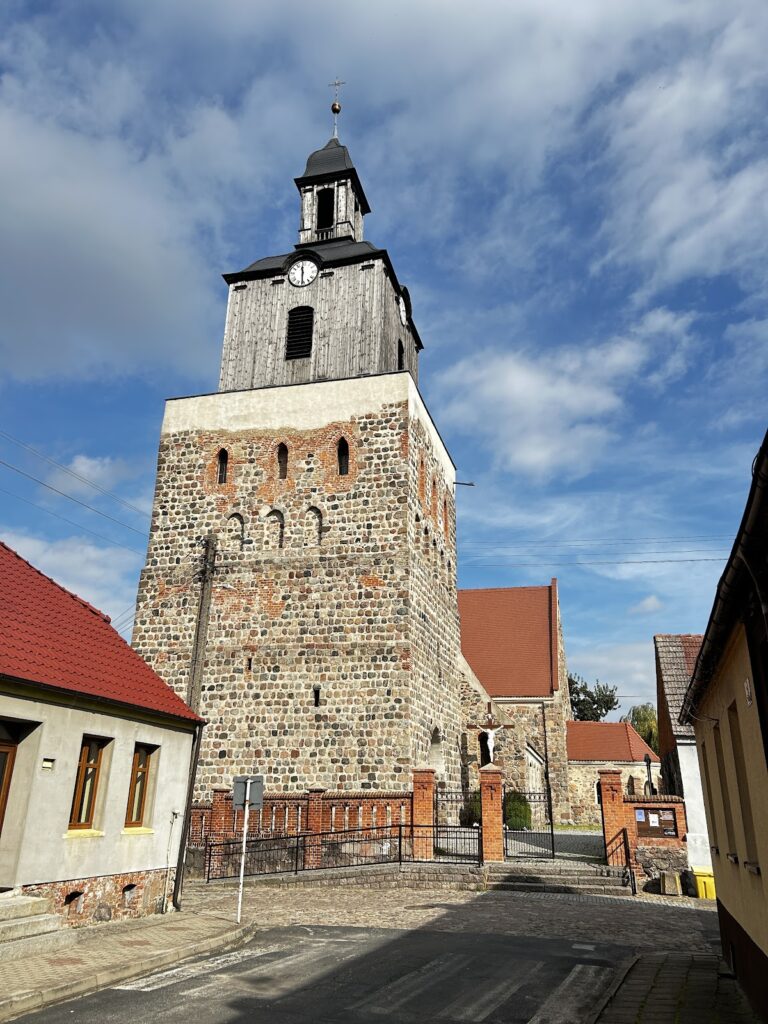
The Church of the Nativity of the Virgin Mary in Smolnica is a Roman Catholic parish church in Poland, built in the second half of the thirteenth century in the Romanesque period. Its first documented mention dates to 1337, when it appeared in the land register associated with Louis the Elder, Margrave of Brandenburg. During the fourteenth century, the tower was heightened and a porch was added on the south side. The parish belonged to the medieval Catholic Diocese of Cammin, an ecclesiastical jurisdiction whose authority covered the area.
A burial chapel of the Marwitz family formerly stood beside the church at the chancel, the part traditionally reserved for the altar and clergy. Its presence reflected the connection between the parish church and the local estate owners.
Reformation and Lutheran use
In 1529, Peter von der Marwitz, the owner of the Smolnica estate, brought a pastor to the church. After Lutheranism, the Protestant Christian tradition associated with Martin Luther and the sixteenth-century Reformation, became the official religion of the New March in 1538, the church became Lutheran. It remained an Evangelical church until 1945.
Alterations before 1945
The tower received a new Baroque top in either 1716 or 1726, although the precise date is uncertain. In 1858, the estate owner Karl Wilhelm von Sydow donated an organ. A more extensive remodeling followed in 1886 under the supervision of Prufer, a Berlin architect. The medieval interior was reshaped in the Neo-Gothic style, a nineteenth-century revival of Gothic forms, and the nave windows were enlarged. Von Sydow also donated an altar, baptismal font, pulpit, two galleries, and Gothic windows fitted with cathedral glass.
Destruction and reconstruction
The Red Army bombing of 1945 damaged the church. Local residents rebuilt it in 1983 and 1984 under the supervision of Wiesław Dąbrowski, a Salesian priest belonging to a Catholic order associated with education and pastoral work. The reconstruction preserved the early Gothic form but did not reproduce the Baroque tower top. The restored church was consecrated on 8 December 1984 and now serves as a Roman Catholic parish church dedicated to the Nativity of the Virgin Mary.
The church entered the heritage register under number A-1177 on 31 July 1956. The inactive churchyard cemetery was entered under number 377 on 10 September 1977, in a decision concerning the palace park.
Remains
Building and openings
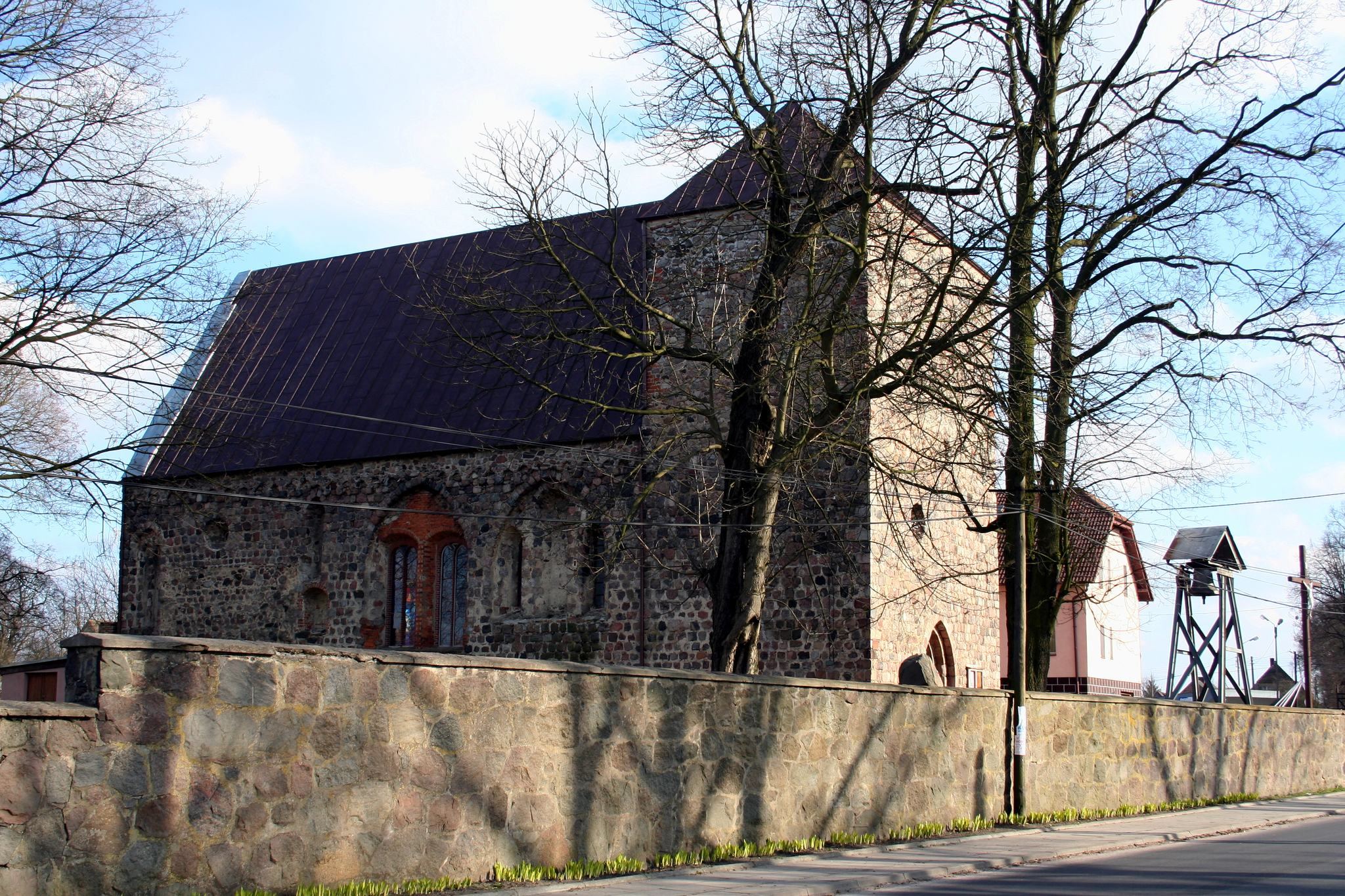
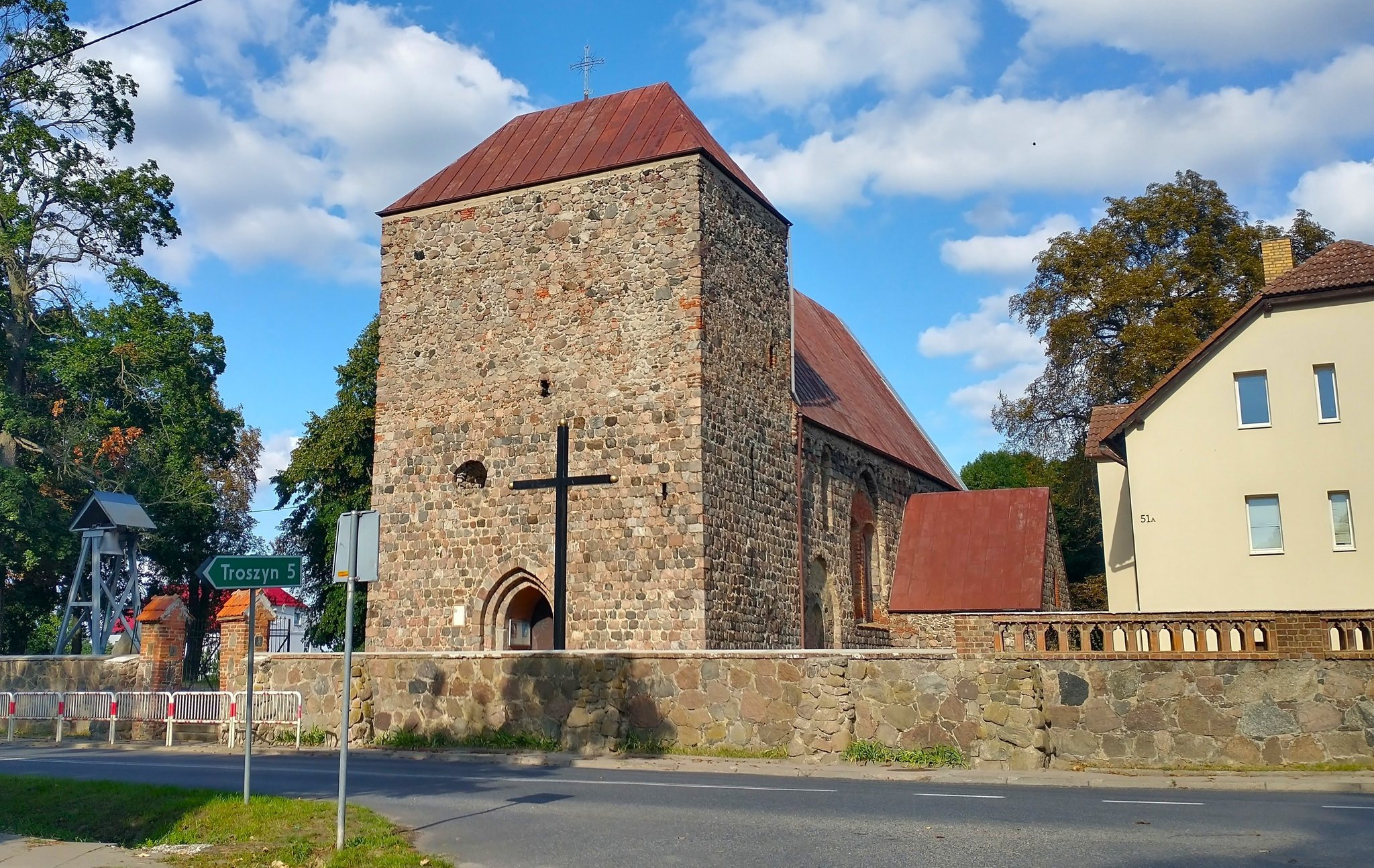
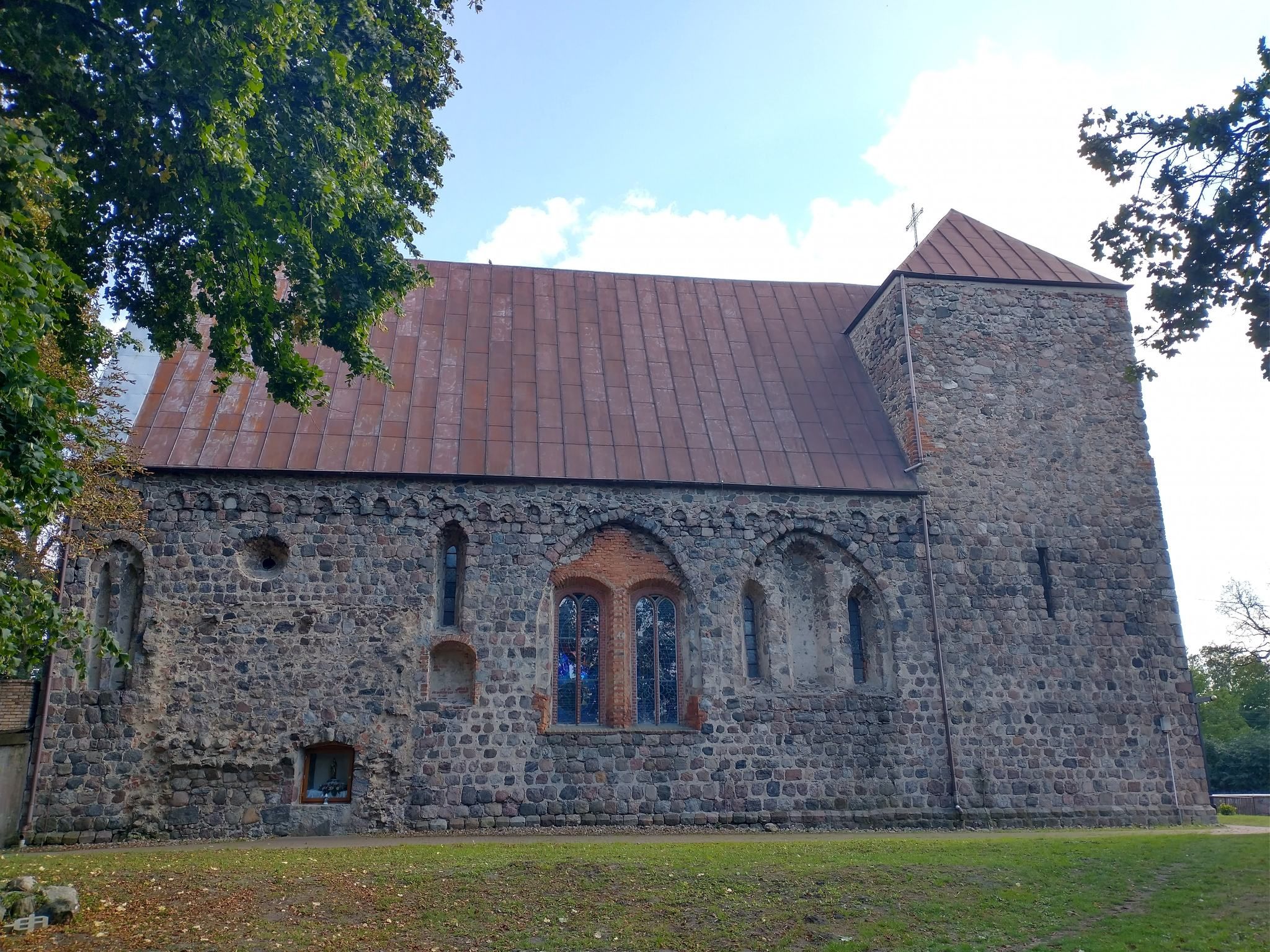
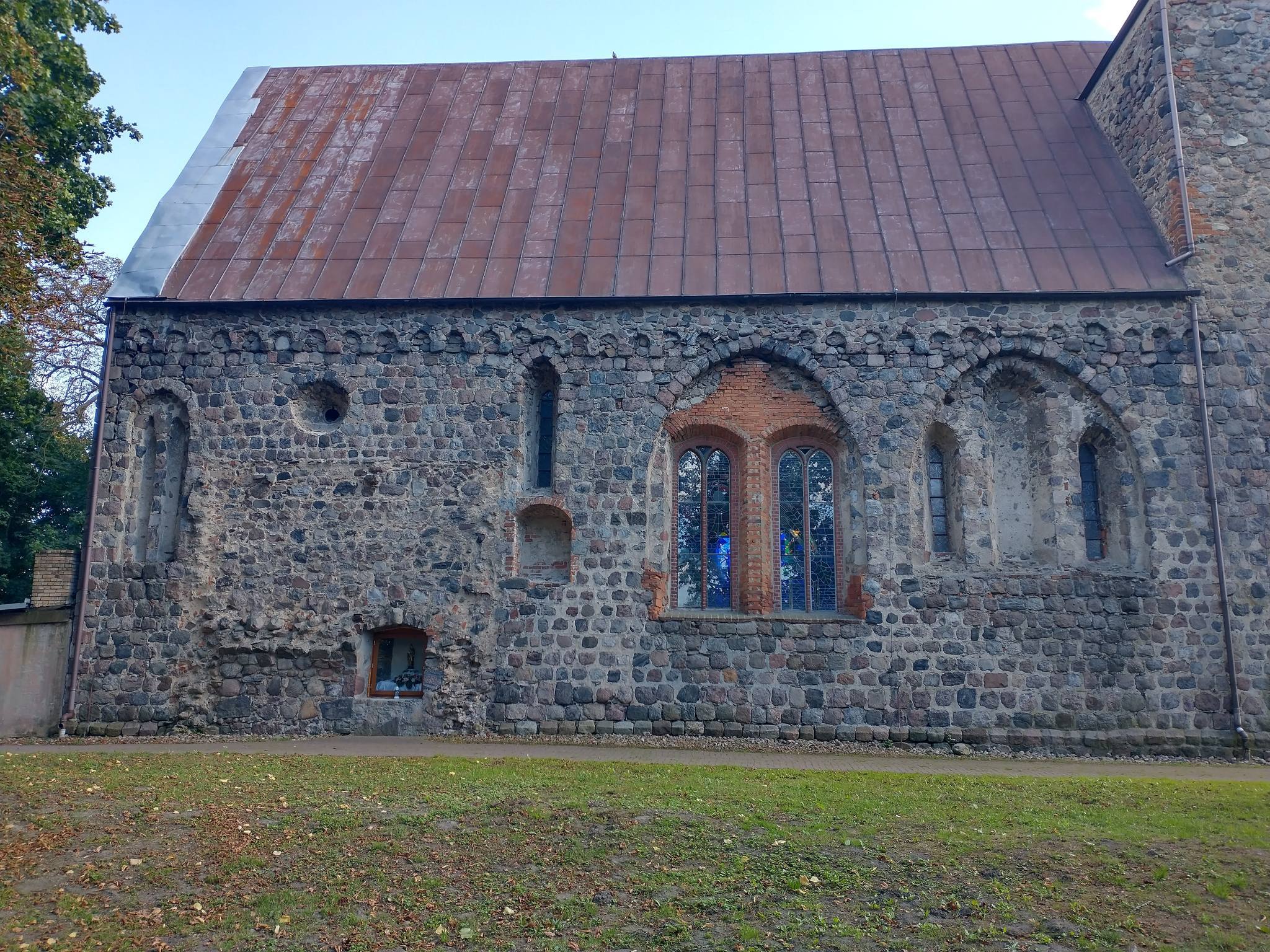
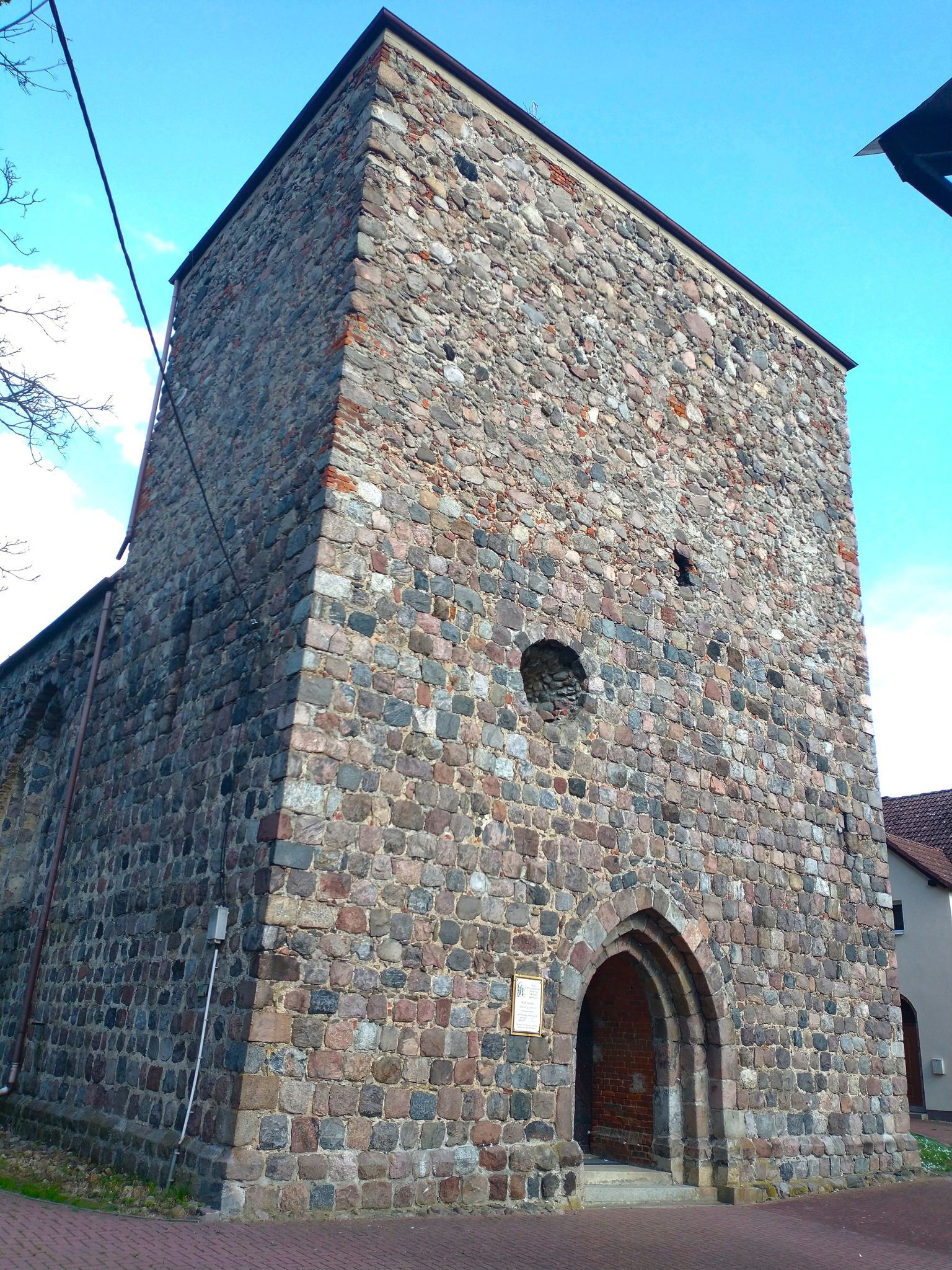
The surviving church is a single-nave rectangular building measuring 20 by 9.3 metres. It has no choir and is built from granite blocks laid in regular courses. The walls are 1.55 metres thick. A massive western tower, as wide as the nave, gives the building its principal vertical element. The west wall contains a pointed-arch entrance portal, while the south wall preserves the remains of a second entrance beside a porch, although its portal no longer survives. Inside, a broad round-arched passage connects the tower hall with the nave. Three pointed-arch windows remain visible in the eastern wall, and the enlarged openings created during the 1886 remodeling accommodated Gothic windows with cathedral glass.
Churchyard and former furnishings
A stone-and-brick wall enclosed the churchyard in 1905. The former interior furnishings included an altar, baptismal font, and pulpit made from Silesian sandstone, together with two galleries. An epitaph commemorating the late-sixteenth-century pastor Franz Schmer and his family stood beside the church’s side entrance.
Bells
The church formerly had four bells. They included a medieval bell measuring 0.58 metres in diameter, a 1581 bell cast by Joachim Karstede with a diameter of 0.28 metres, an 1843 bell measuring 0.91 metres, and a 1904 bell made by Franz Schilling of the Apolda foundry with a diameter of 1.15 metres. A bell dated 10 July 1991 is now mounted on the belfry.