Chulachomklao Fort: A Siamese Coastal Artillery Fortress in Thailand
Site at a Glance
- Rating
- 4.6
- Popularity
- Medium
- Country
- Thailand
- Primary era
- Modern
- Eras represented
- Modern
- Civilizations
- Unclassified
- Site type
- Military
- Remains
- Fort
On this page15 sections
History
Chulachomklao Fort is a Siamese water fortress in Thailand, built in the late nineteenth century as a Western-style artillery installation to strengthen defenses at the mouth of the Chao Phraya River. Construction began around March 1884 and was completed in the middle of 1893 during the reign of King Chulalongkorn, also known as Rama V, whose government pursued major military modernization. The fort was intended to respond to pressure from Britain and France and to replace damaged and outdated defenses that could not match Western military technology.
Planning and construction
In 1878, King Chulalongkorn ordered Luang Cholayut Yothin, a Danish designer, to plan a modern fortification. The project was financed from the royal treasury, but accelerated development elsewhere left the available funds insufficient. King Chulalongkorn then contributed 10,000 chang, stated as 800,000 baht, from his personal property. The fort was established at Laem Fa Pha, with its position extending toward the river mouth and the Gulf of Thailand.
The artillery installation received its first commander as the fort was being equipped. Vice-Admiral Phraya Wichitnawi supervised the installation of the artillery, while Von Holt served as an artillery instructor and became the first fort commander. The site also included paired shrines to Phra Nares and Phra Narai, constructed in 1884 during King Chulalongkorn’s reign as Brahmin-Hindu sacred sites alongside the fort.
The 1893 Franco-Siamese crisis
King Chulalongkorn personally test-fired one of the fort’s guns on 28 May 1893. Soon afterward, the installation became involved in the Franco-Siamese crisis, a confrontation in which France applied naval pressure around the Chao Phraya River and the Paknam area. Paknam is the river-mouth region of present-day Samut Prakan.
On the evening of 13 July 1893, the pilot boat J.B. Say, commanded by Captain Bory, entered the Gulf of Thailand while serving as a pilot boat for two French warships. Chulachomklao Fort fired on the vessels until the pilot boat ran aground at Laem Phu Rai beach. The French warships then raised their battle flags and bombarded the fort, while Thai troops returned fire. The action exposed weaknesses in Thai artillery training. Only one Thai soldier and two recently arrived Danish personnel were on duty at the fort.
From military installation to historical park
The Royal Thai Navy decommissioned Chulachomklao Fort in 1996. The site was subsequently used as an open-air museum presenting the fort’s history, the development of maritime defense, and the history of the Thai Navy. A Naval Historical Park was established in 1999 in honor of King Bhumibol Adulyadej’s sixth-cycle anniversary. It records the evolution of naval weapons and the Navy’s role in protecting national sovereignty, with preserved, repaired, and arranged weapons and components associated especially with the reigns of Kings Chulalongkorn and Vajiravudh.
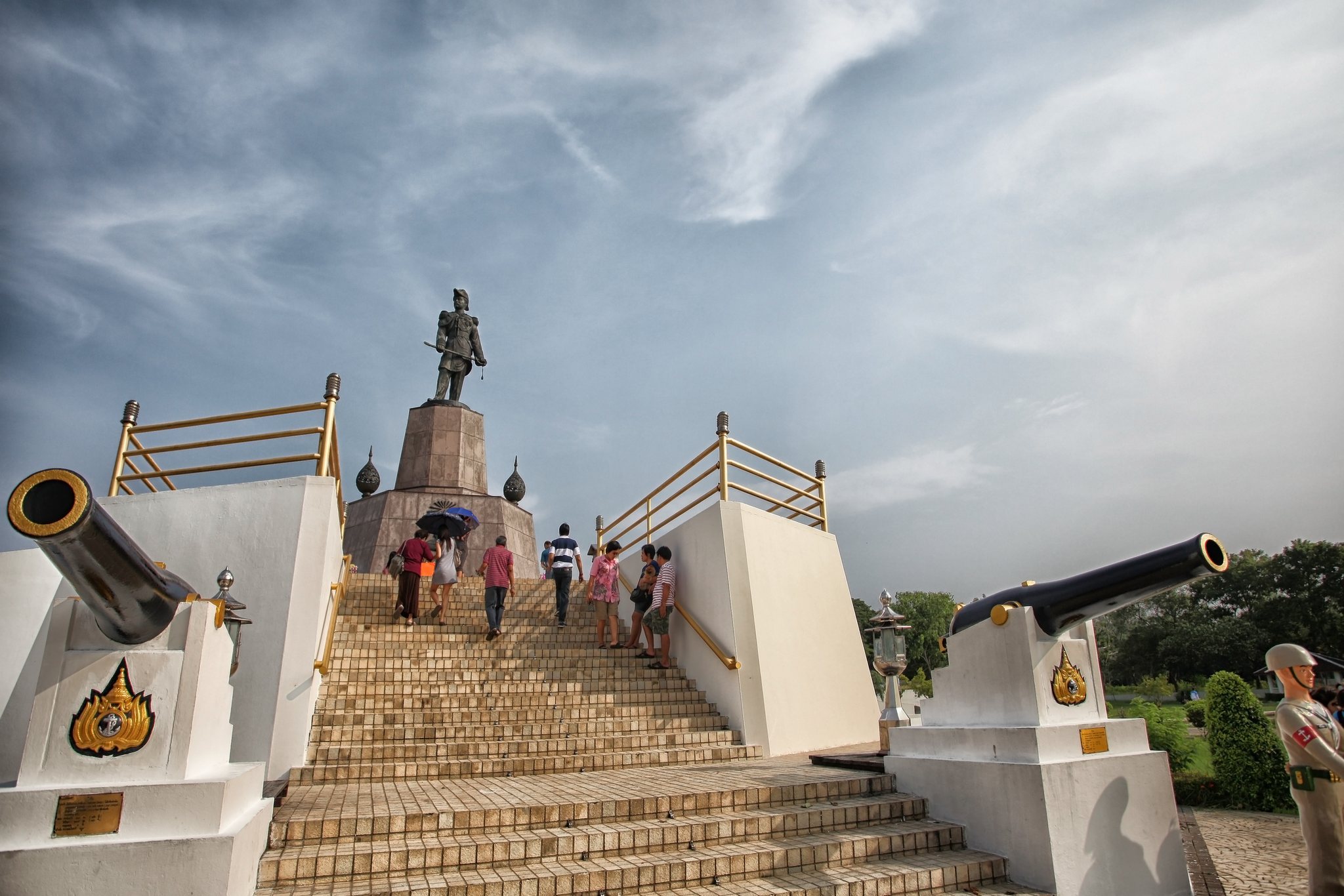
A monument to King Chulalongkorn was established at the fort on 19 January 1993 by the Thai Navy and private-sector partners. King Bhumibol Adulyadej, also known as Rama IX, and Princess Maha Chakri Sirindhorn unveiled it. An inscription from a royal letter appears on its base: “If Siam’s freedom had ended, my life would have ended by then.” The Chulachomklao Fort Exhibition Hall opened beneath the monument on 23 October 2001, presenting the king’s history, the fort’s role in the 1893 crisis, and the history of the Thai Navy.
Remains
Chulachomklao Fort is a hexagonal Western-style artillery turret oriented northward toward the mouth of the Chao Phraya River. Its surviving military layout includes seven artillery embrasures, internal passages for personnel, an armor room, a freshwater tank, and an observation opening above the gun positions. The fort’s principal features reflect the adoption of Western artillery technology by the Thai Navy during the modernization efforts of King Chulalongkorn’s reign.
Fortification and artillery
Hexagonal turret
The turret was designed around seven artillery positions, with narrow corridors connecting the internal spaces. Small rooms served for ammunition storage, while a curved ceiling resembling a tortoiseshell rises approximately 2 metres at the center and slopes downward on both sides. The observation opening above the gun embrasures allowed the artillery position to be watched from within the fort’s protected structure.
Armstrong guns
The main armament consisted of seven 152/32 mm Armstrong guns, commonly called “Crouching Tiger” guns. Sir W. G. Armstrong’s company supplied the weapons, which later became associated with the Vickers Armstrong Engineering Company in England. They were regarded as the Thai Navy’s first breech-loading artillery. Ten guns were acquired in 1893, with seven installed at Chulachomklao Fort and three placed at another fortress identified as Ocean Butterfly Fortress. Each projectile weighed nearly 50 kilograms.
The guns were mounted in dedicated embrasures and raised for firing by a hydro-pneumatic suspension system, which combined compressed oil and gas to control recoil. When fired, the recoil caused each gun to descend, or “crouch,” behind its protective position. These weapons were used during the 1893 crisis against the French fleet, linking the surviving artillery installation directly to the fort’s military history.
Monument and naval museums
King Chulalongkorn monument
The monument to King Chulalongkorn stands within the fort. It commemorates the monarch who ordered the modern fortification and supported its completion. The exhibition hall beneath the monument presents the history of the king, the fort, the Franco-Siamese crisis, and the Thai Navy. The monument’s base carries the quotation from the king’s royal letter.
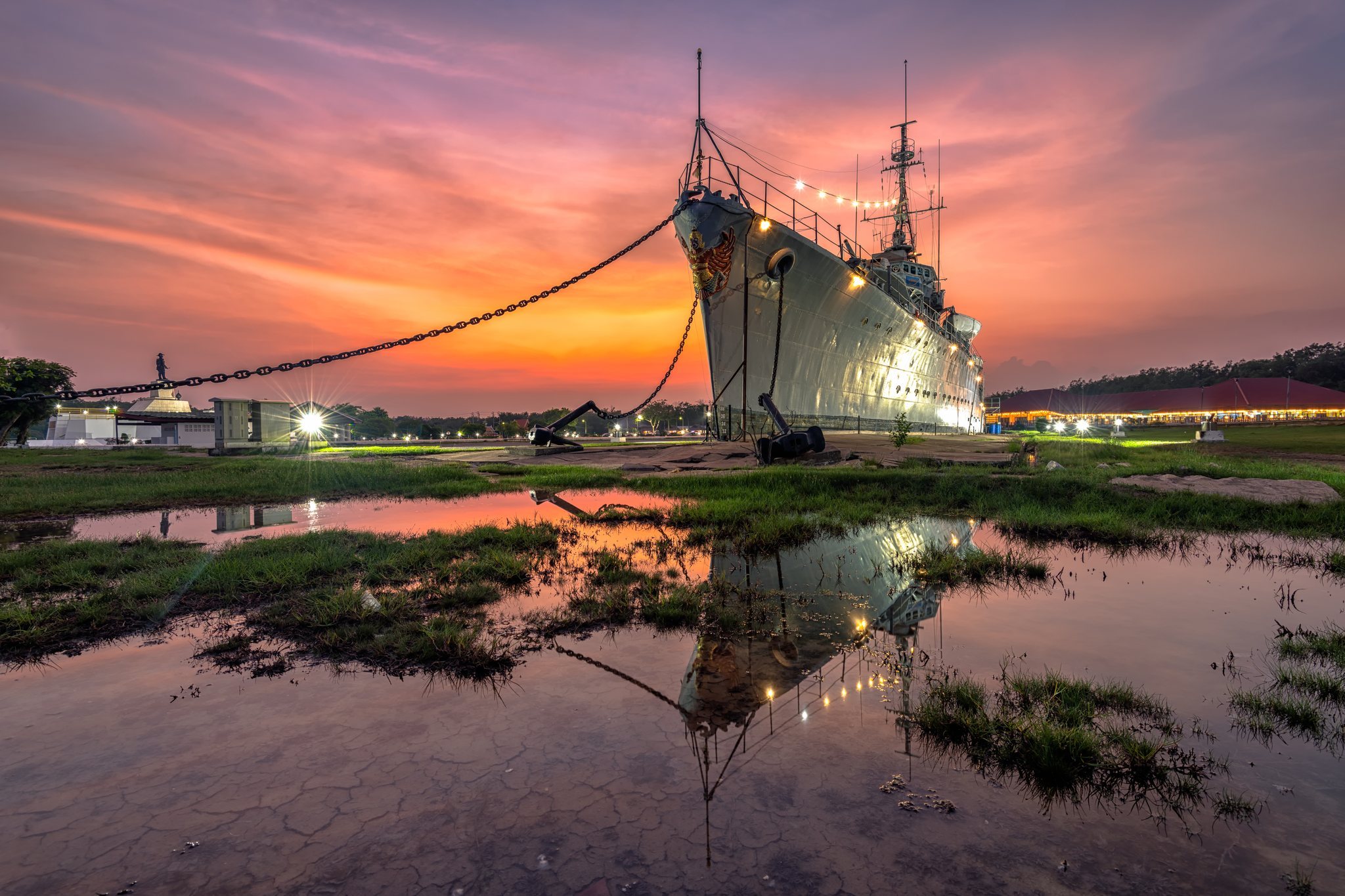
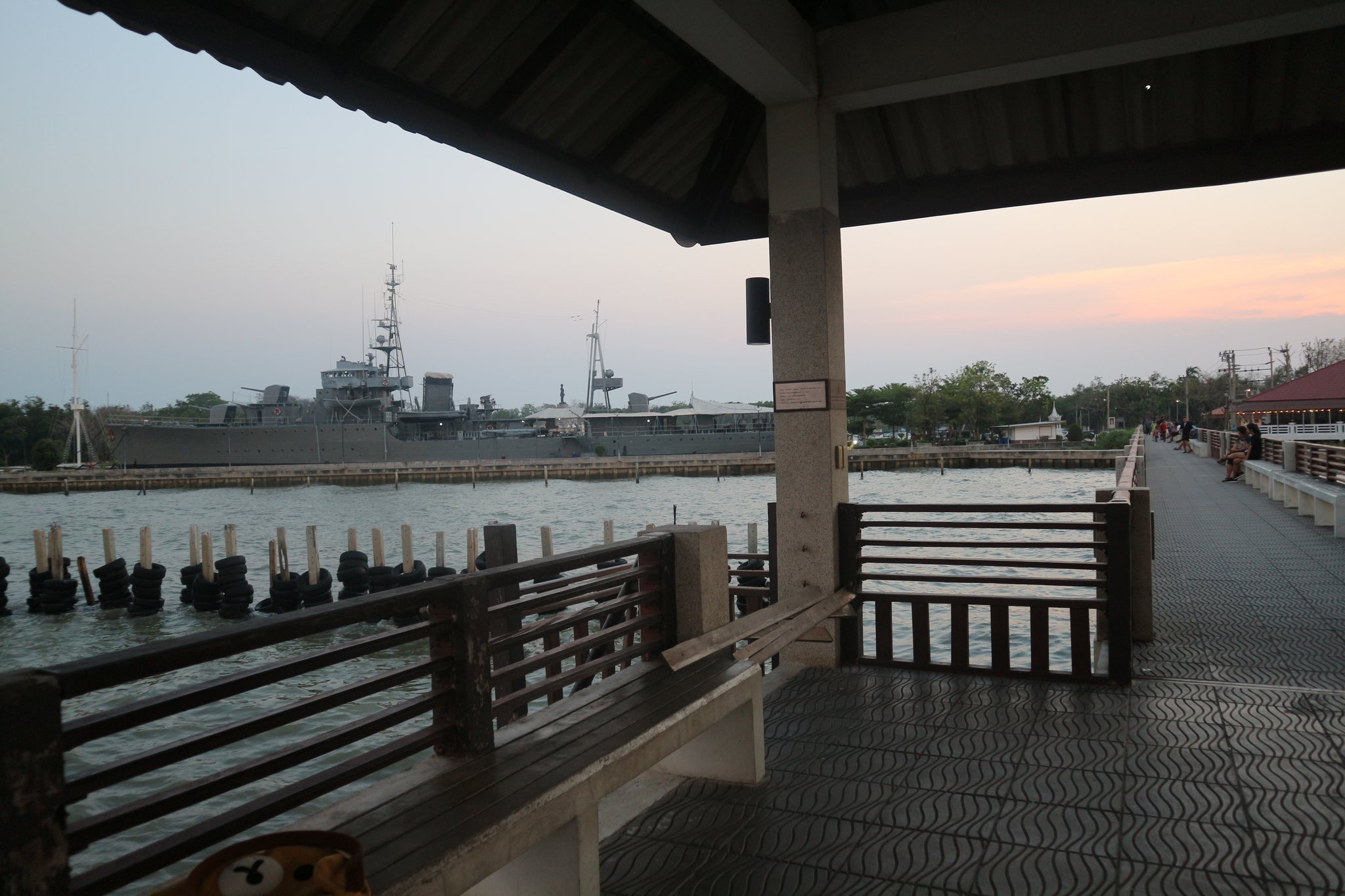
HTMS Mae Klong
The Royal Thai Navy established a museum around the decommissioned HTMS Mae Klong in 1996. The frigate was built at Uraga Shipyard in Yokosuka, Japan, in 1936 under the supervision of Captain Luang Chanchakkit Chamanan and Phra Praprakokkonkit. It entered service in 1937 and was retired in 1996 after more than 59 years of service.
The ship served as a royal barge during the reigns of Kings Ananda Mahidol and Bhumibol Adulyadej, took part in the Great East Asia War, and later served as a naval training ship. The open-air museum includes the ship’s bridge, or control room, together with rooms presenting information about HTMS Mae Klong and the earlier warship Luang Mae Klong.
Naval Historical Park
Exhibition buildings and weapon groups
The Naval Historical Park consists of an exhibition building, nine pavilions devoted to important events in naval history, and outdoor weapons arranged in five groups. The first group contains seven disappearing guns. A disappearing gun is mounted on a carriage that lowers behind protective cover after firing or when not in use.
The second group presents weapons from the reigns of Kings Chulalongkorn and Vajiravudh. It includes 120/40 mm, 76/40 mm, 57/40 mm, 37/20 mm, 47/40 mm, 40/40 mm, 37 mm, 11 mm, and 8 mm guns, as well as machine guns, field carriages, torpedoes, mines, and equipment associated with HTMS Phra Ruang.
The third group contains weapons associated with the First World War, the naval battle at Koh Chang, and the Second World War. Its displays include Type 77 torpedoes, 20 mm Madsen machine guns, 40/40 mm guns, 76/45 mm guns, 80-type guns, and 75/51 mm guns. The fourth group presents weapons used from the Second World War through the modern period, including 75/41 mm and 102/45 mm guns, 20 mm Ericson machine guns, a 37 mm bazooka, a 4.2-inch grenade launcher, a 90 mm gun, a 75 mm recoilless gun, field carriages, an amphibious vehicle, and a water-patrol boat.
Peacetime naval equipment
The fifth group presents naval structures and equipment connected with peacetime activities. Its displays include a simulated marine gas-drilling base and simulated fishing boats, extending the park’s presentation beyond weapons used in wartime.
Mangrove landscape
A 750-metre mangrove nature trail crosses the fort’s mangrove area on a SHERA bridge. Established in 1999, it functions as an outdoor educational route identifying local plants and animals. The trail includes mangrove species, coastal plants, fish, shrimp, and other fauna associated with mangrove environments.