The Sand-Covered Church: A Buried Medieval Church in Denmark
Site at a Glance
- Rating
- 4.2
- Popularity
- Medium
- Country
- Denmark
- Primary era
- Medieval
- Eras represented
- Medieval
- Civilizations
- Danish
- Site type
- Religious
- Remains
- Church
On this page8 sections
History
The Sand-Covered Church, also known as Old Skagen Church or the Buried Church, is a late fourteenth-century Catholic church near Skagen in Denmark. Built in Gothic brickwork between 1355 and 1387, it was dedicated to Saint Lawrence of Rome, a third-century Christian deacon and martyr whose cult was widely established in medieval Europe.
Medieval church and royal ownership
The church first appears in a record dated 31 March 1387, following the stranding of a Hanseatic ship at Skagen. The Hanseatic League was a medieval commercial network linking merchant towns around the North and Baltic Seas. On the first day, 861 packages of cloth were salvaged and taken to the nearest church. On the following day, the priest Bernhard brought seven additional packages to the Sand-Covered Church.
Queen Margaret I of Denmark received 400 packages and paid 320 nobles in restitution in 1394, although the merchants valued the cloth at 2,750 nobles. Bernhard kept the seven packages brought to his church but swore to report their contents to the king and queen. The Danish Crown owned the church until 1459, when it transferred ownership to the Hospital of the Holy Ghost in Aalborg, a medieval charitable and religious institution. The Aalborg hospital administered the church thereafter.
The advance of the sand
Sand began drifting from Råbjerg Mile, a large migrating coastal dune in northern Denmark, around 1600. Over roughly two centuries, advancing sand destroyed fields, buried the nearby village, and reached the church. Comparable sand-covering events affected coastal areas around the North Sea between 1400 and 1800, including parts of Scotland, Denmark, and the Netherlands.
On Great Prayer Day in 1775, a Danish religious holiday traditionally observed on the fourth Friday after Easter, the congregation had to clear the church entrance before a service could take place. Local residents continued removing sand over the next twenty years to keep the building accessible. The furnishings and interior decorations were taken out, and some were sold.
Closure and later preservation
A royal decree closed the church in 1795, and the main body was subsequently dismantled. The church was formally deconsecrated in the same year, bringing to an end the long struggle to keep it usable. The final funeral in the churchyard took place either in 1801 or 1810, although the precise date is uncertain.
In 1841, the chalice, candlesticks, and a bell from the demolished church were transferred to the new Skagen Church, designed by Christian Frederik Hansen. The National Museum of Denmark, which now owns the site, carried out a small excavation near the tower in the late nineteenth century. The nave area has never been excavated. The tower has been listed as a historic building since before 1937 and remains one of Denmark’s best-known churches. Hans Christian Andersen later used it as the setting for A Story from the Dunes.
Remains
Layout and construction
The church was a long Gothic brick building measuring 45 metres from east to west, including its tower. Its main body contained a vaulted nave with exterior buttresses, a vestry on the north side, and a porch on the south. The nave was built of red brick beneath a lead roof. The bricks were imported from the Netherlands and Germany, particularly from Lübeck.
The buried church body
The former nave area remains covered by sand. The floor, altar, and baptismal font are believed to survive beneath it, but this interpretation has not been confirmed by excavation. The nave itself has not been excavated, so the buried interior remains part of the archaeological character of the site.
The surviving tower
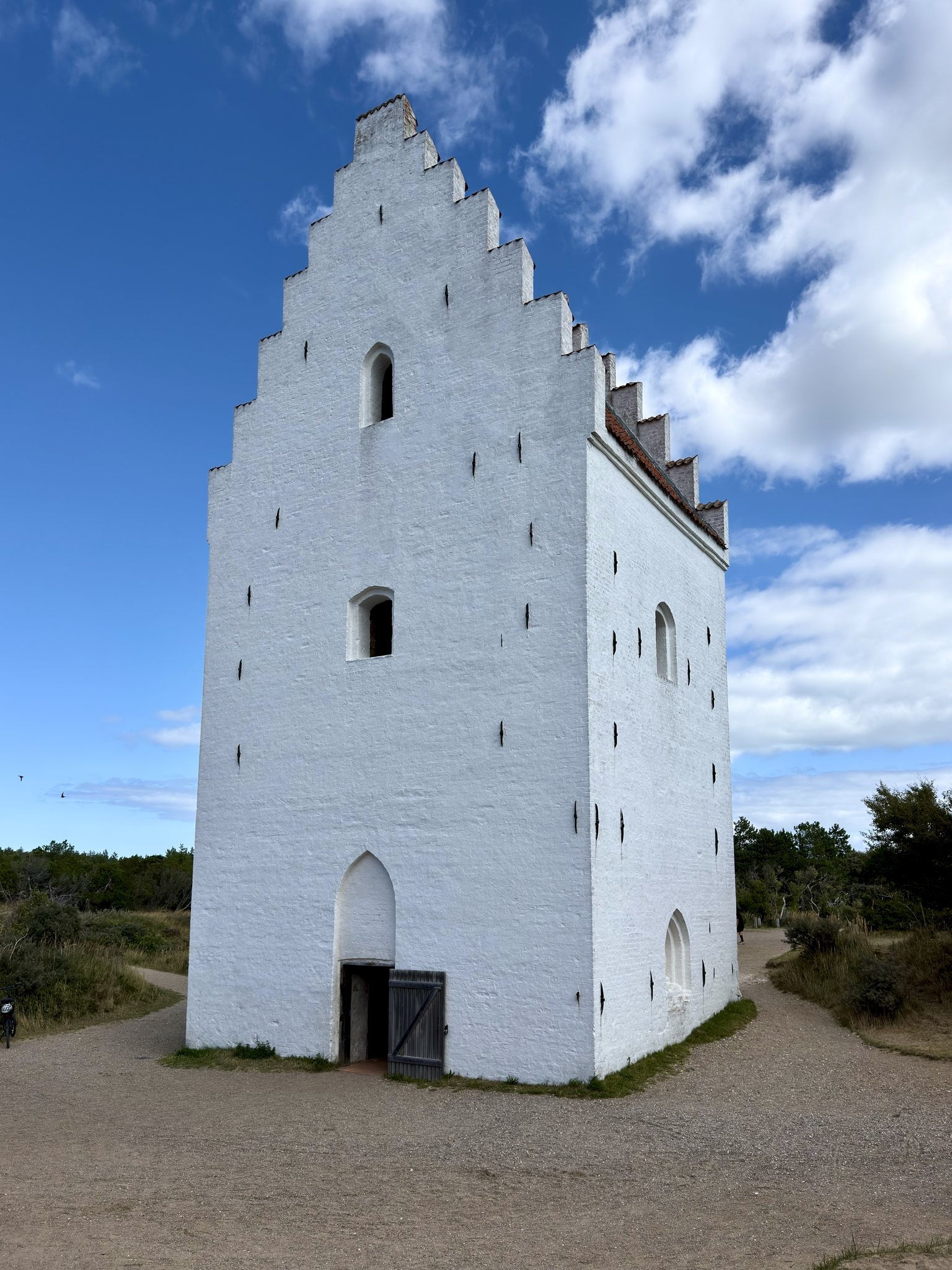
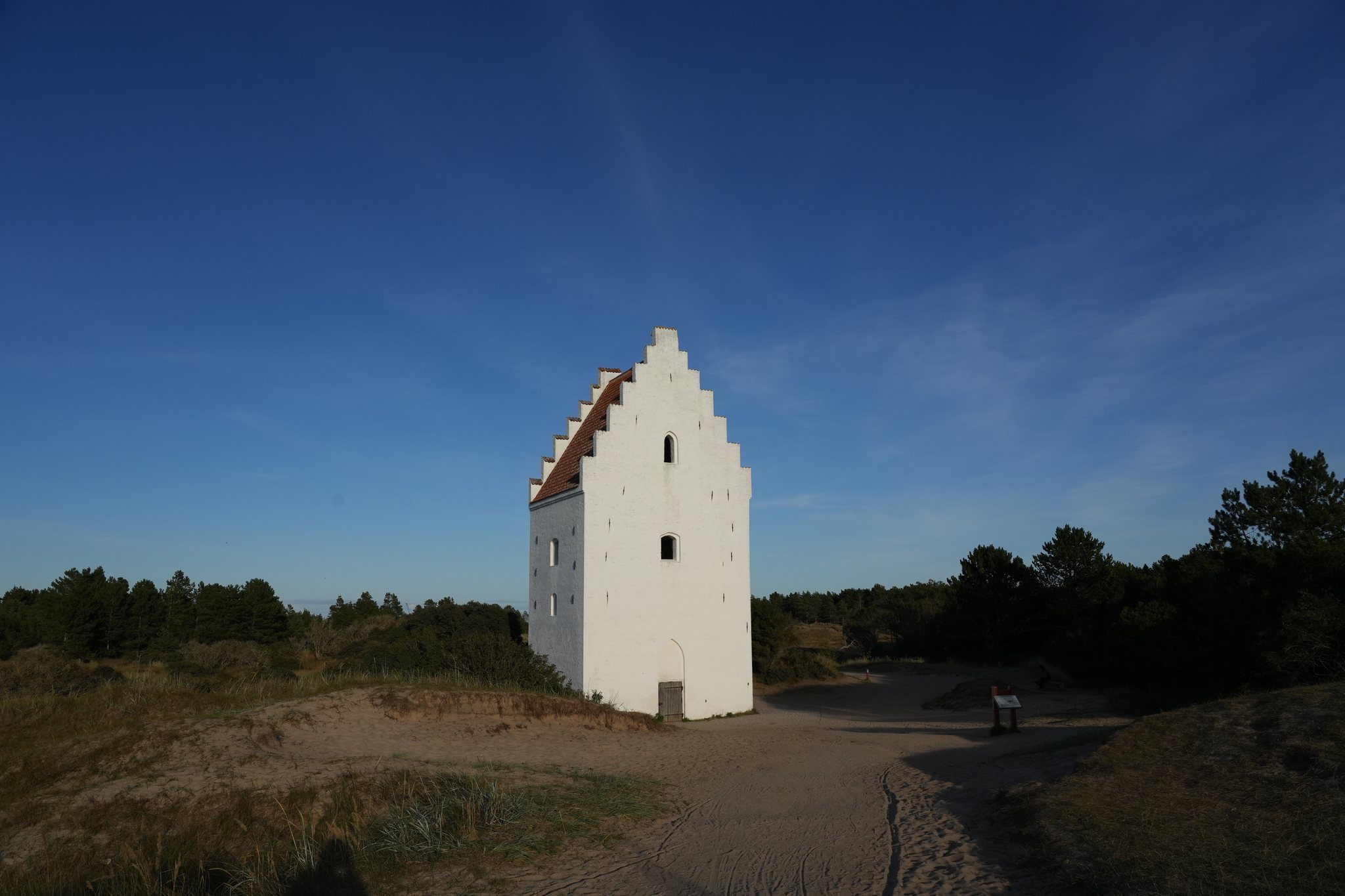
The western tower was added around 1475 and is the only surviving standing part of the original church. It rises slightly more than 22 metres, with approximately 18 metres visible above the sand. Built of yellow brick arranged in geometric patterns, it has a crow-stepped gable, a stepped masonry form characteristic of parts of northern European medieval architecture. The tower was whitewashed after 1816 and is maintained as a navigational landmark.
The whitewashed tower is the only visible surviving structure of both the former church and the village that the drifting sand buried.