Børglum Abbey: A Medieval Premonstratensian Abbey and Episcopal Seat in Denmark


Site at a Glance
- Rating
- 4.5
- Popularity
- Medium
- Country
- Denmark
- Primary era
- Medieval
- External website
- Open
- Eras represented
- Medieval, Early Modern
- Civilizations
- Danish
- Site type
- Domestic
- Remains
- Manor House
On this page16 sections
History
Børglum Abbey is a medieval Premonstratensian abbey in Denmark, founded as a religious institution in the twelfth century and centered on a Romanesque basilica later rebuilt in Gothic form. It stands in northern Jutland, about five kilometres east of Løkken, and became both a major religious centre and the episcopal seat of the bishopric of Vendsyssel.
Royal estate and bishopric
The site began as a royal farm around the year 1000 or earlier. In 1086, King Canute IV, also known as Canute the Holy, fled from Børglum during a peasant revolt. The royal residence was burned during the conflict and later rebuilt.
During the 1130s, the royal estate was transferred to the Church and became the seat of the northern Jutland bishopric, also called the bishopric of Vendsyssel. The bishopric had previously been based at Vestervig. Bishop Self, also known as Sylvester, became the first bishop of Børglum in 1139, and the diocese remained based there until the Reformation.
The Premonstratensian foundation
The identity of Børglum’s first monastic community is uncertain. Augustinians who had formerly settled at Vestervig may have moved to Børglum by 1134, while by the later twelfth century Premonstratensians from Steinfeld Abbey near Cologne had established themselves there. The Premonstratensians, also called the White Canons, were a Catholic order of regular canons founded in the twelfth century. They combined communal religious life with pastoral and administrative duties.
Børglum became the Premonstratensians’ mother house in Scandinavia and developed into a prominent religious centre, possibly with royal patronage. The abbey established a seminary for sons of noble families. During Bishop Troel’s tenure, the canons expanded both the monastery and its church.
Cathedral and medieval power
Before 1220, the bishop of Vendsyssel made the abbey his episcopal seat, meaning his official base. The abbey church became the diocese’s cathedral, and the canons formed its cathedral chapter, the body of clergy attached to the principal church of a bishopric. The bishop was the largest landowner in North Jutland and, by virtue of his office, a member of the Danish State Council. These arrangements increased Børglum’s political as well as religious influence.
The Premonstratensian community reached a period of considerable prosperity. At times, more than 47 manors or dependent farms belonged to its sphere of influence. Correspondence with several popes concerned the canons’ required white woollen habit. In 1403, Pope Boniface IX permitted them to wear black, brown, or other dark colours because floods and mud were frequent in the abbey’s coastal setting. In 1422, the canons were also allowed warmer undergarments and a cowl.
Religious activity extended beyond the monastery itself. An annual market was held on or near 17 June, the feast day of Saint Bodil. A sacred spring associated with Bodil had been a religious site since the Viking period and was believed to have healing powers.
Fire, rebuilding, and the Reformation
A fire destroyed much of the old abbey church in 1500. Reconstruction in the later Gothic style proceeded slowly. The choir and nave had been rebuilt by 1520, while work on the transepts had begun when the Reformation interrupted the project.
Stygge Krumpen, the last Catholic bishop of Vendsyssel and abbot of Børglum, was arrested and imprisoned during the Lutheran Reformation. The Reformation was the sixteenth-century religious transformation through which Denmark replaced Catholicism with a Lutheran state religion. Krumpen was later released after accepting Lutheranism and agreeing to marry. He received the former Asmild Abbey estate near Viborg on the condition that he provide for the nuns displaced when that abbey was dissolved.
Børglum Abbey was dissolved when Denmark officially became Lutheran on 30 October 1536. Its lands and assets passed to the Crown, making the complex royal property again. The church remained the cathedral of northern Jutland until 1554, when the Lutheran bishop moved the episcopal seat to Budolfi Church in Aalborg.
Manor estate and later history
After 1554, the extensive abbey estate was divided and sold or granted to noble families. The principal building became a manor house, while other structures were demolished or adapted for agricultural use. Peder Reedtz became the first private owner in 1669, after which Børglum operated as a landed estate.
Between 1750 and 1754, the estate was modernized in the Baroque style according to plans by the architect Lauritz de Thurah. Børglum has remained privately owned, and the associated estate covers 445 hectares.
The estate also preserves stories from later centuries. In 1764, Colonel Poulsen, then living at Børglum, was severely injured by a mailed box containing gunpowder and a firelock. A later letter in German threatened that the “dose” would be increased, but the perpetrator was never identified.
Neglect caused the buildings to deteriorate, and the church fell into severe disrepair. Godslev Budde received permission from King Frederik II to demolish the incomplete transepts and enclose the church in the form of the original basilica. The former abbey buildings received national historic protection in 1958. They now accommodate a museum, while the church continues to serve as Børglum’s parish church.
Legends and literary memory
Folklore associated with Børglum tells of the bishop’s men plundering ships wrecked off the coast and killing their crews. In the story, a monk carrying a torch misled ships at sea. Another legend concerns the killing of Bishop Oluf Glob and several companions by his nephew Jens Glob in 1206. The event is placed at the altar of Hvidebjerg Church on the island of Thy, rather than at Børglum itself. Hans Christian Andersen later adapted these traditions into literary versions.
Remains
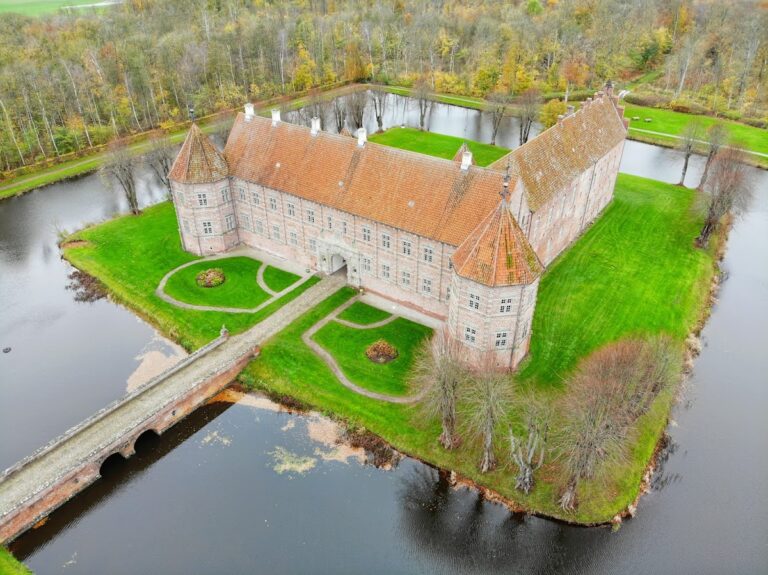
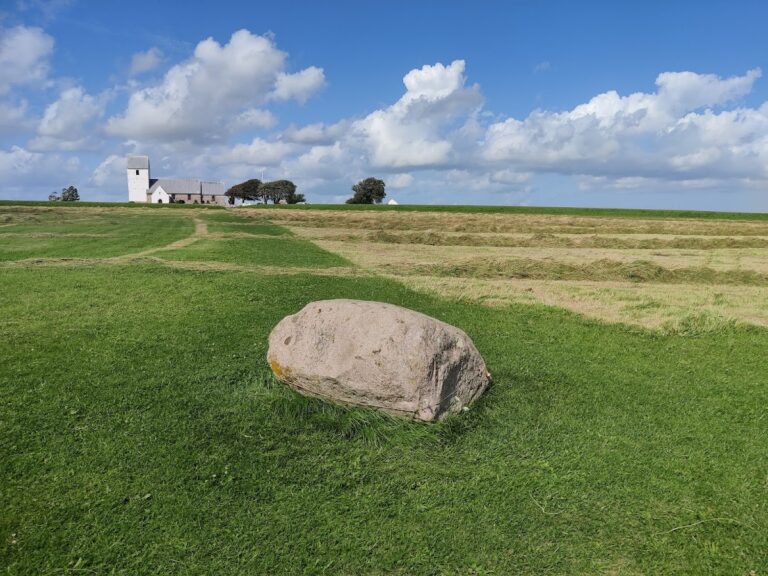
Børglum’s surviving complex stands on a hill near a small lake, in an elevated and exposed position with views toward the North Sea, approximately five kilometres away. Four principal buildings, the gatehouse, stables, main house, and church, enclose a central courtyard. A narrow path beside the church leads to a herb garden, while a Dutch-style gallery windmill stands on a hill opposite the complex.
The church
Romanesque basilica
The church forms the eastern range of the former monastery. Its first building was a Romanesque basilica, a type of church associated with massive masonry, rounded forms, and relatively small window openings. The construction and decoration were probably modelled on Viborg Cathedral. Locally obtained granite was used for its massive walls. The church originally had a flat timber ceiling and no windows, creating a dark interior while helping shield it from cold coastal winds and storms.
Gothic rebuilding
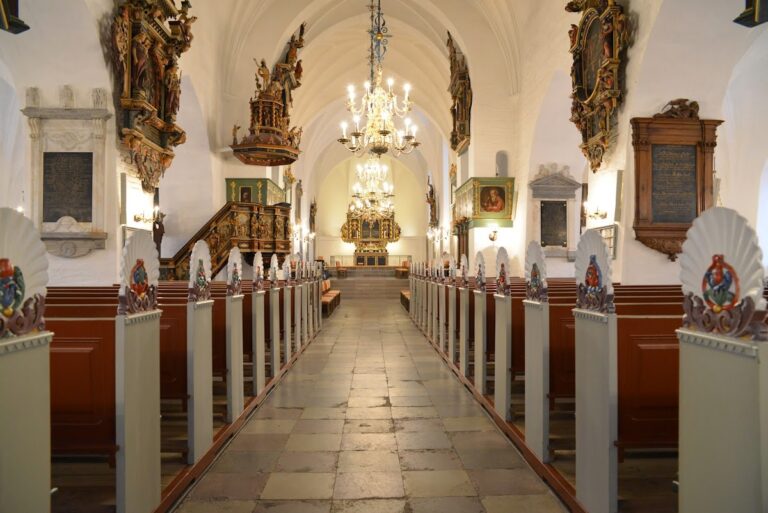
A new Gothic basilica was begun on the foundations of its Romanesque predecessor around 1215. Gothic architecture is associated with high arches and more vertically articulated interiors. Dedicated to the Virgin Mary, the building later served as the cathedral because it was the bishop’s seat, although the project was never fully completed.
Fire damage and altered form
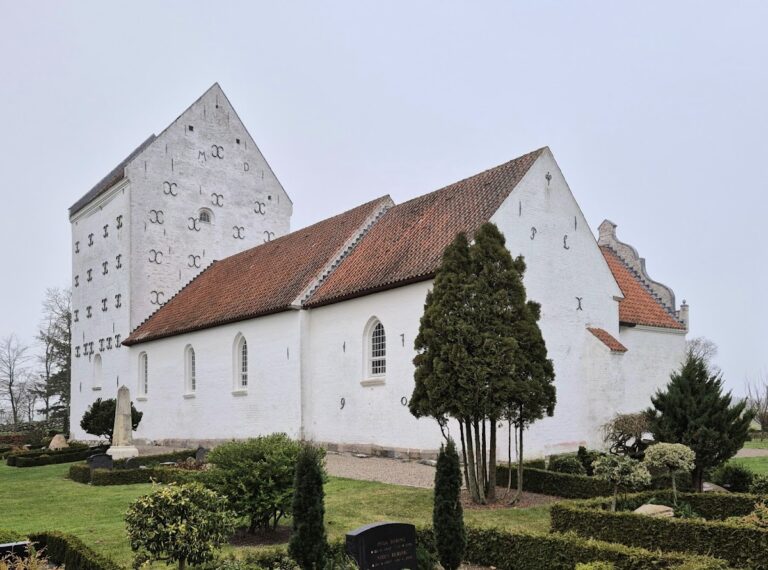
The fire of 1500 and the rebuilding that followed changed the church’s appearance. By 1520, the choir and nave had been reconstructed with high arched ceilings, while the transepts remained unfinished. The incomplete transepts were later demolished, and the church was enclosed in the original basilica form. The building remains in use as the parish church of Børglum.
Manor buildings and collections
Gatehouse and main house
The former abbey buildings survive principally as a manor-house complex arranged around the central courtyard. The museum occupies the complex and contains historical clothing, medieval equipment, documents, a wine cellar, and interiors dating from around 1900. These interiors include a kitchen, living room, bathroom, and bedroom.
Stables and courtyard features
The stables contain a permanent exhibition of old carriages. The church and herb garden remain part of the complex, which also displays a modern copy of the Bayeux Tapestry.
Estate windmill
The gallery windmill on the opposite hill formerly processed grain from the estate. It was taken out of service in 1935. Its restored sails have stood fixed in a cross position since 26 September 1942, after the Rottbøll family learned that Christian Michael Rottbøll, a leader of the British Special Forces in the resistance, had been shot by Danish police during the German occupation.