Abbaye de Fontaine-Daniel: A Cistercian Abbey and Industrial Complex in France
Site at a Glance
- Rating
- 3.9
- Popularity
- Very Low
- Country
- France
- Primary era
- Early Modern
- External website
- Open
- Eras represented
- Medieval, Early Modern
- Civilizations
- French
- Site type
- Religious
- Remains
- Monastery
On this page15 sections
History
Abbaye de Fontaine-Daniel is a former Cistercian abbey in France, located at Fontaine-Daniel within Saint-Georges-Buttavent in the Mayenne department. Founded in the early thirteenth century under the authority of Clairmont Abbey and within the filiation of Clairvaux, it became a powerful religious and feudal institution before its conversion into a textile complex in the nineteenth century.
Foundation at Fontaine-Daniel
The foundation began at La Herperie, near Bourgnouvel and the chapel of Sainte-Anne de Bourgnouvel, under the title of Notre-Dame du Clairet. The monks were later transferred to Fontaine-Daniel in 1204 because pilgrimage crowds near Sainte-Anne disturbed the community. Juhel III of Mayenne, lord and baron of Mayenne, chose the wooded and fertile banks of the Anvore in the forest of Salair for the new monastery. A chapel and temporary buildings were prepared, and the Cistercians formally took possession on 19 May 1205.
Juhel intended the abbey to strengthen his authority against his vassals and the lords of Laval, while also providing a burial place for his family. He endowed it with lands, woods, mills, fishing rights, customary dues, seigneurial rights, and rights of clearance, especially in Salair and Poillé. Its possessions extended across several parts of Maine, Normandy, and Anjou, including Saint-Georges-Buttavent, Contest, Saint-Baudelle, Moulay, Belgeard, Châtillon, Mayenne, Saint-Aubin-Fosse-Louvain, Désertines, and Réville in Normandy. The abbey also received the patronage of Saint-Aubin of Fontenay-le-Pesnel and rights over the markets and halls of Mayenne.
The Cistercians were a reform movement within Western monasticism that emphasized communal prayer, manual labour, austerity, and economic self-sufficiency. Fontaine-Daniel belonged to the network of Clairvaux, one of the order’s principal houses, but it had no daughter houses. Hamelin, bishop of Le Mans, Barthélemy de Vendôme, archbishop of Tours, Philip II Augustus, Pope Innocent III, and members of Juhel’s family confirmed the original endowment. Pope Gregory IX ratified the foundation in 1226. The Cistercians of Savigny nevertheless obtained restrictions preventing Fontaine-Daniel from building granges or sheepfolds or acquiring new property beyond a conventional line between Saint-Georges and Ambrières.
Isabelle of Meulan assigned an annual rent of 20 mancelle pounds towards the construction of the dormitory. Juhel promised 1,000 pounds for the church and other buildings and undertook to complete the work if Isabelle died. His successor and son-in-law, Dreux V of Mello, confirmed the monks’ rights and, before leaving on crusade in 1231, transferred his property at La Haie-sur-Colmont to fulfil Juhel’s promise. In 1243 he granted the abbey high justice, the authority to hear serious civil and criminal cases, over its vassals within the barony of Mayenne.
Medieval religious and feudal power
Fontaine-Daniel subsequently became a barony directly dependent on Maine and one of the region’s major feudal territories. Its court first used the Mayenne seneschal’s audience, then operated independently, and from 1678 used the new ducal courthouse at Mayenne. The abbey church was solemnly consecrated in 1243 by Geoffroy de Loudon, bishop of Le Mans. Dreux V of Mello and Isabelle of Mayenne confirmed earlier donations on that occasion, while Isabelle later reaffirmed the gifts of her father, her first husband, and herself. She also established a perpetual mass for the salvation of her soul.
The community combined prayer, manual work, and almsgiving. Donations, memorial foundations, and anniversary endowments continued during the century after the monastery was completed. Fontaine-Daniel also acquired a substantial network of dependencies and estates. Juhel III gave the manor of Réville in Normandy to the abbey in 1207, and it became a priory initially occupied by two or three monks. Other possessions included farms, fiefs, mills, fisheries, woods, halls, and rights along the Mayenne River.
During the Hundred Years’ War, the abbey received letters of protection from John II the Good, later confirmed by Charles V the Wise. Under English occupation, the monks paid for protection and made agreements with John of Lancaster, Thomas Montagu, and John Fastolf. Jeanne de Laval rebuilt the church choir in 1431, and Adam Châtelain, bishop of Le Mans, blessed it in the same year. The war nevertheless damaged the abbey and the surrounding region.
Conflicts over the abbacy
From the mid-fifteenth century, Fontaine-Daniel was drawn into disputes between regular abbots elected by the monks and commendatory abbots appointed through royal or papal influence. A commendatory abbot held the title and revenues of an abbey without necessarily living there or belonging to its religious community. Jean Goulu was replaced around 1460 by François Cherot, but in 1463 Jean II de Beauvau, bishop of Angers, became commendatory abbot through the favour of Louis XI.
Beauvau’s attempt to take possession provoked armed resistance, imprisonment, legal disputes, and the removal of valuable objects from the church. In 1477 Jean Courtin, the regular abbot confirmed by the Cistercian chapter and the pope, entered Fontaine-Daniel by force with armed supporters. Later that year Beauvau’s forces attacked the monastery with firearms, breached the church wall, pillaged the abbey, and mortally wounded several monks. Courtin eventually secured papal confirmation and remained abbot until his death in 1499. These struggles reduced the community from about twenty-four monks to twelve or thirteen.
The disputes continued during the sixteenth century, especially over the abbacy and control of revenues. Pierre Cordier, Ambroise de Mondot, and Michel Le Fevre were rival claimants in the 1520s. A reform of the Cistercian order entrusted to the abbot of Clermont in 1549 achieved little, and the abbey increasingly remained under commendatory abbots. Jean du Bellay, bishop of Le Mans and cardinal, received the abbey in commendam. The monks elected Étienne as regular abbot in 1558, but the election became a final unsuccessful protest against the system.
Giovanni Antonio Serbelloni later attempted to reduce the abbey’s resources and the number of novices, prompting intervention by the Cistercians and the Parlement of Paris. Regulations changed repeatedly. An order of Clairvaux in 1572 provided for twenty-five monks, a decision in 1575 reduced the number to eighteen, and a visitation in 1579 allowed twenty, including three novices. A judgment in 1580 definitively maintained a limit of eighteen. By 1697 only seven monks remained.
War, division, and eighteenth-century decline
During the Wars of Religion, a series of conflicts between Catholic League forces, royal troops, and their foreign allies, Fontaine-Daniel was exposed to repeated military pressure. English troops serving with supporters of Henri IV and associated with Robert Devereux, 2nd Earl of Essex, pillaged the abbey in 1592 and expelled the monks. They took refuge for about a month at the Hôtel-Dieu of Mayenne. The buildings, furnishings, farms, and livestock suffered extensive damage, and only limited restoration followed.
In 1608 a royal council order divided the abbey’s temporal possessions into two equal menses, separately administered shares of ecclesiastical income and property. One went to the commendatory abbot and the other to the religious community. The buildings, courts, gardens, and enclosed grounds remained available to both. The division also assigned farms, mills, fisheries, woods, halls, seigneurial rights, and rents, while common charges included alms, church maintenance, hospitality, the infirmary, officials’ wages, and payments to dependent religious institutions.
In 1658 the abbey and its monks agreed to exchange several rights and properties in Mayenne with Cardinal Jules Mazarin, who had acquired the duchy of Mayenne. The arrangement involved justice, market halls, customary dues, fishing and river rights, and mills including the Grands-Moulins, Saint-Baudelle, Chorin, and Brives. It was not fully implemented and was annulled in 1678, when the monks recovered their former rights and possessions.
The monastery declined institutionally during the eighteenth century, although its charitable work remained substantial. In 1728 Jean-Baptiste Massillon recorded that general alms were distributed every Friday from 1 January to 22 July. The abbey normally assisted more than six hundred poor people and, during shortages, more than twelve hundred. It also provided food and drink for sick people and impoverished families.
Revolution and industrial transformation
The community was threatened with suppression in the early 1780s. Seven monks remained in 1789, and disputes with the claustral prior continued alongside resistance to monastic discipline. The French Revolution suppressed monastic vows and regular religious orders. The prior and six monks secularized in May 1790, the monks left around the end of 1790 or the beginning of 1791, and the abbey was dissolved in 1791.
The suppression removed an important source of local charity and contributed to hardship among the surrounding poor. During grain unrest in 1790, people attacked grain transporters and stores, while woodcutters and others occupied the forest of Salair and built makeshift fortified camps. The Nation began selling the abbey’s buildings and estates in 1791. Roughly twenty regional buyers acquired the land, but the central complex found a buyer only in 1796. The archives, containing about 9,500 documents and numerous registers, were burned at Mayenne on 30 December 1793. Copies and analyses made by Jean Gaignières later helped form the basis of the published cartulary.
In 1805 and 1806 former monastic buildings were acquired by textile industrialists including Pierre Horem and Sophie Lewille. The site offered water power, large buildings, and nearby woodland. The enterprise employed about 560 workers in 1810 and 760 in 1812. A steam-powered spinning mill operated in 1832, and Martin Denis established a mechanical weaving factory in 1838, employing 300 workers by 1850. Fontaine-Daniel was entered on the French register of monuments historiques in 1927.
Remains
Monastic layout
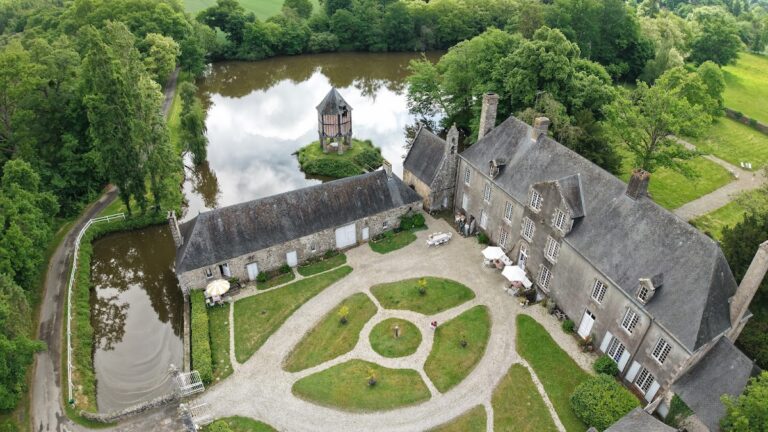
The medieval abbey stood in a wooded and fertile setting in the forest of Salair beside the Anvore. The valley was drained for the monastery, while the abbey controlled the surrounding Salair and Poillé woods. Its main buildings formed a large quadrilateral around a cloister, the covered walkway and enclosed courtyard at the centre of a monastery, measuring approximately 40 to 50 metres on each side.
The church occupied the north side, the monastic range the east, the abbot’s residence the south, and the guesthouse, cellars, and stores the west. A monumental porch preceded the complex, which was surrounded by extensive service areas. Two garden basins, each about 15 metres in diameter, were supplied by springs.
Eastern and western ranges
Eastern monastic range
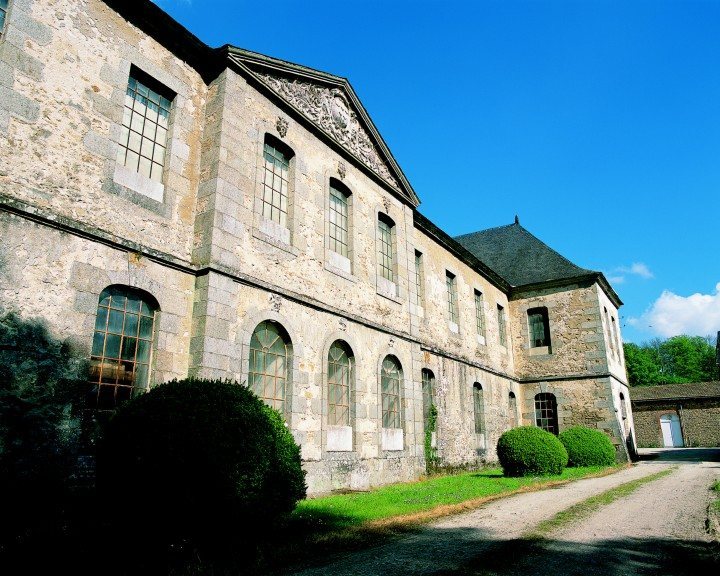
The eastern range contained the sacristy, chapter house, and refectory on the ground floor, with dormitories above. The chapter house was the room where the community met for readings, deliberation, and disciplinary business, while the refectory served as the communal dining hall. Isabelle of Meulan provided financial support for the range. Three surviving broad openings are round-arched, although they belong to an advanced thirteenth-century phase. The outer facade was rebuilt in 1745.
Southern building
The southern building originally housed the monks and later became the abbot’s residence. Under an arrangement made in 1690, it was completely reconstructed for the claustral prior in 1737. This building formed the southern side of the cloister complex.
Salle des Cacaudières
The western range contained large cellars divided into two aisles by five columns. Its unusual vaulted space, known as the Salle des Cacaudières, was built from small angular stones set in cement without plaster. The surviving cellar is one of the principal physical remnants of the former monastic complex.
North building and agricultural gatehouse
A similarly constructed building north of the cloister ranges was probably a residence for the lords of Mayenne. It included a vaulted entrance portal and, in the late seventeenth century, rooms for the commendatory abbot. The agricultural gatehouse has a round-arched entrance and an upper Gothic window that may have belonged to an earlier guest chapel.
Abbey church
The church stood north of the cloister and was oriented east. It had a cruciform plan, a nave with aisles, an eastern choir surrounded by seven chapels, and a tower over the crossing that ended in a tall spire. The building was at least 60 metres long and was regarded in the eighteenth century as one of the largest and finest churches in the province after Le Mans Cathedral.
Jeanne de Laval-Tinténiac rebuilt the choir in 1431, adding seven chapels arranged around its eastern end. She enclosed the choir with a structure resembling a rood screen, a partition separating the choir from the nave. The transepts contained four altars, with two further altars against the pillars at the choir entrance. The facade carried a doorway above which were a Laval coat of arms and an inscription commemorating Jeanne de Laval’s work.
The chapel at the end of the choir contained a large allegorical window. It showed the Virgin above two overflowing basins, with Saint Bernard and one of his disciples below, presented by Saint Peter. The church also held the tomb of Juhel III of Mayenne, a gilded copper monument raised several feet above the floor with an effigy, epitaph, and ten heraldic shields. It stood in the centre of the sanctuary until its removal in 1784, after which a marble commemorative plaque was placed against a crossing pier.
Other funerary remains included the tomb of Jean Courtin, inscribed slabs for Guillaume du Verger and Pierre Bardoul, tombstones of other abbots, and burial chapels founded by families including the d’Avaugour and des Vaux. A monumental high altar was commissioned in 1665 from François Langlois. Designed to reach 46 feet in height, it filled the space between two piers and used three tiers of red-and-black marble columns, numbering eight, six, and two, with marble inlays set into tuffeau, a soft local limestone. Jacques Amiot laid its first stone on 9 July 1665.
The last monks surrendered the church silverware, weighing 92 marks, on 2 May 1790. The sixteen-foot organ, built by Claude Parisot in 1784, was sold in 1792. The choir stalls were transferred to Notre-Dame-des-Miracles in Mayenne, where they remained until 1868.
The church was demolished after the Revolution to recover its building stone and had disappeared by 1806, although the precise demolition date is uncertain. Only the southern nave walls survive. These walls formerly closed the cloister on its southern side and were left at the height of a boundary wall.
Dependencies and landed estate
The surviving complex also includes the chapter-house facade, the two-aisled vaulted Salle des Cacaudières cellar, the kitchen, the agricultural gatehouse, and other buildings largely rebuilt or erected during the eighteenth century. The former dependency at Réville included a manor, house, chapel, and adjoining domain of approximately ten to twelve vergées, a traditional French measure of land. In 1517 the manor was described as badly decayed after earlier wars.
Fontaine-Daniel’s material estate included mills, ponds, canals, fisheries, farms, vineyards, meadows, woods, halls, bridges, and river installations. Named mills included Grenoux, Fèvre, Fauconnier, Daviet, Saint-Baudelle, Chorin, Brives, Folas, and the Grands-Moulins of Mayenne. Their associated millraces, dams, ponds, houses, gardens, and passages formed part of the extensive economic landscape that supported the abbey before its religious community was dissolved.