Norbulingka: The Dalai Lamas’ Summer Palace in Lhasa
Site at a Glance
- Rating
- 4.5
- Popularity
- Low
- Country
- China
- Primary era
- Early Modern
- Eras represented
- Early Modern, Modern
- Civilizations
- Tibetan
- Site type
- Domestic
- Remains
- Palace
On this page20 sections
History
Norbulingka is a Tibetan Buddhist palace-and-garden complex in Lhasa, China, founded in 1755 during the period of the Seventh Dalai Lama, Kelzang Gyatso. Developed around a spring believed to have healing properties, it became the Dalai Lamas’ summer residence and a secondary religious, political, and cultural center alongside the Potala Palace.
Foundation and expansion
Kelzang Gyatso was in fragile health and visited the spring during the summer to rest and bathe. In 1755 he built the first palace, later called the Kelsang Phodrang. The Qing dynasty, which ruled China from 1644 to 1911, maintained an official presence in Tibet, and its imperial representative obtained authorization for the palace to serve as a resting place for the Dalai Lama.
The complex grew substantially under the Eighth Dalai Lama, Jampel Gyatso, and was completed in its expanded form by 1783. Three temples, an enclosing wall, an artificial lake, and extensive plantings transformed the original retreat into a cultivated park. Flowers, fruit trees, evergreens, rare plants, and medicinal herbs were brought from different parts of Tibet.
From the time of the Seventh Dalai Lama, the Dalai Lama and his government moved each year between the Potala Palace and Norbulingka for the summer. The change of residence was marked by a major ceremonial procession, and the summer stay traditionally lasted from the third to the ninth month of the Tibetan calendar. Successive Dalai Lamas used the complex for religious study before enthronement, government work, and religious affairs.
The expanded summer residence
The Thirteenth Dalai Lama, Thubten Gyatso, made further additions and improvements. He developed the northwestern Chensel Lingka area and commissioned the Chensel Phodrang in 1928. Other buildings and alterations were also associated with his period, including the development of a western section with woodland and fields.
By the time of the Fourteenth Dalai Lama, the name Norbulingka referred to both the eastern Norbulingka proper and the western Chensel Lingka. The eastern area contained the principal palaces, an opera area, and government offices. The western area included another palace, woodland, and cultivated fields. Two enclosure walls separated the complex according to status and function. The inner wall surrounded the area reserved for the Dalai Lama and his attendants, while senior officials and the Dalai Lama’s family used the space between the inner and outer walls.
The complex also hosted the annual Shoton, or Yogurt Festival, during the first seven days of the full-moon period in the seventh month of the Tibetan lunar calendar, generally in July or August. Historically, the event combined communal meals, Tibetan opera, traditional dances, military processions, and performances by state-supported theatrical troupes. During the Dalai Lama period, performances could continue from dawn to dusk and sometimes satirized religious ceremonies and sacred rites. The Dalai Lama watched from a pavilion, with officials and spectators occupying designated parts of the grounds.
Late construction and political crisis
The Fourteenth Dalai Lama’s New Summer Palace was begun in 1954 and completed in 1956 with assistance from the central government. It was the last major building project at Norbulingka and served both religious and residential purposes.
In 1948, Heinrich Harrer, an Austrian mountaineer and writer, directed work to reinforce a flood-protection embankment beside the Kyichu River. Five hundred soldiers, 1,000 earthworkers, and 40 yak-skin boats were involved in moving granite from an upstream quarry.
On 10 March 1959, Tibetans gathered at a gate of Norbulingka after rumors spread that the Fourteenth Dalai Lama might be abducted. The palace guard later joined the protesters, who blocked access to the Dalai Lama’s residence. Approximately 30,000 Tibetans surrounded the complex. On 17 March, the Fourteenth Dalai Lama left Norbulingka and went into exile in India.
Artillery struck the palace during the fighting that followed, although the extent of the destruction and the number of casualties remain disputed. Later visitors found parts of the complex and their contents intact, while another account from 2004 observed that visible signs of the fighting had been removed. Norbulingka became a public park in 1959 and was reportedly renamed People’s Park when the Cultural Revolution began in 1966. During that period, the complex suffered extensive damage, including deterioration of murals in the Lake Pavilion.
Preservation and continuing religious traditions
Restoration was decided upon in 2001 and began in 2003. Work concentrated on the Kelsang Phodrang, the Kashak cabinet offices, gardens, lakes, and other buildings. A sewer network was begun in 2007. Norbulingka became a National Important Cultural Relic Unit in 1988. The Potala Palace Historical Ensemble, including Norbulingka, was inscribed on the UNESCO World Heritage List in 1994, and Norbulingka joined the ensemble as an extension in 2001. UNESCO, the United Nations Educational, Scientific and Cultural Organization, recognizes cultural and natural properties through this program. The designation emphasizes the preservation of traditional Tibetan architecture.
Remains
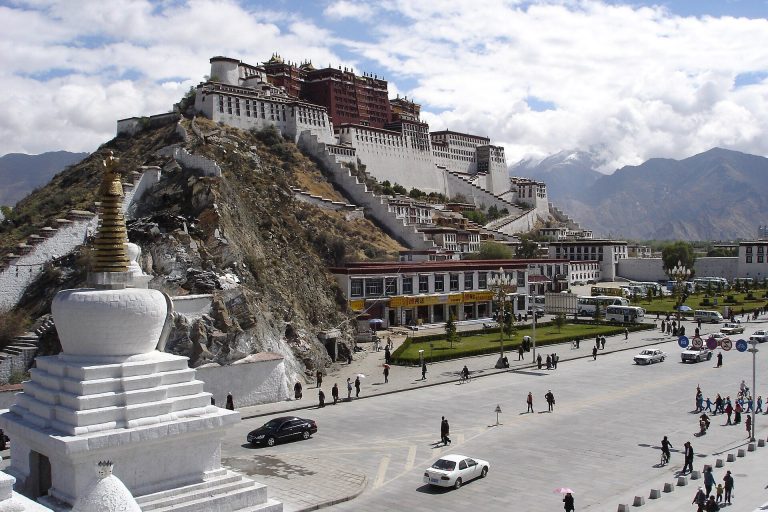
Norbulingka occupies approximately 36 to 40 hectares at about 3,650 metres above sea level beside the Kyichu River, roughly three kilometres southwest of the Potala Palace. Its two principal landscaped divisions are Norbulingka proper in the east and Chensel Lingka in the west. Five principal sections contain gardens, lawns, wooded areas, ponds, lakes, palaces, pavilions, offices, and ancillary buildings, with approximately 370 to 374 rooms.
Eastern palaces and lake landscape
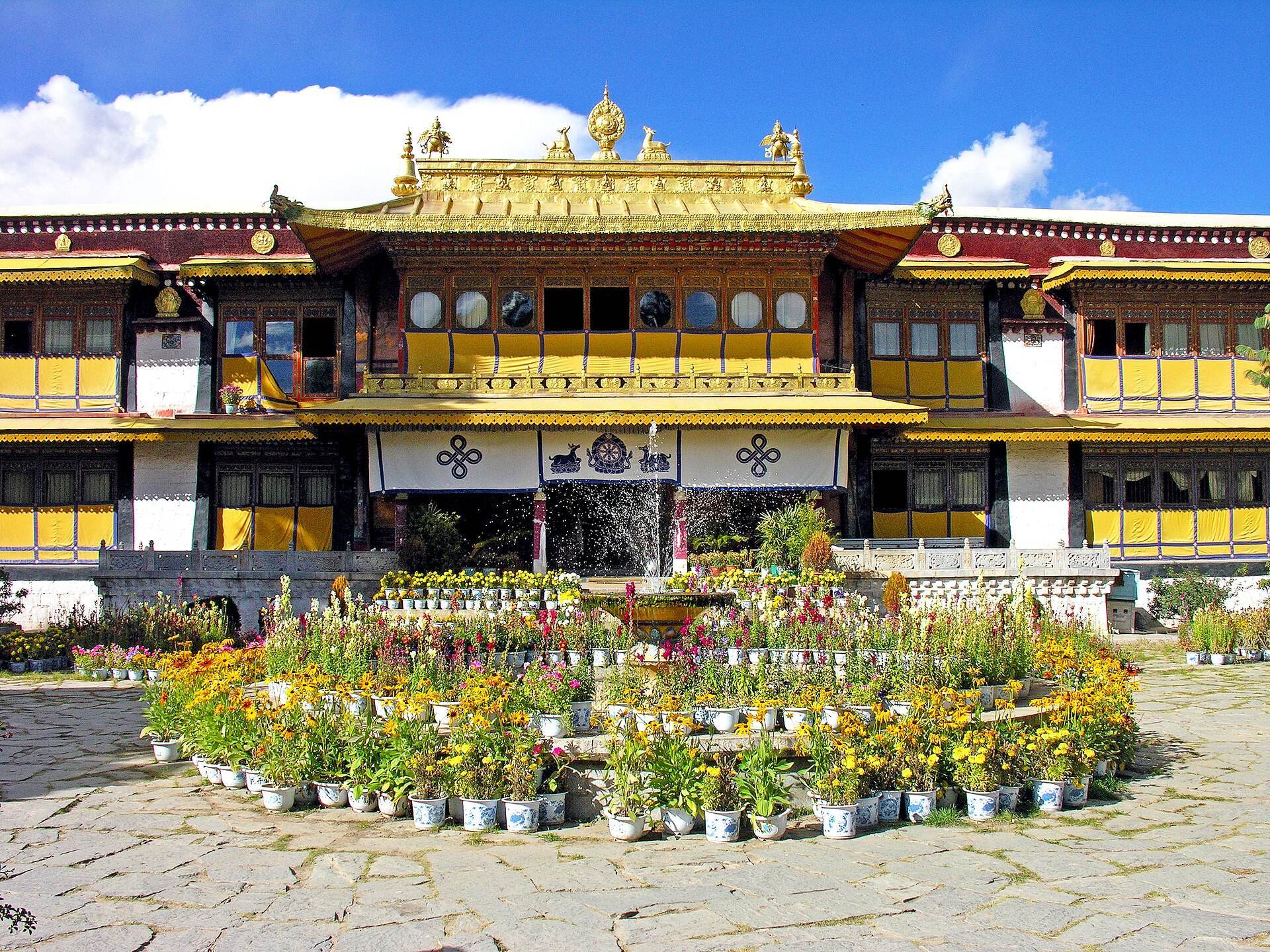
Kelsang Phodrang
The Kelsang Phodrang, also called the Kelsang Potrang or Old Summer Palace, is the earliest major building group. Built in 1755 for the Seventh Dalai Lama, it is a three-level structure containing spaces for Buddhist worship, bedrooms, reading, and retreat. The Eighth Dalai Lama enlarged it with three temples and walls along the southeastern side. It remained the successive Dalai Lamas’ summer residence until the time of the Thirteenth Dalai Lama.
The principal assembly hall contains a restored throne and 65 thangka paintings. A thangka is a Tibetan Buddhist religious image painted or embroidered on cloth or silk for devotional or teaching use. From the upper level, the Dalai Lamas watched Tibetan opera performances held across from the Khamsum Zilnon.
Khamsum Zilnon
The Khamsum Zilnon is a two-level pavilion facing the entrance to the Kelsang Phodrang. Its gilded roof follows Han Chinese architectural forms. The Dalai Lamas used the pavilion to watch opera, and performances continue in the space opposite it during the Yogurt Festival.
Lake Palace group
The Tsokyil Phodrang, or Lake Palace, stands on an island in a lake. Bridges link the central island with the northern and eastern shores. A second island contains the Lukhang Nub, or Western Water Dragon Palace. South of the lake are a stable and four houses or pavilions that held gifts presented to the Dalai Lamas by Chinese emperors and foreign dignitaries.
Takten Migyur Phodrang
The Takten Migyur Phodrang, known as the New Summer Palace, stands north of the Tsokyil Phodrang and faces south. Begun in 1954 and completed in 1956, it is a two-story Tibetan-style building with a flat roof and a complex plan. Its rooms included assembly, meeting, reception, bathing, preaching, sutra study, meditation, and private residential spaces, as well as gardens, fountains, and pools.
The main assembly hall contains 301 paintings and frescoes presenting episodes from Tibetan history, including the 1954 meeting between Mao Zedong, the Dalai Lama, and the Panchen Lama. The Panchen Lama is a major Gelug religious leader traditionally regarded as second in religious rank to the Dalai Lama. The paintings are attributed to Jampa Tseten, also known as Amdo Jampa, whose realistic portraits were considered striking in his period.
The Fourteenth Dalai Lama’s private quarters included an outer study used under the direction of his two tutors and an inner bedroom. The rooms retain descriptions of a bed, a Philips gramophone with 78-rpm records, a Russian radio, an art-deco bed, and British plumbing.
Western palaces and enclosed areas
Chensel Phodrang
The Chensel Phodrang was built in 1928 for the exclusive use of the Thirteenth Dalai Lama after he demolished an earlier building on the site. The white-stone structure has a ground floor and two upper levels. Its entrance cloister is supported by six columns.
The ground floor contains an assembly hall used for Geshe examinations, ceremonies involving monks from Sera and Drepung, and a throne room. A Geshe is an advanced Tibetan Buddhist scholastic degree awarded after extensive study and examination. Murals in this level depict the Buddha’s one hundred actions in previous lives.
The upper floors contained sleeping and study rooms, servants’ rooms, another bedroom, a hall for tantric initiations and ordinations of senior lamas, and a meditation and prayer room. Their murals portray the Dalai Lamas from the first through the thirteenth and major Gelug monasteries. The Gelug school is a Tibetan Buddhist tradition known for monastic discipline and scholarly study. The ground floor was later converted into a museum, while the upper floors were closed to the public and emptied of many contents. The floors and murals remained.
Golden Phodrang and Chensel Lingka
The Golden Phodrang in the western part of Norbulingka was built by a benefactor in 1922. The western section also includes buildings associated with the Thirteenth Dalai Lama and the improved Chensel Lingka garden.
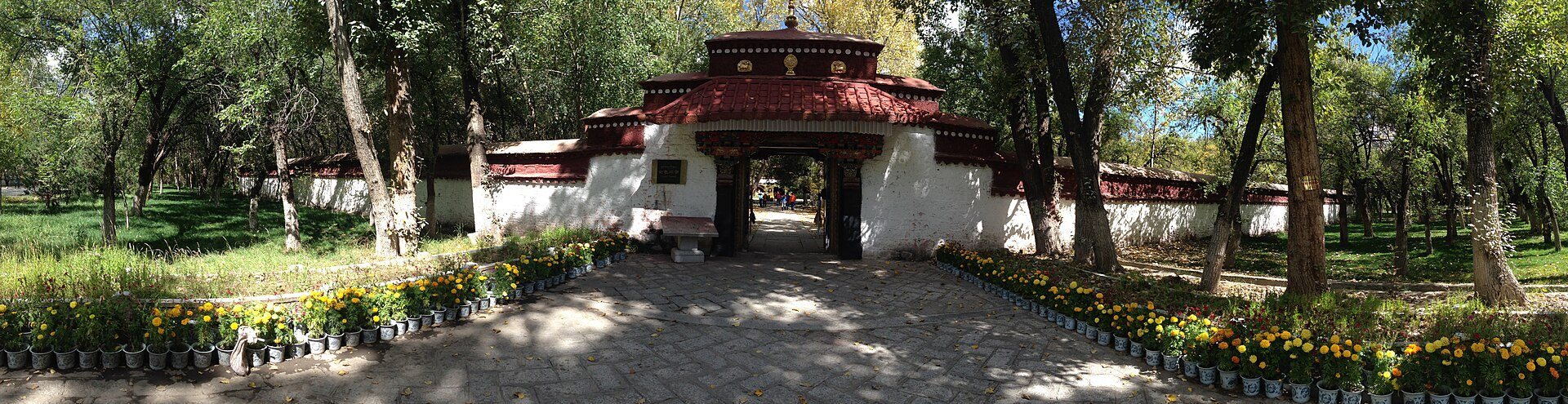
Walls and entrances
Two walls enclosed the complex. The inner wall was painted yellow and separated the Dalai Lama’s private grounds from the outer areas. Officials and the Dalai Lama’s family occupied the zone between the inner and outer walls. Soldiers guarded the gates and the yellow-walled enclosure, where Tibetan mastiffs were kept in niches in the compound walls. The dogs were attached to long yak-hair leashes that allowed them to patrol parts of the perimeter.
Two Snow Lion statues flank the eastern entrance. They are covered with white khatas, ceremonial scarves offered as signs of respect, and the statue on the left is accompanied by a cub.
Gardens, animals, and cultural facilities
Planting and water features
The gardens contain lawns, wooded areas, ponds, and lakes, with plantings that include roses, petunias, hollyhocks, marigolds, chrysanthemums, medicinal herbs, rare potted plants, apple, peach, and apricot trees, poplars, bamboo, and evergreens. The fruit trees produced little or no fruit because of Lhasa’s high altitude. The lakes historically supported peacocks and waterfowl, including ruddy shelducks. Picnics, theatrical performances, dancing, music, and festivals took place within the landscaped grounds.
Zoo
A small zoo housed animals presented to the Dalai Lamas, especially injured animals. Its inhabitants included bears, and in 2009 it held a young snow leopard.
Cinema
A small cinema was created during the winter of 1949 to 1950 for the Fourteenth Dalai Lama. Heinrich Harrer converted an existing building into a 20-metre projection room with a raised equipment platform. A separate building housed the dynamo and petrol engine.
Artistic and material remains
Norbulingka contains Tibetan carpets, Italian chandeliers, murals and frescoes, decorative paintings influenced by Ajanta art, Buddhist and Dalai Lama images, thangka paintings, and other cultural objects. Approximately 30,000 items connected with Tibetan artistic and cultural history are preserved within the complex. Restoration begun in 2003 repaired or renewed parts of the Kelsang Phodrang, cabinet offices, other buildings, greenery, flower beds, and smaller lakes after the extensive damage suffered during the Cultural Revolution.