Samye: Tibet’s First Buddhist Monastery
Site at a Glance
- Rating
- 4.7
- Popularity
- Low
- Country
- China
- Primary era
- Medieval
- Eras represented
- Medieval
- Civilizations
- Tibetan
- Site type
- Religious
- Remains
- Monastery
On this page14 sections
History
Samye, also known as Samye Migyur Lhundrub Tsula Khang, is a Buddhist monastery in Zhanang County, Shannan, Tibet, China. Built under the patronage of the Tibetan king Trisong Detsen in the mid-eighth century, it is regarded as Tibet’s first Buddhist monastery and the first institution of the Nyingma school, the oldest major school of Tibetan Buddhism.
Royal Foundation
The Indian Buddhist scholar Shantarakshita began construction after accepting Trisong Detsen’s invitation to Tibet, probably around 763. Another tradition places the foundation in 762. The main shrine was completed and consecrated in either 767 or 779, while the original building is also dated to 780. The first Tibetan monks were ordained at Samye in 779, and the monastery became a major royal religious foundation, a residence for the monastic community, and a centre for Buddhist teaching and translation.
Foundation traditions say that repeated collapses during construction were blamed by workers on an obstructive spirit associated with a nearby river. At the king’s request, Padmasambhava, an Indian tantric Buddhist master also known as Guru Rinpoche, came to Tibet and subdued the local spirits. He performed Vajrakilaya rites, using a ritual dagger symbolically associated with binding obstructive forces, after which construction was able to proceed. Padmasambhava is also traditionally said to have subdued the protector Pehar Gyalpo and bound him by oath to defend Buddhist institutions. In later Tibetan tradition, Pehar, also called Dorje Drakden, became associated with the protective hierarchy of Tibetan Buddhism and with the Nechung Oracle.
Teaching and Religious Development
Samye’s foundation coincided with strong royal support for Buddhism and the religion’s advance over Bon. Because Nyingma was the only Tibetan Buddhist school established at the time, the monastery became a Nyingma institution. The king, his queens, students, and subjects were connected with its monastic community. Indian translators and scholars worked there, making the monastery an important place for translating Buddhist texts and teaching their contents.
After Shantarakshita’s death, Samye hosted a major Buddhist debate in the early 790s. Kamalashila, an Indian philosopher associated with the Madhyamaka tradition, represented Indian Buddhist thought, while Moheyan represented a Chinese Chan approach that emphasized sudden awakening. Trisong Detsen presided and ruled in Kamalashila’s favour. The outcome was later regarded as decisive for the position of Chan in Tibet.
Damage, Restoration, and Modern History
The monastery suffered repeated destruction and decline. Civil conflict damaged it in the eleventh century, while fires struck in the mid-seventeenth century and again in 1826. An earthquake caused further damage in 1816. A separate historical tradition describes prolonged disorder and political fragmentation between the fifteenth and sixteenth centuries as a period of decline.
Later restorers included important religious figures associated with the Sakya tradition. Samye received priority cultural-relic protection from the Tibet Autonomous Region in 1962, but it was severely damaged during the Cultural Revolution. Extensive rebuilding began after 1986, particularly through the efforts of Choekyi Gyaltsen, the Tenth Panchen Lama, and continued after 1988. The reconstructed complex preserves the principal design associated with the eighth-century foundation and again functions as an active monastery and pilgrimage centre.
In May 2007, Chinese authorities reportedly demolished a gold- and copper-plated statue of Padmasambhava at Samye Gompa that was about nine metres high. In March 2008, a protest at the Samye government administrative headquarters was followed by prison sentences for nine monks studying at the monastery. A visiting scholar who claimed responsibility for organizing the protest later died by suicide.
Remains
Mandala Layout
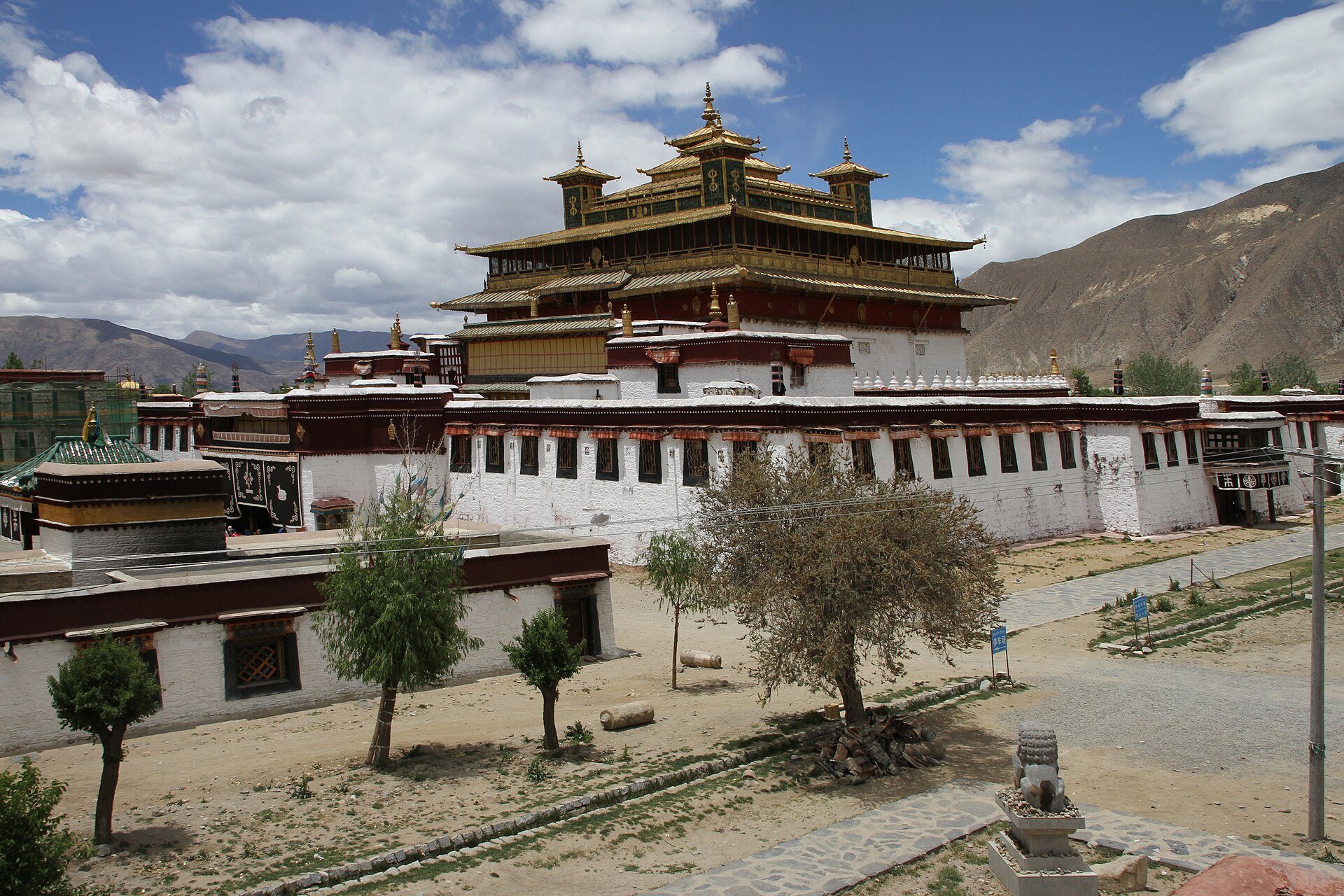
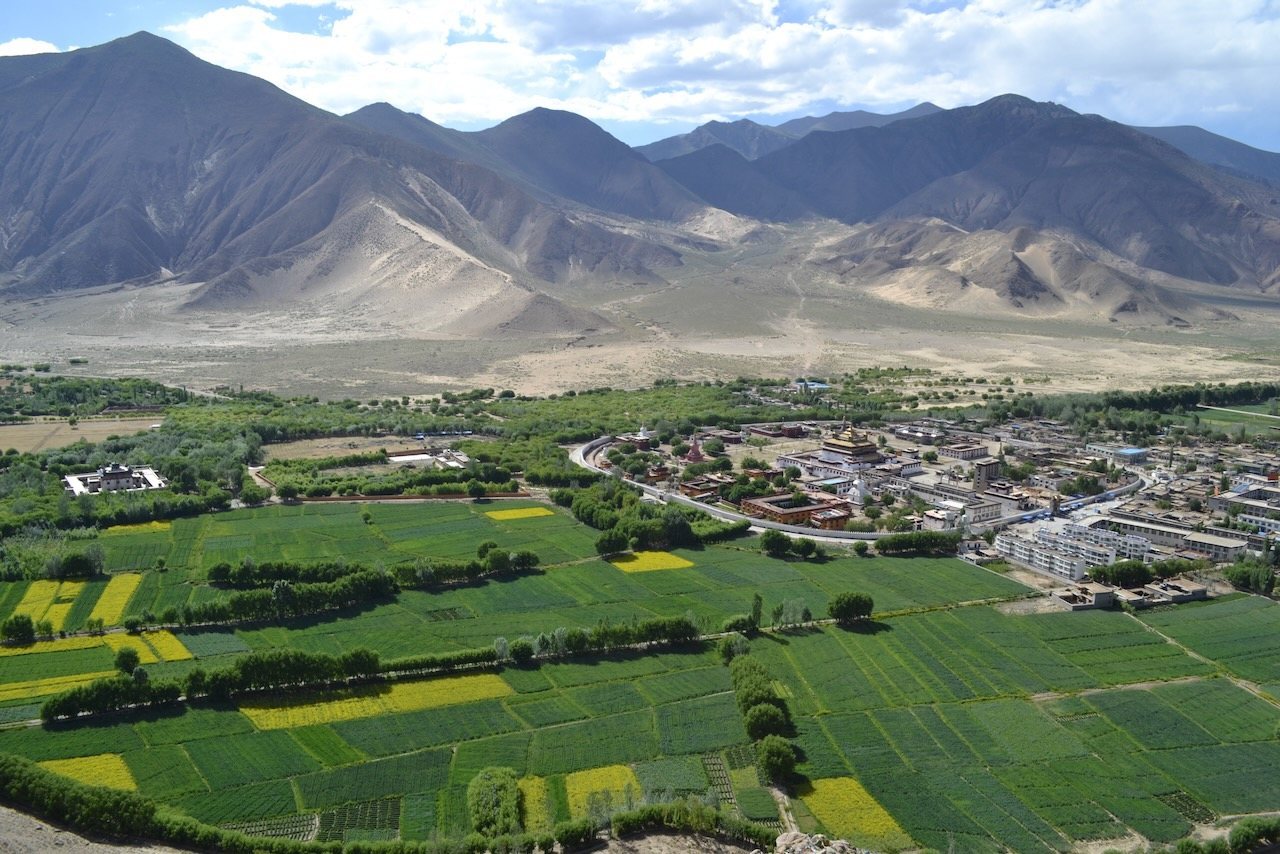
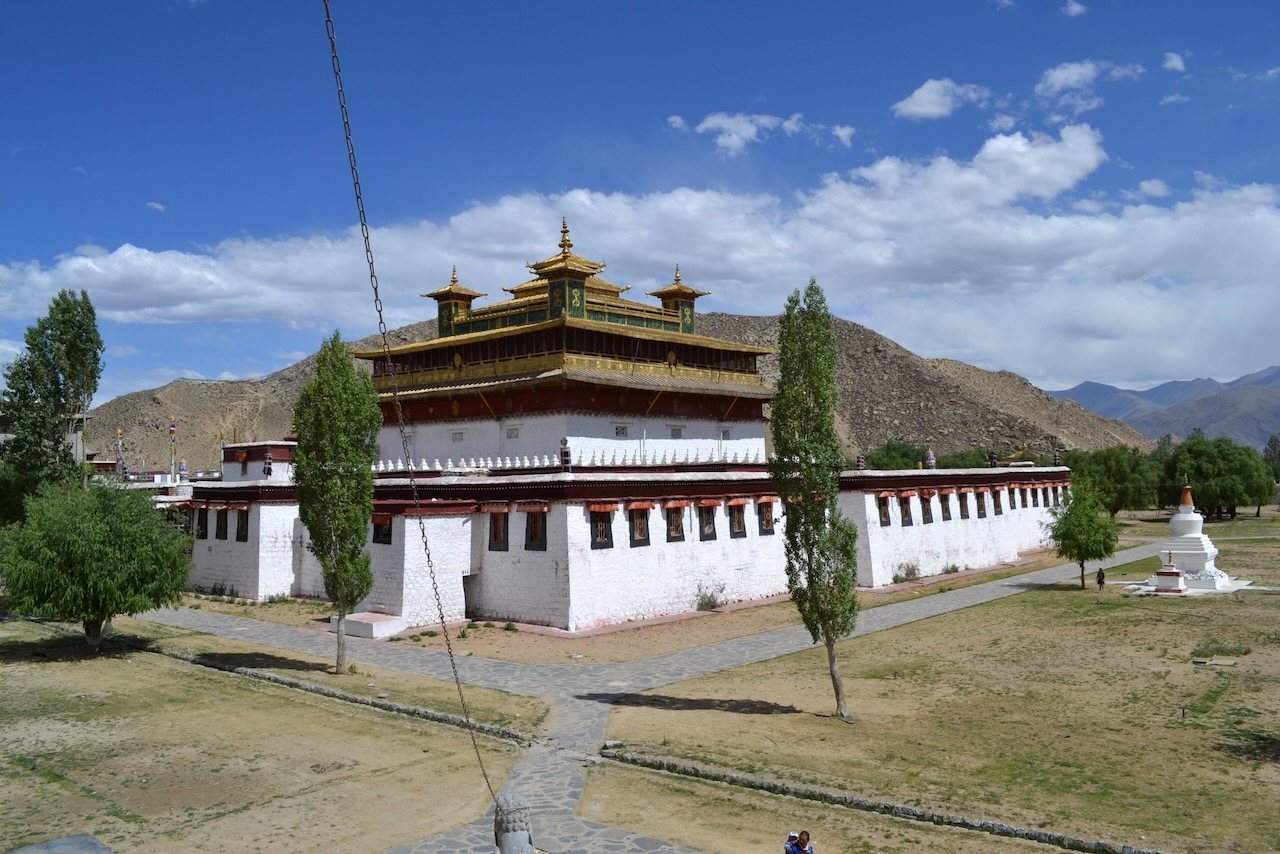
Samye stands in the Chimpu Valley south of Lhasa, beside Hapori Mountain and within the wider Yarlung Valley. Its reconstructed complex is arranged as a three-dimensional mandala, a sacred geometric plan representing the Buddhist cosmos. A circular enclosure surrounds the buildings and opens toward the four cardinal directions. At the centre, the main temple represents Mount Meru, the cosmic mountain, while the surrounding buildings and monuments express the plan’s directional symbolism.
Central Temple
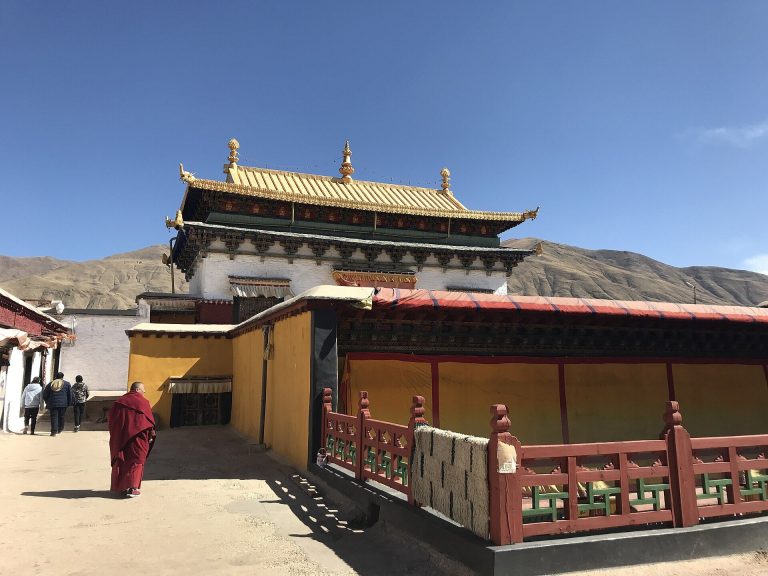
The three-storey main temple is dedicated to Vairocana, a cosmic Buddha associated with the ordering and illumination of the Buddhist universe. Its first storey follows Indian architectural forms, the second uses Chinese forms, and the third combines Khotanese or Tibetan forms. The lower storey contains an assembly hall supported by eighteen pillars. It holds a principal image of Padmasambhava, representations of the three masters and disciples, Vairocana, and other Buddhist figures. The central shrine contains a self-arisen stone image of the Great Enlightenment Buddha, accompanied by images of bodhisattvas and wrathful deities.
The middle storey has an assembly space supported by twenty pillars. Its principal images include the three masters and disciples, a leather image of Vairocana, and a standing image of Maitreya. The upper storey contains cloth and clay images of Vairocana, the five families of Buddhas, eight close disciples, and other Buddhas and bodhisattvas. Painted scenes from Buddhist sutras cover the walls, together with extensive tantric murals showing Buddhas, bodhisattvas, meditation deities, and protective deities. A gilded finial topped with a crystal ornament crowns the roof.
Enclosure and Directional Monuments
Four Directional Stupas
Four major stupas, or chortens, occupy the northeast, northwest, southeast, and southwest corners of the enclosure. They are traditionally associated with the colours blue, black, white, and red. The northeast blue stupa, built from Tibetan stone, is about seven storeys high. It has sixteen directional gateways, subsidiary shrine structures, thirteen Dharma wheels, and a jewelled finial. The northwest black stupa has an inverted-vessel form and is associated with relics. The southeast white stupa is surrounded by 108 small white stupas and eight lions. The southwest red stupa is constructed from brick and stone and has a bell-like inverted form.
Vajrakilaya Stupas
Four Vajrakilaya stupas stand at the cardinal points as ritual monuments intended to prevent malevolent forces from entering the sacred enclosure. They commemorate the ritual dagger, or kilya, used symbolically in the foundation rites to subdue or bind obstructive forces.
Temple Compounds and Directional Functions
The complex contains eight principal temple compounds: Dajor Ling, Dragyar Ling, Bétsa Ling, Jampa Ling, Samten Ling, Natsok Ling, Düdül Ling, and Tamdrin Ling. Their functions were distributed by direction. Eastern buildings included the ordination place of the first Tibetan monks, areas for doctrinal study, and translation facilities. Southern buildings were associated with tantric rites and the practice of Hayagriva. Western buildings included a Vairocana shrine, a hall connected with Maitreya prophecy, and a meditation centre. Northern buildings contained treasure storehouses, a centre associated with cultivating bodhicitta, and other treasury buildings.
Stone Inscriptions and Entrance Features
Eighth-Century Inscribed Pillar
An eighth-century stone pillar stands in front of the monastery. Although it carries no explicit date, its inscription describes the construction of Samye and other monasteries in Lhasa and Brag Mar. It also records oaths made by the king, ministers, and nobles to preserve and protect monastic endowments.
Southern Wall and Main Entrance
A second stone pillar stands beside the southern wall of the main entrance. It was erected during the reign of Trisong Detsen and carries Tibetan writing without other decorative imagery. Above the entrance is a Chinese-language plaque attributed to a Qing emperor, while a large bell bearing Tibetan writing hangs within the entrance structure.
The original buildings disappeared through repeated destruction and rebuilding. In 1982, the outer wall was still distinguishable, but the temples and stupas had not survived. The reconstructed complex nevertheless retains the principal mandala layout associated with Trisong Detsen’s eighth-century foundation.