Sera Monastery: A Gelug Buddhist University in Lhasa
Site at a Glance
- Rating
- 4.6
- Popularity
- Low
- Country
- China
- Primary era
- Medieval
- Eras represented
- Medieval, Early Modern, Modern
- Civilizations
- Tibetan
- Site type
- Religious
- Remains
- Monastery
On this page25 sections
History
Sera Monastery is a Gelug Buddhist university monastery at the northern edge of Lhasa, China, at the foot of Pubuchok Mountain. Founded in 1419 during the Ming dynasty, it became one of Tibet’s three great Gelug monasteries, alongside Ganden and Drepung, and was dedicated to Je Tsongkhapa, the scholar and reformer regarded as the founder of the Gelug, or Yellow Hat, tradition.
Foundation and religious traditions
The monastery was founded by Jamchen Chojey Sakya Yeshe of Zel Gungtang, a disciple of Tsongkhapa. King Nedong Dagpa Gyaltsen provided financial support and carried out the foundation-laying ceremony, while Tsongkhapa supervised the installation of sacred images and other objects of worship. The institution became known as the “Seat of the Mahayana Tradition,” referring to the broad Buddhist path associated with compassion and the pursuit of enlightenment for all beings.
Traditions surrounding the foundation connect Sera with visions experienced by Tsongkhapa. He was said to have seen the twenty verses of the Prajnaparamita, Buddhist teachings on the perfection of wisdom and emptiness, together with rain-like characters descending from the sky. Twelve years later, Jamchen Chojey was believed to have fulfilled the related prophecy by establishing Sera Je as a centre for the complete teachings and practices of the Mahayana tradition.
The monastery’s name is traditionally linked with the wild roses that covered the hill during construction. Another explanation connects it with raspberry-like shrubs called Sewa, which formed a Rawa, or fence. Before the monastery was established, Tsongkhapa and his disciples had founded hermitages at higher elevations above Sera Utsé. The Sera Je complex was also associated with Jetsun Kunkhen Lodroe Rinchen Senge, a disciple of Tsongkhapa who had previously taught at Drepung.
The monastic university
Sera developed into a Gelug university with three colleges and eventually housed about 6,000 monks. Before 1959, each college was administered by an abbot assisted by a council of ten lamas. Sera Je and Sera Me offered a twenty-year philosophical curriculum that ended with the award of the geshe degree, an advanced qualification in Tibetan Buddhist philosophy. Ngakpa Dratsang, the earliest of the three colleges, specialized in tantric ritual and practice. The colleges admitted monks described as ranging from eight to seventy years of age.
The monastery’s educational world extended into the surrounding hills. Approximately nineteen affiliated hermitages, including four nunneries, stood in the foothills north of Lhasa. These establishments trained scholars, maintained ritual practices, and formed pilgrimage networks connected with Sera. The annual cycle also included formal debates, in which monks examined Buddhist doctrines through questions and answers. The debates began with an invocation of Manjushri, the bodhisattva associated with wisdom. Questioners presented doctrinal problems, while defenders answered within a fixed period. Clapping, striking one palm with the other, circular gestures around the defender’s head, and loud exchanges formed part of the established method.
Sera’s religious calendar included the Sera Bengqin festival in February, on a date determined by the Tibetan calendar. During the ceremony, a ritual Dorje pestle was taken to the Potala Palace, where the Dalai Lama prayed over and blessed it. The Khenpo of Ngakpa College then placed it briefly on the heads of monks and disciples. The August Sho Dun festival included the symbolic unveiling of the Buddha.
Destruction, exile, and reconstruction
Sera suffered severe damage during the Lhasa revolt of 1959. Sera Je was bombarded from 18 March, hundreds of monks were killed, ancient texts were destroyed, and many works of art were lost. Ngakpa College was destroyed, and none of its resident monks survived. Sera Je had housed 5,629 monks that year. Many surviving monks, lamas, geshes, and laypeople crossed the Himalayas to India, where they were resettled at Bylakuppe near Mysore in Karnataka with assistance from the Indian government.
In 1970, 197 Sera Je monks and 103 Sera Me monks established a counterpart of Sera at Bylakuppe. Since no Ngakpa monks survived, the two scholastic colleges were re-established first, while a Ngakpa counterpart was added later. The Indian community received government-allotted forest land, with 193 Sera Je monks assigned 147.75 acres and 107 Sera Me monks receiving the remaining allocation. Thirty-eight residences were built with government grants, and the monks cultivated the surrounding land for food.
The Bylakuppe assembly prayer hall, completed in 1978, could accommodate 1,500 monks. A later assembly hall, measuring 23,275 square feet and standing 31 feet high, was supported by 110 pillars and designed for 3,500 monks. The Indian community now includes more than 3,000 monks and has established Dharma centres in several countries. Both the Tibetan and Indian branches remain known for their formal Buddhist debate tradition.
The Tibetan monastery continued to function after restoration. Modern figures include about 550 resident monks, with about 300 reported in 2011, a decline attributed to the 2008 Tibetan unrest. Sera was designated a monument of the People’s Republic of China on 23 February 1982.
Affiliated institutions and later history
Pabonka Hermitage was independent of Sera before 1959. Chinese authorities controlled it from 1960 until the mid-1980s, after which it was placed under Sera’s control and renovated by Sera monks. Drakri Hermitage had traditionally been under the authority of Sera Je and supervised the training of Garu’s nuns. After its monks were expelled in 1959, it became Drapchi Prison. It was re-established under the Nyingma tradition during the 1980s and partly renovated.
Several other affiliated sites were rebuilt after destruction during the Cultural Revolution or earlier upheavals. Keutsang Hermitage was rebuilt in 1991 and 1992 by a former monk and now houses twenty-five monks. Purchok Hermitage began reconstruction in 1984 with local-government approval and has been substantially restored, while Trashi Choling was rebuilt during the 1990s. Rakhadrak was destroyed in 1959 and came under Sera’s control during the 1980s, although rebuilding has proceeded intermittently.
Chupzang Nunnery developed from an earlier hermitage attributed to Trinle Gyatso, regent of Tibet from 1665 until his death in 1667. His nephew, Desi Sangye Gyatso, formally founded it around 1696. After restoration begun by nuns during the 1980s, it became a modern nunnery in 1984. Garu Nunnery traces its history to the eleventh-century Buddhist preceptor Phadampa Sanggye, who was said to have designated the site for nuns. Some Garu nuns later organized silent protests against Chinese rule and sought Tibetan independence, leading to arrests, imprisonment, mistreatment, and prolonged detention.
Negodong began as a retreat connected with a scholar of Sera Je’s Gomde Regional House. It was first established as a monastery for seventeen monks and was assigned exclusively to nuns in 1930, partly to provide greater security for nuns who had lived in the remote Nenang area. Nenang was associated with Padmasambhava, who was said to have meditated in two nearby caves in the ninth century. Its foundation as a nunnery was attributed to Jetsun, also called Khacho, Drol dor Wangmo, and after a period of decline it was placed under the jurisdiction of Khardo Hermitage.
Remains
Setting and overall layout
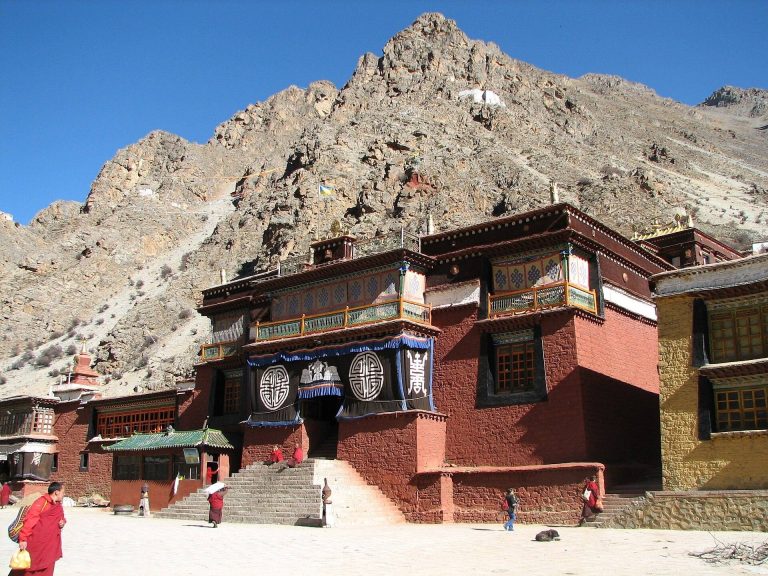
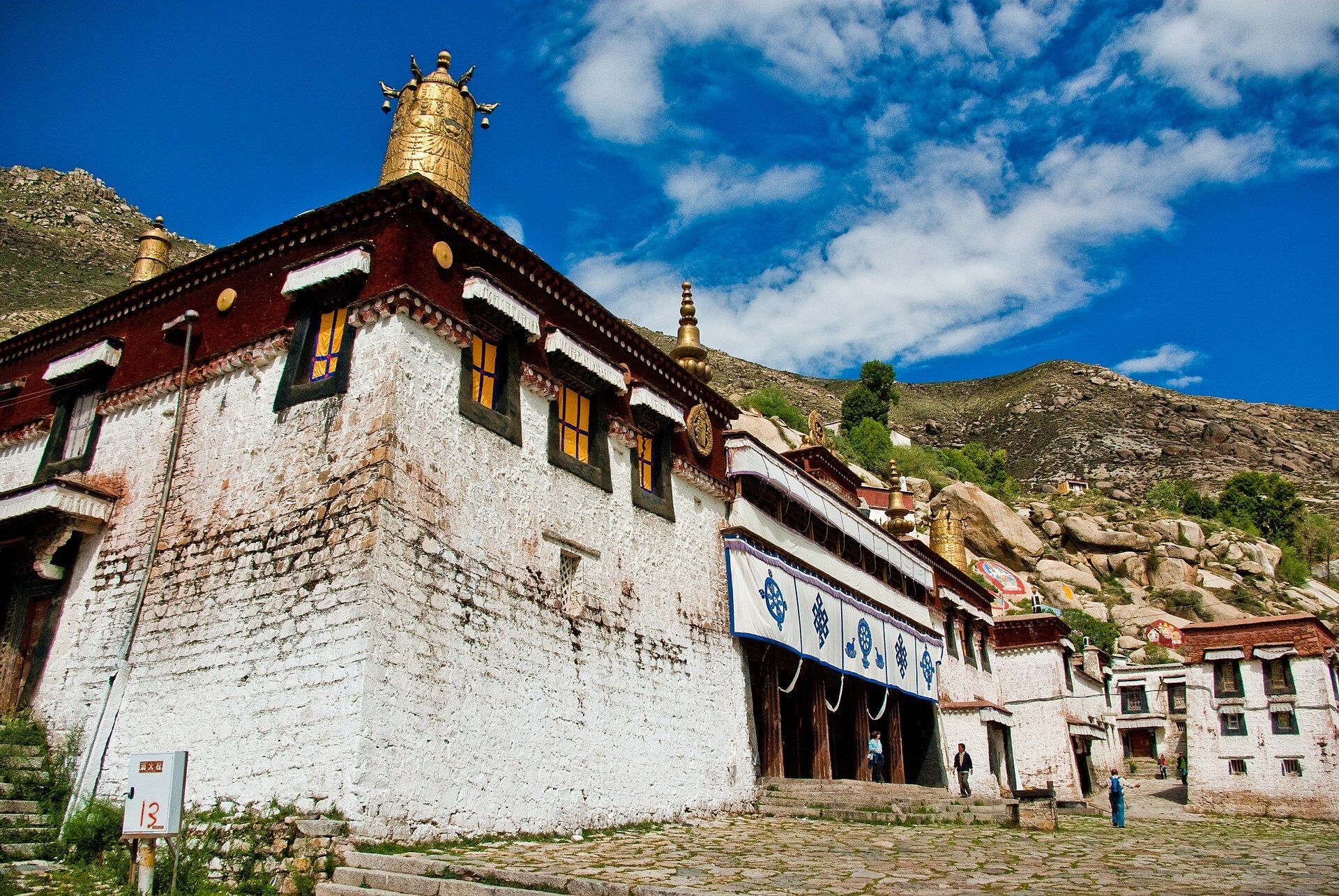
Sera stands on the northern outskirts of Lhasa at the foot of Pubuchok Mountain, also called Tatipu Hill. The mountain forms part of the watershed between the basins of the Kyi Chi and Penpo Chu rivers. The main complex covers approximately 28 acres. Paths divide it into an eastern sector containing the Great Assembly Hall and residential buildings and a western sector containing Sera Je, Sera Me, and Ngakpa colleges.
The buildings once formed a clockwise pilgrimage circuit. It began at the colleges, continued through the Great Assembly Hall and the residential quarters, and ended at Tsongkhapa’s hermitage above the hall. The principal elements are the Great Assembly Hall, the three colleges, and the Homdong Khangtsang residential units, also called Kamcuns. Before 1959, the complex contained gold-powdered scriptures, statues, scent cloths, murals, chapels, ritual objects, and monastic residences.
The Great Assembly Hall
Architecture and chapels
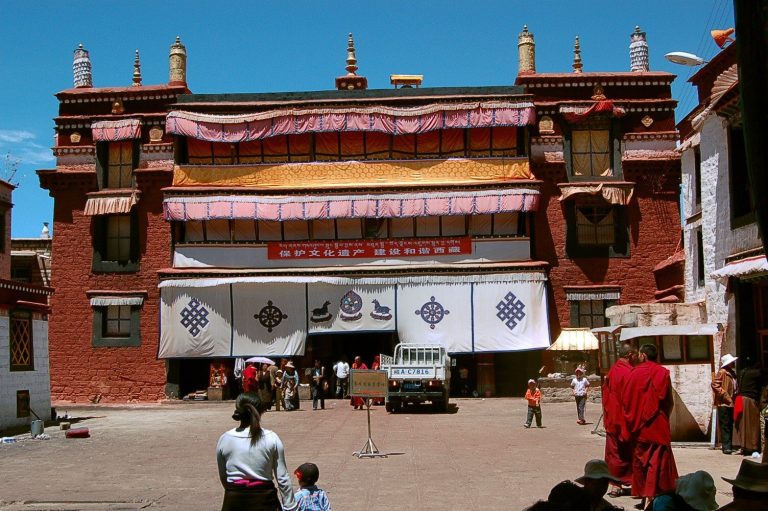
The Great Assembly Hall, also called Tsokchen or Coqen Hall, was built in 1710 by Lhazang Khan. It is a four-storey, east-facing structure in the northeastern part of the monastery. The building covers about 2,000 square metres and is supported by 125 pillars, including 86 tall and 39 short pillars. Its entrance portico has ten columns.
The hall was described as containing five chapels dedicated to Maitreya, Shakyamuni, the Arhats, Tsongkhapa, and the thousand-armed, eleven-faced Avalokiteshvara. Its three inner chapels were Jampa Lhakhang, Neten Lhakhang, and Jigje Lhakhang. Jampa Lhakhang contained a six-metre-high image of Maitreya surrounded by eight bodhisattvas, with Hayagriva and Acala guarding the entrance. Jigje Lhakhang contained Bhairava with Bhairavi, Shri Devi, and other protector deities.
On the second floor, Zhelre Lhakhang contained a Maitreya image with a small image of Tsongkhapa at its heart. Tu-je Chenpo Lhakhang contained eleven-faced Avalokiteshvara, Tara, and six-armed Mahakala, while Shakyamuni Lhakhang contained the historical Buddha flanked by Gelug lamas. The third and fourth floors served as private apartments for Dalai Lamas and preceptors of the main assembly hall.
Scriptures and images
The hall formerly held 105 surviving volumes of the Kangyur, the Tibetan Buddhist canon of translated scriptures, from an original set of 108. The volumes were dated to 1410 and were traditionally said to have been presented to Jamchen Chojey by the Ming emperor Chengzu. Printed in China from woodblocks, they had gold covers engraved in red lacquer.
Large appliqué religious paintings hung along the side walls, and a central skylight illuminated the hall. The central image represented Jamchen Chojey Sakya Yeshe. Other images included a gilded Maitreya about five metres high flanked by two lions, the Fifth, Seventh, and Twelfth Dalai Lamas, Tsongkhapa with his principal disciples, Chokyi Gyeltsen, and Desi Sangye Gyatso.
The three colleges
Sera Me College
Sera Me Tratsang, also called Sera Me Zhakan, was the oldest college. Founded in 1419, it occupied about 1,600 square metres and contained thirty residential units. Lightning struck its main hall in 1761, and the building was reconstructed during the same year with seventy pillars, including eight tall and sixty-two short pillars.
The main hall contained a copper image of Shakyamuni and images of Maitreya, Manjushri, Amatyas, Bhavishyaguru, Tsongkhapa with his students, the Seventh Dalai Lama, Pawanga Rinpoche, and former college teachers. Five chapels extended from west to east: Tawok Lhakhang, Je Rinpoche Lhakhang, Neten Lhakhang, Jowokhang, and Tsongkhapa Lhakhang. Their contents included images of protector deities, Buddhas, the Sixteen Elders, Atisha, Dromtonpa, several Dalai Lamas, Jamchen Shakya Yeshe, and former teachers.
The second floor contained Nyima Lhakhang, with Shakyamuni and Tuwang Tsultrim, and Khangyur Lhakhang, where 1,000 Tara images were installed in place of sacred texts destroyed during the Cultural Revolution. The third floor was reserved for the Dalai Lamas.
Sera Je College
Sera Je Tratsang, also called Zhekong, is the largest college, covering about 17,000 square metres. It began as a three-storey building, and a fourth storey was added in the eighteenth century after the structure was strengthened with 100 columns.
The college contained a gilded-copper image of Hayagriva, a wrathful Buddhist deity associated with protection, healing, and the removal of obstacles. Traditionally attributed to Lodro Rinchen, the image represented Sera’s supreme protector. The assembly hall also contained frescoes of the Buddha’s life, the thrones of the Dalai Lamas and Panchen Lamas, and images and stupas connected with several religious leaders and teachers.
The chapels followed a circumambulatory sequence. Dusum Sangye Lhakhang contained the Buddhas of the Three Times and eight bodhisattvas. Tamdrin Lhakhang housed the principal Hayagriva image. Jampa Lhakhang contained Maitreya, eleven-faced Mahakarunika, Tsongkhapa, and a library. Tsongkhapa Lhakhang included images of Tsongkhapa, his students, Sera Je lamas, Nagarjuna, other Indian Buddhist commentators, Hayagriva, and Acala. Jampeyang Lhakhang contained two images of Manjushri, one shown in the teaching gesture and facing the debate courtyard.
Zelre Lhakhang on the second floor offered a view of the main Hayagriva image below. It contained a small nine-headed Hayagriva, Padmasambhava, the Fifth Dalai Lama, and protector deities. Namgyel Lhakhang stood above it, while the uppermost floor contained residences for Dalai Lamas and Sera Je teachers.
Ngakpa College
Ngakpa Tratsang, also called Ngaba Zhacang, was the smallest college and was devoted to tantric studies. It was originally constructed in 1419 by Jetsun Kunkhen Lodroe Rinchen Senge as a three-storey building and was refurbished in the eighteenth century by Lhazang Khan. Its assembly hall had four tall and forty-two short pillars with carved capitals.
The central image represented Jamchen Chojey wearing a black hat and was traditionally believed to have been presented by the Yongle Emperor. Other images included Maitreya, Gyeltsen Zangpo, Pawangka Rinpoche, Tsongkhapa with his principal disciples, the Thirteenth Dalai Lama, Chokyi Gyeltsen, and Lodro Rinchen. Neten Lhakhang contained Shakyamuni and two series of the Sixteen Elders, one in Tibetan style and one in Chinese lacquer. Jigje Lhakhang contained a fifteenth-century Bhairava, Mahakala, Dharmaraja, Shri Devi, and other deities. The upper floors held images, stupas, and a Dalai Lama residence.
Residential quarters and debate courtyard
Homdong Khangtsang
Homdong Khangtsang consists of thirty-three Kamcuns arranged around a central courtyard. Their sizes varied according to the number of residents. Monks from the same village lived together, with each monk occupying a separate cell. Every Kamcun also included a doctrinal prayer hall and an attached tea house.
The principal Homdong assembly hall contained small images of Tsongkhapa, Choyi Gyeltsen, Shakyamuni, and the Three Deities of Longevity. Its Jampakhang contained a “speaking” Tara associated with Sera’s springs and a portrait of Lama Tubten Kunga, who renovated Sera Me. The Gonkhang contained the protector Gyelchen Karma Trinle.
Debate courtyard
The debate courtyard is the principal architectural setting for Sera’s doctrinal debates. The ritualized exchanges combine spoken questions and answers with distinctive gestures, including clapping, striking one palm with the other, and circular movements around the defender’s head. The courtyard therefore belongs both to the physical organization of the monastery and to the educational system that shaped its colleges.
Mountain hermitages and sacred sites
Choding and Sera Utsé
Choding Khang lies immediately behind the Great Assembly Hall on the slope of Sera Utsé. Tsongkhapa meditated there. A stepped path leading to the hermitage has painted rock carvings of Tsongkhapa, Jamchen, and Dharma Raja. The former hermitage was destroyed during the Revolution and replaced by a new building. Caves associated with Tsongkhapa’s meditation lie higher on the mountain, while the upper and lower tantric colleges of Lhasa lie below it.
Sera Utsé, meaning “Sera Peak,” occupies the mountain directly behind the main monastery and is traditionally considered older than Sera itself. The site was associated with Tsongkhapa’s meditation hut and with the seventeenth- or early eighteenth-century meditator Sgrub Khang Geleg Gyatso. After destruction in 1959, only part of the former monastery was rebuilt. The surviving complex includes a two-storey chapel, monks’ quarters, protector shrines, a small assembly hall, a lama’s residence, meditation huts, a Dharma enclosure, a ruined kitchen, and storage huts.
Pabonka Hermitage
Pabonka is the largest and most important of Sera’s affiliated hermitages. It lies about eight kilometres northwest of Lhasa in Nyangbran Valley, on the slopes of Mount Parasol. More than 1,300 years old, it includes a central shrine associated with Songtsen Gampo and the Rigsum Gompo Trinity of Chenresig, Jampelyang, and Chana Dorje.
The original nine-storey monastery was partly destroyed by King Langdharma in 841 during his campaign against monastic Buddhism. It was rebuilt in the eleventh century as a two-storey structure for 200 monks. Tsongkhapa later lived there as a hermit, after which it became a scholarly institution, and the Fifth Dalai Lama funded an additional upper floor. The site includes several shrines, a blue-and-gold carved hallway bearing a mantra translated as “Hail to the jewel in the lotus,” and the Palden Lhamo Cave above the hermitage. The cave is associated with Songtsen Gampo’s meditation and contains images of him and his two wives, together with a rock carving of Palden Lhamo.
Drakri and Jokpo
Drakri Hermitage, also called Bari Hermitage, lies about three kilometres north and slightly east of central Lhasa. It is partly ruined and has five principal sections, including a temple compound around a central courtyard, kitchen and residential rooms, a ruined terraced complex, a building formerly used by eight fully ordained monks, a mdzo stable, and several huts. The main temple contains statues of Guru Rinpoche and tantric deities, as well as a three-dimensional model of Guru Rinpoche’s celestial palace, the Glorious Copper-Coloured Mountain. Four tantric priests live in the main compound, and two nuns occupy huts to the southeast.
Jokpo Hermitage is now a ruin at the western end of Nyangbran Valley. Bones of a Sera Me meditator traditionally associated with the site were exhumed when the regional house was rebuilt during the 1980s and placed inside a clay altar statue in the regional-house temple.
Keutsang and Khardo
Keutsang Hermitage began as a precarious cave inhabited by Tsongkhapa. After the cave collapsed in a landslide, the present hermitage was rebuilt in a safer location beside the ruins of Keutsang West. It stands east of Sera on a hillside above Lhasa’s principal cemetery, while Rakhadrak lies below it. Keutsang forms part of the Sera Mountain Circumambulation Circuit. Local traditions connect the Maitreya image with the belief that remains brought to the cemetery below can receive assurance of rebirth, and that rays of light pass between the image and the Maitreya Chapel at the northern end of Lhasa’s Barkor.
Keutsang East is now a ruin between Keutsang West and Purchok. Before 1959 it belonged to Purchok, contained an assembly hall and monks’ quarters, and housed ten monks. It was known for an Avalokiteshvara image believed to bless the dead at the nearby funeral ground. Keutsang West is also ruined, beside the rebuilt hermitage.
Khardo Hermitage lies in Dodé Valley northeast of Sera and Lhasa, within a charnel ground, a funerary setting regarded in tantric traditions as suitable for meditation and ritual. The hermitage is surrounded on three sides by sacred mountains and includes the Offering Place Cave, where a copy of the Kangyur was said to have been found. Established in 1706, it originally had three superimposed levels: the main hermitage, the Upper Residence, and the Temple of the Sixteen Arhats. The Seventh Dalai Lama supported the temple and a residence for his visits, while a funerary stupa and statue were later installed for his teacher.
Purchok, Rakhadrak, and Panglung
Purchok Hermitage is the final stop on the Sixth-Month Fourth-Day pilgrimage circuit and has been substantially rehabilitated. It contains the main cave associated with Padmasambhava’s meditation, the Cavern of Dochung Chongzhi. The surrounding hills are identified with Avalokiteshvara, Manjushri, and Vajrapani, and the site is associated with the mantra “Om Mani Padme Hum.”
Rakhadrak lies northeast of Sera and north of Lhasa. Its upper temple complex was built as a formal monastery under the patronage of the mother of the Fifth Dalai Lama. The complex remains only intermittently rebuilt. Panglung Hermitage is completely ruined. It formerly contained a large temple and an oracle associated with Dorje Shugden. An attempted renovation during the 1990s was halted after local opposition because of the site’s association with the controversial protector deity.
Smaller hermitages and nunneries
Sera Gonpasar is completely ruined, although foundations, wall fragments, notable rock carvings, and a large stupa remain. Takten Hermitage consists mainly of caves with decorated entrances. It belongs to the Pabongkha Lama’s estate and is occupied by Gelug nuns who carried out restoration work. Trashi Choling is a south-facing site about three kilometres northwest of Sera and forms part of the Sera Mountain Circumambulation Circuit. It was substantially destroyed during the Cultural Revolution and rebuilt during the 1990s.
Chupzang Nunnery contains a lower temple with a self-arisen stone image of the Buddha, traditionally said to have been discovered by the Fifth Dalai Lama during an investigation of the site. A later four-pillared temple had a rear household-deity chapel and a portico. After modern restoration, the nunnery included individually owned houses for nuns, an administrative body, and a communal gathering space. Negodong lies northeast of Sera in Lhasa’s Dogde suburb, while Nenang lies east of it and is associated with two caves where Padmasambhava was traditionally believed to have meditated.
The Bylakuppe counterpart
The Bylakuppe counterpart reproduces the Sera Je and Sera Me institutions and includes assembly halls, monastic residences, and a later counterpart of Ngakpa College. Its larger assembly hall measures 23,275 square feet, or 2,162.3 square metres, stands 31 feet high, and is supported by 110 pillars. Together, the Tibetan and Indian branches preserve the college structure, ritual practices, and formal debate tradition that have defined Sera’s religious and educational life.