St Melangell’s Church: A Medieval Pilgrimage Church in Wales
Site at a Glance
- Rating
- 4.9
- Popularity
- Very Low
- Country
- United Kingdom
- Primary era
- Medieval
- External website
- Open
- Eras represented
- Medieval, Early Modern, Modern
- Civilizations
- Welsh
- Site type
- Religious
- Remains
- Church
On this page14 sections
History
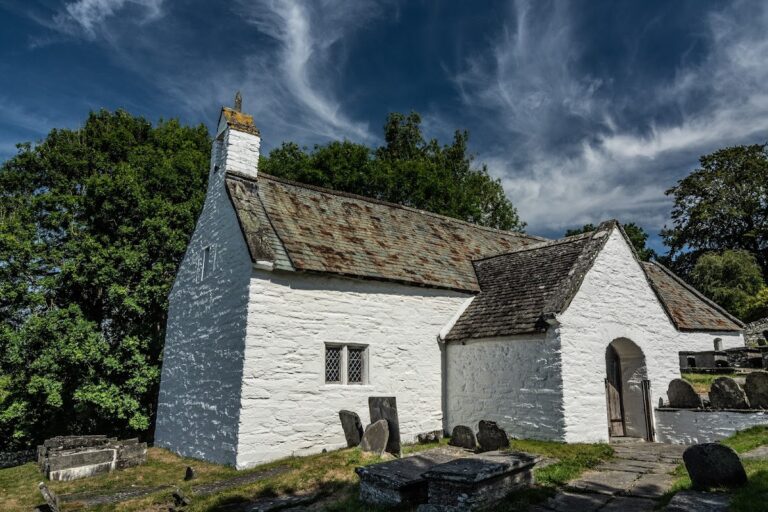
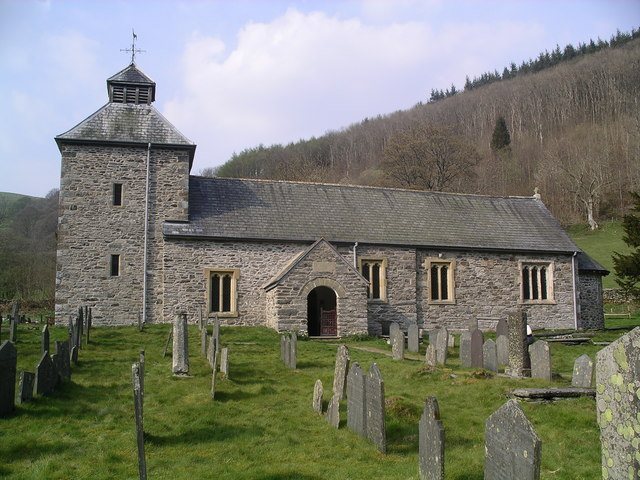
St Melangell’s Church is a medieval Church in Wales building at Pennant Melangell in Powys, United Kingdom. The site probably became a Christian centre in the early medieval period, traditionally around the eighth century, to commemorate the reputed grave of Melangell, a hermit and abbess associated with a convent and sanctuary. The present Romanesque church was built in the twelfth century, probably by the third quarter of that century, during a period of Welsh ecclesiastical patronage.
Early religious centre
The site had funerary importance before the present church was built. Middle Bronze Age cremation burials, Bronze Age pottery, and early medieval graves show that the location was used for burial over a long period. Pennant Melangell was probably founded as a Christian community in the late eighth century. The surviving medieval life of Melangell describes her as an Irish woman who escaped an arranged marriage and lived in solitude at Pennant for 15 years.
In that foundation story, Prince Brochwel of Powys discovered Melangell while hunting a hare. She protected the animal beneath her clothing, and Brochwel granted her the land with perpetual sanctuary rights for fugitives. Melangell then founded a community of nuns. References to abbots in her medieval life suggest that a male monastic community was later established as well, although neither community survived into the thirteenth century. The story also shaped local custom, since people traditionally avoided killing hares. That veneration may preserve elements of an older Celtic religious tradition.
Construction and medieval pilgrimage
During the eleventh and twelfth centuries, reforms of the Welsh Church under Norman rule revived and reshaped local saints’ cults, including the cult of Melangell. A possible wall footing suggests that a timber church may have stood here from no earlier than the eleventh century. It was replaced by the present stone building, probably under the patronage of Rhirid Flaidd, the local lord, during the period when his liege, Madog ap Maredudd, was king of Powys.
The earliest written reference to the church comes from the Valuation of Norwich in 1254, when its property was valued slightly below the average for the diocese. By 1291 it ranked among the more valuable churches in the Diocese of St Asaph, probably reflecting the increasing popularity of Melangell’s cult. Her shrine became a Welsh pilgrimage centre, and by the fifteenth century visitors came in search of cures. Income from offerings at the shrine remained comparable with that of other major Welsh cult centres in 1535.
The church probably received a new roof during the fifteenth century, when its carved rood screen was installed. A south aisle may also have been added beside the chancel to help pilgrims reach the shrine. These changes belonged to a period when the church’s religious life was closely connected with devotion to Melangell and her reputed remains.
Reformation and later alteration
The Reformation and the religious changes introduced under Henry VIII, Edward VI, and Elizabeth I suppressed pilgrimage and saints’ cults. Melangell’s shrine was probably dismantled, while the grave chapel was blocked. Pieces of the shrine were reused in the church walls and in the seventeenth-century lychgate. By the 1660s the church’s value had fallen below the diocesan average.
The walls were plastered and seating was introduced sometime from the late sixteenth century. Eighteenth-century work blocked doors and windows, built a new porch, replaced parts of the walls, and may have removed the rood-screen loft. The medieval apse and grave chapel were replaced by an eighteenth-century room known as the cell-y-bedd, or grave chamber. It was probably built partly as a schoolroom and later served as a vestry.
From the eighteenth century until 1886, the surrounding glebe farmland supported the church’s rectors and vicars. It was used for summer grazing and peat cutting. The former tower was replaced during restoration in 1876 and 1877. New pews and an altar table were installed in 1878, and the church was transferred to the parish of Llangynog in the same year. The neighbouring rectory and vicarage were sold in 1886.
Rediscovery and restoration
As the congregation declined and funds diminished after the nineteenth-century restoration, the church became increasingly neglected. By 1954 the cell-y-bedd was considered unsafe and its demolition was proposed. Repairs and archaeological work followed in 1958, when fragments found in and around the church were used to reconstruct Melangell’s shrine under a design by the archaeologist Ralegh Radford.
The shrine was dismantled again in 1989 and restored in 1991 in accordance with revised scholarship. The wider restoration of 1989 to 1992 rebuilt the apse, moved the shrine and medieval effigies into the chancel, repaired and rearranged the furnishings, and installed electricity in the previously unheated, oil-lit church. A thanksgiving service took place on 27 May 1992 and was attended by Alwyn Rice Jones, the Archbishop of Wales.
During the 1980s the deteriorating church faced the possibility of demolition. Paul Davies, parish priest of Meifod, then took responsibility for it voluntarily, oversaw its complete restoration, and helped establish a cancer ministry in a nearby cottage. After his death in 1994, Evelyn Davies continued the shrine’s ministries as its first shrine guardian. She was followed by Linda Mary Edwards in 2003, Lynette Norman in 2011, and Christine Browne in 2016.
Excavations in 1958 and from 1989 to 1994 examined the cell-y-bedd, chancel, nave, churchyard, and surrounding land. They revealed Middle Bronze Age cremation activity, early medieval burials, medieval graves, and successive phases of use. Pennant Melangell has continued to attract religious and non-religious pilgrims in the twenty-first century. The church is a Grade I listed building, designated in 1953, and belongs to the Diocese of St Asaph and the Mission Area of Tanat-Vyrnwy.
Remains
St Melangell’s Church stands in the Tanat Valley near the Berwyn Mountains. Its Romanesque plan consists of a single nave, chancel, eastern apse, and square western tower. The fabric belongs to periods from the twelfth to the twentieth centuries. Walls are built from waterworn pebbles, large sedimentary slabs, and shale blocks. The principal roof is slate with stone ridge tiles, while the porch has black ceramic tiles.
Church building and shrine
Apse and grave chamber
The eastern apse is known as the cell-y-bedd, meaning grave chamber. The present structure was built in 1989 from local rounded boulders to resemble the original twelfth-century apse. It has three rounded windows in a twelfth-century style, a concrete floor with a cobbled surface, and a grave slab above the traditional location of Melangell’s grave.
Excavation beneath the cell-y-bedd revealed the footings of the medieval apse, which was semicircular and contemporary with the chancel’s east wall. The work also found a cobbled floor, a large slab, and a grave containing pebbles, soil, and bone fragments. A stone slab now marks the putative grave of Melangell. It may have been introduced in the eighteenth century and differs in size from the stone settings beneath it. The apse may originally have enclosed Melangell’s grave and relics for pilgrimage veneration.
Melangell’s shrine
The reconstructed shrine is regarded as the oldest surviving Romanesque shrine in northern Europe. The original was probably made locally under Norman influence and may have been erected around 1160 to 1170 to contain Melangell’s translated remains. The present reconstruction was assembled in 1958 from surviving fragments, incorporating an altar and reliquary. It was dismantled in 1989 and restored in the chancel in 1991, while some fragments were kept separately.
The fragments are made from pinkish-grey and yellowish-grey sandstone, much of it heavily weathered. Several retain traces of limewash and dark red paint. The steep gable and foliage motifs, including willow-shaped and half-pear-shaped leaves on a running half-palmette, have been interpreted as suggesting Irish connections. The foliage may also represent the bramble bush associated with the story of Melangell and the hare.
Rood screen and furnishings
A late-fifteenth-century carved oak rood screen, a decorated partition between the nave and chancel, survives in fragmentary form. The surviving portions were restored and joined to parts of the loft balcony during the restoration of 1989 to 1992. Its carvings show Brochwel on horseback, a huntsman, Melangell as a veiled abbess holding a crosier, a hare, and two hunting dogs within a foliated border. Red, pink, yellow, brown, black, and blue paint remains on parts of the screen. It was carved from solid oak, and its cornices include acorns and oak leaves.
The interior contains a twelfth-century baptismal font, a seventeenth-century chest, an eighteenth-century chalice, an early-eighteenth-century pulpit, and an eighteenth-century candelabrum. It also contains a large whale rib of uncertain purpose and provenance, sometimes called the Giantess’s Rib or Melangell’s Rib. The rib may have formed part of a harp.
Carved monuments and decoration
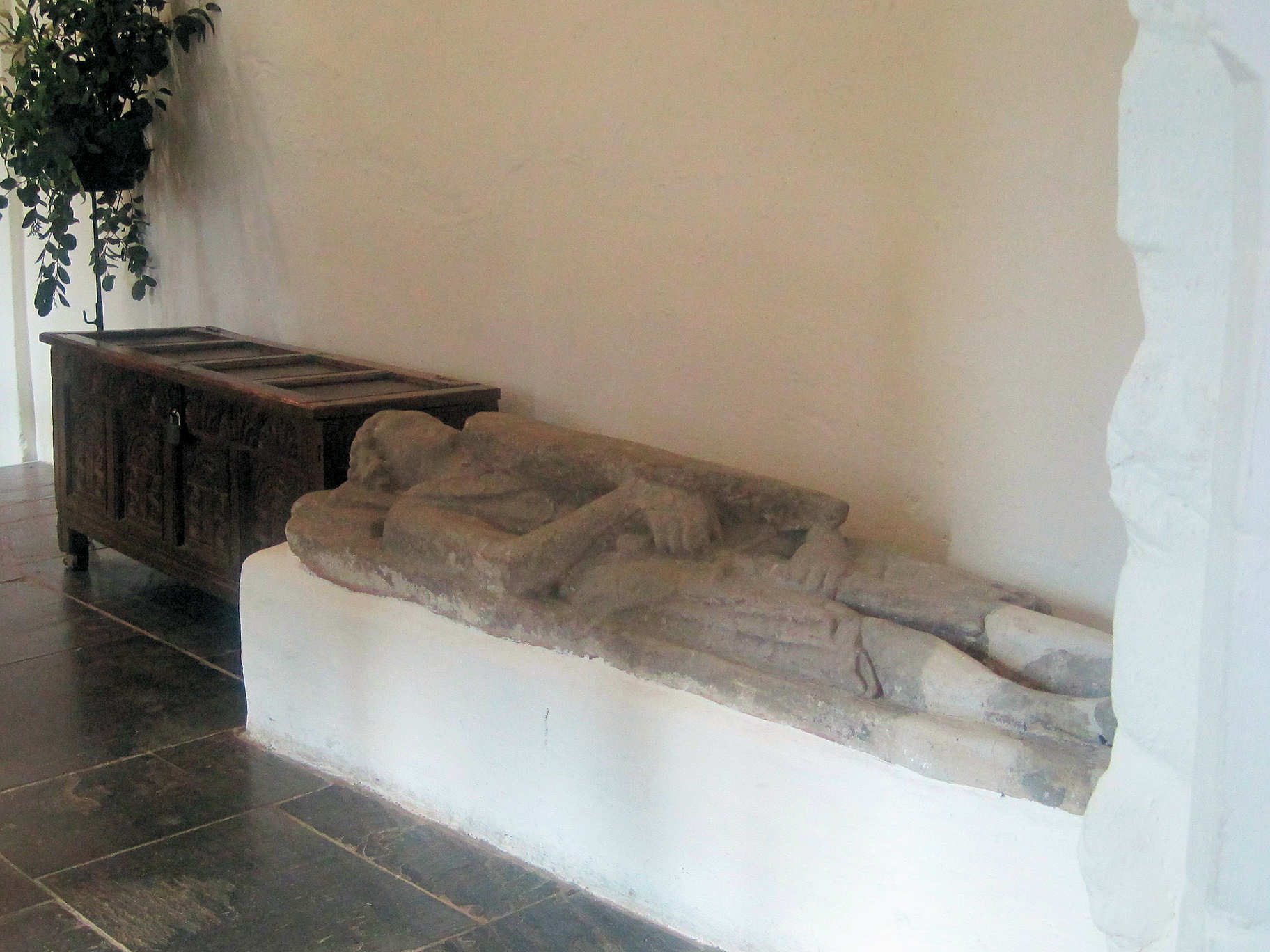
Two fourteenth-century stone effigies stand on either side of the chancel. Both were moved into the church in 1876, and their original positions are unknown. The male figure is a young man with a sword and shield, cushions beneath his head, and a possible wolf beneath his feet. An inscription on the shield is illegible. The figure has been associated both with Iorwerth Drwyndwn and with Iorwerth of Penllyn, but neither identification is certain. Knife sharpening and cut initials have damaged the effigy.
The female effigy shows a figure in a long gown and square headdress, with a lion at her feet and two animals at her sides. It is traditionally identified as Melangell, although that interpretation remains uncertain. The animals may be hares, which would support its use as an image connected with her cult. The effigy is broken into two parts and has also been damaged by knife sharpening.
Traces of thirteenth-century floral and geometric wall decoration survive inside the church. A Stuart coat of arms was found beneath later decoration and had been painted over in the eighteenth century with a Hanoverian coat of arms; the later painting was subsequently covered with plaster. A 1791 reredos displaying the Ten Commandments, the Apostles’ Creed, and the Lord’s Prayer in Welsh, with cherub decoration, was later conserved and moved to the tympanum. An 1886 wooden copy was placed on the altar and helped protect the original. Gothic Revival stencilled decoration was added around the chancel during the nineteenth century.
Churchyard and associated features
The roughly circular churchyard is enclosed by a stone wall that may predate the earliest eighteenth-century references to it. Its oldest marked grave dates from 1619. Around 1,000 burials are recorded from 1680 onward, most unmarked, and a further 1,000 to 2,000 unmarked graves, possibly dating from the twelfth century onward, are believed to lie within the churchyard. Three marked graves belong to First World War servicemen registered by the Commonwealth War Graves Commission. The grave of the Welsh harpist Nansi Richards is also located here. A medieval stone-cross base has been reused as the support for a sundial.
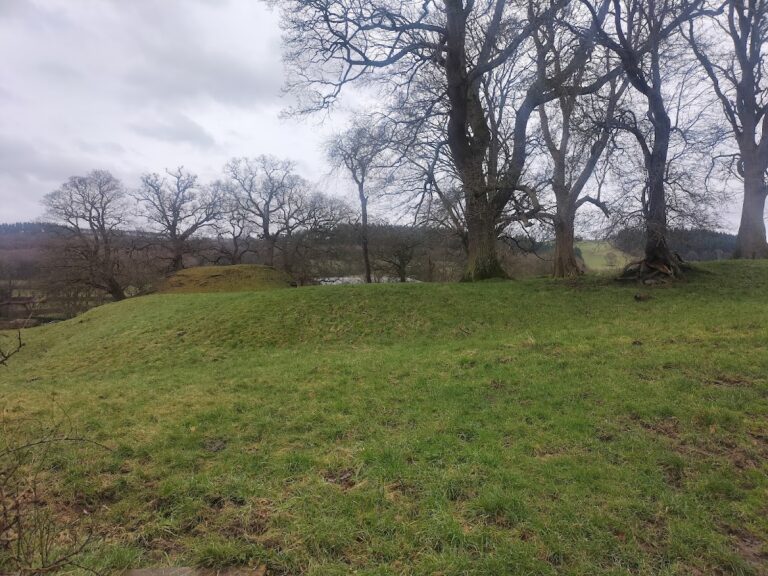
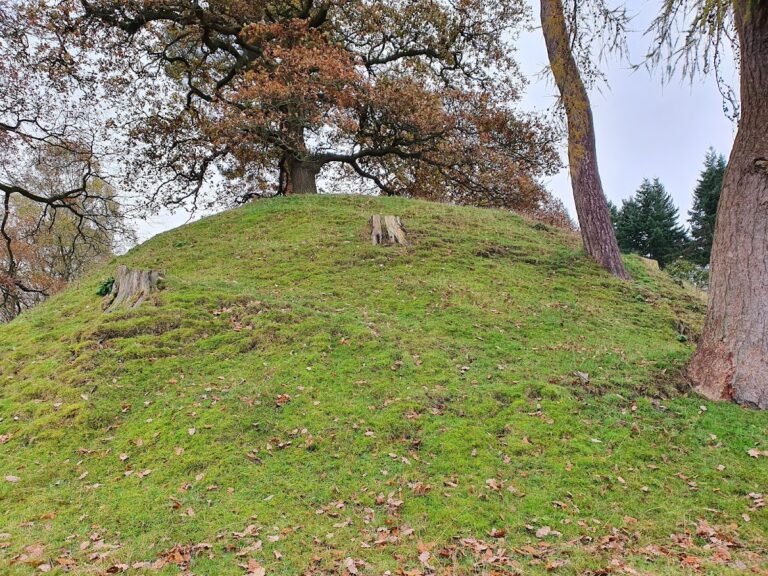
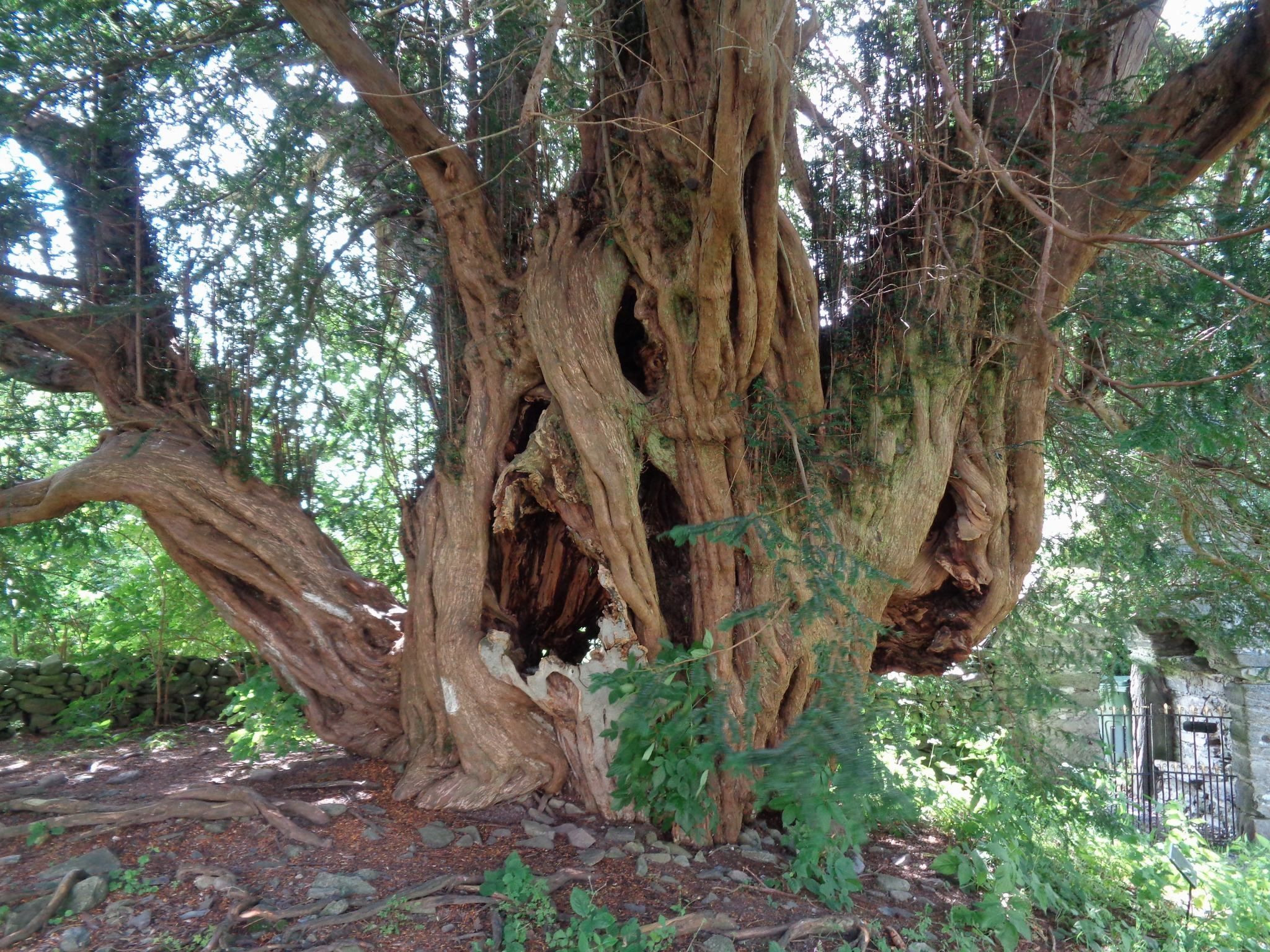
Seven yew trees grow in the churchyard, including one measuring 3.5 metres in diameter. Most are believed to be considerably older than the earliest written references to the site. A mound north of the church may have been a preaching mound associated with Saint Germanus, a Christian saint linked with preaching and ecclesiastical missions. The lychgate probably dates from the sixteenth or seventeenth century. It has corbelled arches on both sides, internal stone seats, and part of an inscription. Fragments of Melangell’s dismantled shrine were formerly incorporated into it and were removed in 1958.
Archaeological remains
Twenty-nine pits near the apse contained human bone fragments, and radiocarbon dating placed deposits from two charcoal- and bone-filled pits in the Middle Bronze Age. Excavation also identified a posthole, an early medieval stone slab, thirteen graves east of the cell-y-bedd, and a charnel deposit of disarticulated human bones. Seven comparable pits beneath the western end of the church contained charcoaly soil, charred plant matter, and human remains. Nine sherds of Bronze Age pottery were recovered there, including seven from the upper part of a large bucket urn.
Early medieval burials predated the present twelfth-century church. At least sixteen later burials beneath the building ranged from the church’s construction to the eighteenth century. Finds from the excavations include green-glazed medieval pottery, a dark red glass bead resembling pre-Saxon beads, a carved stone tool, and part of a twelfth-century Romanesque candlestick decorated with a stylised dragon head and beadwork.
Investigation of the north wall indicated that it is largely twelfth-century. In the northern churchyard, 25 or 26 previously unknown possible graves were found, probably earlier than the sixteenth century. Some had edging stones, and one was covered by dense white quartz pebbles. A potentially prehistoric circular pit containing charcoaly soil and a possible posthole was also identified. Removal of contaminated topsoil in 1987 exposed cobbled graves dating from the mid-eighteenth to the mid-nineteenth centuries.
Wider historic landscape
The churchyard and surrounding area preserve evidence of medieval settlement, a late-medieval farmstead, sheepfolds, enclosures, shelters, huts, and peat-drying platforms. The churchyard was also used for games, festivals, plays, and ball games, and two former cockpits are recorded. Nearby features associated with the site include the natural rock shelf called Melangell’s Bed and the holy well Ffynnon Cwm Ewyn, also known as Ffynnon Iewyn. The well was traditionally associated with cures for rheumatism, scrofula, and skin diseases. An inscription meaning Saint Monacella’s Bed was probably carved into the rock in the nineteenth century.
Surrounding land contains remains connected with medieval farming and possible earlier industrial activity. The valley landscape includes a distinctive rounded hill described as breast-shaped. Together with the church, shrine, burial ground, well, rock shelf, and settlement remains, these features preserve the physical setting of a religious centre whose history extends from prehistoric funerary activity to continuing pilgrimage.