Shobuike Kofun: A Seventh-Century Square Burial Mound in Japan
Site at a Glance
- Rating
- 3.8
- Popularity
- Very Low
- Country
- Japan
- Primary era
- Medieval
- External website
- Open
- Eras represented
- Medieval
- Civilizations
- Unclassified
- Site type
- Burial
- Remains
- Burial Mound
On this page7 sections
History
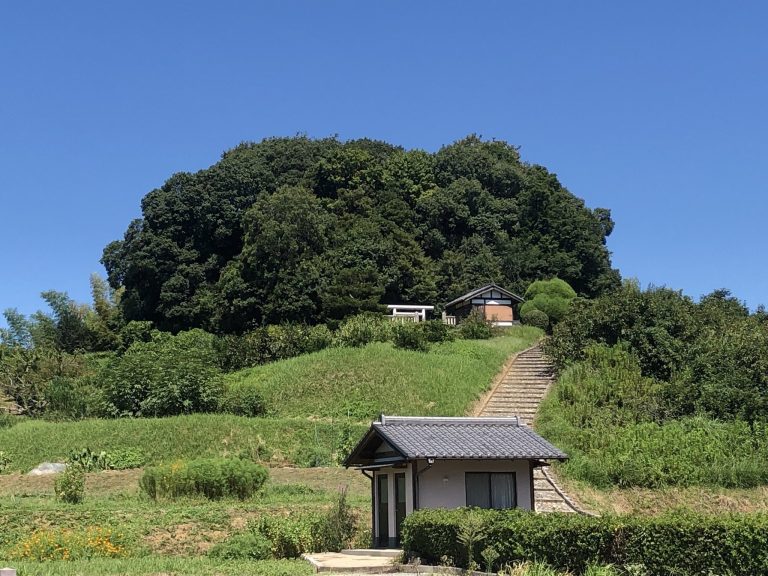
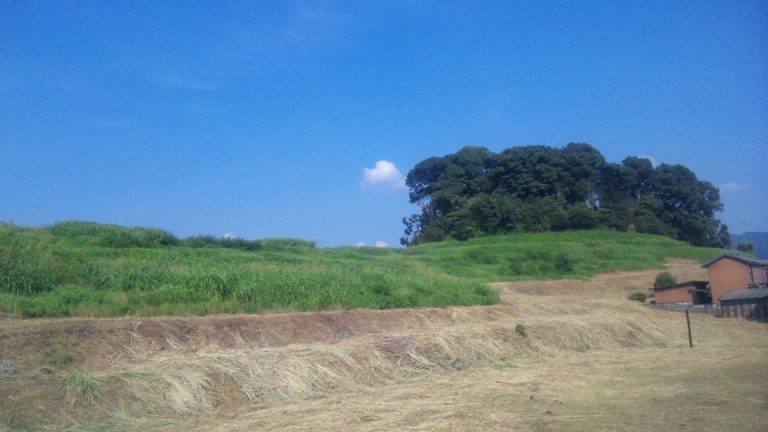
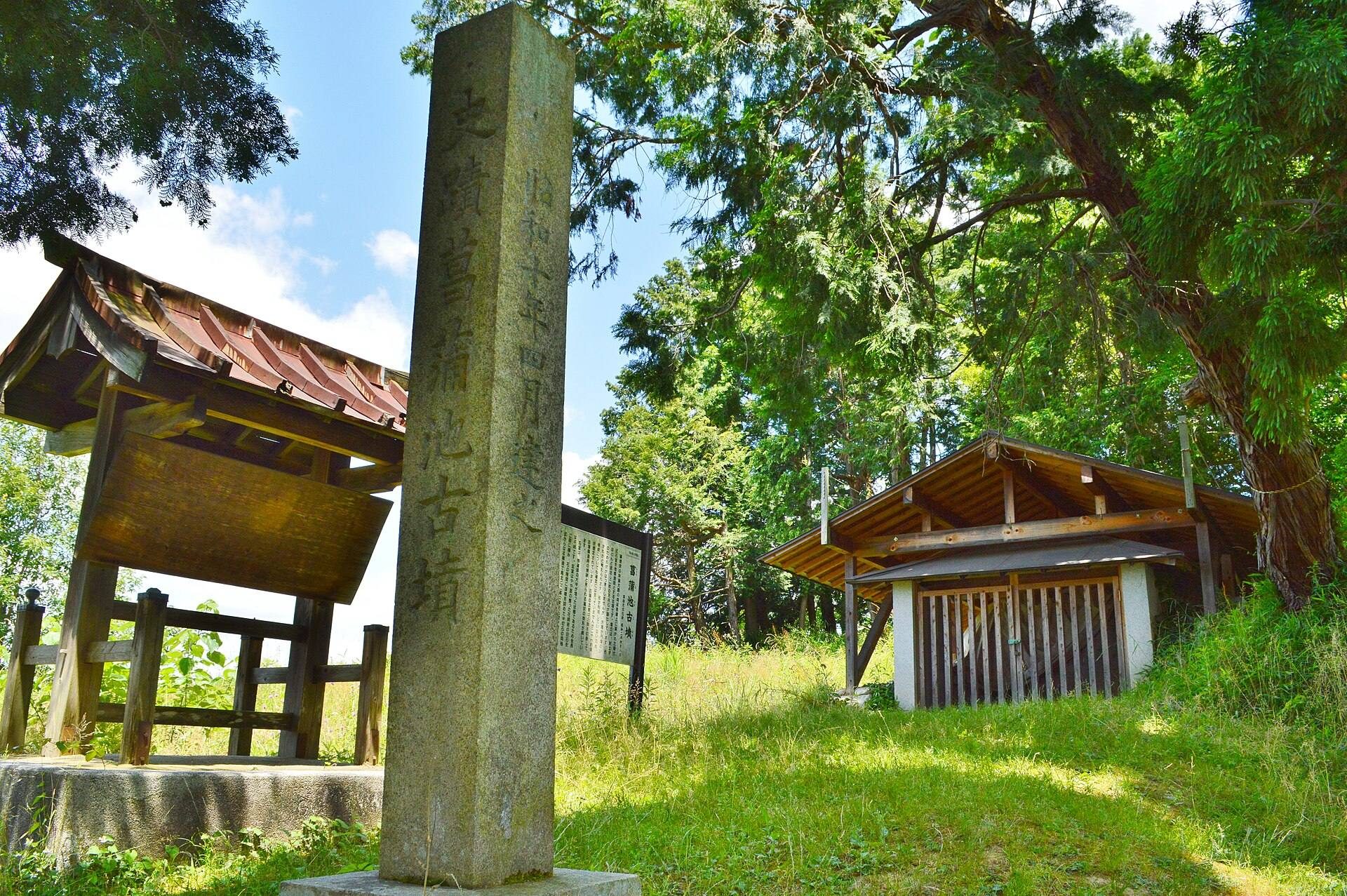
Shobuike Kofun is a square Japanese burial mound in Kashihara, Japan, built around the middle of the seventh century during the final Kofun period or the Asuka period. A kofun is a Japanese burial mound, especially an elite tomb, while a square mound is called a hōfun. Pottery recovered from the site supports this dating. Its unusually extensive burial precinct indicates that it held an important place among elite tombs of the period.
Final Kofun and Asuka periods
By the end of the seventh century, during the period of Fujiwara Palace, the mound had already been affected by leveling and partial destruction. Fujiwara-kyo, the imperial capital established in the late seventh century, developed around a formal north-south axis. Shobuike Kofun lies on the southward extension of this axis, a relationship that has shaped interpretations of the tomb’s occupants.
The person or persons buried at Shobuike Kofun remain unknown. One interpretation identifies them as members of the imperial family, partly because the tomb’s position resembles that of the burial attributed to Emperor Tenmu and Empress Jito, seventh-century rulers associated with Fujiwara-kyo. Another interpretation places the mound within a Soga burial area that also included Ueyama Kofun and the Gojono-Miyagahara burial mounds. The Soga clan was a powerful aristocratic family in sixth- and seventh-century court politics.
A further theory connects Shobuike Kofun and nearby Koyamada Kofun with Soga no Emishi and Soga no Iruka. These prominent Soga figures lived immediately before the political changes of the mid-seventh century. The theory associates the two mounds with the “large tomb” and “small tomb” mentioned in the Nihon Shoki, an eighth-century chronicle of early Japanese history and court traditions.
Recognition and archaeological investigation
A document dated 1082 mentions a “stone tomb” that may refer to Shobuike Kofun. Stone coffins and the stone chamber were described in works published in 1893 and 1923. The chamber was investigated in 1925, and the results were reported in 1927. Surveys around the chamber followed in 1985, an internal survey took place in 1988, and further investigation of the mound was carried out in 2008.
Four stages of excavation to confirm the site’s boundaries took place from 2009 to 2012. These investigations clarified the extent of the burial precinct and added pottery fragments and other finds to the archaeological evidence from the mound. Shobuike Kofun was designated a National Historic Site in 1927. Its protected area was enlarged in 2015 and again in 2025. The kofun is also included within the World Heritage property Asuka-Fujiwara: Archaeological sites of Japan’s Ancient Capitals.
Remains
Shobuike Kofun stands on the lower southern slope of a low ridge near the boundary between Kashihara and Asuka. The mound’s main axis runs slightly west of true north. Its surviving form has been altered by erosion, but investigations indicate a square mound built in two tiers, surrounded by a substantial burial precinct and entered from the south through a stone chamber.
Mound and burial precinct
The mound originally measured about 30 meters on each side and 7.5 meters in height. Its lower tier was approximately square, measuring 30.6 meters along the south side, 29.0 meters along the north side, 29.4 meters from north to south, and 3.2 meters high. The upper tier measured about 17.7 meters on each side and rose approximately 4.3 meters.
The burial precinct extended about 82 meters from north to south. Its east-west width was approximately 67 meters without assuming an outer bank on the west, or about 90 meters if such a bank is included. Ditches bordered the north, east, and west sides. Reddish-gray clay covered parts of the mound, while gravel paving was found in the forecourt, on sections of the ditch bottoms, and on the level surface at the foot of the upper tier. Bricks may have been used near the summit.
Stone burial chamber
The burial facility is a south-opening, horizontal-entry stone chamber, meaning that the burial room is reached through a passage built or excavated horizontally from the side of the mound. Its entrance has side extensions, giving the plan a double-sleeved form. The complete facility is estimated to be about 20 meters long. The chamber measures approximately 7.2 meters in length, 2.5 meters in width, and 3.5 meters in height, while the passage is about 12.8 meters long.
Roughly faced, massive granite blocks form the chamber walls in two courses, and three large stones cover the ceiling. Plaster fills the spaces between the blocks, possibly making the roughly worked masonry resemble more finely cut construction. Erosion of the mound has exposed two ceiling stones. The lower half of the chamber and most of the passage remain buried.
Stone coffins
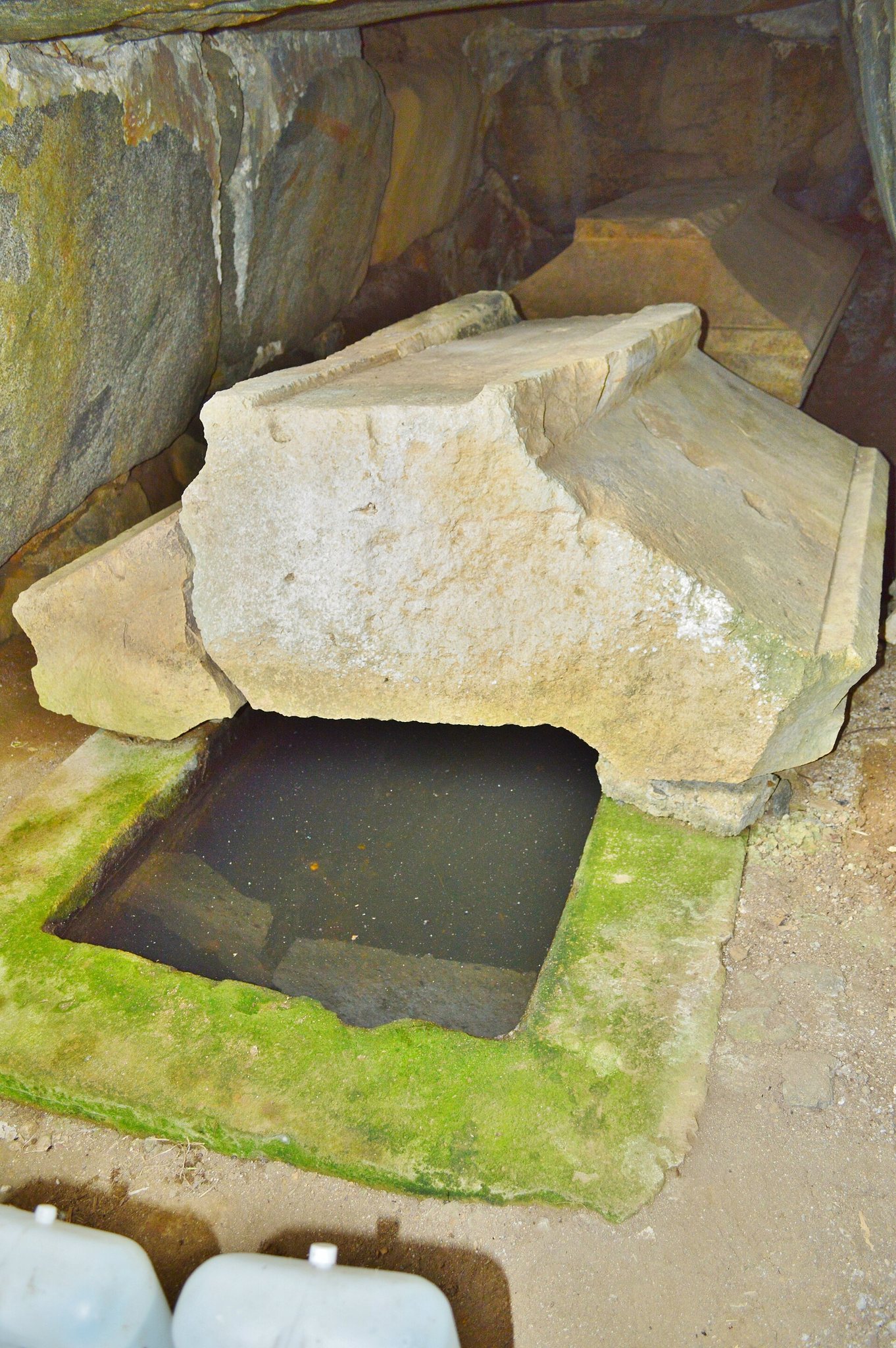
Two hollowed-out, house-shaped stone coffins stand in a north-south line inside the chamber. A house-shaped coffin imitates a building through its roof-like lid and architectural projections. Both coffins were made from stratified hyaloclastite, a volcanic rock formed from fragmented lava that cooled and accumulated in water. The stone came from the Kakogawa River basin in Hyogo Prefecture. The coffins are broadly alike, although the southern one was made with somewhat finer workmanship.
The lids imitate hipped roofs and carry ridge-like projections, while the coffin bodies have projections representing posts and beams. The northern lid has a flat ridge, whereas the southern lid has a concave ridge. Both lids have been displaced and damaged on all sides. Lacquer covered the inner surfaces, and traces of vermilion lacquer survive inside the northern coffin. The interior treatment of the southern coffin remains uncertain, while both coffins may originally have received lacquer on their outer surfaces. Their refined workmanship is unusual, with no close parallel among known stone coffins.