Hiwashi Shrine: A Shinto Shrine of Martial Protection in Japan


Site at a Glance
- Rating
- 4.2
- Popularity
- Very Low
- Country
- Japan
- Primary era
- Early Modern
- Eras represented
- Early Modern
- Civilizations
- Tokugawa
- Site type
- Religious
- Remains
- Sanctuary
On this page10 sections
History
Hiwashi Shrine is a Shinto shrine in Japan, located in Onaba, Odaka, Minamisoma, Fukushima Prefecture. Its present site dates from 1364, while its main sanctuary was rebuilt in 1847 in the nagare-zukuri style, whose gabled roof extends forward over the entrance. Traditionally dedicated to Ame-no-Hiwashi-no-Mikoto, the shrine became associated with archery, warfare, and martial protection.
The martial deity and early tradition
Ame-no-Hiwashi-no-Mikoto is traditionally said to have accompanied Ninigi-no-Mikoto during his descent from heaven and to have served Ame-no-Futodama-no-Mikoto. He is described carrying a bow, arrows, and other weapons while riding a great eagle and descending ahead of the other deities. This tradition gave the shrine a martial character, with Ame-no-Hiwashi-no-Mikoto believed to appear as a great eagle and lead armies in battle.
The historical record Okusoshi also names Kanatobi-no-Mikoto, known as Ama-no-Kanatomi-no-Mikoto, and Ama-no-Nagashiroha-no-Kami among the shrine’s deities. In an earlier tradition, the shrine stood in Numamori Village in Toyoda District, Shimosa Province, where it was called Ogata Shrine. Shimosa was a historical province in eastern Japan.
Warrior patronage and relocation
Taira no Masakado, a tenth-century warrior and provincial leader associated with a major rebellion in the eastern provinces, is said to have revered Ogata Shrine as a shrine of the bow and arrows. He reportedly prayed for the deity to guide his army. After pacifying the Kanto region, the area of eastern Honshu that includes present-day Tokyo and its neighboring prefectures, he was believed to have rewarded the deity’s protection by constructing shrine buildings, donating sacred rice lands, and holding the Rooster ritual.
During the Bunji era, Minamoto no Yoritomo, founder of the Kamakura shogunate, revered Washinomiya in Shimosa Province. He donated sacred rice lands and a sacred horse while praying for good fortune. In 1180, Soma Moritsune began serving under Yoritomo and reportedly distinguished himself repeatedly in battle. Before joining the Oshu Campaign in September 1189, Moritsune prayed for victory at Washinomiya in imitation of his ancestor Taira no Masakado. After gaining substantial military merit, he received Namekata District from Yoritomo and later repaired Washinomiya while deepening his devotion to the shrine.
Around 1323, Soma Shigetane, head of the Soma family of Mutsu, moved from Shimosa Province into the northeastern province of Mutsu. The shrine was then newly established in the Soma region at present-day Ota in Haramachi. Other shrines revered by the ancestral Chiba family, including Myoken Shrine and Shio-gama Shrine, were also newly established there. Myoken is a Buddhist-Shinto astral deity associated traditionally with the Pole Star and the Big Dipper. Hiwashi Shrine was revered in this new setting as a shrine of the martial deity Ame-no-Hiwashi-no-Mikoto.
In 1364, the shrine moved to its current site in Onaba, Odaka. It was called Washinomiya when transferred, but the name changed to Hiwashi Shrine in 1872. The change followed a Meiji government prohibition against shrines dedicated to deities other than imperial ancestral deities using the title “Miya.” Under the former Japanese shrine-ranking system, Hiwashi Shrine was classified as a village shrine.
Rituals and local religious practice
The shrine continues the Rooster Market ritual. Small hand rakes are distributed as auspicious objects, symbolizing the gathering of household goods, precious metals, treasures, and products from the mountains and sea. Merchant households continued this custom. On the first Rooster Day in November, the ritual also included the sale of early taro heads. During wartime, purchasing one was understood symbolically as capturing an enemy’s head.
During the Edo period, Soma Masatane, lord of the Soma-Nakamura domain, studied Yoshida Shinto, a form of Shinto developed by the Yoshida family and influential among shrine institutions. He promoted it among the domain’s shrines, a practice associated with the presence of prayer halls within the precincts of many shrines in Soma District, including Hiwashi Shrine. The annual festival is held on April 10. The Nishiyama family priesthood has served the shrine, and the approach steps were built in 1829 by the serving priest, Nishiyama Masatomo, through his own efforts.
Remains
The shrine complex contains a worship hall, an offering hall, and a main sanctuary, together with a prayer hall beside the stone approach and several smaller precinct shrines. The surviving buildings and ritual features combine the shrine’s central worship spaces with structures associated with fire offerings, local protective deities, fertility, and family well-being.
Central shrine buildings
Main sanctuary
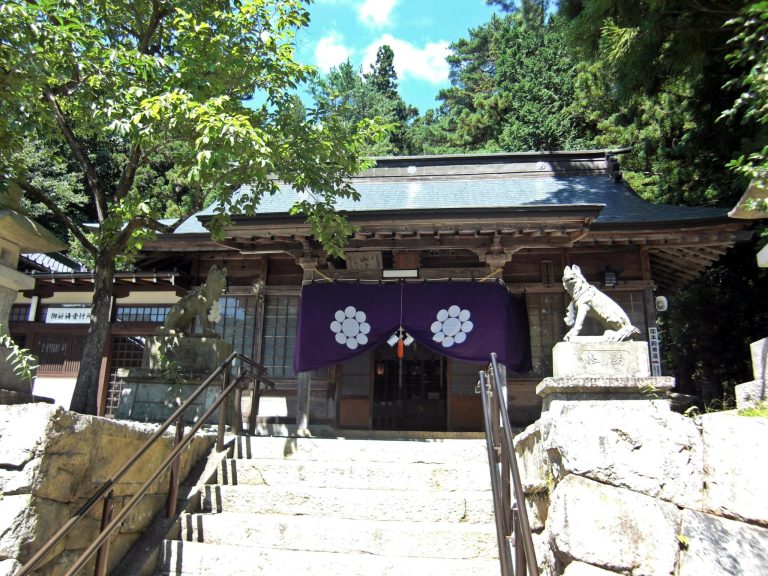
The main sanctuary is a one-bay nagare-zukuri building rebuilt in 1847. Its gabled roof projects over the front to create a covered entrance. The sanctuary was formerly roofed with thatch, and copper sheeting replaced that covering in 1989.
Prayer hall and goma altar
The prayer hall beside the approach is an irimoya-style building, with a gabled upper roof combined with hipped lower sections. It contains a square goma altar, an altar used for ritual fire offerings, and a divine seat. The altar was once made in two sections that folded at the center, allowing it to be carried for ceremonies held away from the shrine. It was later altered into a single structure to prevent damage.
Stone approach
The approach includes stone steps constructed in 1829. The first and third flights retain the form given to them at that time, preserving part of the work associated with Nishiyama Masatomo’s tenure as shrine priest.
Precinct shrines and sacred stones
Several smaller shrines stand within the precinct. Koyasu Shrine is dedicated to Konohanasakuya-hime-no-Mikoto, Yamatsumi Shrine to Oyamatsumi-no-Kami, and Yosan Shrine to Wakumusubi-no-Kami and Ukemochi-no-Kami. A shrine dedicated to Dosojin is also present. Dosojin are protective boundary or roadside deities associated with safe travel and protection from harmful influences.
Beside the Dosojin monument is a stone shaped like female genitalia, known as the Female Genital Stone. It is revered as a Dosojin and regarded as a symbol of fertility and harmony between married partners.