Matsuoka-ji Temple: A Jōdo Shinshū Temple in Japan

Site at a Glance
- Rating
- 4.1
- Popularity
- Very Low
- Country
- Japan
- Primary era
- Modern
- Eras represented
- Modern
- Civilizations
- Japanese, Tokugawa
- Site type
- Religious
- Remains
- Temple
On this page16 sections
History
Matsuoka-ji Temple is a Jōdo Shinshū temple in Japan, belonging to the Honganji-ha tradition and centered on worship of Amida Buddha. Its full development is associated with the early 1470s, when Renkō, the third son of Rennyo, settled in Kaga. The temple later became one of the Three Kaga Temples, influential institutions that organized Jōdo Shinshū followers and helped lead Ikkō uprisings, movements involving organized believers and regional allies.
Foundations in Kaga
Two traditions describe the temple’s beginnings. One traces Matsuoka-ji to a chapel established at Hasatani in 1451 by Rennyo, the eighth head priest of Honganji and a major organizer of medieval Jōdo Shinshū. This chapel later joined a temple founded at Furuya-shiki in present-day Matsuoka, Komatsu, by Renkō. The other tradition traces the institution to a temple that Renkō founded at Yamauchi after moving to Kaga at the invitation of Renzō of Honsen-ji. It was subsequently moved to Furuya and then Hasatani.
Formerly called Hasatani Matsuoka-ji, the temple worked with Wakamatsu Honsen-ji and Yamada Kōkyō-ji as the Three Kaga Temples. In the 1480s, Matsuoka-ji was involved in organizing Shinshū followers in Nomi District, including the group known as the Nomi District Four Kō. Even after the temple lost its base at Hasatani, a communal religious center remained there, reflecting the institution’s former role in regional organization.
Religious and political influence
Renkō’s influence extended beyond religious affairs. In 1485 and 1486, the shogunate ordered him to administer estate-related matters in Kaga, including the enforcement of rights at Isobe and Aozaki and the appointment of an agent at Yasue. These responsibilities reflected his connections with prominent court and shogunal families.
During the 1488 Kaga uprising, more than 50,000 people from Nomi District were said to have joined the wider movement, although the actions of Matsuoka-ji itself are not recorded. In 1506, a Kaga religious army invaded Echizen at the request of Hosokawa Masamoto. The Asakura army defeated it at the Battle of the Kuzuryu River, where Matsuoka-ji’s internal retainer, Shimotsuma Shōken, was said to have been killed. He may also have commanded the invading force, but that role remains an inference.
A temple tradition states that Emperor Go-Kashiwabara granted Renkō the title of saint and the name Matsuoka-ji in 1517. An inscription on the reverse of the principal image indicates that the temple already had followers in Noto by 1524. A Matsuoka chapel was suspended in 1519 under Honganji restrictions on new branch chapels. In the early sixteenth century, Matsuoka-ji, Honsen-ji, and Kōkyō-ji reached the height of their influence and were jointly entrusted with assisting in the guardianship of Shōnyo, Honganji’s tenth head priest.
The Daishō Uprising
Rivalry between the Three Kaga Temples and Chōshō-ji and Hongaku-ji led to the Daishō Uprising, a sixteenth-century internal conflict among Shinshū forces in the Hokuriku region that began in 1531. Matsuoka-ji at Hasatani was attacked, and the temple eventually fell after fighting that may have taken place in two stages.
Renkō was held as a hostage and died on October 18. On November 18, nine members of the temple family and its warrior retainers, including Renkei and members of his family, died by suicide. The surviving family was excommunicated, although Yūshū was pardoned in 1550. After the loss of Hasatani, later tradition places the temple first at Kirihata in Yanagida Village and then at Matsunami, where it was transferred in 1583 during the tenure of its fifth abbot, Kaneshū.
Relocation and later affiliations
A related temple, later known as Hōeiji, moved to Matsunami with Matsuoka-ji and became part of the compound. The village of Fūra is traditionally said to have become the temple’s parish community. Another genealogical tradition states that the fourth abbot, Kenkei, and his mother moved to Matsunami and occupied an abandoned former Tendai temple called Kōfuku-ji. The institution supposedly retained that name for more than sixty years before restoring Matsuoka-ji. A temple in present-day Suzu adopted the name Kōfuku-ji in 1620, apparently preserving the earlier name associated with this history.
Traditions from the Sengoku period say that the abbot Keijun supported the Chō clan during Uesugi Kenshin’s invasion of Noto, met Maeda Toshiie, and acted with the Oda side. He is also said to have accompanied Maeda Toshiie and Sakuma Morimasa during an attack on Noto Hatakeyama loyalists at Mount Sekidō. Historian Kitanishi Hiroshi proposed that an early alliance among the Oda forces, the Chō clan, and Matsuoka-ji contributed to the early submission of southern Kaga. In 1614, at the beginning of the Winter Campaign of Osaka, Matsunami Kōfuku-ji, identified with Matsuoka-ji, supplied hostages when Maeda Toshinaga demanded them from powerful Shinshū temples.
Under the Kaga domain, Matsuoka-ji became associated with the Maeda family after a daughter of the abbot Keiei became the nurse of Maeda Mitsutaka. The temple later transferred to the western, or Honganji, branch of Shinshū and became an official liaison temple of that branch in Okunoto. Its name is thought to have returned from Kōfuku-ji to Matsuoka-ji during this period.
The temple’s authority subsequently declined. Of its ten subordinate temples, six transferred to the eastern branch and two became temples within Matsuoka-ji’s own compound. Only Kōrin-ji and Daigyō-ji remained effective subordinate temples. By the Kansei era, Matsuoka-ji was no longer listed among the official liaison temples, and in 1820 it petitioned Nishi Honganji for treatment equivalent to that of Kōtoku-ji.
Community and continuing life
Matsuoka-ji’s followers were concentrated around Matsunami and in parts of Suzu and Noto, particularly along the coast. Their number reached about 850 households in the early Meiji period and had fallen to approximately 650 by the 1980s, partly because subordinate temples became independent. In the late Edo period, the sixteenth abbot was a central cultural figure in the Matsunami association of local intellectuals. A prominent Southern School painter stayed at the temple and taught a farmer’s son who later became known as a painter and calligrapher.
The chief priesthood passed from the twenty-first abbot, Hasatani Terumitsu, to the twenty-second, Hasatani Masamitsu, on September 24, 2011. Ceremonies held in 1990, 2001, and 2014, associated respectively with the statue of Prince Shōtoku, the five-hundredth memorial observance for Rennyo, and the seven-hundred-and-fiftieth memorial observance for Shinran, included processions of children. The January 1, 2024, Noto Peninsula earthquake severely damaged the assembly hall, mountain gate, and approach. In June 2024, the twenty-second abbot received Honganji’s head priest, Ōtani Kōjun, during his visit to the disaster-affected area. The wooden statue of Prince Shōtoku received designation as an Important Cultural Property of Japan in 1993.
Remains
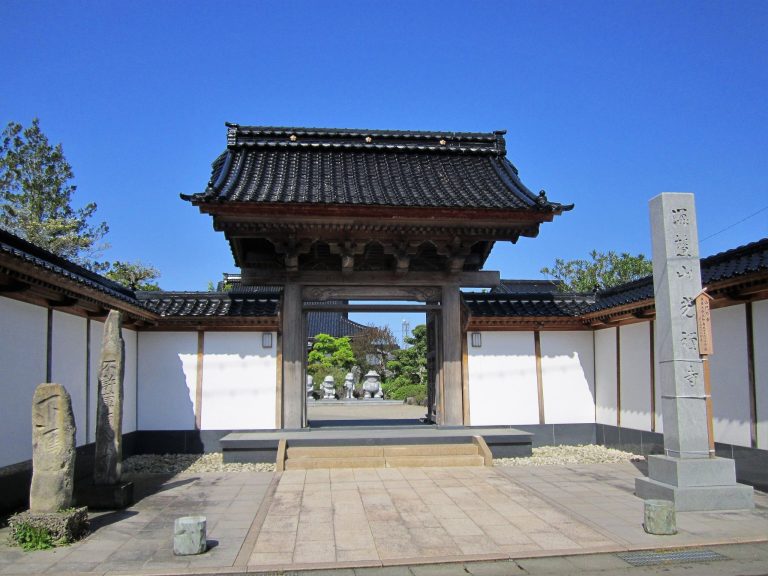
The present compound occupies the Matsunami site. It contains a large wooden main hall, a sutra repository, surviving residential quarters, a mountain gate, Buddhist statues, devotional inscriptions, and a large red pine. Earlier buildings stood in the low-lying area now called Gobō-machi, where flooding led the temple to request relocation in 1811. After official approval, the fourteenth abbot, Hōkun, built a temporary main hall on the present grounds on August 14, 1814.
Temple buildings
Mountain gate
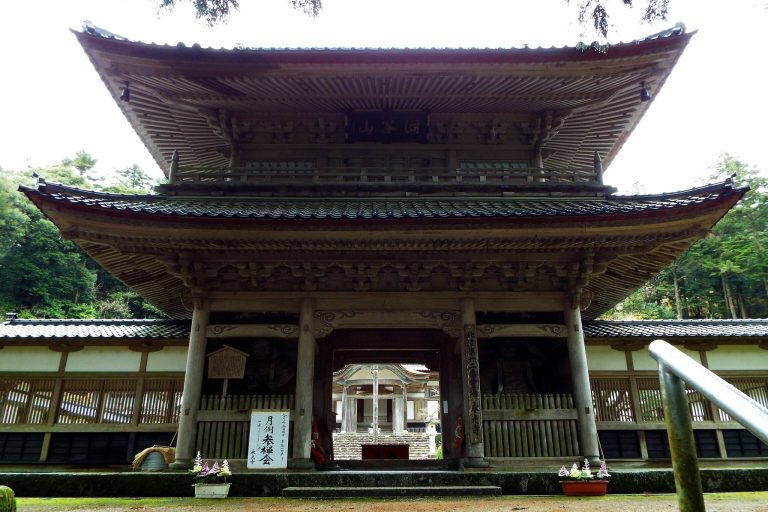
The mountain gate is a single-bay, single-entrance Kōrai gate with a gabled roof covered in ceramic tiles. It forms part of the approach to the main compound and was among the structures damaged by the 2024 earthquake.
Main hall and supporting buildings
A large main hall, described as measuring fourteen bays on each side and as one of the largest in Okunoto, was completed in April 1824. A sutra repository followed, and new priests’ residential quarters were added in 1849. The main hall and repository burned in 1880. The present main hall was rebuilt in 1892, while the 1849 residential building survived.
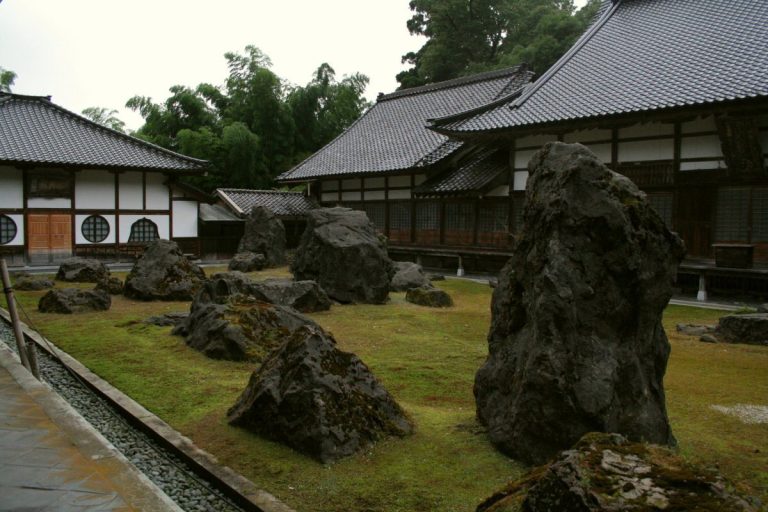
The present main hall is a single-story wooden structure with a hipped-and-gabled roof covered in ceramic tiles. Its entrance faces forward beneath a three-bay canopy. The exterior uses traditional post-and-panel construction with board siding. The grounds also contain statues of Shinran and Rennyo and an explanatory sign concerning the temple’s history.
Red pine
A red pine in the compound measures 255 centimeters in circumference and 25 meters in height. It is counted among the large trees of the former Uchiura area.
Buddhist images and inscriptions
Principal image
The principal image is a wooden standing statue of Amida Buddha. Its artist and date of manufacture are unknown.
Prince Shōtoku statue
A wooden statue of Prince Shōtoku stands in a large shrine on the right side altar. It is traditionally said to have been transmitted from Kōfuku-ji in Nara and is regarded as a refined Kamakura-period work using raised gold decoration and colored pigments. The 152.7-centimeter figure represents Prince Shōtoku at sixteen, a filial-devotion image portraying him as a youth devoted to his parents.
The statue was assembled using joined-block construction, a technique in which several wooden blocks form the image, and has glass eyes inserted into the head from within. The prince’s hair is tied in sidelocks, and he wears a Buddhist stole over his robes while holding a handled incense burner in both hands. Its face, body proportions, realistic robe folds, and elegant raised-gold decoration are described as being in good condition and characteristic of dignified Kamakura sculpture. The recorded measurements include 23 centimeters from crown to chin, a face width of 16 centimeters, an ear-to-ear width of 19.7 centimeters, an arm-span measurement of 52.5 centimeters, and a hem width of 44.1 centimeters.
Female deity figures
Two small wooden seated female deity figures are carved from single blocks. One is 27 centimeters high, 20.5 centimeters across the knees, and 8 centimeters deep; the other is 27.5 centimeters high, 20.5 centimeters across the knees, and 9 centimeters deep. Both sit upright with their hands folded and their hair falling down their backs.
The black pigment in their hair remains well preserved, while much of the painted facial detail and brown pigment on the robes has flaked away. One figure bears a simple ink design extending from the abdomen to the knees. An ink inscription on its base refers to the fifth year of the Ōei era. The pair is associated with two male deity figures preserved at Hakusan Shrine in Takinobo because those images carry a date inscription from the Ōei era and share the same artistic style. The female figures are regarded as rare examples of early Muromachi-period deity sculpture.
Devotional inscriptions
Two six-character devotional inscriptions attributed to Rennyo are preserved at Matsuoka-ji. One is written in regular script and the other in cursive script. An appraisal by Okamura Yoshifumi of Ryukoku University confirmed the cursive inscription as Rennyo’s work in 1997.