Shidori Shrine: An Ancient Weaving Shrine in Yosano, Japan


Site at a Glance
- Rating
- 4.4
- Popularity
- Very Low
- Country
- Japan
- Primary era
- Early Modern
- External website
- Open
- Eras represented
- Classical, Early Modern
- Civilizations
- Tokugawa
- Site type
- Religious
- Remains
- Sanctuary
On this page12 sections
History
Shidori Shrine is an ancient shrine in Yosano, Japan, traditionally founded in 710 or 712 when the Shidori deity was enshrined on Mount Ishizaki. Its origins are associated with the beginning of fine patterned-silk production in the region, linking the shrine from an early period with the weaving traditions of historic Tango Province, a province corresponding broadly to northern Kyoto Prefecture.
Origins and medieval development
The shrine appears in the Engishiki Jinmyocho, a tenth-century administrative and ritual compendium listing officially recognized shrines and their ritual provisions. Compiled in 927, it places Shidori among the shrines of ancient Tango. Tradition connects its foundation with an imperial order received by an official of Tango’s leading shrine, who established worship for the Shidori deity. Emperor Daigo, who reigned from 897 to 930, is also traditionally said to have venerated the shrine.
The shrine was moved to its present location in 1223. In 981, it received the rank of Junior Second Rank. At Migochi, it became the tutelary deity of the local people, while the prosperity of the regional weaving industry, especially the production of Tango crepe silk, reinforced its religious importance. Worshippers from neighboring villages traditionally came to the festival carrying ramie or hemp fibers.
Religious changes and local worship
For centuries, Shinto-Buddhist syncretism, the combination of kami worship with Buddhist institutions, shaped the shrine’s identity. It was then known as the Ishizaki Great Deity or the Ishizaki Shidori Great Deity. The Meiji government’s policy of separating Shinto and Buddhism required the two traditions to be administratively distinguished, and Buddhist associations were removed from the shrine. It was subsequently renamed Shidori Shrine.
The shrine was designated a village shrine in 1873, began receiving offerings from the state in 1907, and became a prefectural shrine on November 20, 1944. Its observances were later reorganized, bringing the former spring festival and a separate May offering ceremony together as the present spring festival.
The principal deity is regarded traditionally as an ancestor of the Shidori clan and as a deity of weaving. One tradition says that the deity wove patterned cloth at the command of the heavenly deity Takamimusubi while the sun goddess Amaterasu was concealed in a heavenly rock cavern. The deity is also associated with martial valor, leading some parishioners to venerate Hachiman, a major deity traditionally linked with warfare and the protection of warriors.
The Migochi Float Festival
The annual Migochi Float Festival is traditionally dated to 1755 and grew alongside the prosperity of the Tango crepe-silk industry. It was formerly held on the first day of the eighth lunar month as the Hassaku Festival. Around 1887, it was incorporated into the Kayadani Festival and held on April 24 and 25. The celebration became independent and moved to May 3 and 4 in 1991, a change associated with the decline of weaving and the difficulty of finding participants with regular weekday employment.
The present sequence begins with a deity-procession ceremony on May 2, followed by the eve festival on May 3 and the main festival and return procession on May 4. Its rites include kagura, sacred dance and music performed for Shinto deities, a deity-invitation ceremony, float processions, entertainment processions, and the return of the sacred procession. Twelve floats participate, including shrine-music floats, mountain floats, and children’s floats. Mountain and performance floats alternate from year to year.
During the deity-invitation rite at a bridge near the Okuyama River, sacred sake and consecrated rice are offered to the river three times. A representative raises a ritual wand and calls three times toward the east. Local tradition says that the principal deity and the female deity of a neighboring shrine in the Akashi district were once spouses, separated when she became the chief wife of a powerful deity. They are believed to reunite during this festival, when she joins the procession from beneath a pine tree on the Noda River bank. Her brother and two other associated deities are also traditionally said to take part.
In April 2017, Shidori Shrine and the Migochi Float Festival were recognized as components of the Japan Heritage story “The Tango Crepe-Silk Corridor.” The festival is also a Kyoto Prefecture intangible folk cultural property. A recent repair campaign found an ink inscription on the roof naming a dedication made in 1808. The entire precinct is designated a Kyoto Prefecture cultural-property environmental conservation district.
Remains
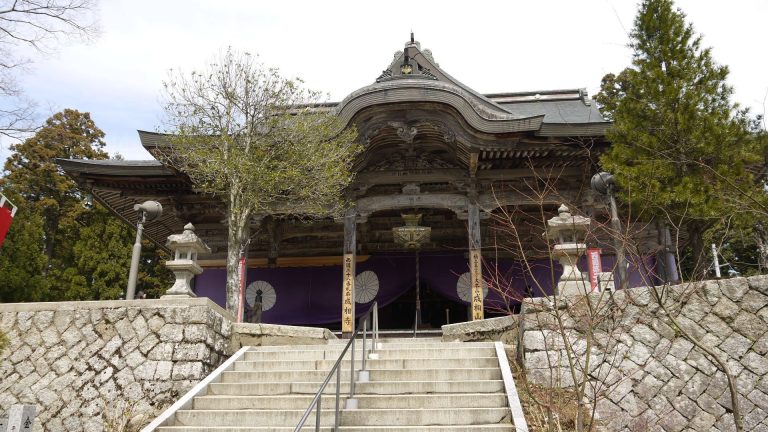
The precinct is organized around a connected main sanctuary, dance hall, and worship hall, with a storehouse, shrine gate, office, and other buildings. Subsidiary shrines stand at several points within this arrangement, while four ancient burial mounds occupy part of the precinct. Together, the buildings and archaeological features preserve the shrine’s religious setting and its long association with the Migochi district.
Sanctuary and precinct buildings
Main sanctuary
The main sanctuary burned during the Kaei era, and the present building was constructed in 1821. It is a standard one-bay sanctuary with an irimoya roof, which combines a hipped roof with a gabled section, covered in copper sheet. A front porch carries a karahafu, a curved cusped gable, while verandas extend along the front and both sides. A projecting wooden staircase and front platform connect the sanctuary with the dance hall.
Paired folding lattice doors close the front, and the side elevations have double-leaf wooden doors with carved decoration. Inside, double-leaf wooden doors divide the building into an inner sanctuary and an innermost sanctuary. Lower and intermediate tie beams, together with capital blocks, secure the main posts. The bracket system has two projecting levels with tail rafters and a surrounding decorative beam, above which another three-bracket set supports a rounded eave beam and the rafters.
The entrance porch uses projecting brackets, with additional brackets above the rainbow beam joining the porch to the main building. Its ceiling is a coffered grid ceiling formed from recessed panels, a feature associated with shrine sanctuaries in the Tango region during the Edo period. Carved side screens and doors show Huang Shigong and Zhang Liang, along with guardian lions and peonies. The carving is considered similar to that of the Great Gate of Nishi Honganji in Kyoto. The sanctuary was designated a Kyoto Prefecture cultural property in 1996.
Shrine gate and worship hall
The shrine gate is a single-story, eight-legged structure with three bays and one central passage. It has a gabled, tiled roof and a side-entry arrangement. The worship hall has a hipped-and-gabled tiled roof, a side-entry arrangement, a six-bay length, and a one-bay entrance porch.
Subsidiary shrines
Awashima Shrine stands beside the outer torii, or shrine gateway. Inari Shrine is positioned on the right side of the central precinct, and Wakamiya Shrine stands on the left. Additional shrines associated with Shidori Shrine lie in Okadayama, Umetani, Okuyama, Daido, Moriya, Nakatsubo, Okuji, and Fukumori. Their traditions include mountain peaks, fire, a mountain deity, commerce, an island sanctuary, and the Inari cult.
Burial mounds and excavated ritual evidence
Ishizaki Burial Mounds
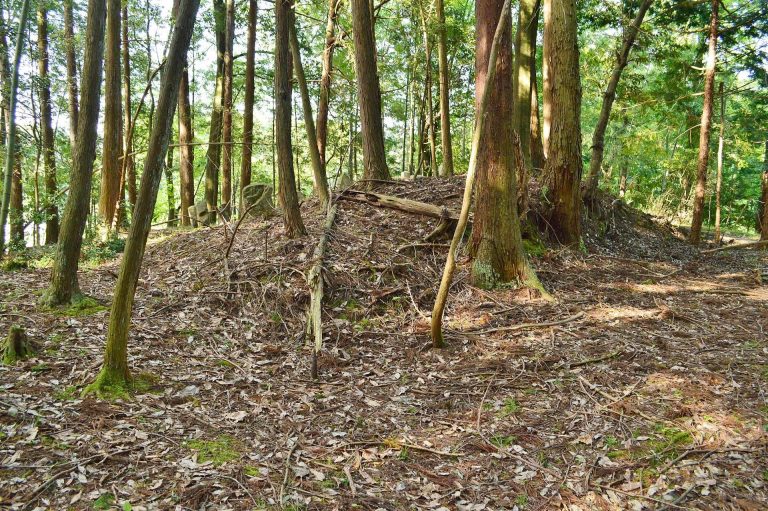
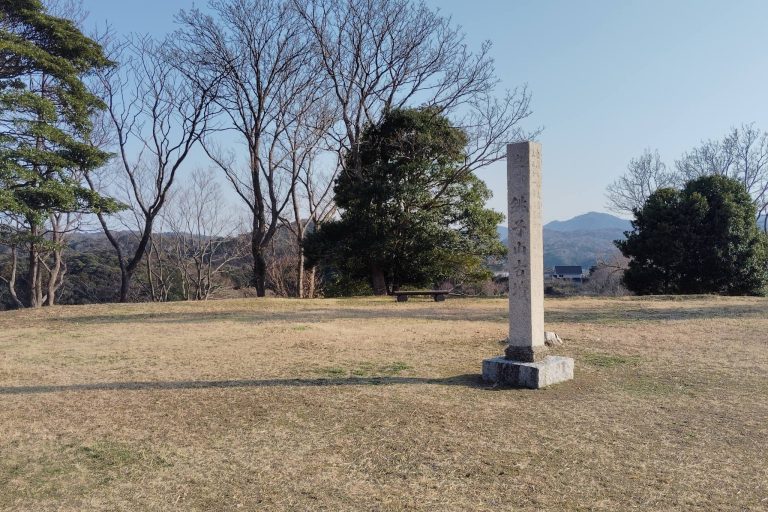
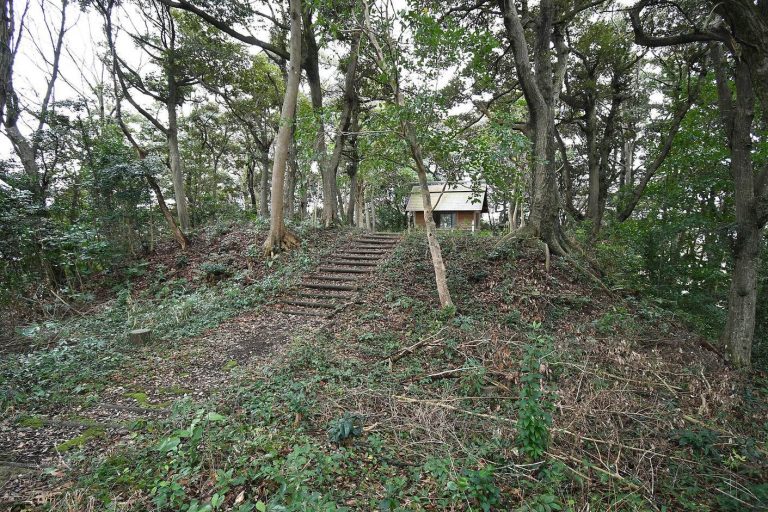
Four burial mounds, known as the Ishizaki Burial Mounds or the Shidori Shrine Burial-Mound Group, are located within the precinct. Three are round mounds and one is keyhole-shaped, a form combining a circular rear section with a narrower rectangular front. They are estimated to date from the fifth century, during the middle of the Kofun period, when large elite burial mounds were constructed in Japan.
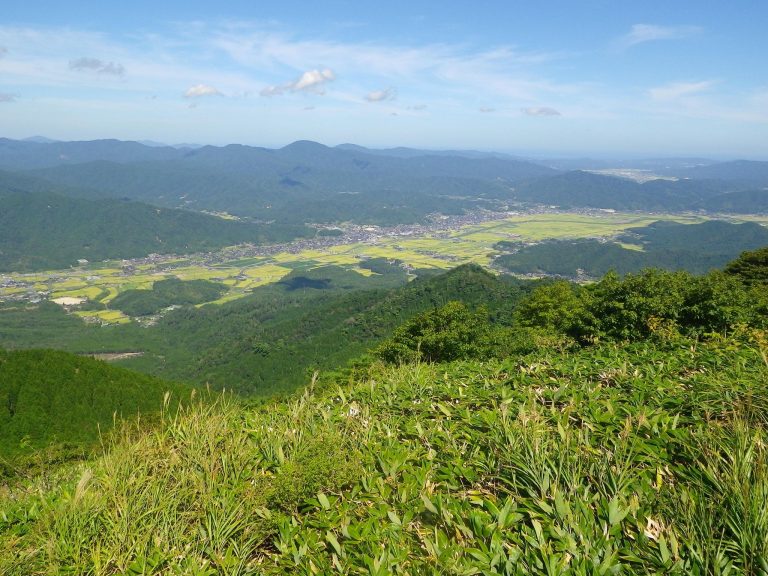
The first round mound is 4 meters high and 15 meters across at its longer diameter. The second is 2.5 meters high and measures 10 meters across its longer diameter, while the third is 2 meters high and 7 meters across. The keyhole-shaped mound is 60 meters long. Their relationship to the shrine remains unclear. The burial-mound group provides views across the Migochi district toward Mount Oeyama.
Bronze ritual bell
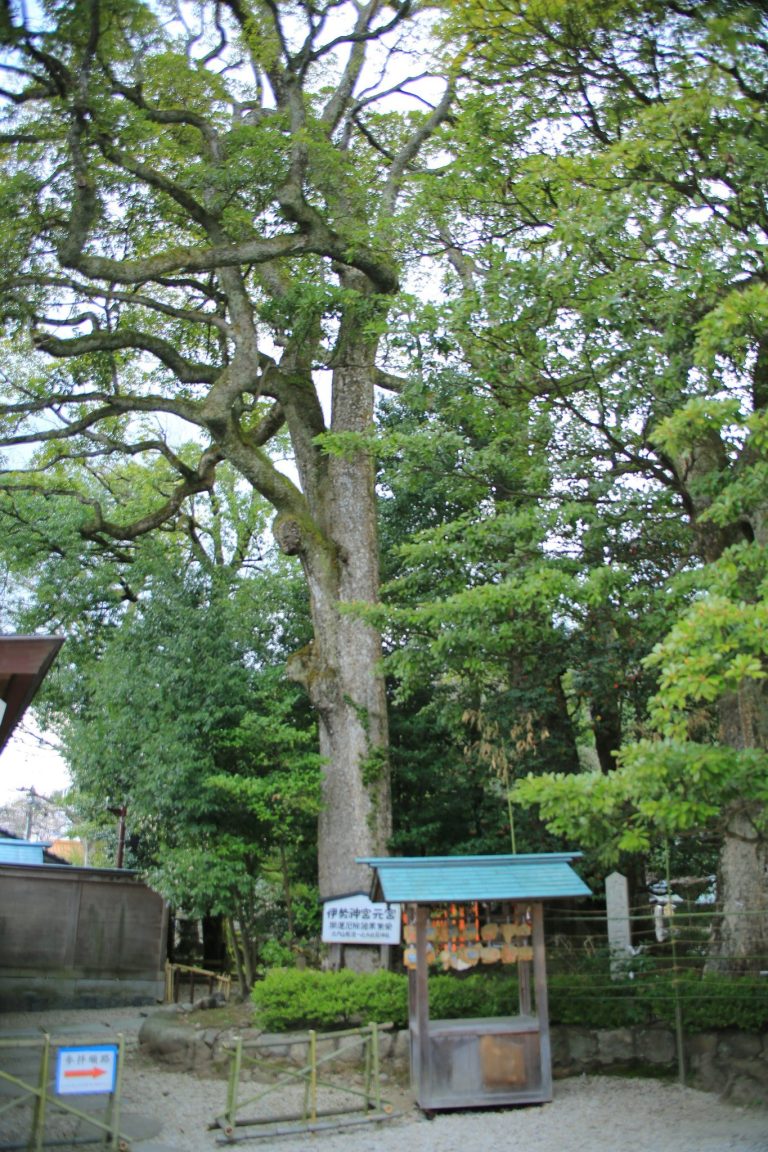
A bronze ritual bell was excavated from the precinct. Its discovery accords with a shrine tradition in which people gathered beneath a sacred tree, displayed treasures and offerings, sounded ritual vessels, and divined the success of planting. The bell therefore forms a material connection with an older ritual tradition associated with the shrine’s grounds.