Isesaki Shrine: A Shinto Shrine of Isesaki, Japan


Site at a Glance
- Rating
- 4.1
- Popularity
- Low
- Country
- Japan
- Primary era
- Modern
- External website
- Open
- Eras represented
- Modern
- Civilizations
- Japanese
- Site type
- Religious
- Remains
- Sanctuary
On this page7 sections
History
Isesaki Shrine is a Shinto shrine in Isesaki, Japan, founded during the Kamakura period, the era of samurai governments conventionally dated from the late twelfth to the fourteenth century. Its traditional foundation date is the first year of the Kenpo era, when the warrior Miura Yoshizumi established it. Formerly called Iifuku Shrine and popularly known as Iifuku-sama, it became closely associated with the military and political history of the area.
Kamakura and feudal connections
The lords of Akashi Castle, later known as Isesaki Castle, strongly revered the shrine. Among the military leaders associated with its worship were Uesugi Kenshin, a major sixteenth-century daimyo and commander in eastern Japan, and Yura Narishige, a military leader of the Yura family. Their devotion reflects the shrine’s place within the religious life of local warrior rule.
Recognition and local administration
From the Edo period onward, successive lords of the area repaired the shrine buildings and organized its festivals. In the ninth year of the Meiwa era, the Yoshida family granted the shrine Sho-ichi-i, the highest rank in Japan’s traditional system of court ranks. In 1873 it was classified as a village shrine, and in 1906 it became eligible to receive government offerings of ritual food and cloth.
Several nearby shrines, including an Inari shrine dedicated to the Shinto tradition associated with rice, agriculture, prosperity, and commerce, were merged with Iifuku Shrine in 1926. The shrine then took the name Isesaki Shrine. In 1941 it was placed in the former prefectural shrine category. The former town name Miyamoto-cho, which encompassed areas now called Sankocho, Heiwa-cho, and Honcho, originated from the shrine’s location.
Religious life and local traditions
Ukemochi, a Shinto deity associated with food and agriculture, is the principal deity of Isesaki Shrine, which also enshrines 27 other deities. Its continuing religious calendar includes the Joshu Yaki-Manju Festival on January 11 and the Ebisu-ko Festival on November 19. The latter honors Ebisu, a deity associated particularly with fishing, commerce, prosperity, and good fortune.
Since 2003, the Yaki-Manju Festival has been held together with Isesaki’s first market, a daruma-doll market, and includes the preparation of a giant grilled manju, a Japanese bun made from manju dough. Isesaki Shrine is also regarded as the birthplace of the local specialty known as shrine croquettes.
Remains
Precinct and worship hall
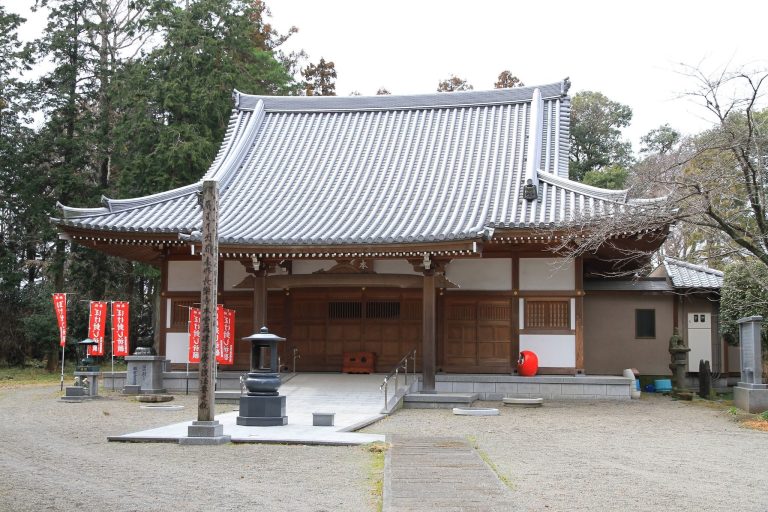
Isesaki Shrine occupies a precinct of approximately 700 tsubo, or about 2,300 square metres, with dense planting that includes zelkova and ginkgo trees. A torii, the gateway marking the approach to a Shinto sacred precinct, stands among the grounds, together with the worship hall where offerings and prayers are presented. The worship hall was built in 1935.
Aircraft propeller and associated shrines
A large wooden propeller is mounted above the worship hall’s front entrance. It came from a Type 90 No. 3 reconnaissance seaplane and was donated in 1937 by employees of the former Nakajima Aircraft Company as a prayer for personnel to return safely from the war front. The propeller design appears on the shrine’s stamp and on amulets for travel and aviation safety.
The precinct also contains an Inari Shrine, originally from Sankocho, and Fukutoku Shrine, which is located within Fukutoku Community Hall. Isesaki Shrine’s crest is a sworded oxalis emblem enclosed within a circle.