Kaijin Shrine: A Shinto Shrine and Hachiman Sacred Site in Tsushima, Japan


Site at a Glance
- Rating
- 4.3
- Popularity
- Low
- Country
- Japan
- Primary era
- Medieval
- External website
- Open
- Eras represented
- Medieval
- Civilizations
- Ashikaga shogunate
- Site type
- Religious
- Remains
- Sanctuary
On this page15 sections
History
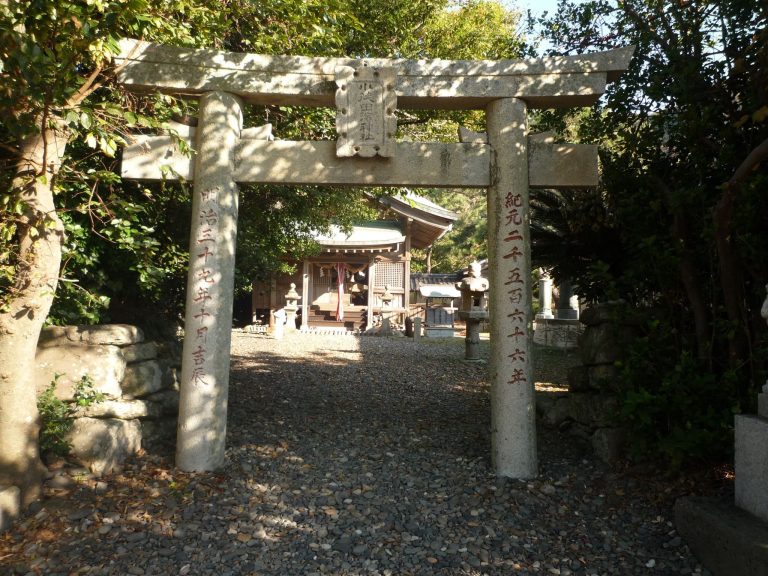
Kaijin Shrine is a Shinto shrine in Tsushima City, Japan, on Mount Izu in the Kizaka area of Nagasaki Prefecture. Shinto is Japan’s indigenous religious tradition, centered on reverence for kami associated with nature, places, ancestors, and historical traditions. The shrine’s history combines worship of the sea deity Watatsumi, traditions surrounding Empress Jingu, and the later prominence of Hachiman, a major kami associated with Emperor Ojin and with protection and the state.
Origins in sea and mountain worship
Shrine tradition connects the site with Empress Jingu’s return from her campaign against the Three Han states. It says that she first worshipped Watatsumi at sea and later dedicated eight banners on the mountain. The same tradition regards Kizaka as the origin of Hachiman worship, states that shrine buildings were established during the reign of Emperor Keitai, and says that the deity was transferred to Usa during the thirty-first year of Emperor Kimmei’s reign. These emperors belong to the traditional imperial genealogy, and the account reflects the shrine’s long association with both maritime belief and the imperial line.
Another tradition attributes the destruction of foreign warships to violent clouds and winds rising from Mount Kizaka during the reign of Emperor Nintoku. The banners associated with Empress Jingu were later moved to the present mountain site, which became known as Kizaka Hachiman Shrine. The traditions surrounding Toyotama-hime, a sea-associated goddess, also shaped local religious interpretation. Some accounts connect the shrine with an older custom of building childbirth huts, linking it to the story that Toyotama-hime gave birth at Kizaka.
Foundation and medieval development
The shrine’s foundation date remains uncertain. A claim that an official order established it in 906 is not confirmed by surviving evidence. A record concerning branch shrines of Usa Hachiman suggests that its establishment, or its conversion into a Hachiman shrine, may date to 1052 or earlier. By March 1160 at the latest, documentary evidence shows that the shrine existed as a Hachiman shrine.
Fujiwara Chikamitsu, the governor of Tsushima, repaired sixty shrines in 1179, including this Hachiman shrine. Further repairs were ordered in 1253, while disputes over delayed construction reached the court in 1256. In 1288, Shoni Tadahiro ordered the completion of buildings that had already been delayed for six years. In 1378, the provincial military governor So Sumishige became principal patron of new shrine construction, and in 1407 the shrine received exemption from miscellaneous public services.
Medieval records also preserve details of its religious administration. Chokei served as chief priest and lecturer, while Tsuneyoshi held the position of deputy chief priest and lecturer in 1267. In 1296, Daifubo Keigaku received confirmation as overall chief priest of the Hachiman shrine. The shrine was regarded as Hachiman Hongu and as the leading shrine of Kamigata County. Tsushima already had an ichinomiya, the chief-ranking shrine of a historical province, by 1230, but the earliest surviving reference explicitly identifying Kaijin Shrine as the province’s chief shrine dates to May 26, 1378.
Names, identities, and religious change
The shrine’s name changed several times. It was formerly called Watatsumi Hachiman Shrine, and from the Hakuho period onward it was known as Hachiman Hongu or Kamitsu Watatsumi Hachiman Shrine. In the early-modern period it was called Kizaka Hachiman Shrine. The names Tsushima Sho Hachiman Shrine, Kamitsu Hachiman Great Bodhisattva, and Izu Shrine also appear in historical records. A document dated March 17, 1267, uses Hachiman Hongu, while another dated January 9, 1362, uses Kamitsu Hachiman. The latter name distinguished it from Shimotsu Hachiman Shrine, now Izuhara Hachiman Shrine, in southern Tsushima. The shrine was renamed Watatsumi Shrine in 1870 and Kaijin Shrine in June 1871.
Its identity has been debated in relation to several ancient shrine designations, including Watatsumi Shrine, Watatsumi Miko Shrine, Koroku Shrine, and Koroku Miko Shrine. The Engi-shiki, a tenth-century compilation of court procedures and regulations, contains a register of shrines recognized by the ancient state. A Myojin Taisha was a high-ranking category in that register, and Kaijin Shrine remains a claimant to that ancient rank because scholars have not reached a single identification among the possible shrines. The shrine is also regarded as Tsushima Province’s ichinomiya.
Until the Edo period, the shrine worshipped Hachiman. In connection with its classification in 1871, its principal deity was changed from Hachiman to Toyotama-hime. Earlier religious traditions also associated the site with Emperor Ojin, Emperor Chuai, Hikohohodemi, Ugayafukiaezu, Empress Jingu, the Munakata deities, and Michinushi-no-Muchi. Local practice brought together sea and mountain worship, solar worship, mother-and-child belief, and Hachiman worship. Toyotama-hime and Ugayafukiaezu expressed one maternal relationship, while Hachiman belief connected Empress Jingu with Emperor Ojin.
Ritual traditions and modern history
The former shrine-affiliated settlement south of the shrine maintained strict rules concerning ritual pollution. Women traditionally crossed south of the river to give birth in a hut and remained there until childbirth seclusion ended. The settlement also followed a two-grave system, with visiting graves on the southern riverbank and burial graves near the coast beyond the southern mountains.
The traditional Yakuma festival took place at dawn on the day of the Horse in the sixth lunar month. A stone pagoda on the west coast was used for worship directed toward Mount Izu. The rite began as a Ten-do festival venerating the sun and giving thanks for the wheat harvest. Another annual observance, the Hamadono Hojosai, includes the priestess’s Dance of the Court Lady, sacred songs, and a dance directed toward the four directions. A procession then travels to Hamadono and Omae Beach, where turban shells are released into the sea. Tradition explains this act as a rite to pacify the spirits of Silla people after Empress Jingu’s campaign, with the shells symbolizing their heads because they resembled Silla hairstyles. The procession returns to the shrine for sumo and performances.
The Dance of the Court Lady was recognized in 1996 as an intangible folk cultural property requiring recording and preservation. The shrine was classified in 1871 as a former state-supported middle-ranking shrine and is now included in the separate schedule of the Association of Shinto Shrines. Its ritual traditions, sacred grove, and surviving objects continue to express the layered religious history of the mountain and coast.
In October 2012, the shrine’s bronze standing Buddha was stolen and taken to South Korea during the Tsushima Buddhist-statue theft case. South Korean prosecutors recognized the shrine as the legitimate rights-holder on July 15, 2015, and the statue returned to Tsushima on July 18, after nearly three years away. Its fingertip was missing, apparently as a result of an impact during the theft.
Remains
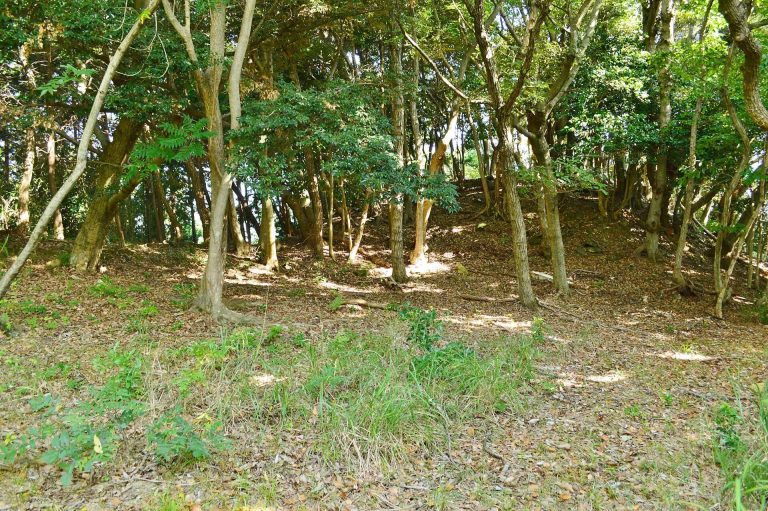
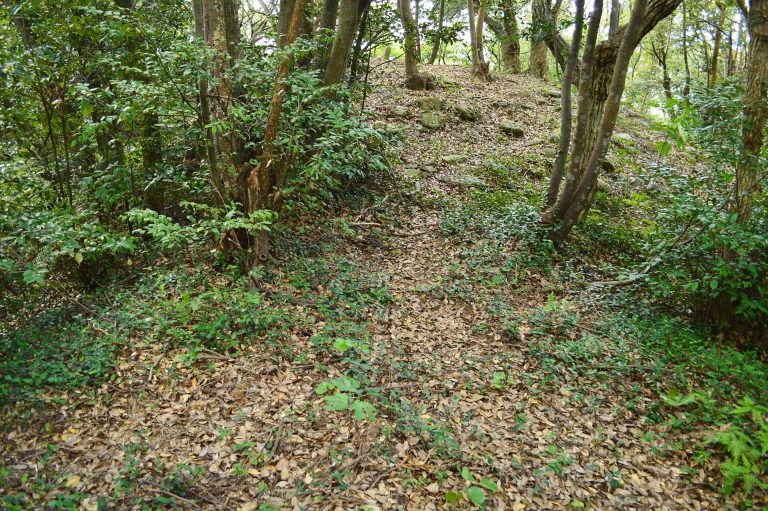
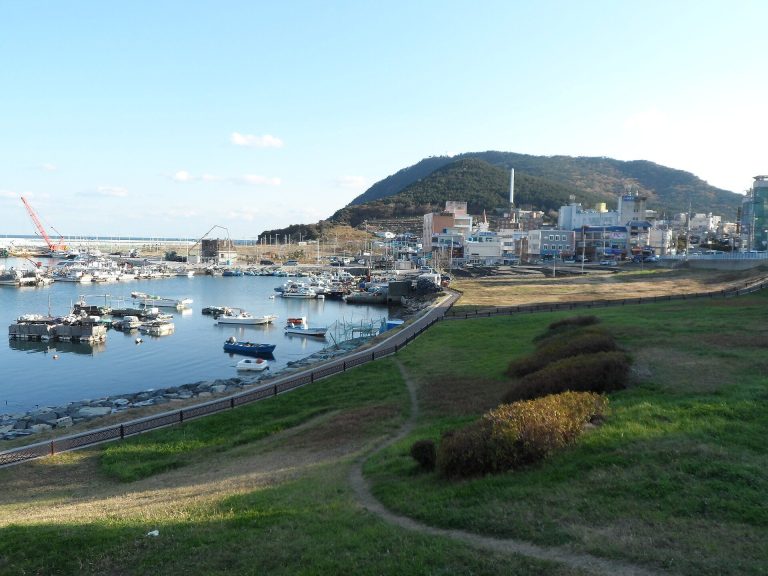
Kaijin Shrine occupies Mount Izu, also called Mount Kizaka or Kizaka-yama, in the northern part of Kizaka, north of Mine Bay. The name Izu is locally explained as deriving from a term for a sacred or awe-inspiring mountain where deities gather. The precinct includes a designated sacred grove, and its ritual landscape extends from the mountain shrine toward Hamadono and Omae Beach. The recorded precinct area varies from approximately 40,661 to 91,478 square metres, while other descriptions give approximately 67,828 or 68,036 square metres. Woodland figures range from approximately 192,397 to 365,950 square metres, and one historical description gives the shrine estate as approximately 0.22 square kilometres.
Principal shrine buildings
Main sanctuary
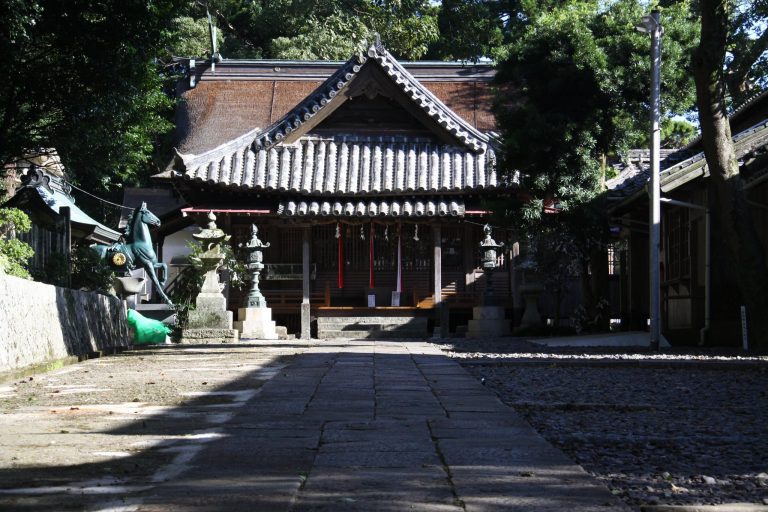
The honden, or main sanctuary, covers approximately 79.34 square metres and measures eight ken by six ken, approximately 14.55 by 10.91 metres. It follows the nagare-zukuri style, whose gabled roof has a curved front slope extending forward to shelter the entrance. The building is constructed of Japanese cypress. Its roof was covered with cypress bark before the Second World War and was replaced with tile after the war.
Offering and worship halls
The heiden, or offering hall, covers approximately 19.83 square metres. It is a simple gabled building with a tiled roof and is also constructed of Japanese cypress. The haiden, or worship hall, covers approximately 52.89 square metres and uses the irimoya-zukuri form, which combines a gabled upper roof with additional slopes around the lower section.
Food-offering hall and office
The shinsenjo, a building for preparing or presenting food offerings to the kami, covers approximately 52.89 square metres. It is constructed of Japanese cedar and has a tiled roof. The shrine office has the same construction material and roof covering and covers approximately 66.12 square metres.
Storehouse and purification pavilion
The shrine storehouse covers approximately 23.14 square metres and has a tiled roof. The temizuya, a pavilion where worshippers purify themselves with water, covers approximately 6.61 square metres and has a copper-plate roof.
Auxiliary shrines and sacred landscape
Affiliated shrines
The affiliated Yukisakiden Shrine, a sessha or closely connected auxiliary shrine, measures one ken by one ken, approximately 1.82 metres square. The subsidiary shrines Ichinomiya, Wakamiya, Shinreisha, and Imamiya each measure four shaku by four shaku, approximately 1.21 metres square. They form part of the smaller shrine architecture within the main precinct.
Mountain and coastal ritual area
The shrine’s physical and ritual setting continues from Mount Izu toward Hamadono and Omae Beach. The Hamadono Hojosai uses the shore for the release of turban shells, while the Yakuma festival employs a stone pagoda on the west coast oriented toward Mount Izu. These features connect the mountain sanctuary with the coastal spaces used in the annual ritual cycle.
Surviving cultural objects
The bronze standing Buddha is designated an Important Cultural Property. After its return in 2015, it retained the damage caused during the theft, including a missing fingertip. The shrine’s wooden masks and sacred grove are designated by Nagasaki Prefecture. Tsushima City designates additional associated objects, including bronze spearheads, Goryeo celadon, bronze mirrors, a bell, a wooden monk-shaped deity image, ridge-end plaques, wooden guardian dogs, a sho, a silver bowl and spoon, and fragments of an iron thirty-eight-plate helmet and large armor.