Dongsam-dong Shell Midden: A Jeulmun-Period Neolithic Archaeological Site in Busan
Site at a Glance
- Rating
- 4.2
- Popularity
- Low
- Country
- South Korea
- Primary era
- Stone Age
- External website
- Open
- Eras represented
- Stone Age
- Civilizations
- Unclassified
- Site type
- Domestic
On this page8 sections
History
Dongsam-dong Shell Midden is a prehistoric archaeological site on the western coast of Yeongdo Island in Busan, South Korea, formed by communities of the Jeulmun pottery tradition during the Neolithic period. Occupation began between 8000 and 7000 BP, with later activity during the Middle Jeulmun period around 3500 BC and the Late Jeulmun period around 2000 BC. The site is regarded as one of the oldest Neolithic sites and among the oldest and largest shell middens discovered in southern Korea.
Jeulmun-Period Occupation
The midden was created as inhabitants repeatedly discarded shells, food remains, tools, pottery, and household refuse in a relatively confined coastal area. These deposits preserve evidence of prehistoric subsistence and the local natural environment. They also illuminate wider cultural connections, including the influence of Siberian cultures on Korea and exchange between southern Korea and Kyushu in Japan.
Objects linked with the Japanese Jomon pottery tradition and Japanese obsidian show that contact across the Korea Strait reached the community at Dongsam-dong. Sobata pottery from Kyushu may, in turn, have originated from the culture represented at the site. These connections place the midden within a broader network of interaction during the Korean Neolithic period.
Discovery and Protection
Oigawa discovered the site in 1929. Part of the midden was excavated during the period of Japanese colonial rule, followed by three investigations conducted by archaeologists from the National Museum of Korea beginning in 1969. The Busan Municipal Museum carried out another excavation in 1999.
Dongsam-dong Shell Midden became Historic Site No. 266 of the Republic of Korea on 26 July 1979. The excavated remains have been displayed in a museum dedicated to the site since 24 April 2002, allowing the archaeological evidence to be preserved and interpreted at the place where it was found.
Remains
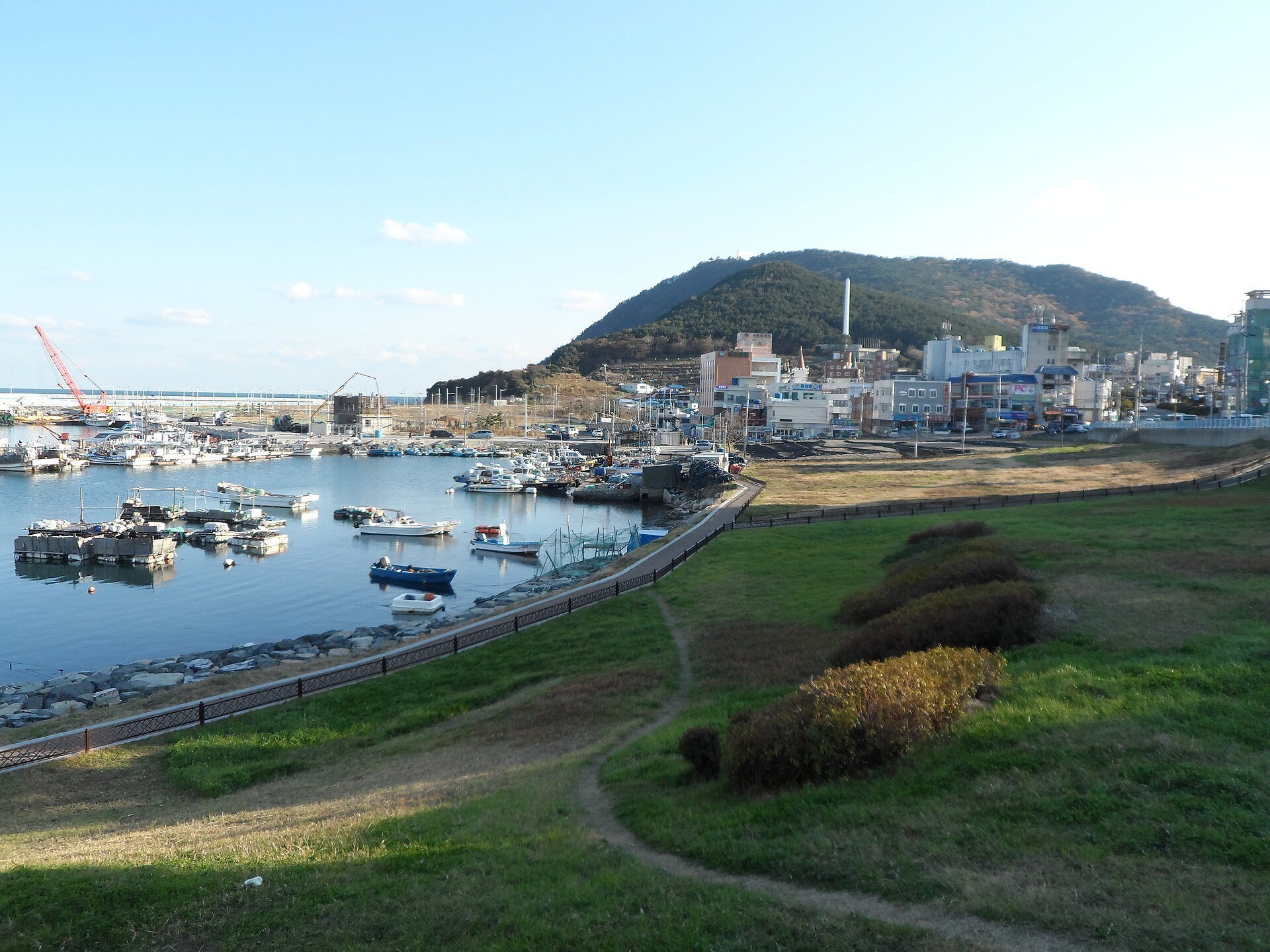
The site occupies a coastal hillside near the shore in Dongsam-dong on the western side of Yeongdo Island. Its protected area covers 11,811 square metres. The physical remains consist of a shell midden, an archaeological deposit formed from discarded shells, food remains, artefacts, and domestic refuse. Five stratigraphic layers represent occupation across the Neolithic period.
Shell Deposit and Environmental Evidence
The deposit contains shells from molluscs that lived in both shallow and deep water, together with bones of whales, seals, and deer. Numerous bones bear cut marks, preserving evidence of the processing of animals. The range of marine and land remains provides material for examining diet and environmental conditions around the settlement.
Tools and Pottery
Bone and stone tools include needles and awls that may have been used to make clothing, probably from seal skin. Agricultural implements were also recovered. The pottery includes patternless vessels, comb-patterned Jeulmun pottery, and Yunggimun pottery, whose decoration was made by adding raised strips or other relief to the vessel surface.
Fragments of Jomon pottery and tools made from obsidian, a natural volcanic glass used for cutting implements, were found in the midden. The presence of Japanese obsidian provides physical evidence of prehistoric contact with Kyushu.
Jar-Coffin Burial
A jar-coffin burial was identified at the site. In this burial form, a large ceramic vessel serves as the container for human remains. It is considered the oldest example of the form in Korea and was the first confirmed example of this burial practice in the country, making it important for the study of prehistoric customs.
Site Museum
The excavated material is exhibited in the museum dedicated to Dongsam-dong Shell Midden. The displays preserve the relationship between the layered coastal deposit and the artefacts, animal remains, pottery, and burial evidence recovered from it.