Ame-no-Tanagao Shrine: Traditional Ichinomiya of Iki


Site at a Glance
- Rating
- 3.9
- Popularity
- Low
- Country
- Japan
- Primary era
- Early Modern
- External website
- Open
- Eras represented
- Early Modern
- Civilizations
- Tokugawa
- Site type
- Religious
- Remains
- Sanctuary
On this page12 sections
History
Ame-no-Tanagao Shrine is a Shinto shrine in Iki City, Japan, traditionally established in 811 and built in the nagare-zukuri style, in which the sanctuary roof projects forward to create a covered entrance. It is regarded as the successor shrine of the Ichinomiya of Iki Province, the highest-ranking shrine traditionally recognized within a province. The shrine is also identified, though with limited certainty, as the Myojin Taisha named in the Engishiki, a tenth-century Japanese administrative and ritual compilation whose shrine register listed officially recognized shrines. A Myojin Taisha was a high-ranking shrine dedicated to a deity considered especially powerful or prestigious.
Early traditions and official recognition
The shrine’s principal deities are Ame-no-Oshihomimi, Ame-no-Tajikarao, and Ame-no-Uzume. Its traditions also connect it with the former Ame-no-Tanagahime Shrine and Monobe Futsu Shrine. The names Ame-no-Tanagao and Ame-no-Tanagahime are associated with the sacred flagstaff called the “Mitenaga.” According to the tradition, the deity of Munakata Taisha attached two red-and-white flags held by Takeuchi no Sukune to the staff during Empress Jingu’s legendary expedition against the Korean kingdoms. The flags were used to confuse the enemy, and the staff was eventually planted on Okinoshima in the Genkai Sea.
The shrine’s own tradition holds that Empress Jingu stopped at the site during her expedition against Silla, one of the ancient Korean kingdoms, and personally performed a rite in recognition of the shrine’s assistance. The Ichinomiya Record placed Ame-no-Tanagao Shrine and Ame-no-Tanagahime Shrine in Monobe Village, named the former as Iki’s first-ranking shrine, and identified Ame-no-Omikane as its deity. These traditions preserve the shrine’s claimed connection with the ancient provincial religious order, although its precise historical identity remains debated.
In 850, Ame-no-Tanagao was entered among the officially recognized shrines, and in 851 it received the senior sixth rank. Its rank was raised again in 897 or 898, 940, 1081, 1141, 1180 or 1181, 1185, 1201, 1261, 1275, and 1381. Imperial envoys presented offerings in 857, 858, and 863. The sequence of promotions and imperial offerings reflects the shrine’s place within the recognized religious institutions of Iki during the medieval period.
Decline and early-modern identification
After the Mongol invasions, the shrine declined and its location became unknown. It survived in local form as a small shrine called Wakamiya. During the 1670s, the Hirado-domain scholar Tachibana Mitsuyoshi identified Wakamiya with the ancient Ame-no-Tanagao Shrine. He connected the identification partly with the local place-name Tanagao, also rendered Tanakao, and with objects found on the hill.
In a bamboo grove at Shiroyama in Tanaka, Tachibana found a sacred mirror and two stone images of Maitreya, a Buddhist figure associated with the future Buddha. He established a stone shrine for them. One of the Maitreya images carries an inscription dated 1071. The image was later designated an Important Cultural Property and, as of 2012, was preserved at the Nara National Museum.
Hirado patronage and shrine finances
Following Tachibana’s identification, the shrine gained the patronage of the Hirado domain. In 1688, the domain lord Matsura Shigenobu ordered new shrine buildings, and pine, cedar, and cherry trees were planted there in 1689. Matsura Shigenobu later donated two koku of estate income in 1700. A koku was a historical unit of rice-based land revenue, conventionally associated with the amount needed to support one person for a year, so this grant represented an income allocation rather than the size of the precinct.
In 1707, after the completion of Kameoka Castle, Matsura Shigenobu gave two bowls to the shrine as a thanksgiving offering. Matsura Atsunobu rebuilt the treasure hall in 1724. In 1739, the shrine’s estate income increased to ten koku, and it received ten bales of first-fruit offerings from across Iki Province. Records from 1789 specify rice allocations for several ceremonies, including approximately 11.91 liters for the official kagura, a ritual performance, 54.12 liters for a good harvest, 541.17 liters as first fruits, and 162.35 liters for the great kagura.
The domain lord’s representatives attended each festival and visited the shrine when entering the domain or when a castle governor or district governor changed office. Matsura Shigenobu is recorded as having worshipped at the shrine in 1845. These practices connected the shrine to the political administration of Hirado as well as to the religious life of Iki.
Modern consolidation and continuing debate
Ame-no-Tanagao Shrine was classified as a village shrine in 1879. In 1910, it was designated a shrine eligible to receive state offerings of food and cloth. In 1965, Ame-no-Tanagahime Shrine, Monobe Futsu Shrine, and Wakamiya Shrine were formally merged into it. The recorded group of enshrined deities was also expanded to include Emperor Nintoku, Emperor Chuai, Yamato Takeru, and Hime Okami. Awashima Shrine was moved into the precinct at the same time.
The shrine’s identification with the ancient Ame-no-Tanagao Shrine remains contested. A leading alternative view names Ko Shrine in Ashibe Town as the original Ame-no-Tanagao Shrine and the original Ichinomiya of Iki. This interpretation partly rests on the understanding of Ko as an old form meaning “provincial government,” as well as on the presence there of a subsidiary provincial grand shrine. The original location of Ame-no-Tanagahime Shrine remains unknown, while recent research regards Kunitsu Shrine at Wataraura as a possible original location of Monobe Futsu Shrine. Ame-no-Tanagao Shrine is nevertheless treated today as the Ichinomiya of Iki, and the deities traditionally associated with the two related shrines remain enshrined there.
Remains
Mountain precinct and archaeological setting
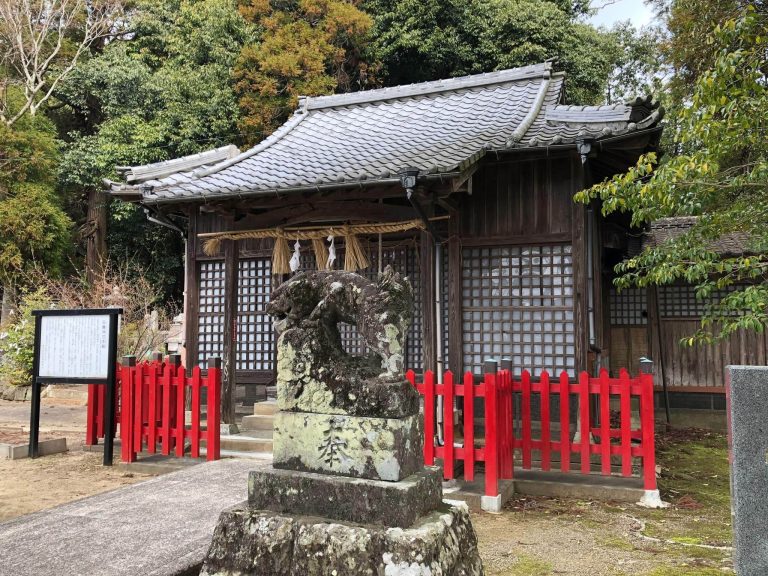
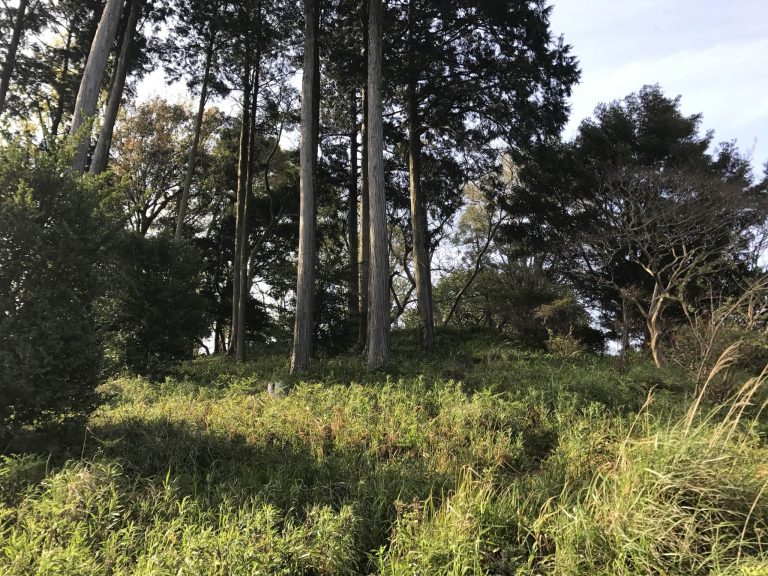
Ame-no-Tanagao Shrine occupies the summit of Hachigatayama, also called Hachigatamine, in central-southwestern Iki. The mountain also contains the Hachigatayama archaeological site, which dates to the Yayoi period, and Hachigata Castle. The shrine precinct covers 175 tsubo, approximately 578.5 square meters. Three stone torii gates mark the precinct, which also contains six stone lanterns.
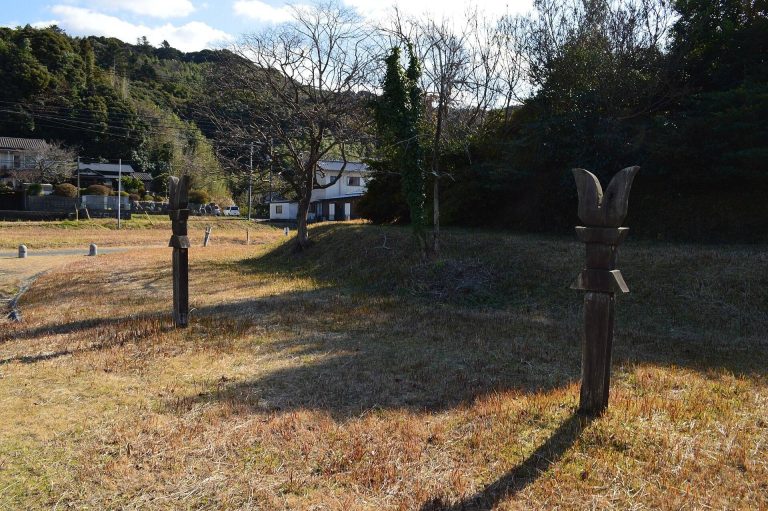
A site associated with the former Ame-no-Tanagahime Shrine is marked within the precinct. Awashima Shrine also stands there and enshrines Minamiichi-no-Mikoto. Yayoi-period pottery found on Hachigatayama provides archaeological evidence for activity on the mountain during that period, while the sacred mirror and two stone images of Maitreya connect the early-modern identification of the shrine with the Shiroyama bamboo grove in Tanaka. The Maitreya image inscribed with the date 1071 is preserved at the Nara National Museum.
Shrine buildings
Main sanctuary
The main sanctuary is built in the nagare-zukuri style. Its roof extends forward in a flowing curve to form a covered entrance. A roofed protective structure with white walls connects the sanctuary to the worship hall and shields it from rain and wind.
Worship hall
The worship hall has yellow walls and a tiled roof. It measures approximately 2.5 bays across by 4 bays in length, or about 4.55 by 7.27 meters. Its position beside the main sanctuary creates the principal covered arrangement of the shrine buildings.
Treasure hall
The treasure hall has a tiled roof and measures approximately 1.5 bays across by 2 bays in length, about 2.73 by 3.64 meters. It was rebuilt in 1724 under Matsura Atsunobu, preserving the building’s connection with the period of Hirado-domain patronage.
Shrine office-storehouse
The shrine office-storehouse is also roofed with tiles. It measures approximately 5 bays across by 3.5 bays in length, or about 9.09 by 6.36 meters. Together with the worship hall and treasure hall, it forms part of the surviving architectural complex on the mountain summit.