Akagi Shrine: A Shinto Shrine in Shinjuku, Tokyo


Site at a Glance
- Rating
- 4.1
- Popularity
- Medium
- Country
- Japan
- Primary era
- Modern
- External website
- Open
- Eras represented
- Modern
- Civilizations
- Japanese
- Site type
- Religious
- Remains
- Sanctuary
On this page10 sections
History
Akagi Shrine is a Shinto shrine in Shinjuku City, Tokyo, Japan, traditionally associated with the Akagi region and the local community of Ushigome. Shinto is Japan’s indigenous religious tradition, centered on reverence for kami, sacred beings or powers connected with places, nature, ancestors, and cultural traditions. Before the Meiji Restoration, the shrine was known as Akagi Daimyojin and Akagi Myojin Shrine.
Origins and relocation
The shrine tradition places its foundation in 1300, when Ogo Hikotaro Shigeharu moved from the foot of Mount Akagi in Kozuke Province to Ushigome and transferred the spirit of Akagi Shrine to a new sanctuary at Tajimamura, in Ushigome Waseda. The Ogo clan’s migration to Ushigome is estimated to have taken place in the late fifteenth century, and the family later adopted the surname Ushigome. This chronology places the traditional foundation story alongside a later estimate for the clan’s arrival in the district.
The shrine received a dedication of the Great Perfection of Wisdom Sutras, known as the Daihannya-kyo, in 1444. In 1460, Ōta Dōkan, a fifteenth-century military leader traditionally credited with constructing Edo Castle, moved the shrine to Ushigomedai. In 1555, a member of the Ogo clan who held the court title Kunnai-shosho transferred it to its present location. The earlier site later became known as Moto Akagi Shrine.
Ushigome’s major shrine
During the Edo period, when the Tokugawa shogunate governed Japan from 1603 to 1867 and Edo was the city’s former name, the government recognized Akagi Shrine as one of Edo’s major shrines. It served as the tutelary shrine of Ushigome, a sanctuary responsible for the spiritual protection of the district, and drew worshippers from the surrounding community.
The Edo Meisho Zue described the institution as Akagi Myojin Shrine and identified it as Ushigome’s tutelary shrine. It also associated the shrine with Tōkakuji, a Tendai Buddhist temple. Tendai is a major Japanese Buddhist school, while a bettōji was a Buddhist temple institution that administered a shrine’s religious affairs under the historical system in which Buddhist and Shinto institutions operated together. The work attributed the shrine’s foundation to Ogo Shigeyasu, whereas the Ushigome genealogy does not include that name and the shrine tradition identifies Ogo Shigeharu as its founder.
Deities and changing status
The principal deity is Iwatsutsuo no Mikoto, who is enshrined with Akagihime no Mikoto. Iwatsutsuo no Mikoto is said to have been born from the fire deity Kagutsuchi and to be the parent of Futsunushi no Mikoto. Traditions differ about Akagihime no Mikoto: one identifies her as a daughter of the Ogo clan, while another regards her as the Buddhist counterpart associated with Tōkakuji.
During the Meiji Restoration, the shrine adopted the name Akagi Shrine in 1868. In 1873 it received the rank of gōsha, a prewar classification generally used for a locally important village or district shrine. The former Kitano Shrine, also called Asahi Tenmangu, was transferred from Yokoteramachi into Akagi Shrine’s precincts in 1876 as an associated shrine.
Fire, war, and rebuilding
A fire destroyed the shrine buildings on March 7, 1842, and they were subsequently rebuilt. Wartime fire destroyed the buildings again on April 13, 1945, during the Pacific War. The main sanctuary was rebuilt in October 1951, followed by the worship hall and offering hall in May 1959. The associated Shusse Inari Shrine received a rebuilt building in October 1962.
The wartime-damaged Kitano Shrine was revived in October 2005 as Keisetsu Tenjin. Akagi Shrine’s annual festival is held on September 19.
Renewal in the twenty-first century
Between 2009 and 2010, the Akagi Shrine Renewal Project replaced the aging shrine buildings and comprehensively rebuilt the complex, with completion in September 2010. The adjacent private Akagi Kindergarten had helped support the shrine financially, but it closed in March 2008 because of declining birthrates and related factors. The redevelopment was planned to provide operating income through land rent and leases. Its apartment building is scheduled to be dismantled when its approximately seventy-year lease ends, after which the land is to return to the shrine’s wooded precinct.
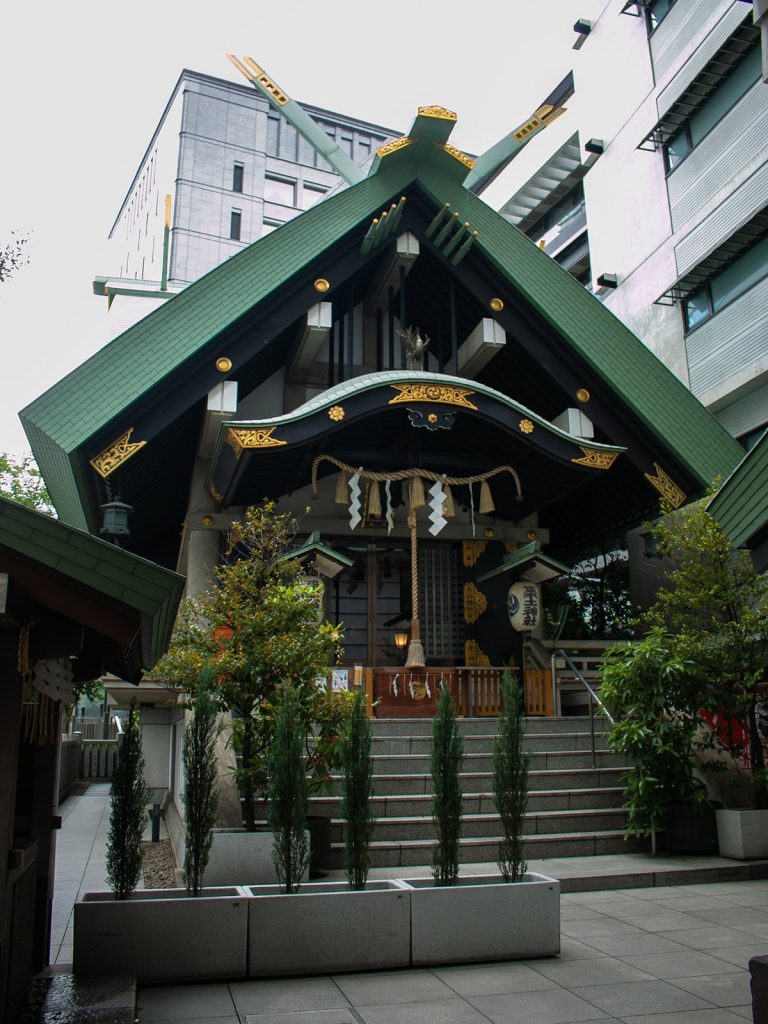
Architect Kengo Kuma supervised the design. As a local resident and parishioner, he coordinated the apartment building and shrine facilities so they would harmonize with one another, while retaining and incorporating parts of the existing tree cover. The completed project received the 2011 Good Design Award in both the housing and business-solutions categories. Several sacred trees and the Monument to Loyalty, erected in 1906 to commemorate Field Marshal Ōyama Iwao and the Russo-Japanese War, were removed during the redevelopment.
Remains
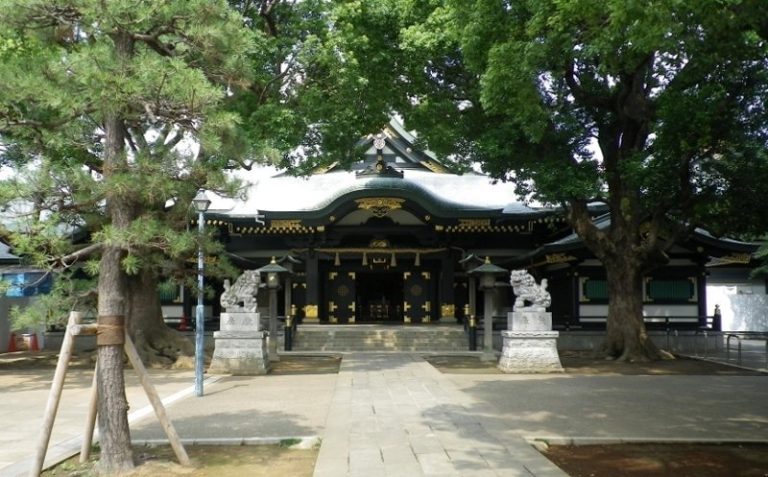
Akagi Shrine’s present complex combines rebuilt Shinto buildings with facilities incorporated into the 2009–2010 renewal. The sanctuary and associated structures occupy a wooded precinct, where parts of the earlier trees were retained as part of the redevelopment. The complex also includes an apartment building, a hall, and a gallery on shrine land.
Main shrine buildings
The main sanctuary follows the nagare-zukuri style. This form has a gabled roof whose front slope projects over the worship area. The sanctuary belongs to the comprehensive rebuilding completed in September 2010, while the wider renewal replaced the aging buildings and incorporated the hall and gallery within the redeveloped complex.
Associated shrines
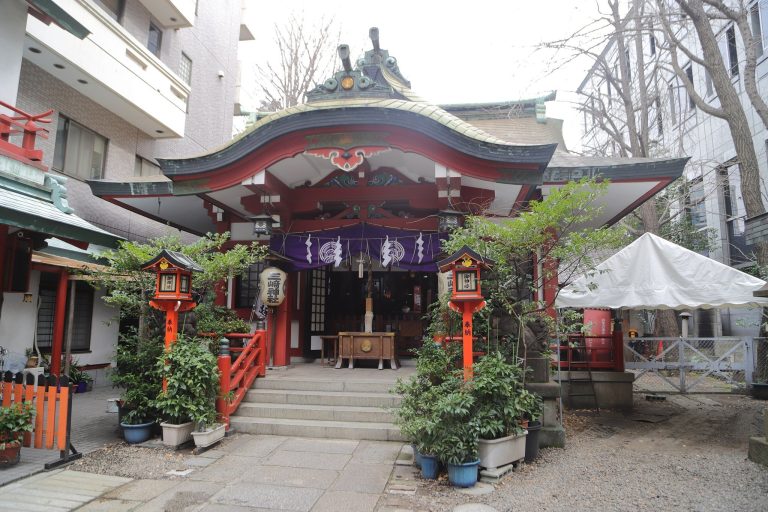
Keisetsu Tenjin occupies the role once held by Kitano Shrine, which entered the precincts in 1876 after being moved from Yokoteramachi. Wartime fire destroyed the transferred shrine, and it was re-established as Keisetsu Tenjin in October 2005. Shusse Inari Shrine is another associated sanctuary within the precincts; its shrine building was rebuilt in October 1962.
Former commemorative monument
The precincts formerly contained the Monument to Loyalty, a memorial to Field Marshal Ōyama Iwao and the Russo-Japanese War. Erected in 1906, it remained part of the shrine grounds until it was removed during the 2009–2010 redevelopment.