Denzū-in Temple: A Jōdo Buddhist Mausoleum in Tokyo
Site at a Glance
- Rating
- 4.2
- Popularity
- Low
- Country
- Japan
- Primary era
- Early Modern
- External website
- Open
- Eras represented
- Early Modern
- Civilizations
- Tokugawa
- Site type
- Religious
- Remains
- Monastery
On this page15 sections
History
Denzū-in Temple is a Jōdo Buddhist temple in Japan, located in Koishikawa, Tokyo. Its foundation reaches back to 1415, when the seventh patriarch of the Jōdo sect established a hermitage at Gokurakumizu. The institution was first known as Jukyōji and carried the mountain name Muryōzan. Its principal image is an Amida Buddha attributed to Genshin, the Heian-period monk associated with devotion to Amida and rebirth in the Pure Land.
From Jukyōji to Denzū-in
The hermitage was founded after a request from a disciple of the seventh patriarch. That disciple later became the founding priest of Zōjōji, one of the central Jōdo institutions in Edo. The original Jukyōji stood at Gokurakumizu in what is now Koishikawa 4-chōme, before the institution was moved to its present location in the early seventeenth century.
In 1602, Lady Odai, the mother of Tokugawa Ieyasu, died at Fushimi Castle. Her will directed that her remains be taken to Edo. She was cremated there, and her cremated remains were later buried at the present temple site. In 1603, Ieyasu transferred Jukyōji to the location, constructed temple halls and a tomb for his mother, and renamed the institution Denzū-in after her posthumous Buddhist name.
Ieyasu had initially intended to bury Lady Odai at Zōjōji. He instead established Denzū-in at a place linked to the religious lineage that had produced Zōjōji. The halls were completed on September 15, 1608, and a monk from the circle of Zōjōji’s twelfth chief priest became Denzū-in’s abbot.
Edo-period expansion
Under the Tokugawa shogunate, the military government that ruled Japan from 1603 to 1867, Denzū-in received temple lands yielding about 600 koku, a rice-based measure of income. The complex grew to include halls, pagodas, study buildings, and numerous monastic facilities. The temple received permission to use the highest-ranking purple robes and became the second-ranking mausoleum temple of the Tokugawa shogunal family after Zōjōji. Together with Zōjōji and Kan’eiji, it was counted among the “Three Sacred Mountains of Edo.”
In 1613, 300 scholar-monks were transferred from Zōjōji, and Denzū-in became the senior institution among eighteen major Jōdo monastic academies in the Kantō region. A monastic academy, or danrin, was a Buddhist school where monks studied doctrine and prepared for clerical service. The academy at Denzū-in reportedly housed as many as 1,000 monks at its peak. Its land allotment rose to 830 koku in 1623.
Further protection followed the burial of Kame-matsu, the second son of Tokugawa Iemitsu, at Denzū-in in 1647. The shogunate enlarged the complex, which later suffered major fires in 1721 and 1725. Illustrated and cartographic works, including Edo Meisho Zue, the Illustrated Plan of the Muryōzan Temple Grounds, and the revised 1857 edition of the Koishikawa Map of Edo, preserve a record of its appearance during the Edo period. These depictions show a large temple on elevated ground, associated with views toward Mount Fuji, Edo Bay, and the Edo River.
Late-Edo political connections
On February 4, 1863, the Rōshigumi was formed in Denzū-in’s Daishin dormitory. The Rōshigumi was a corps of masterless samurai organized to protect the shogunate and later provided the basis for the better-known Shinsengumi. About 250 men gathered, among them Yamaoka Tesshū, Kiyokawa Hachirō, Kondō Isami, Hijikata Toshizō, Okita Sōji, and Serizawa Kamo. Denzū-in is also associated with the formation of the Shōgitai, a pro-shogunate military organization active during the collapse of the shogunate.
Rinzu, the abbot of the subtemple Shojō-in, was an imperial-loyalist monk troubled by the country’s political condition. Sons of shogunate retainers assassinated him. His death reflects the tensions that surrounded Denzū-in in the final years of the Tokugawa regime.
Meiji transformation and literary memory
The Meiji Restoration ended the Tokugawa protection on which Denzū-in had depended. In 1869, the temple was designated an imperial-prayer temple, meaning that it was expected to conduct Buddhist prayers for the imperial institution. The status did not endure during the anti-Buddhist movement of the early Meiji period, which sought to separate Buddhism from state-supported Shinto and reduced many Buddhist establishments. Numerous Denzū-in subtemples and branch institutions became independent, greatly diminishing the size of the complex.
One former subtemple, Enju-in, became a branch temple of Zenkōji because of Denzū-in’s relationship with that Jōdo institution in Shinano. It was renamed Zenkōji in 1884, and the slope before it later became known as Zenkōji-zaka. In 1890, a Jōdo-sect school moved onto the grounds and formed the basis of Shukutoku Girls’ School, now Koishikawa Shukutoku Gakuen Junior and Senior High School. During the Meiji period, the cemetery was opened to the general public and began to receive the graves of ordinary townspeople as well as members of prominent families.
The writer Nagai Kafū was born near Denzū-in in 1879 and lived there until 1893. In his essay Denzū-in, written around 1909, he compared the temple’s place in Koishikawa with that of Notre-Dame of Paris. He revisited the temple in 1908, and the main hall burned that night, an event he later described in the essay. Denzū-in also appears in Natsume Sōseki’s novel Kokoro. The Kōda family moved near the temple in 1924, and their descendants continued to live there at the time associated with the account.
War damage and rebuilding
On May 25, 1945, an American air raid burned the Koishikawa area. Denzū-in’s Edo-period gate and the main hall then standing were destroyed, along with the other temple buildings. The destruction removed most of the complex’s remaining shogunal-era appearance, while the graves survived.
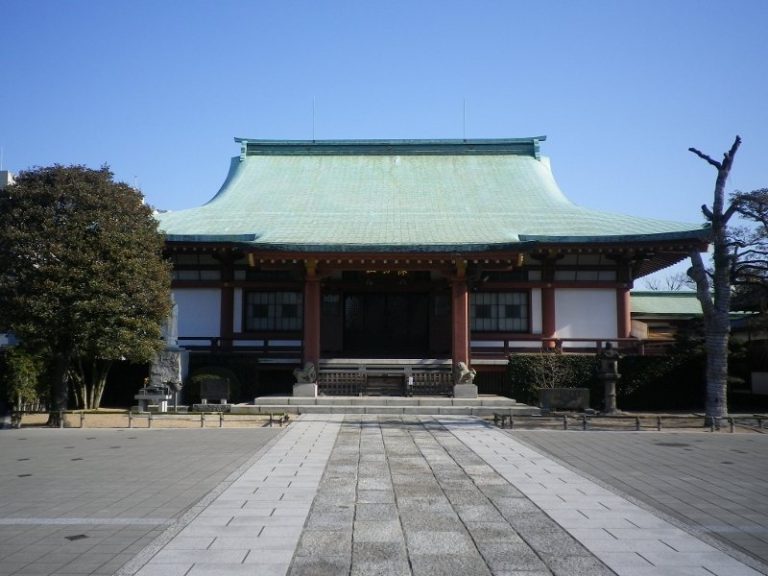
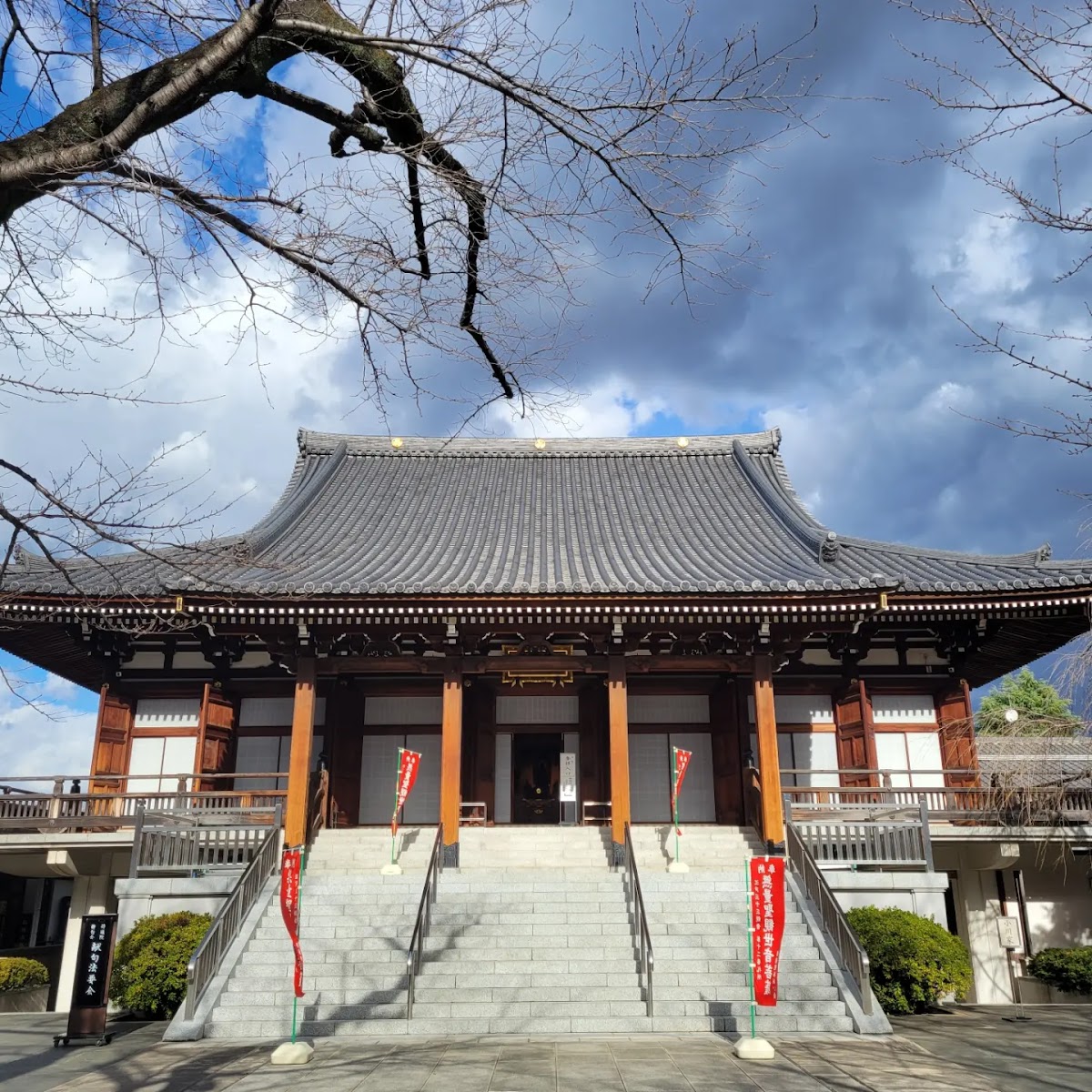
The main hall was rebuilt in 1949 and reconstructed again in 1988. A wooden main gate was rebuilt in March 2012. Denzū-in remains a Jōdo temple, a Tokugawa-associated mausoleum, and the twelfth station of the Edo Thirty-Three Kannon pilgrimage circuit.
The cemetery contains graves connected with the Tokugawa family, including Lady Odai, Senhime, and Takatsukasa Takako. Other burials include Denzū-in’s founding priest; the temple’s first abbot after its revival, who later became the thirteenth chief priest of Zōjōji; Hatsuhime, a daughter of Tokugawa Hidetada; Kame-matsu; Ieyasu’s concubine O-Natsu; and Kiyokawa Hachirō, whose head alone was buried there, together with his wife Oren. The cemetery also holds the graves of Sawa Nobuyoshi, Ōhara Shigetomi, Sugiura Jūkō, Kuno Hisa, Koizumi Chikashi, Kanno Dōmei, Ominohara Naoyoshi’s son, Chigusa Makiko, Satō Haruo, Shibata Renzaburō, Hashimoto Meiji, Namikoshi Tokujirō, Yakazu Dōmei, Ekuan Kenji, Sakaiya Taichi, and Hashi Yukio.
The temple continues to have cultural associations with spring cherry blossoms and a July morning-glory market. Its wider literary connections include works by Kikuchi Kan, Sasaki Mitsuzō, Tokuda Shūsei, Okamoto Kidō, Miyamoto Yuriko, Nakazato Kaizan, Natsume Sōseki, Yumeno Kyūsaku, and Futabatei Shimei.
Remains
Elevated grounds and former complex
Denzū-in occupies elevated ground in Koishikawa. Its historical layout comprised a large Buddhist complex with halls, pagodas, study buildings, and subtemples. The original Jukyōji hermitage stood at Gokurakumizu in present-day Koishikawa 4-chōme, while the temple now known as Sōkeiji occupies that earlier location. Historical plans and illustrated views present the later Denzū-in complex as an extensive establishment set above the surrounding area, with outward views toward Mount Fuji, Edo Bay, and the Edo River.
Temple hall and entrance
Main hall
The present main hall is a reinforced-concrete structure rebuilt in 1988. It replaced the hall rebuilt in 1949 after the wartime destruction of the temple buildings. The hall houses the temple’s principal image, an Amida Buddha attributed to Genshin, whose teachings helped shape the devotional tradition of Japanese Jōdo Buddhism.
Main gate
The Edo-period main gate was destroyed in the air raid of 1945. A wooden gate was reconstructed in March 2012, providing the present entrance structure associated with the temple grounds.
Tokugawa graves and memorial features
Lady Odai’s grave
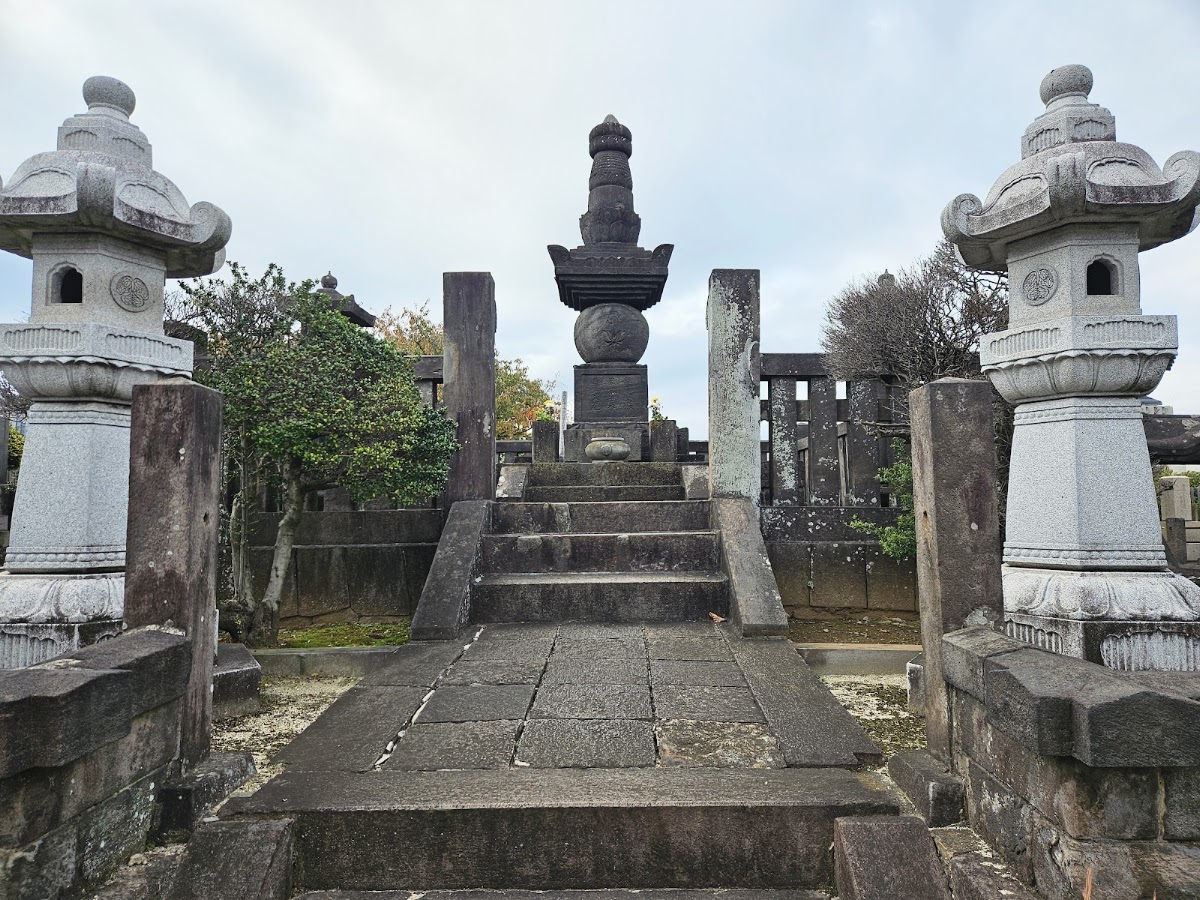
Lady Odai’s grave lies to the left of the main hall and is marked by a large five-ring pagoda. This form is a memorial monument made of five symbolic shapes representing earth, water, fire, wind, and space. The surrounding grounds contain other graves connected with Tokugawa women and children, as well as later burials opened to the wider public during the Meiji period.
Finger-pressure monument
A finger-pressure monument stands within the grounds. It was donated by Namikoshi Tokujirō, the founder of the Japan Shiatsu School beside the temple, and forms part of Denzū-in’s later commemorative landscape.
“Thus Have I Heard” monument
The grounds also contain a monument inscribed “Thus Have I Heard,” with calligraphy by Nakamura Sodō. Together with the cemetery and reconstructed buildings, it forms part of the surviving physical record of Denzū-in’s religious and cultural history.
Nearby sites