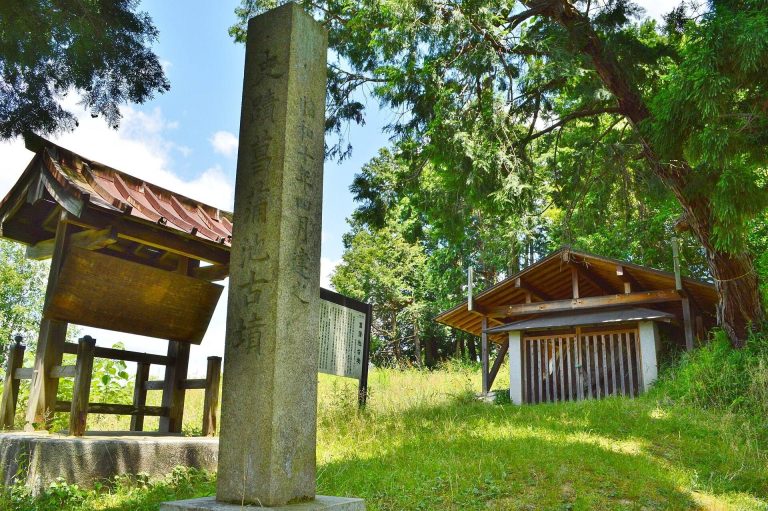
Takamatsuzuka Tomb: An Asuka-Period Kofun in Japan


Site at a Glance
- Rating
- 4.1
- Popularity
- Low
- Country
- Japan
- Primary era
- Medieval
- External website
- Open
- Eras represented
- Medieval
- Civilizations
- Yamato
- Site type
- Burial
- Remains
- Burial Mound
On this page12 sections
History
Construction and discovery
Takamatsuzuka Tomb is a circular Asuka-period kofun in Japan, built during the Fujiwara-kyo period between AD 694 and 710. A kofun is an ancient Japanese burial mound, generally constructed for members of ruling or elite groups. The Fujiwara-kyo period was the era when Fujiwara-kyo served as Japan’s imperial capital. Takamatsuzuka belongs to a time when political authority and court culture were developing in the Asuka region.
The tomb was discovered in October 1970 when villagers digging a hole to store ginger encountered ancient cut stones. Its small size and the lack of historical records initially led to the view that it was relatively unimportant. Excavation began on March 1, 1972, as an Asuka Village project conducted by the Nara Prefectural Kashihara Archaeological Institute with researchers and students from Kansai University and Ryukoku University. Masao Suenaga directed the work, while Muneyasu Date and Yoshinori Aboshi led the fieldwork.
That assessment changed on March 21, 1972, when the horizontal-entry burial chamber was opened and vividly colored murals were revealed. The discovery brought Takamatsuzuka into major archaeological, art-historical, and conservation debates. Initial academic investigations followed on April 6 and April 17, and a wider committee of specialists in archaeology, art history, and conservation science undertook further study in October 1972.
Looting and historical interpretation
The tomb had been looted around the Kamakura period. A shaft cut through the south wall of the burial chamber, probably destroying the decoration on that side, but much of the mural coloring and several grave goods survived. The murals were treated as an exceptionally rare archaeological discovery, and preservation and research measures began soon afterward.
The person buried at Takamatsuzuka remains unidentified. The decorations have been interpreted as suggesting a member of the imperial family or a high-ranking noble. Proposed identifications have included Prince Osakabe, Prince Takechi, Prince Yuge, Isonokami Ason Maro, and Kudara no Konikishi Zenko. The theory that the tomb belonged to Prince Osakabe draws on the estimated age of the human remains, the grave goods, and the clothing shown in the murals. Other proposals combine the burial objects, historical chronology, and the attire of the painted figures.
The tomb’s murals have also been compared with those in Goguryeo tombs. Goguryeo was an ancient Korean kingdom whose funerary art influenced imagery in parts of East Asia. The four directional deities and the clothing of the female figures have especially encouraged these comparisons, while the paintings at Takamatsuzuka and Kitora have also been described as having a distinctively Japanese style. The celestial chart may have been based on a model transmitted from Goguryeo.
Protection and conservation
Takamatsuzuka became a Special Historic Site on April 23, 1973, and its polychrome murals became a National Treasure on April 17, 1974. These are high-level Japanese cultural-heritage designations. The tomb is also part of the World Heritage property “Asuka-Fujiwara: Archaeological Sites of Japan’s Ancient Capitals.”
Conservation began after the murals were found. A climate-control facility was built beside the chamber from 1974 and completed in March 1976. Rather than regulating the chamber directly, it controlled the antechamber so that conditions would remain close to the chamber’s natural temperature and humidity. Three phases of mural repair took place between September 1976 and 1985, and a serious mold outbreak in 1980 was treated with chemical removal measures. Temperature and humidity control, anti-mold treatment, and annual inspections continued from 1981.
Photographs taken between 2002 and 2003 showed pronounced fading and discoloration associated with water infiltration and mold. The findings became public in 2004, as the chamber’s nearly saturated humidity, fragile plaster, and environmental changes caused by human entry made preservation in place increasingly difficult. A major mold outbreak had occurred in 2001 during work intended to prevent the ceiling from collapsing at the junction between the chamber and the conservation facility. It was attributed to workers entering without sterilized protective clothing. A later third-party investigation identified inadequate coordination between the Agency for Cultural Affairs divisions responsible for the mound and the National Treasure murals, insufficient awareness of conservation procedures, and delayed disclosure of the damage.
Two accidental injuries occurred on the west wall on January 28, 2002. A fallen air purifier scratched an unpainted area beneath the male figures, while contact with a light caused plaster to detach from the chest of a male figure. Additional retouching on parts of the east wall, north wall, and ceiling was not disclosed at the time. A third-party committee submitted its investigation report to the government on June 19, 2006.
An emergency mural-preservation committee was established in March 2003, followed by a permanent committee in June 2004. After consideration of enclosing the mound, removing the murals, or preserving them in place, the decision was made on June 27, 2005, to dismantle and move the stone chamber for repair, with the intention of returning it to the tomb. The Archaeological Society of Japan, the Asuka Preservation Foundation, and the Asuka Village Assembly opposed the decision or requested conservation in place.
Excavation of the mound and dismantling of the chamber began on October 2, 2006. A temporary insulated structure was completed over the tomb in January 2007, and the chamber was transferred piece by piece to a repair facility in Asuka Historical National Government Park between April and June. During pigment analysis on November 25, 2008, equipment accidentally damaged a pigment area in the east-wall female group. Twelve years of mural restoration ended on March 26, 2020. In March 2022, the Agency for Cultural Affairs announced plans for a new preservation and display facility within the historical park, with opening targeted for fiscal year 2029 because the stone and plaster had become increasingly fragile.
Remains
Mound and burial chamber
Two-tiered mound
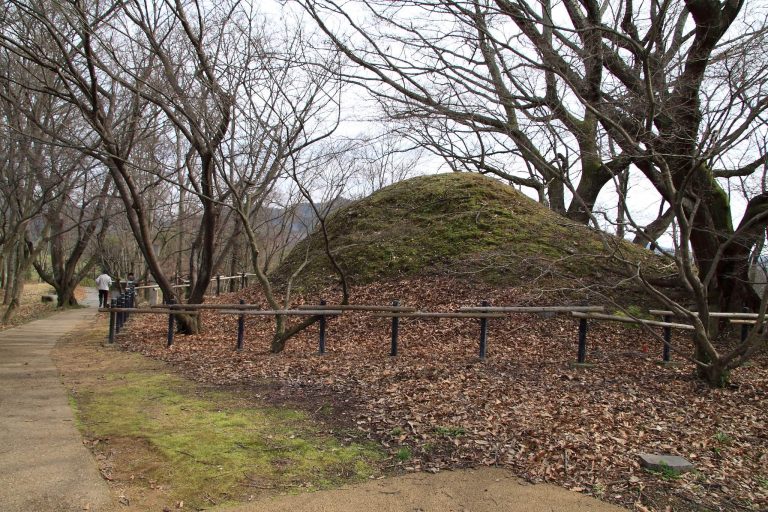
Takamatsuzuka is a two-tiered circular mound constructed from alternating layers of clay and sand. The lower tier is approximately 23 meters in diameter, the upper tier about 18 meters across, and the mound rises roughly 5 meters. Buried sections of a surrounding ditch helped establish its original form. Archaeological investigation also identified numerous cracks, probably caused by earlier earthquakes, that could allow insects and rainwater to enter. The mound was provisionally reconstructed in its original form after the chamber was removed. Its steep sides are now enclosed by hedges and fencing.
Stone burial chamber
The burial chamber is made of cut tuff, a relatively soft volcanic rock that can be shaped into building blocks. It is elongated along a north-south axis and entered through a passage on the south side. Internally, it measures approximately 265 centimeters from north to south, 103 centimeters from east to west, and 113 centimeters in height, allowing only about two adults to enter while crouching.
The chamber belongs to the horizontal-entry stone-chamber tradition, in which the burial space is reached from the side rather than from above. Slabs were assembled on a flat bottom stone. Related examples include the Oni no Manaita and Oni no Kawaya structures, Kengoshizuka Tomb, Noguchi Royal Tomb, and Kitora Tomb. This form continued from the middle of the seventh century to the beginning of the eighth century.
The chamber contained a lacquered wooden coffin, preserved through a few surviving fragments. Excavated objects include coffin metal fittings, copper nails, fittings from a large sword, a bronze mirror decorated with a sea-beast and grapes, and beads of glass and amber. The mirror follows a Sui-Tang style, while the coffin had prominent openwork fittings made of gilt bronze.
Painted walls and celestial imagery
East and west walls
The murals were painted over plaster several millimeters thick, applied to the cut-stone walls. Red, blue, gold, and silver pigments depict human figures, the sun and moon, the four directional deities, and constellations. The east wall is arranged from south to north with four male figures, the Azure Dragon and the sun, followed by four female figures. The west wall follows a corresponding arrangement with four male figures, the White Tiger and the moon, followed by four female figures. The sixteen human figures therefore form four groups of four.
The western female group was especially vivid when uncovered and became widely known as the “Asuka Beauties.” Most of the figures hold implements or other objects. The women carry items such as a scepter, a round fan, and a fly whisk. The men hold a folding stool, a polo mallet, a parasol, weapons, and a bag. These objects correspond to items carried by attendants and officials at the New Year’s morning court ceremony described in the Jogan Ceremonies, which also used banners representing the sun, moon, and four directional deities.
North wall and ceiling
The north, or rear, wall depicts the Black Tortoise. On the ceiling, circular pieces of gold leaf are connected by vermilion lines to form constellations. At the center is the Purple Enclosure, a celestial region associated with the North Celestial Pole and the residence of the Celestial Emperor. It consists of five North Pole stars and four auxiliary stars, surrounded by the Twenty-Eight Mansions, the twenty-eight sectors used in traditional Chinese astronomy to map the apparent movement of celestial bodies.
The east-wall sun and west-wall moon appear before tall mountains rising as if from a sea of clouds. Traces of gold leaf survived on the sun and silver leaf on the moon, although most of these surfaces had been scraped away, probably during the Kamakura-period looting. The Vermilion Bird probably occupied the south wall and would have completed the four directional deities, but that part of the decoration is thought to have been destroyed during the same episode.
Materials and conservation of the murals
A non-destructive pigment study identified red lac resin in the skirt of one female figure and white lead in the painting known as the Lady in the Pink Garment. These materials have been interpreted as evidence that Asuka society had access to trade with South and Southeast Asia.
For conservation, the chamber was dismantled and removed to a repair facility. The four ceiling stones and eight wall stones were moved individually. The stone carrying the “Asuka Beauties” was transferred on May 10 and 11, 2007, and the final wall stone was moved on June 26. After the conservation facility was removed, the mound was provisionally rebuilt from archaeological findings. The mural restoration was completed in 2020, while the planned facility in Asuka Historical National Government Park is intended to provide a new setting for preservation and public display.