Shōmanji Temple: A Jōdo Shinshū Temple and Former Stronghold in Oyabe
Site at a Glance
- Rating
- 3.6
- Popularity
- Very Low
- Country
- Japan
- Primary era
- Early Modern
- Eras represented
- Early Modern, Modern
- Civilizations
- Japanese, Tokugawa
- Site type
- Religious
- Remains
- Temple
On this page11 sections
History
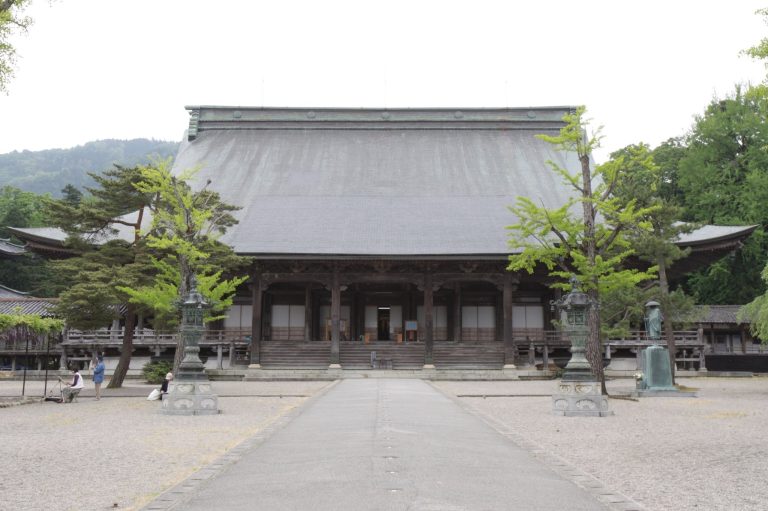
Shōmanji Temple is a Jōdo Shinshū temple in Japan, located in Oyabe, Toyama Prefecture. Founded in 808 by a Shingon Buddhist monk, it later became a temple of the Ōtani branch, one of the major branches of the Honganji tradition, with Amida Buddha as its principal object of worship. Its history includes a change of religious affiliation, involvement in the Ikkō-ikki leagues, destruction in warfare, repeated rebuilding, and a long association with the religious and political history of Etchū.
Foundation and conversion to Jōdo Shinshū
Shōmanji was first established at Kōhōji Village, an area now within Oyabe. It was regarded as a subordinate temple of Angoji Temple in present-day Tonami. In 1207, a descendant of the founding monk changed the temple from Shingon Buddhism to Jōdo Shinshū, a Japanese Pure Land tradition centered on reliance on Amida Buddha and the recitation of the nenbutsu, the devotional invocation of Amida.
The conversion was associated with Shinran, the medieval Buddhist teacher traditionally regarded as the founder of Jōdo Shinshū. The descendant is said to have encountered Shinran during his journey toward Echigo while Shinran was in exile, received instruction from him, and became his direct disciple. He was also traditionally entrusted with a portrait of Shinran, which he worshipped each morning and evening.
Rennyo and the move to Mizushima
During the early Bunmei era, the ninth abbot showed the portrait to Rennyo aboard a boat at Miyanokoshi, now Kanaiwa in Kanazawa. Rennyo, a later head priest of Honganji who greatly expanded the Jōdo Shinshū movement, is said to have worshipped the portrait reverently and granted the abbot the surname Funami.
After passing through Wazawa Village, Shōmanji moved in 1479 to the then undeveloped Mizushima Village. The relocation took place as the temple prepared for the Ikkō-ikki, leagues of Jōdo Shinshū followers, local warriors, and other supporters who organized collectively and sometimes fought regional military authorities. A record from 1544 identifies “Mizushima Shōmanji” as having supplied a guard contingent to Ishiyama Honganji, the principal institutional center of Jōdo Shinshū.
Conflict and destruction in the sixteenth century
In 1481, the Shinshu religious movement defeated the allied forces of the Ishiguro family of Fukumitsu and Iōzan Sōkaiji at Tayakawara. After the Great and Small Ikkō-ikki of 1531, a major sixteenth-century conflict involving factions within the movement, Shōmanji came under the authority of Hongakuji at Wada.
During the period of the Etchū Ikkō-ikki, Shōmanji developed into a major religious stronghold. Its precinct reportedly extended over more than 1,000 tsubo, a traditional Japanese unit of area, and was defended by an earthwork rampart and moat. Its followers extended across more than 50 settlements from Nojiri along the Oyabe River. A monthly religious gathering held on the twenty-ninth day allowed them to encourage one another in their faith.
On August 29, 1566, Ishiguro Naritsuna, the lord of Kifune Castle, launched a surprise attack on Shōmanji. The temple was burned, the eleventh abbot, Keijun, was killed, and the portrait of Shinran was lost. The Takasu-yakata, a fortified residence controlled by the influential follower Ogura Rokuheibei, was also burned and fell during the attack.
Rebuilding and the Maeda period
Keijun’s son, Tatsuchiyo, survived by hiding in a Japanese yew in front of the temple. He later spent 11 years with the follower Kanego Yogo at Naka-no-myō in Takasu Village. Returning at the age of 19 in 1577, he took the name Jōkei and rebuilt Shōmanji on its former site. The tradition that successive heirs should have “Ichi” in their childhood names, together with the reverence shown to the yew, derives from this escape.
When the Maeda family gained control of Etchū in 1586, Shōmanji received 1,620 bu of land, a historical unit of area, and entered the family’s sphere of protection. In 1589, the temple transferred a wooden standing image of Amida Buddha to a newly established branch temple in present-day Tonami. Tonami City designated the image an Important Cultural Property in 1987.
The division of Honganji began in 1593. Jōkei, by then the twelfth abbot, supported Kyōnyo, the former head priest of Honganji, in opposition to Junnyo. The Maeda family remained loyal to Toyotomi Hideyoshi and Junnyo’s side. Under this pressure, Shōmanji’s buildings were destroyed in 1594, and Jōkei was ordered into seclusion. He again lived at Naka-no-myō under the protection of powerful local followers.
Revival as an Eastern-branch temple
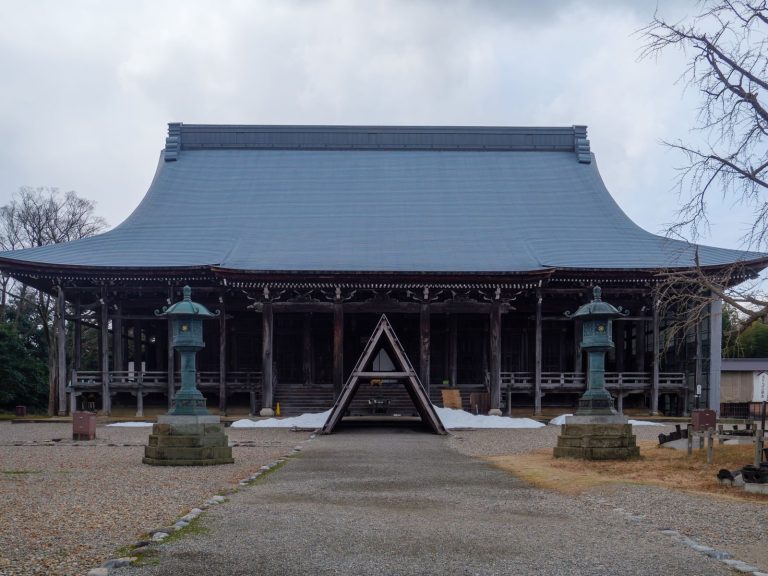
During the tenure of the fourteenth abbot, Seikei, Shōmanji’s main hall was rebuilt. During the tenure of the sixteenth abbot, Seitō, a fire during a Buddhist memorial service destroyed the priests’ residence, kitchen, and study. Seitō rebuilt and reorganized these facilities.
After Hideyoshi’s death, the division of Honganji became permanent, establishing the Eastern and Western branches of Jōdo Shinshū. Shōmanji was revived as a leading temple of the Eastern branch, also known as the Ōtani branch. It became one of the four principal Eastern-branch temples of Etchū, together with Seianji, Chōganji, and Isurugi Jōkōji.
During the Kaga domain period, Shōmanji was one of four Etchū temples that received special treatment under domain law. Its precinct included the dependent temples Kyōnenji, Myōrakuji, and Zenjuji. After Zenjuji’s main hall was damaged and demolished in 1831, Shōmanji kept its principal image and other belongings and administered its affairs. Local petitions eventually led to Zenjuji’s relocation and reconstruction at Nabata in 1879.
A land register from 1843 records that Shōmanji held more than 50 koku within Mizushima Village. A koku measured assessed agricultural production in the historical Japanese domain system. The dependent temple Kyōnenji held 49 koku, while Myōrakuji held slightly more than one.
Modern work has continued to maintain the temple complex. An ossuary was built in 1993, and the bell tower was reconstructed in 1995. In 2016, the principal Amida image and the inner sanctuary of the main hall were repaired. The inner sanctuary is the sacred interior area surrounding the principal object of worship.
Remains
Fortified precinct and associated temples
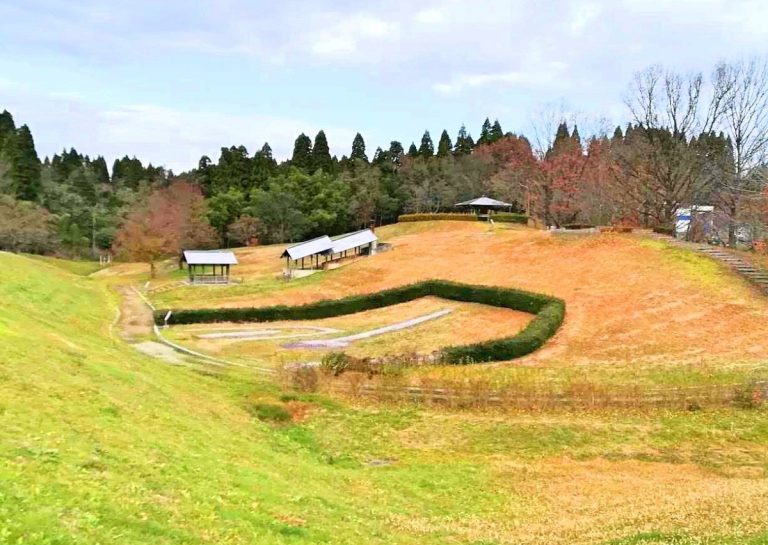
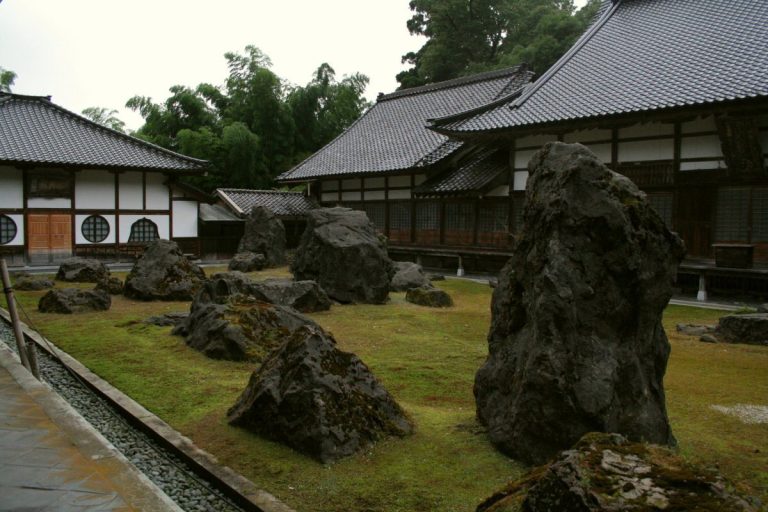
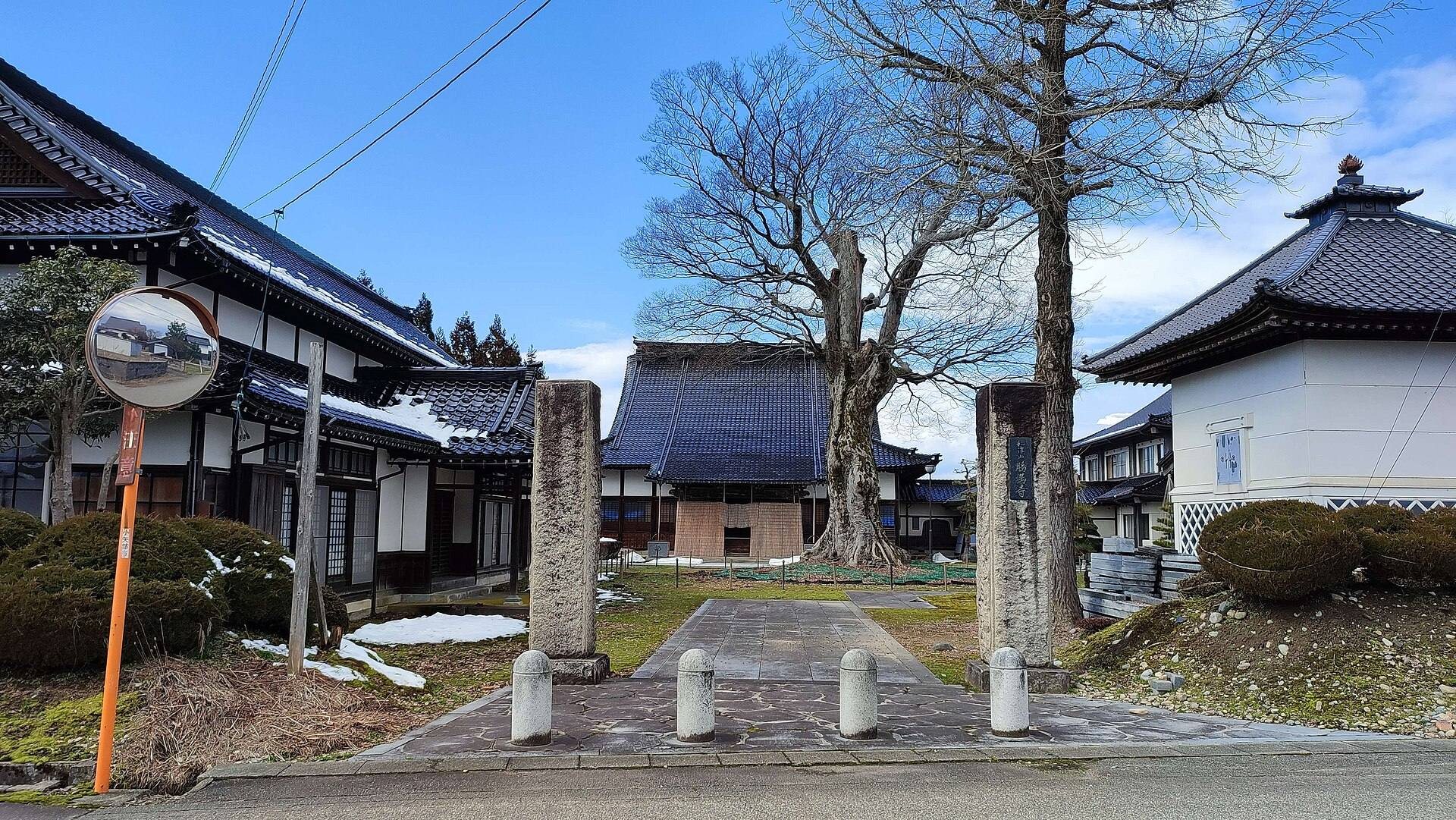
Shōmanji’s historical precinct was enclosed by an earthwork rampart and moat. During the Etchū Ikkō-ikki, its greatest reported extent exceeded 1,000 tsubo. The present precinct includes the adjacent temples Kyōnenji and Myōrakuji, with Kyōnenji on the right side of Shōmanji and Myōrakuji on the left.
Kyōnenji was founded at Wazawa in 1472 and moved to Mizushima in 1713. Myōrakuji was traditionally founded in the Yutani area of Tonami District by a Shingon monk, converted to Jōdo Shinshū in 1470, and moved to Mizushima in 1682. Their presence reflects the organization of the precinct as a group of related temples.
Main hall and religious objects
Shōmanji is centered on worship of Amida Buddha. The principal Amida image and the inner sanctuary of the main hall were restored in 2016. A separate Amida Buddha portrait traditionally presented by Rennyo in 1479 is preserved as a temple treasure. Rennyo’s written endorsement appears on the reverse of the portrait.
The temple also preserves a Muromachi-period bell made by an unknown maker. It is 140 centimeters high, with a mouth diameter of 78 centimeters and a thickness of 10 centimeters. Regarded as an unusually fine old bell, it was exempted from wartime metal requisition.
Sutra repository and later structures
The sutra repository was built in 1818 to house 6,771 scrolls forming the complete Buddhist canon. Its construction reportedly required 100 kan of silver, a historical unit used here to measure silver, raised through donations from various areas.
The present bell tower results from the 1995 reconstruction, while the ossuary dates from 1993. The precinct also preserves the tradition of the Japanese yew associated with Tatsuchiyo’s escape during the 1566 attack. That story gave rise to the custom of including “Ichi” in the childhood names of successive heirs and of venerating the tree.
Woodland and riverbank monument
A former extensive woodland near the Oyabe–Tonami boundary was traditionally said to have been donated to Shōmanji after serving as a protected forest of the Kaga domain. Part of the woodland became the cemetery of successive abbots. Cultivation began in the mid-nineteenth century, and the construction of the Hokuriku Expressway later changed the area; the cemetery remains. The woodland was associated with pheasants, copper pheasants, rabbits, foxes, and tanuki.
At an associated site stands a stone monument titled “Record of the Shōmanji Riverbank.”