Kasama Inari Shrine: A Major Inari Shrine in Japan


Site at a Glance
- Rating
- 4.2
- Popularity
- Medium
- Country
- Japan
- Primary era
- Early Modern
- External website
- Open
- Eras represented
- Early Modern, Modern
- Civilizations
- Tokugawa
- Site type
- Religious
- Remains
- Sanctuary
On this page10 sections
History
Kasama Inari Shrine is a Shinto Inari shrine in Kasama, Japan, whose foundation tradition dates to 651 during the reign of Emperor Kotoku. At the shrine, Ukanomitama, a Shinto kami associated with grain, food, agriculture, industry, prosperity, and good fortune, is worshipped in the form of Inari Okami. The shrine is also known as Kurumigashita Inari and Monzaburo Inari.
Foundation traditions
The traditional foundation story places the shrine beneath a walnut tree at its present location in 651. This account comes through oral tradition, and the shrine from which its deity was transferred is unknown. Another tradition, preserved in the Kasama Benran, states that an Inari shrine once stood among six shrines on Mount Sashiro before being moved to the walnut-tree site during the Hakuchi era. A similar tradition is associated with nearby Shiroyama Inari Shrine.
The shrine’s early history, from its foundation until the middle of the Edo period, remains uncertain. The Edo period, also called the Tokugawa period, lasted from 1603 to 1868, when the Tokugawa shogunate governed Japan through regional domains ruled by daimyo, hereditary feudal lords. During this era, Kasama Inari became widely known and received strong support from successive lords of the Kasama Domain, including the Matsudaira and Asano families. Some of these lords continued to enshrine branch manifestations of the deity after leaving Kasama.
Edo-period prosperity
The shrine’s later prosperity is closely associated with Inoue Masakata. A shrine document dated 1784 preserves the tradition that, in 1743, Masakata dreamed of an elderly figure who identified himself as the Inari of Takahashi. The figure complained that his small shrine was too confined. After Masakata found a walnut beside his pillow and confirmed that the shrine existed, he donated land, ritual vessels, and ceremonial equipment, and expanded its rites.
A related tradition tells of a court-dressed official who visited Masakata at the Edo residence of the domain carrying a box of walnuts. He identified himself as Monzaburo of the Walnut-Tree Inari and promised continued protection for the people in gratitude for Masakata’s earlier donations. Masakata then offered two banners and vowed to worship at Kasama Inari whenever he was in Kasama, or to send a representative in his place.
In 1747, the Inoue family was transferred from the domain, and Makino Sadamichi became lord of Kasama. The Makino family followed the Inoue precedent and made Kasama Inari its prayer shrine. Makino Sadanaga, the second Makino lord, petitioned the imperial court and independently received for the shrine the title “Inari Daimyojin of Senior First Rank.” Makino Sadanao, the eighth lord, supported construction of the present historically important shrine buildings and the establishment of the Tokyo branch. The Makino family also provided five koku of vermilion-seal land, land granted under a shogunal vermilion seal, and donated ritual equipment.
Modern institutional history
In 1860, the Kasama Domain established a separately enshrined manifestation of the deity at its Hamacho residence in Edo, creating the predecessor of the shrine’s Tokyo branch. The main shrine was repaired and rebuilt in the same year. After the Meiji Restoration, Kasama Inari was classified as a former village shrine under the modern system of shrine ranks, and its official name in the shrine register was simply “Inari Shrine.” It did not receive promotion to former district-shrine status, although it was already nationally renowned before the Second World War.
The Tokyo branch moved to its present Hamacho location in 1873. Worship by commoners was authorized in 1878, and the Makino family transferred administration of the branch to Kasama Inari Shrine in 1888. The branch buildings were destroyed by the Great Kanto Earthquake in 1923 and rebuilt immediately. They were destroyed again during the Tokyo air raid of March 1945. The sanctuary and a temporary shrine office were completed in December of that year, followed by reconstruction of the worship hall in 1953, the shrine office in 1957, the sacred-fence enclosure in 1958, and the offering hall by 1978.
Kasama Inari is designated a Beppyo shrine by the Association of Shinto Shrines. It is regarded as one of Japan’s three major Inari shrines and is included among the “Kasama Inari and Mount Sashiro” sites in the Ibaraki Hundred Scenic Views. Its religious following extends from the Kanto region throughout Japan, and more than three million pilgrims visit annually.
Festivals and religious traditions
The principal annual festival is held on April 9, traditionally regarded as the shrine’s foundation day. Other major rites include Tsuina, a Shinto exorcism intended to drive away harmful spirits, the First Horse Festival, and the rice-planting festival.
The shrine’s chrysanthemum exhibitions developed from a morning-glory exhibition begun in 1890. In 1908, the chief priest expanded the activity by creating an agricultural section and beginning chrysanthemum displays. A national chrysanthemum competition followed in 1913, and a chrysanthemum-figure exhibition began in 1948. The tradition later developed into the Kasama Chrysanthemum Festival, whose associated rites include yabusame, a mounted archery offering, demonstrations of Kasama Jigen-ryu iaibatto swordsmanship, a Yamato Koryu dedication ceremony, and a bugaku festival of court dance performed with gagaku, the classical court music and dance tradition of Japan.
In 1988, the shrine’s main sanctuary and one associated ridgepole inscription were designated an Important Cultural Property of Japan. The shrine is also linked with the popular singer Sakamoto Kyu. After surviving the 1943 Tokiwa Line train collision near Tsuchiura as a two-year-old, he believed that Kasama Inari’s deity had saved him, and his wedding ceremony was held at the shrine. Following his death in the 1985 Japan Airlines Flight 123 crash, a pendant inscribed “Kasama Inari” helped establish his identity.
Remains
Main sanctuary
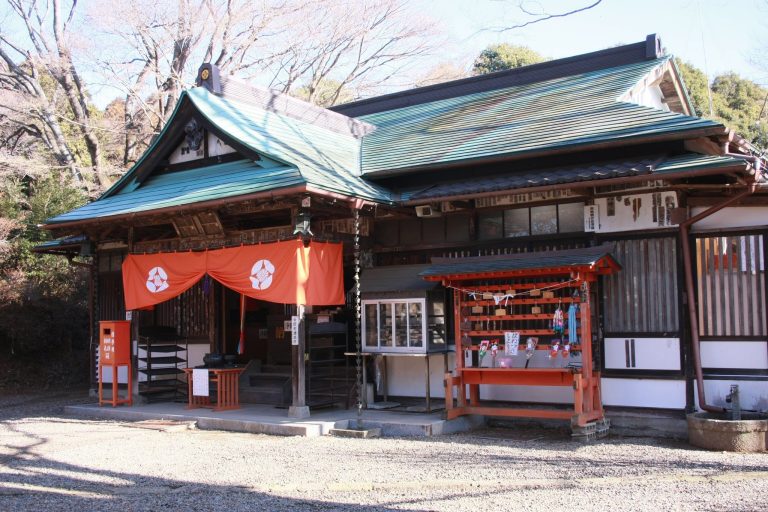
The principal sanctuary was built in 1860 as a composite structure, combining an outer section that formerly served as the worship hall with an inner sanctuary. Its carved decoration includes dragons, peonies, and lions. Walls enclose the sanctuary, which is approached through a large entrance gate. The buildings retain the form associated with the shrine’s late Edo-period rebuilding, while the sanctuary and its associated ridgepole inscription have protected cultural-property status.
Torii and earthquake repairs
The original large torii was built in 1990 from Inada stone quarried in Kasama. It partially collapsed during a minor earthquake in October 2010 and was removed before the Great East Japan Earthquake of 2011. The 2011 earthquake also affected the main sanctuary and other shrine buildings, so repairs to those structures took precedence over rebuilding the torii. A replacement was completed in October 2016 after more than six months of work. It is approximately 10 metres high, compared with about 8 metres for its predecessor, and is made of iron painted Kasama vermilion, the same color used on the worship hall.
Subsidiary shrines
The compound includes Shotokuden and five subsidiary shrines. Shotokuden is a combined hall for Prince Shotoku, Daikokuten, and Kotohira Shrine. The other shrines are Tsukiyomi Shrine, Hakusan Shrine, Sugawara Shrine, Awashima Shrine, and Yamakura Shrine. Their enshrined deities include Okuninushi, Omononushi, Tsukiyomi, Kikurihime, Izanagi, Izanami, Sugawara no Michizane, Sukunabikona, Takamimusubi, Susanoo, and Okuninushi.
Tokyo branch
The Tokyo branch preserves the separate Hamacho manifestation first established by the Kasama Domain in 1860. Jurojin is enshrined beside its main sanctuary, and the branch is one of the shrines associated with the Nihonbashi Seven Lucky Gods. Its present buildings reflect successive rebuilding after the 1923 earthquake and the destruction caused by the March 1945 Tokyo air raid.