Kohata Kitayama Haniwa Production Site: Japan’s Largest Known Kofun-Period Haniwa Complex


Site at a Glance
- Rating
- 3.6
- Popularity
- Very Low
- Country
- Japan
- Primary era
- Medieval
- External website
- Open
- Eras represented
- Medieval
- Civilizations
- Yamato
- Site type
- Economic
- Remains
- Production Complex
On this page12 sections
History
The Kohata Kitayama Haniwa Production Site is a Kofun-period production complex in Ibaraki, Japan, where people made haniwa during the latter half of the sixth century and the seventh century. Haniwa were hollow clay objects placed around or on burial mounds, often depicting people, animals, weapons, and other objects for funerary and commemorative purposes. Recognized as Japan’s largest known haniwa production site, it reveals the scale of late Kofun-period manufacture and the regional networks that supplied burial mounds with these objects.
Discovery and expansion of the site
The remains came to light in the 1950s, when land clearance for agricultural expansion exposed large quantities of haniwa. A kiln discovered in a western side valley in 1987 demonstrated that the production area extended well beyond the part first recognized. Three surveys carried out between 1987 and 1988 established that the complex covered approximately 8 hectares.
The surveys showed that the site combined kilns, workshops, and clay-extraction areas on a substantial scale. It appears to have operated mainly during the later Kofun period, an era from approximately the third to the seventh century associated with large burial mounds and powerful regional elites. Its organization provides evidence for the production systems that supported those communities.
Distribution and regional identity
Haniwa made at the site were supplied to nearby kofun, or burial mounds, and also travelled farther afield. Clay analysis has identified Funazuka Kofun on the northern shore of Lake Kasumigaura, about 15 kilometers away, among the destinations. The objects share artistic features and manufacturing methods with haniwa found elsewhere in Ibaraki Prefecture, forming a regional style known as the Hitachi type. Hitachi was the historical province corresponding broadly to present-day Ibaraki Prefecture.
The production complex was designated a National Historic Site of Japan on January 21, 1992. Its surviving layout and distribution evidence connect local ceramic manufacture with the political spheres and economic networks of late Kofun-period society.
Remains
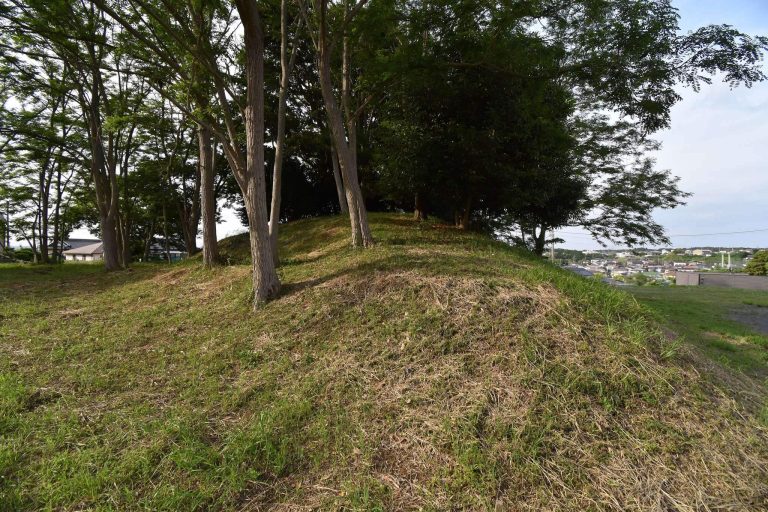
The site occupies a plateau between approximately 22.5 and 27 meters above sea level on the southern bank of the Hinuma River. It lies in the innermost part of a valley cut by a tributary, where two smaller valleys extend east and west. The valleys are approximately 5 to 10 meters wide. High-quality clay deposits, springs along the plateau edges, and timber for fuel provided the principal materials and water resources needed for ceramic production. The remains include 59 haniwa kilns, eight workshop buildings, and two areas where clay was extracted.
Kiln groups
Eastern valley kilns
The kilns were set into plateau slopes facing the valleys, which rise approximately 6 meters. On the eastern side, 28 kilns lie mainly along the western slope. Two groups stand about 80 meters apart. The northern group contains 21 kilns, while the southern group contains seven. They are regularly spaced at intervals of 2 to 7 meters, creating an ordered arrangement along the slope. Later earthworks altered the innermost part of this valley, although the bottoms of two kilns survived beneath the disturbed ground. Another group may have occupied the levelled area, but the sequence linking the kiln groups remains unclear.
Western valley kilns
The western side contains 29 kilns, concentrated mainly on the southern slope of the plateau. Eighteen partly overlapping kilns form an east-west group, with the kilns positioned next to one another. A second group about 18 meters away contains 11 kilns distributed up and down the slope in units of several kilns. The surviving arrangements show that different parts of the complex used distinct patterns of organization.
Kiln construction
Where excavation has examined them, the kilns are semi-subterranean, meaning that they were cut partly into the ground. Each was an unstepped structure dug approximately 1 meter into the sandy loam of the underlying formation. The basic design was narrow and elongated, with kiln bodies about 6 meters long and firing chambers approximately 1.2 meters wide. These facilities were suited to the repeated production of the long, hollow clay forms used for haniwa.
Workshops and clay extraction
Workshop buildings
Eight pit buildings stood on the plateau. Their floors contain accumulations of raw clay, and their arrangement and contents indicate that they were workshops connected with haniwa manufacture. The buildings provide a separate working area within the larger complex, alongside the firing installations on the valley slopes.
Clay-extraction areas
Two extraction areas occupy the plateau slopes. They consist of numerous large and small pits that overlap heavily, reflecting repeated digging for the nearby high-quality grayish-white clay. A locality called Kabett Mountain was also known for its clay deposits. Together, the pits and workshops show how raw material was obtained and prepared within the production landscape.
Surviving haniwa
The recovered haniwa include cylindrical and morning-glory-shaped forms, as well as numerous figures. Among the figurative examples are warriors, people blowing vertical flutes, figures wearing crossed sashes, and figures holding jars. Horse-shaped and shield-shaped haniwa are also represented. Their forms, artistic characteristics, and manufacturing techniques correspond with examples from elsewhere in Ibaraki and help define the Hitachi regional style.
Four straight ditches cross the plateau, although their date and function remain uncertain. The relationship between these earthworks and the production facilities is therefore not established. The combination of kilns, workshops, clay pits, haniwa, and associated landscape features preserves the physical evidence of a large manufacturing centre serving burial mounds across the region.