Izuhara Hachimangū Shrine: A Shinto Shrine and Historic Provincial Sanctuary in Tsushima


Site at a Glance
- Rating
- 4
- Popularity
- Low
- Country
- Japan
- Primary era
- Classical
- Eras represented
- Classical
- Civilizations
- Yamato
- Site type
- Religious
- Remains
- Sanctuary
On this page15 sections
History
Izuhara Hachimangū Shrine is a Shinto shrine in Japan, located in central Izuhara at the eastern foot of Mount Shimizu. Its foundation tradition reaches back to 677, when an imperial order is said to have established a shrine building at the mountain’s foot. The shrine’s principal deities are Empress Jingū, Emperor Ōjin, Emperor Chūai, Hime Ōkami, and Takeuchi no Sukune. Its religious character belongs to the Hachiman tradition, which centers on the deified Emperor Ōjin and is associated with protection, warfare, and imperial ancestors.
Foundation and medieval development
Shrine tradition holds that Empress Jingū visited Mount Shimizu while returning from her expedition against the Three Han states. At the summit, she established a sacred boundary and worshipped heavenly and earthly deities with a sacred mirror and offerings. The tradition attributes the later construction of a shrine at the foot of the mountain to an imperial order issued in 677, during the sixth year of Emperor Tenmu.
The shrine’s earlier names reflect its connection with Kamitsu Hachimangū, now called Kaijin Shrine, in Kamigata District. Because worship was said to have been transferred from that shrine, the institution became known as Shimotsu Hachimangū, using the medieval name of Shimogata District. It was also called Hachiman Shingū, Fuchū Hachimangū, and Izuhara Hachimangū. One tradition connects the name Hachimangū with the eight banners associated with Empress Jingū’s expedition.
The earliest surviving documentary reference dates from March 1160, when the shrine appears as Shimotsu Hachimangū. The transfer of worship from Kamitsu Hachimangū is therefore placed between 1052 and 1160. In 1189, Fujiwara Akiyori became a shrine administrative official, and in 1190 he was appointed hereditary chief priest of the main Hachiman shrine.
A document of 1267 describes Hachiman Shingū as the leading shrine of Shimogata District. Another document, from 1348, gives the earliest surviving reference identifying it as the first shrine of Tsushima Province. Tsushima already possessed an ichinomiya, the highest-ranking shrine in a historical province, by 1230, so the later designation reflects the shrine’s particular standing in the province’s religious and administrative order.
Provincial sanctuary and wartime damage
Izuhara Hachimangū stood near the former site of the Tsushima provincial government. In October 1274, a temporary building of the provincial Fuchū Hachimangū and the shrine protecting the provincial government burned. Because the Mongol invasion began that same evening, the fire later came to be regarded as an omen.
The buildings suffered further damage in 1336, when falling trees struck the shrine. The people of Shimogata District were ordered to repair the structures before the August religious rites. During the fourteenth century, designated lands and revenues in Saga, Chiki, and Sago supported the shrine’s monthly ceremonies. Local officials were also instructed to conduct rites and pray for the provincial military governor and land stewards.
A roof-board inscription from 1476 preserves a popular tradition that the shrine was the original sanctuary of Otokoyama and the spiritual protector of the realm. The same tradition connected it with the origins of Iwashimizu Hachimangū, although this account was not included in the shrine’s modern abbreviated history.
Ritual life and changing identity
From the Edo period onward, the shrine’s possible identification with the ancient Meishin Taisha Watatsumi Shrine was debated. A Meishin Taisha was a high-ranking shrine listed in the Engishiki, a tenth-century compilation of court procedures and officially recognized shrines. Records from 1760 and the late eighteenth century identified Izuhara Hachimangū with Watatsumi Shrine, while another investigation proposed Oto-Watatsumi Shrine. The shrine later ceased to claim the connection.
Several rites expressed the shrine’s role in community welfare. Musha Shinji prayed for abundant harvests, martial improvement, health, and safety. It probably began when the shrine adopted the Hachiman cult in the middle of the Heian period, although its earliest surviving records date from the Edo period. Archers included a ritual official responsible for the norito, or formal Shinto prayer, and two government officials from the Abiru family. Local communities supplied mats, targets, drums, assistants, arrow retrieval, and food for a communal feast. The Tsushima Fuchū domain contributed silver for the feast and meals, while the ritual official received fine paper and a fan each year. The rite had ended by the modern period.
The Tōnin no Shinji, also known as the Hatsu-uma Festival, sought abundant harvests, prosperous livestock breeding, and protection from calamity. A horse decorated with bells and flowers underwent purification as performers played gong, drum, and flute and participants danced to festival music. The Hōjōe Festival prayed for harvests, good health, and prosperity in every occupation. This Buddhist-influenced rite of releasing living creatures began with a service on the previous evening, followed by a procession to Izuhara Port where shellfish were released. Fourteen Izuhara districts took turns every three years in sending about 150 participants. After the Second World War, the shrine also began presenting dances of court women and the Urayasu Dance.
Modern institutional changes
During the Meiji period, the shrine was temporarily renamed Watatsumi Shrine. It was classified as a village shrine in 1874, restored to the name Hachimangū Shrine in 1890, designated a shrine receiving state offerings in 1907, and elevated from village shrine to prefectural shrine in 1916. Its historical administrative setting passed through Shimogata District’s Yora township, Nakamura Town, Izuhara Village, and Izuhara Town. The former parish comprised approximately 2,500 to 2,514 households.
Remains
Main precinct
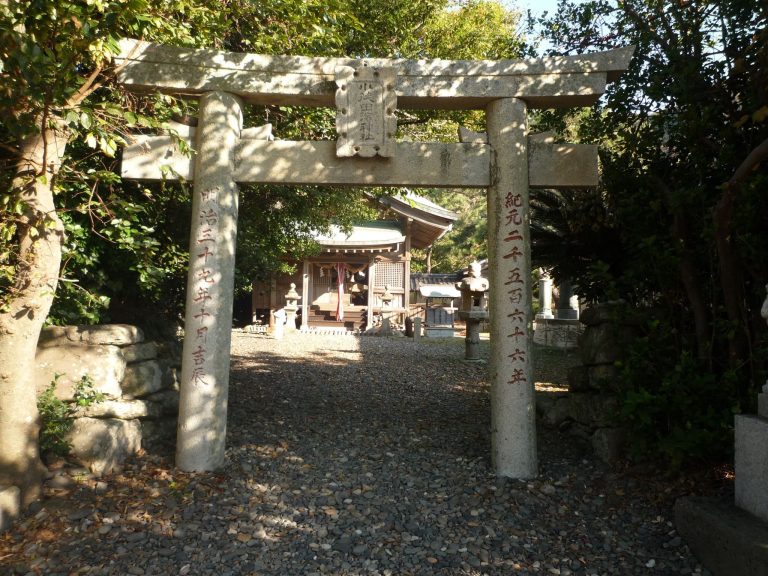
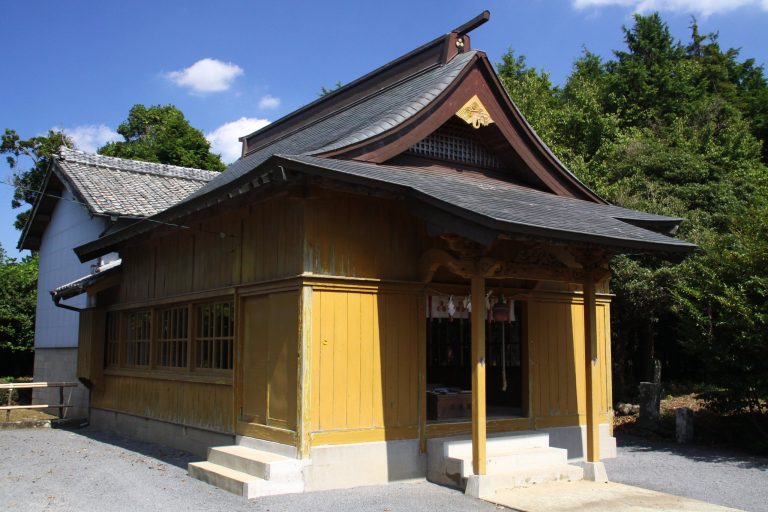
The precinct occupies the eastern foot of Mount Shimizu and is reached by stone steps leading to a gate tower. Beyond it stand the worship hall and main sanctuary, while the former provincial-government area lies nearby. Historical records give the precinct an area of either about 2,882 tsubo or about 7,913 tsubo, traditional Japanese units of area. One record also describes one chō and six tan of mountain woodland. Mount Shimizu was formerly shrine-owned land and became national forest during the Meiji period.
Main sanctuary
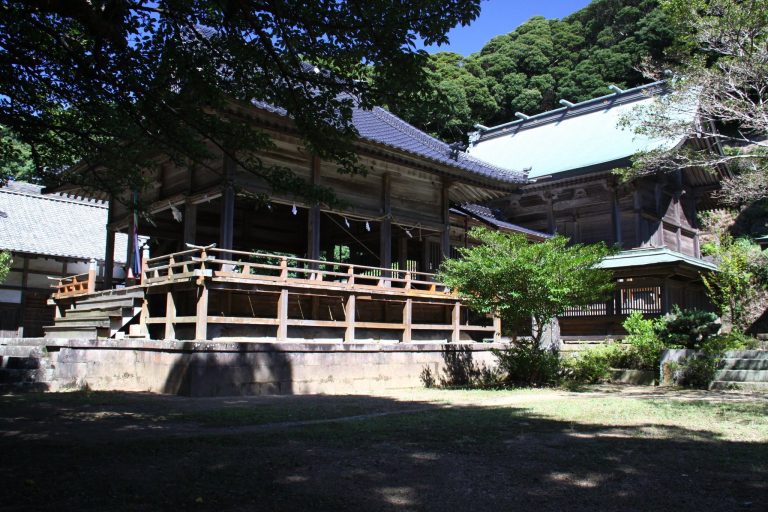
The main sanctuary covers about 22 tsubo and measures five ken wide by three ken deep, approximately 9.09 by 5.45 metres. It follows the nagare-zukuri form, in which the front roof slope projects farther than the rear slope to create a covered entrance area. The roof is covered with cypress bark.
Worship hall and gate tower
The worship hall measures about 4.5 ken by three ken, or approximately 8.18 by 5.45 metres, and has a tiled roof. Its surrounding corridor measures about 1.5 ken by four ken, approximately 2.73 by 7.27 metres. The gate tower measures two ken by 1.5 ken, or about 3.64 by 2.73 metres, and is also tiled.
Ancillary buildings
The shrine office and the ema hall, a building for displaying votive wooden plaques, each measure seven ken by three ken, approximately 12.73 by 5.45 metres. A storehouse measures three ken by two ken.
Affiliated and transferred shrines
Hira Shrine
Hira Shrine is a village shrine and a candidate for the ancient Hira Shrine. Its sanctuary measures 1.5 ken square and has a sheet-copper roof, while its worship hall measures two ken by 1.5 ken and has a tiled roof. The shrine was formed by merging Amateru, Gunden, Wakamiya, and Shinrei shrines. Its recorded deities are Ame no Hohi no Mikoto, Yamato Takeru, Emperor Nintoku, and Prince Uji.
Records associate Hira Shrine with a sequence of divine ranks beginning with Junior Fifth Rank, Lower Grade, in 841. It rose to Junior Fifth Rank, Upper Grade, in 859, followed by Senior Fifth Rank, Lower and Upper Grades, and later Junior Fourth Rank, Lower and Upper Grades. The records for 859 and 877 are questioned because they do not appear in the cited documentation of the Nihon Sandai Jitsuroku. Another interpretation identifies the references with the separate Hirano Shrine, leaving Hira Shrine’s status as an ancient state shrine uncertain, although it remains a distinctive candidate among the proposed identifications.
Unuto Shrine
Unuto Shrine occupies approximately 100 square metres. Its main sanctuary is one ken square, about 1.82 metres square, and its worship hall is 2.5 ken square, approximately 4.55 metres square. It is a village shrine and a candidate for the ancient Unuto Shrine.
Sō Sadakuni transferred Unuto Shrine from Saga Village in Kamigata District to the present precinct in 1491. It had enshrined Susanoo no Mikoto, the deity of Yasaka Shrine, in 869 and was known as Gion until the Meiji period. In 870 it received the rank of Junior Fifth Rank, Upper Grade.
Inyaku Shrine
Inyaku Shrine once safeguarded official seals and keys. It stood at Kokufu-daira in the Imayashiki area of Izuhara and probably originated before 1212, since a document mentions its seal-service rite. Warfare destroyed the shrine by fire in 1528. During the attack on Kaneshi Castle that October, a member of the Sō family survived by hiding in the inner sanctuary. After the attacker was defeated and killed in a counterattack, the shrine’s storehouse and documents are thought to have burned as well. A 1686 record placed it in the hills northwest of Kaneshi Castle, and it was merged into Unuto Shrine during the early Meiji period.
Other transferred shrines
Tenjin Shrine was established through the tradition that Emperor Antoku died on Tsushima. Sugawara no Michizane was enshrined there in 1362 after Sō Tsuneshige invited him from Dazaifu. Kokufu-daira Shrine, formerly at Kokufu-daira in Imayashiki or on Mount Tendo, was merged into Tenjin Shrine together with Shiraiso Shrine. Its deity is identified as Sō Yoshitoshi in one record and as Emperor Antoku and Sō Yoshitoshi in another, while Shiraiso Shrine was associated with Sō Yoshizumi.
Yora-so Shrine was transferred from Hisamichi into the precinct in 1502 following a divine oracle. Yora Gōzu Shrine, originally at the foot of the hills east of Ōgibara, was moved temporarily to Tsushima Kokubunji and transferred to the Hachimangū precinct in 1870. Kamado Shrine, also called Hiyoshi Shrine because it originated at Kita-Hiyoshi in Ichimine, was moved into the precinct in 1186. Fire-Calming Shrine came from Ōgibara in Tabuchi during the Genroku period. Ōtoshi Shrine remains in Kasabuchi, Nakamura, Izuhara, where its deities are Ōtoshi no Kami, Okitsuhiko no Kami, and Okitsuhime no Kami; it was classified as a village shrine in 1874.