Osahozuka Kofun: A Fifth-Century Japanese Burial Mound

Site at a Glance
- Rating
- 4.3
- Popularity
- Very Low
- Country
- Japan
- Primary era
- Classical
- External website
- Open
- Eras represented
- Classical
- Civilizations
- Yamato
- Site type
- Burial
- Remains
- Burial Mound
On this page13 sections
History
Osahozuka Kofun is a large Japanese burial mound in Saito, Miyazaki Prefecture, Japan, built during the first half of the fifth century in the middle Kofun period. The Kofun period was an era of large-scale mound construction and expanding chiefly and royal political networks, conventionally dated from about the third to the sixth centuries. Osahozuka formed part of the Saitobaru Kofun Group, which contains more than 320 tombs and is the largest kofun group in Kyushu.
Integration of chiefly lineages
The Saitobaru Kofun Group occupies the central part of the Saitobaru Plateau beside the middle Hitotsuse River. Osahozuka belonged to the Maruyama Subgroup, together with the adjacent Mesahozuka Kofun and three smaller subsidiary tombs. Before the two large central mounds were built, six chiefly burial lineages had existed in parallel along the plateau margins. The scale and central position of Osahozuka and Mesahozuka suggest that the pair represented an integration of those lineages.
The chiefly tombs built afterward at Saitobaru were considerably smaller. The principal chiefly tomb of southern Kyushu later shifted to Yokose Kofun in present-day Osaki, Kagoshima Prefecture, placing Osahozuka within a broader change in the region’s political landscape.
Traditions about the occupant
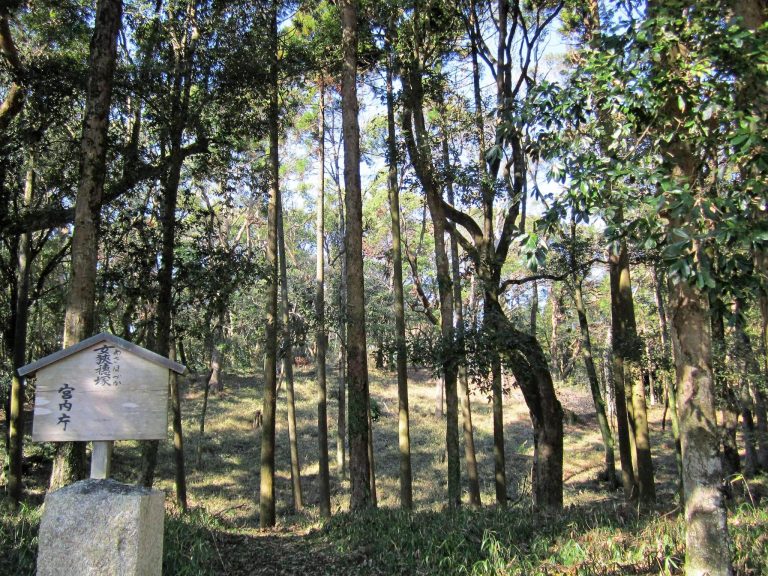
The person buried at Osahozuka is unknown. In 1895, the Imperial Household Ministry, the predecessor of the Imperial Household Agency, designated the mound as the Osahozuka Imperial Mausoleum Reference Site without formally identifying its occupant. An Imperial Mausoleum Reference Site is managed as a possible imperial burial location even when the deceased has not been established. The agency lists Ninigi-no-Mikoto as one possible occupant. In Japanese mythology, Ninigi-no-Mikoto is described in the classical chronicles as descending from the heavenly realm to rule in Japan.
This identification belongs to a wider tradition concerning Ninigi-no-Mikoto’s burial place. The Nihon Shoki, one of Japan’s earliest major chronicles, describes a mausoleum for him in the Tsukushi-Hyuga region without specifying its location. The tenth-century Engishiki, a compilation of regulations and records concerning imperial rites and mausolea, lists a distant mausoleum in Hyuga without a tomb-guard household, suggesting that its location was already unknown when the work was compiled. Several traditional locations existed in Miyazaki and Kagoshima. A mausoleum within the precincts of Nitta Shrine in Satsumasendai, Kagoshima, was designated in 1874, while Osahozuka received its reference-site designation in 1895.
A different interpretation identifies the occupant as Morokata kimi Ushimoro, called Ushimoro in the Kojiki and Ushimoroi in the Nihon Shoki. Under this interpretation, the neighboring Mesahozuka Kofun was the burial place of his daughter Himuka no Kaminaga-hime, who is described in the chronicles as a consort of Emperor Nintoku.
Protection and investigation
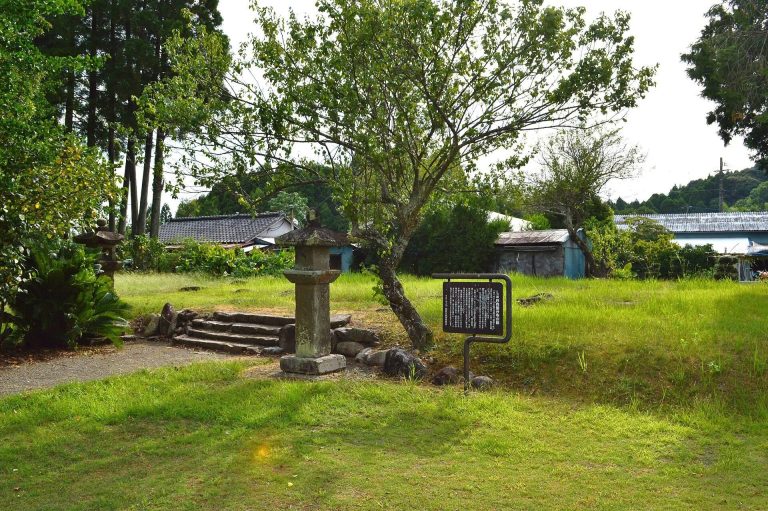
A shrine once stood on the mound before being moved to the precincts of Miyake Shrine. The Imperial Household Agency now manages Osahozuka as an Imperial Mausoleum Reference Site. The wider Saitobaru Kofun Group was designated a national historic site in 1934 and a special historic site in 1952, but Osahozuka and Mesahozuka were excluded because they had already been classified as Imperial Mausoleum Reference Sites.
Investigation began with a survey in 1926, followed by the completion of its drawings in 1929. The Miyazaki Prefectural Board of Education carried out an on-site survey in 1997 and ground-penetrating-radar investigations in 2004-2006 and 2009-2010. On September 5, 2019, representatives of 16 archaeological and historical societies were permitted to investigate the mound. These studies have helped clarify the relationship between Osahozuka and Mesahozuka while the burial facility itself remains unidentified.
Remains
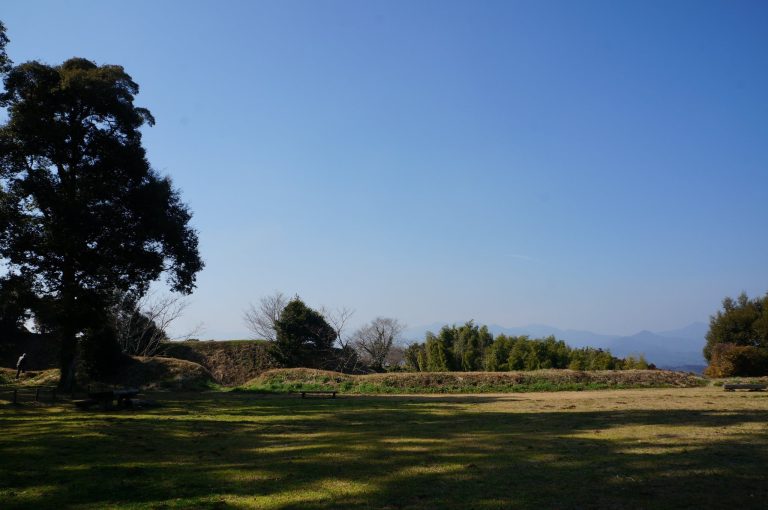
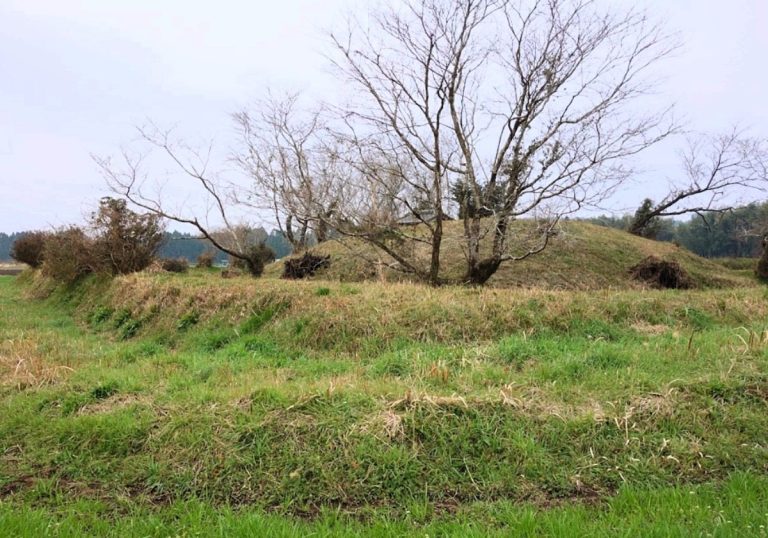
Osahozuka is a scallop-shell-shaped kofun, a variant of the keyhole form with a broad rounded rear mound and a particularly short rectangular front projection. The projection points south-southeast, and Mesahozuka lies directly to its south. The original mound is estimated to have been 176 meters long, while the 1997 survey measured the surviving mound at 154.6 meters. The estimated original length places Osahozuka among the largest kofun in Kyushu and makes it the largest known scallop-shell-shaped kofun in Japan.
Mound and moats
Rear mound and front projection
The circular rear mound was constructed in three tiers. It measures about 132 meters in diameter and 19.1 meters in height. A narrowed junction, 45.5 meters wide, connects it to the front projection. The rectangular projection was built in two tiers, is approximately 40.7 meters wide and 4.5 meters high, and was altered in later periods.
Encircling moats
Two moats once surrounded the mound. The inner moat is 15-18 meters wide, followed by a berm measuring 17-23 meters across, while the outer moat is 20-25 meters wide. Both moats form ear-shaped rings and stop before crossing the front of the rectangular projection.
Construction setting and relationship with Mesahozuka
Osahozuka and Mesahozuka occupy the end of a low ridge extending from the west. Their central position appears to have been selected both for the available ground and for access to enough earth for construction. Within the restricted area, the two mounds were planned to reach the greatest possible size and to have equal lengths.
The relationship between the two tombs was once interpreted in several ways. Some reconstructions placed Osahozuka first and attributed part of its short front projection to construction of Mesahozuka; others placed Mesahozuka first and regarded Osahozuka’s projection as unfinished. Ground-penetrating-radar investigation found no overlap, supporting the conclusion that both mounds were completed without one being built across the other.
Haniwa
Cylindrical haniwa were found on the mound. Haniwa are clay funerary objects placed on or around burial mounds, and their forms can help date construction and trace production connections. The Osahozuka examples have thin walls, narrow ends on their projecting bands, orange-brown to dark-brown surfaces, and indistinct black spotting. Their appearance indicates firing in a pit kiln, a built chamber used for firing pottery, rather than in the open air.
The haniwa are close in date to those from Mesahozuka but were made by a different technique. The Mesahozuka examples were open-fired, while haniwa from Saitobaru Tomb 170 follow the Osahozuka production tradition. Those from Tombs 169 and 171 follow the Mesahozuka tradition. The Osahozuka tradition is regarded as non-Kinai in character, whereas the Mesahozuka tradition shows influence from the Kinai region around the ancient political centers of Nara and Kyoto.
Subsidiary tombs
Saitobaru Tomb 170
Saitobaru Tomb 170 is a circular mound considered to be a subsidiary tomb of Osahozuka or Mesahozuka and is particularly closely associated with Osahozuka. It measures approximately 47 meters in diameter and 3.5 meters in height. The tomb was excavated in 1912 and reinvestigated by the Miyazaki Prefectural Board of Education in 2004-2006. Its haniwa belong to the Osahozuka production tradition.
Saitobaru Tombs 169 and 171
The other two nearby subsidiary tombs are Saitobaru Tomb 169, a circular mound, and Saitobaru Tomb 171, a square mound. Together with Tomb 170, they formed the smaller group associated with Osahozuka and Mesahozuka.