Hase-dera Temple: A Buddhist Temple in Kamakura, Japan


Site at a Glance
- Rating
- 4.5
- Popularity
- High
- Country
- Japan
- Primary era
- Modern
- External website
- Open
- Eras represented
- Modern
- Civilizations
- Japanese
- Site type
- Religious
- Remains
- Sanctuary
On this page17 sections
History
Hase-dera Temple, also known as Hase Kannon, is a Buddhist temple in Kamakura, Japan, traditionally founded in 736 during the Nara-period Tenpyo era. Its early history remains uncertain, but the temple became an important institution during the Kamakura period, when Kamakura served as the center of Japan’s military government. Today it is an independent temple affiliated with the Jodo school, the Japanese Pure Land tradition centered on devotion to Amida Buddha.
Foundation Traditions
Temple tradition connects Hase-dera with the monk Tokudo, who is associated with the Hase-dera tradition in Nara. In 721, Tokudo is said to have carved two Eleven-Headed Kannon images from a single large camphor tree. Kannon is a bodhisattva associated with compassion, while the eleven-headed form expresses an expanded capacity to perceive and respond to suffering. One image became the principal image of Hase-dera in Nara. The other was placed in the sea after prayers and, fifteen years later, allegedly came ashore at Nagai on the Miura Peninsula. It was then brought to Kamakura, where a temple was founded to enshrine it. Fujiwara Fusasaki, an early Nara-period court noble and statesman, is identified in this tradition as the founding patron.
The precise circumstances of the temple’s foundation have not been established. An inscription on the temple bell, however, shows that the institution existed by 1264, when it was called “New Hase-dera.” The bell was cast that year by the metalworker Monobe at the request of the abbot Shinko. Other medieval objects include stone memorial tablets dated 1262 and 1308 and a Buddhist votive plaque dated 1326.
Medieval Repairs and Institutional Change
Hase-dera underwent repairs during the rule of the Ashikaga shogunate. Ashikaga Takauji, one of the successive leaders of that shogunate, is traditionally said to have repaired the temple buildings and sacred images in 1342. Ashikaga Yoshimitsu is traditionally said to have repaired the halo of the Kannon image in 1392 and installed a statue attributed to Gyoki as its attendant image. Gyoki was an eighth-century Buddhist monk remembered for religious and public works.
The temple’s institutional affiliations changed over time. It originally belonged to the Tendai school, a major Japanese Buddhist tradition based on the teachings of the Chinese Tiantai school. In 1607, during Tokugawa Ieyasu’s restoration of the temple complex, Hase-dera converted to Jodo-shu. The abbot Gyokuho Shunso is regarded as the temple’s restorer and reviving founder. The complex and its pagoda were renovated in the same year, and Sakai Tadakatsu carried out further repairs to the buildings in 1645.
The temple received a donation from Hojo Ujiyasu in 1547 and a vermilion-seal document from Tokugawa Ieyasu in 1591. Ujiyasu was a sixteenth-century military leader of the Hojo family, while Ieyasu founded the Tokugawa shogunate. These connections place Hase-dera within the changing political and religious landscape of medieval and early modern Japan.
Modern History and Religious Associations
The buildings collapsed during the Great Kanto Earthquake and were subsequently rebuilt. Hase-dera later became independent from Jodo-shu during the religious reorganization immediately after the Pacific War, while retaining its affiliation with the Jodo school. In 2016, it was designated a component of the Japan Heritage program and placed within Kanagawa Prefecture’s specially protected historical landscape district.
Hase-dera is the fourth station of both the Bando Thirty-Three Kannon pilgrimage and the Kamakura Thirty-Three Kannon pilgrimage. Its Daikokuten image also connects the temple with the Kamakura-Enoshima Seven Lucky Gods pilgrimage. The grounds have a literary history as well. Takayama Chogyu lived within the precinct around 1901, shortly before his death, and a commemorative monument was erected in 1959. A writers’ association installed a bust of Kume Masao on the occasion of his third death anniversary, while another monument commemorates the poet Takahama Kyoshi.
Remains
Mountain Layout and Main Halls
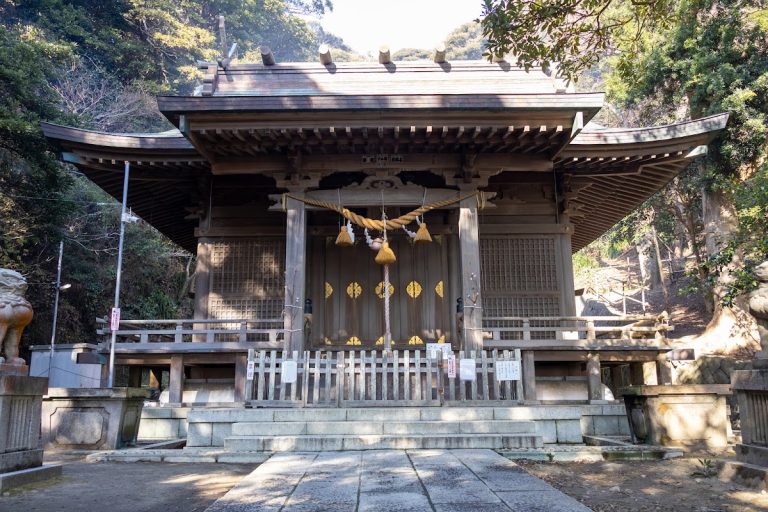
Hase-dera occupies a mountainside overlooking the sea, with its principal halls arranged on two levels of the slope. The lower level contains the entrance, the wooden main gate known as the Sanmon, a pond, and stairs leading upward. The upper area includes the principal halls and provides views toward Kamakura, Yuigahama, and the coast around Kamakura and Zushi. A bamboo grove, Hojo-ike pond, and a small circuit along the mountainside are also part of the grounds.
Kannon-do
Kannon-do, the main hall, houses the standing Eleven-Headed Kannon known as Hase Kannon. The statue measures 9.18 metres in height and is carved from solid camphor wood with gilded decoration. Its eleven heads represent different stages in the search for enlightenment. The figure holds a rosary and ritual staff in the right hand and a water vessel in the left, a combination associated with the Hase-dera image type. Its repairs are traditionally linked to Ashikaga Takauji in 1342 and Ashikaga Yoshimitsu in 1392, the latter being credited with work on the halo.
Amida-do
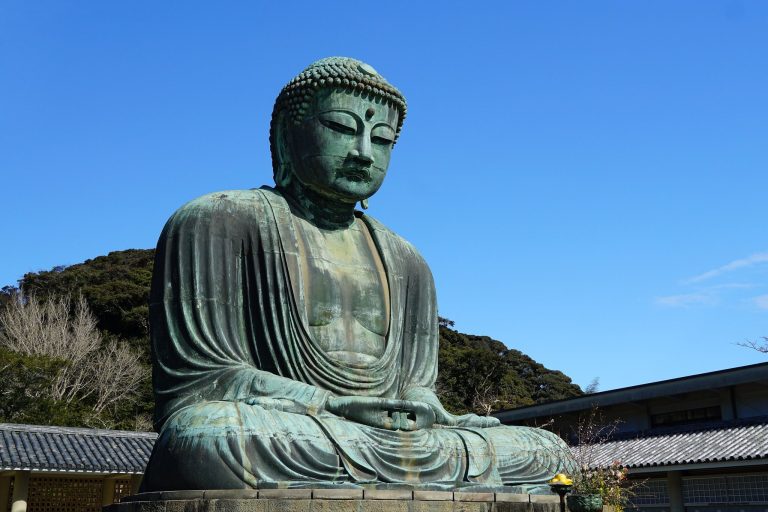
Amida-do stands to the right of Kannon-do and contains a seated Amida Nyorai measuring 2.8 metres in height. Tradition attributes the commission of the image to Minamoto no Yoritomo, founder of the Kamakura shogunate, while its actual manufacture is dated to the Muromachi period, the era of Ashikaga rule from 1336 to 1573. The statue formerly served as the principal image of Seiganji Temple at Hase and is counted among the six Amida images of Kamakura.
Daikoku-do
Daikoku-do stands to the left of Kannon-do and enshrines a Daikokuten image associated with the Kamakura-Enoshima Seven Lucky Gods pilgrimage. The original image, made in 1412, was transferred to the temple’s treasure collection, and a newer image is now worshipped in the hall.
Collections and Scripture Repository
Kannon Museum
The Kannon Museum occupies the former treasure hall, which was renovated and opened in 2015. Its collection includes the original bronze bell cast in 1264, six Eleven-Headed Kannon votive plaques, and images of the Thirty-Three Manifestations of Kannon. Objects found during restoration work are also displayed there. The bell and medieval votive materials connect the museum collection with the temple’s early history.
Kyozo
Kyozo is built in the rotating-library style and contains a wooden revolving scripture repository called a Rinzo. The repository holds the temple’s Buddhist scriptures. Its ritual rotation is traditionally understood to carry the same merit as reading the texts stored inside.
Devotional Features and Sacred Landscape
Jizo-do
Jizo-do stands beside the route ascending toward the halls on the mountainside and is associated with Fukujyu Jizo. Hundreds of small Jizo figures surround the hall. Jizo is a bodhisattva regarded in Japan as a protector of children and other vulnerable beings, and these figures were placed by parents mourning miscarriages, stillbirths, or abortions. They generally remain for about a year before being removed to make room for others. More than 50,000 such figures are estimated to have been placed at Hase-dera since the Second World War.
Benten-do and Benten-kutsu
Benten-do stands to the right after the Sanmon, near Hojo-ike pond. It enshrines an image of Benzaiten traditionally attributed to Kobo Daishi, the posthumous title of Kukai, the monk who founded the Shingon school in Japan. The image is now kept in the Kannon Museum. Benzaiten is associated with water, eloquence, music, and good fortune, and is the sole female deity in the Seven Lucky Gods tradition.
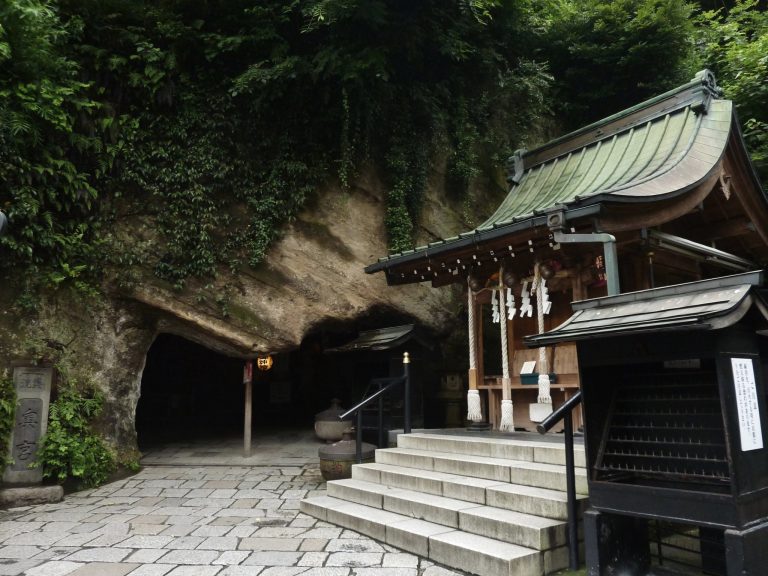
Nearby, Benten-kutsu, the Benzaiten Grotto, is a cave with a long, winding passage and a low ceiling. Benzaiten and her sixteen attendants are carved into the walls. An Uga-jin image, with a human head and serpent body, is also enshrined there, together with numerous small Benzaiten figures and other devotional objects.
Kakigara Inari
Kakigara Inari stands beside the bell tower. Tradition holds that it enshrines oyster shells that adhered to the Kannon image when the statue washed ashore. The tradition gives this small feature a physical connection with the temple’s foundation story.
Later Buildings and Memorials
The present main temple building adjoins the administrative office near the entrance. Completed during the Heisei era, it is constructed entirely of Taiwanese cypress and is used mainly for parishioners’ memorial services. In front of Daikoku-do, a stone Kannon figure has a pedestal incorporating Takahama Kyoshi’s poem monument, and a bust of Kume Masao also stands nearby. The monument to Takayama Chogyu is positioned to the left after entering through the Sanmon.
The Hydrangea Path forms a sloping route through the grounds. Hydrangeas bloom there in June and July in white, blue, and pink, while the upper section provides views toward the coast around Kamakura and Zushi. Near Kyozo, Choon-tei, a small restaurant with a terrace, forms part of the later landscape arrangements.