Mizuta Tenmangū: A Shinto Shrine Dedicated to Tenjin in Japan


Site at a Glance
- Rating
- 4.3
- Popularity
- Medium
- Country
- Japan
- Primary era
- Early Modern
- External website
- Open
- Eras represented
- Early Modern
- Civilizations
- Unclassified
- Site type
- Religious
- Remains
- Sanctuary
On this page9 sections
History
Mizuta Tenmangū is a Shinto shrine in Japan, founded in 1226 and centered on a principal sanctuary in the Nagare-zukuri style. It is a Tenman-gū, a shrine dedicated to the deified Sugawara no Michizane, a prominent Heian-period court scholar and statesman who became venerated as Tenjin, a deity associated especially with learning. The shrine stands in Chikugo, Fukuoka, and has long been connected with the Sugawara family and the religious history of the region.
Foundation and the Mizuta Estate
Shrine tradition holds that Sugawara Tamenaga founded Mizuta Tenmangū in 1226 by imperial order from Emperor Go-Horikawa, who ruled Japan from 1221 to 1232. Tamenaga was a descendant of Sugawara no Michizane and head of the Sugawara clan. The shrine served as the guardian sanctuary of the Mizuta Estate, a medieval landed estate known as a shōen. The estate belonged to Dazaifu Tenman-gū and was administered by the Otori clan, a branch of the Sugawara lineage.
Within Kyushu’s network of Tenman-gū shrines, Mizuta was regarded as second in rank after Dazaifu Tenman-gū. This position reflected its association with the Sugawara lineage and its role within the Mizuta Estate.
Patronage in the Edo Period
During the Edo period, Chikugo Province was divided between the domains of Kurume and Yanagawa. Mizuta Tenmangū received patronage and religious support from both the Arima clan of Kurume and the Tachibana clan of Yanagawa. A record associated with Tanaka Tadamasa, an early Edo-period lord of Chikugo, assigns the shrine estate revenue of 1,000 koku and places the shrine third among the area’s temples and shrines. A Yanagawa domain record from 1681 lists 50 koku of shrine land and ranks Mizuta fourteenth among Yanagawa’s religious institutions.
The shrine also remained connected with the political and intellectual currents of the late Edo period. Maki Yasuomi, a Kurume scholar and activist and a priest of Kurume Suitengū, lived in the Sanshika retreat beside Mizuta Tenmangū while confined after the failure of a reform of the domain government. He stayed there with his brother, Otori Rihei, who served as a priest of Mizuta Tenmangū.
Ritual Life and Preservation
The shrine’s annual observances include New Year rites, first-Tenjin rites, a plum-blossom festival, a festival marking Sugawara no Michizane’s birth, and purification ceremonies. The yearly cycle also includes summer purification with a chinowa rite, a lantern and fireworks festival, a procession featuring children’s performances, and harvest-thanksgiving rites.
The Sanshika retreat survives west of the shrine and is designated a Fukuoka Prefectural Historic Site. The honden, the principal sanctuary of a Shinto shrine, and the stone torii, the gateway marking the entrance to a sacred precinct, were designated Fukuoka Prefectural cultural properties in 1961.
Remains
Main Precinct and Associated Buildings
Honden and Stone Torii
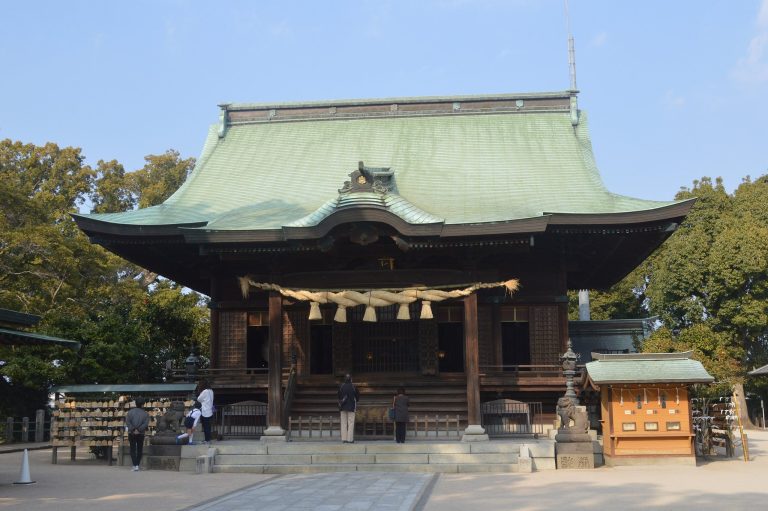
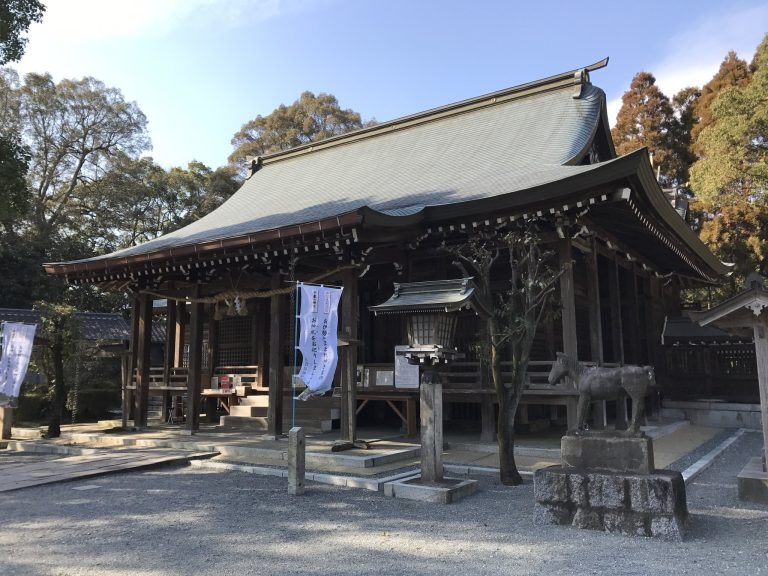
The main sanctuary is a three-bay building in the Nagare-zukuri style. This form has a gabled roof whose front slope extends forward to create a covered veranda over the entrance. The honden and the stone torii were rebuilt in 1672. Together with the worship hall, they form the principal architectural elements of the shrine precinct, and both the honden and torii retain their status as Fukuoka Prefectural cultural properties.
Sanshika Retreat
The Sanshika retreat stands west of the shrine. Its surviving building occupies the former residence associated with Maki Yasuomi’s confinement during the late Edo period. The retreat is designated a Fukuoka Prefectural Historic Site.
Subsidiary Shrines
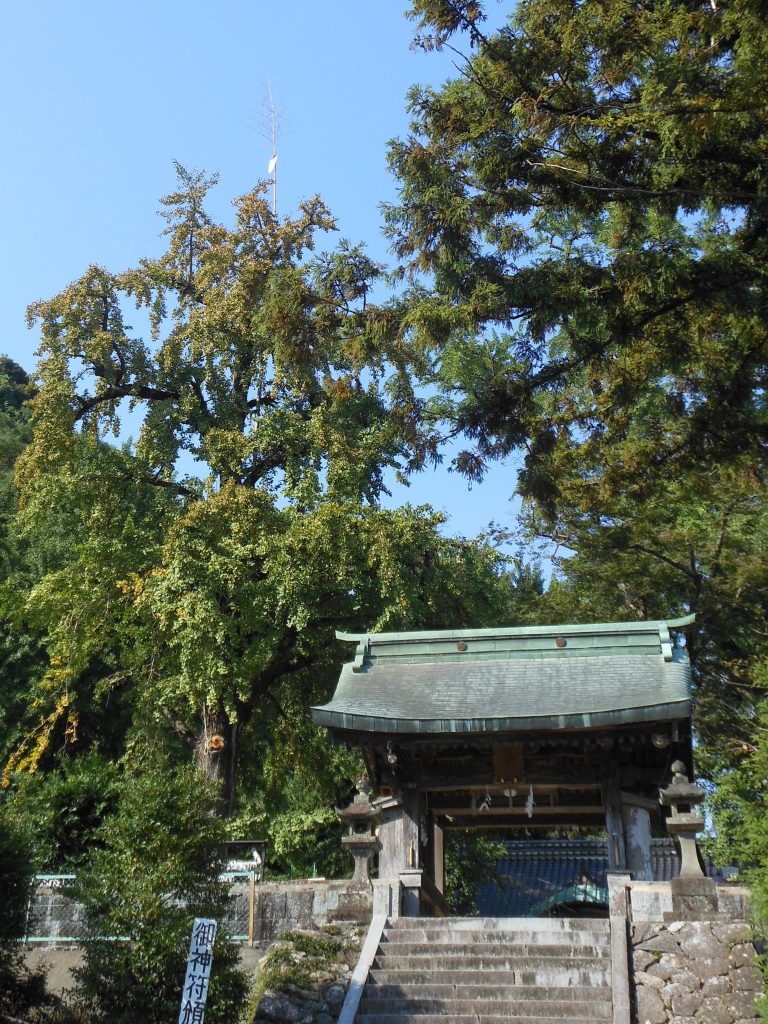
Numerous subsidiary shrines stand within the precinct. Among them is Koinoki Shrine, which is associated with prayers for successful romantic relationships.