Hokke-ji Temple: Japan’s National Head Nunnery of the Nara Period


Site at a Glance
- Rating
- 4.2
- Popularity
- Low
- Country
- Japan
- Primary era
- Early Modern
- External website
- Open
- Eras represented
- Medieval, Early Modern
- Civilizations
- Toyotomi regime, Yamato
- Site type
- Religious
- Remains
- Monastery
On this page15 sections
History
Hokke-ji Temple is a Buddhist head temple of the Kōmyō sect in Nara, Japan. Empress Kōmyō converted the former residence into a temple in May 745, during the Nara period, and it became the national head nunnery within Emperor Shōmu’s system of state-supported Buddhist institutions. The temple’s principal image is Eleven-Headed Kannon, and its formal name, Hokke Metsuzai no Tera, means “the Temple for the Extinction of Sin through the Lotus Sutra.”
From Fujiwara residence to imperial temple
The site was originally the residence of Fujiwara no Fuhito, a leading statesman of the early Nara period. After his death, his daughter Empress Kōmyō inherited the property and made it her imperial residence. She later transformed it into a Buddhist temple, an event recorded in the Shoku Nihongi. The name Hokke-ji appears in written evidence from 747.
In 741, Emperor Shōmu ordered the creation of provincial Buddhist monasteries and nunneries. Hokke-ji was developed as the national head nunnery of this network, corresponding to Tōdai-ji’s position as the national head monastery. The early development of the provincial nunneries remains uncertain, including the question of whether an earlier institution called Hokke-ji had existed elsewhere. One theory connects a predecessor Hokke-ji with an Amida hall associated with the institution that preceded Tōdai-ji.
Nara-period construction
The temple was built over several decades. Documents from 762 show that work on the Main Hall was still under way. The government office responsible for construction was abolished in 782, suggesting that the main precinct was probably complete by that time.
An Amida Pure Land Hall was constructed in the southwestern part of the precinct between 759 and 760. It became the setting for memorial services for Empress Kōmyō on the first anniversary of her death in 761. The hall’s remains later helped reveal a pond garden regarded as Japan’s oldest known example of a Pure Land garden, a Buddhist garden symbolically representing the western Pure Land.
Decline and medieval restoration
After the capital moved from Nara to Nagaoka in 784, Hokke-ji gradually declined. By the end of the Heian period, many of its buildings were considerably dilapidated. A record from 1017 states that fifteen nuns were serving at the temple.
Hokke-ji was damaged during Taira no Shigehira’s attack on Nara in 1180. Chōgen, a Buddhist monk active in the restoration of major temples, rebuilt buildings and repaired images in 1203. About half a century later, Eison, a monk of the Shingon Ritsu tradition, carried out a major restoration. Shingon Ritsu combined esoteric Buddhist practice with the Ritsu emphasis on monastic discipline. After this work, Hokke-ji held the status of a monzeki nunnery, an institution whose abbots or resident heads were drawn from the imperial family or aristocracy.
Destruction and Edo-period rebuilding
Military conflicts caused further destruction in 1499 and 1506. The Keichō–Fushimi earthquake of 1596 severely damaged the temple, leaving the East Pagoda as the only surviving principal building. That pagoda later collapsed in the Hōei earthquake of 1707.
Toyotomi Hideyori and his mother, Lady Yodo, rebuilt the Main Hall and South Gate in 1601, with Katagiri Katsumoto serving as construction magistrate. The Bell Tower was rebuilt the following year. During the Edo period, Hokke-ji again became a monzeki nunnery after an adopted daughter of Emperor Go-Mizunoo entered religious life there.
Modern religious and archaeological history
In 1999, Hokke-ji left the Shingon Ritsu sect and again became an independent temple. It adopted the name Kōmyō sect in reference to Empress Kōmyō. The former Hokke-ji precinct, including the site of the Amida Pure Land Hall, was designated a National Historic Site in 2001, with the designation expanded in 2015. The Amida Pure Land Hall remains also received designation as a National Place of Scenic Beauty.
A dry-bath tradition is associated with the story that Empress Kōmyō bathed one thousand people. Bathing ceremonies connected with anniversaries of her death continued until the early Meiji period. The Kōmyōkai association later maintained the tradition by lighting the bath once a year, and sometimes at the request of local residents. From 6 to 8 May 2010, the temple held a grand memorial service marking the 1,250th anniversary of Empress Kōmyō’s death.
Remains
Excavations show that the Nara-period precinct stood along the eastern side of the Tōgū Palace within the Heijō Palace complex. It extended three city blocks from north to south and two from east to west. Ichijō Jōkanmichi bounded it to the north, Nijō Jōkanmichi to the south, Higashi-Nibō Ōji to the east, and Higashi-Ichibō Bōkanmichi to the west. The original Main Hall and Lecture Hall were farther south than the present South Gate, while the Middle Gate stood south of the Main Hall and two pagodas stood farther south. The Amida Pure Land Hall occupied the southwestern area.
Surviving buildings
Main Hall
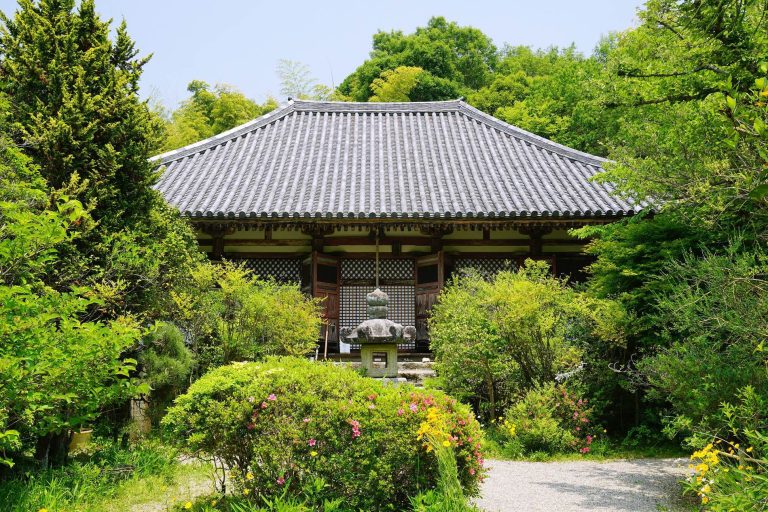
The present Main Hall is an early Edo-period building reconstructed in 1601. Its hipped roof is covered with traditional tiles, and the structure measures seven bays across the front and four bays along the sides. Finials on its railing carry an inscription from 1601 showing that the building was then called the Lecture Hall. Materials from two buildings that collapsed in the 1596 earthquake were reused in its construction. Traces indicate that these materials included parts of a Kamakura-period former Main Hall and a Muromachi-period former Lecture Hall. The shrine containing the principal image is normally closed, with a replica placed before it except during special viewing periods.
South Gate and Bell Tower
The South Gate was rebuilt in 1601 as part of the same reconstruction project as the Main Hall. The Bell Tower belongs to the early Edo period and was rebuilt in 1602 with materials from an earlier structure. It has two stories, with the bell on the upper level, but that level unusually lacks both a veranda and a railing.
Yokobue and Goma pavilions
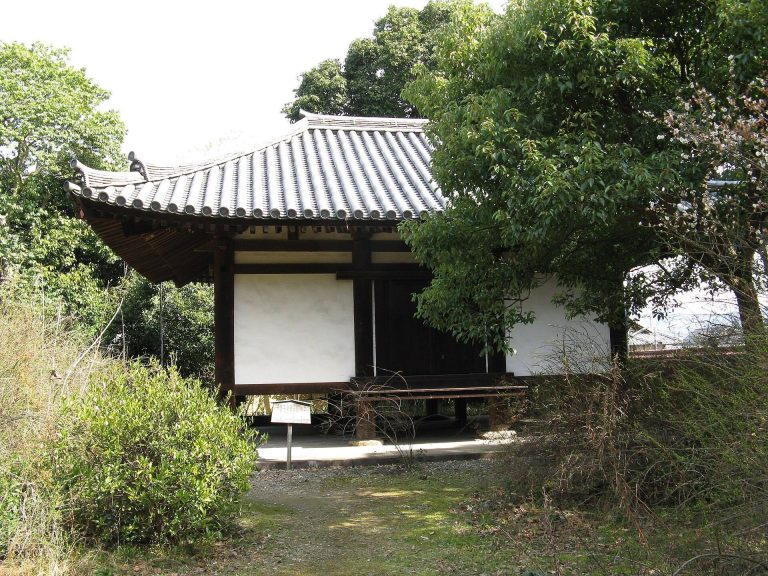
The Kamakura-period Yokobue Pavilion is described as the oldest surviving building in the temple precinct. The temple also contains a Goma Pavilion, where funerals have been held on the twenty-eighth day of each month since 2005.
Bathhouse
The bathhouse was reconstructed in 1766. Its dry-bath installation introduces steam rather than immersing bathers in a tub. Hot water from an iron cauldron beneath the floor fills a sealed wooden room with steam. A well and a roof inscription board dated 1766 are associated with the facility. The arrangement is a rare surviving example of a Japanese folk bathing installation. Historical bathing involved men and women bathing separately while wearing yukata, with bathers repeatedly entering and leaving and covering their mouths with a wet towel.
Gardens and relocated structures
The Meishō Garden is known for its irises. The Karakuen garden contains Japanese camellias and more than 750 plant species. Kōgetsutei, meaning Moonlight Pavilion, is a rural house relocated from Tsukigase village.
Principal image
Hokke-ji’s principal image is a one-metre-high wooden standing statue of Eleven-Headed Kannon, a form of the bodhisattva Avalokiteshvara associated with compassionate assistance in multiple directions. The statue stands inside a shrine in the Main Hall and is a hidden image, normally concealed except during limited spring and autumn openings.
Tradition attributes the statue to Mondaishi of Gandhara, an ancient cultural region in parts of present-day Afghanistan and Pakistan, and says that the sculptor modeled it on Empress Kōmyō. Its actual date is generally placed in the first half of the ninth century, during the early Heian period. The figure was probably not the temple’s original principal image. A record compiled around 1216 names a Vairocana Buddha, the cosmic Buddha, as the principal image, with a sandalwood Kannon behind it. A temple record from 1666 identifies the present Kannon as the Main Hall’s principal image. The surviving wooden head of a Kamakura-period Vairocana is thought to belong to the earlier image restored by Chōgen.
The Kannon is carved mainly from a single block of Japanese kaya wood. The head and body, the central part of the lotus pedestal, and the core beneath it were cut from the same block. The hands and some detached sections of the heavenly garment were made separately. The sculpture is largely unpainted, without overall coloring or gold leaf. Ultramarine colors the hair, eyebrows, and beard, vermilion colors the lips, and white marks the eyes. Copper plates form the eyes, hanging hair, crown, and bracelets.
A single thin stem supports the lotus pedestal from below, an unusual design. The halo was added in 1905 from the model of an earlier form and depicts unopened lotus flowers and leaves. The statue bears its weight on the left leg, while the right leg is relaxed and its first toe is slightly raised, suggesting the moment before a step. Its exceptionally long right arm represents the “hands reaching the knees” mark, one of the Buddha’s thirty-two major physical marks and eighty minor characteristics. The full proportions, treatment of the face, emphasis on the chest and thighs, and alternating thick and thin incised garment folds reflect early Heian sculpture.
Paintings, sculptures, and historical documents
Among the temple’s National Treasure objects is a late-Nara-period wooden seated statue of Yuima, also known as Vimalakirti, a celebrated lay Buddhist disciple and thinker. It was probably made in the late eighth century. Its realistic face reflects Tenpyo-period sculpture, while its forceful profile shows early Heian characteristics.
The temple also has a painted-silk work in three scrolls depicting Amida, Kannon, Seishi, and child attendant figures. The paintings date from the late Heian to early Kamakura periods. The Amida scroll measures 185.5 by 146.1 centimetres, the Kannon and Seishi scroll measures 186.4 by 173.6 centimetres, and the attendant scroll measures 183.3 by 55.2 centimetres. Their styles differ. The frontal Amida is static and uses vermilion lines without gold or silver, while the other figures employ gold paint, cut gold leaf, and muted colors. Their position on clouds suggests an Amida welcoming scene, although Amida makes a preaching gesture rather than a welcoming one, and Seishi holds a banner canopy instead of joining the hands. Whether the scrolls originally formed one set, and where they were first used, remain debated. They are deposited at the Nara National Museum.
Other designated objects include wooden heads representing Bonten and Teishakuten, Buddhist guardian deities derived from Indian religious figures, dating from the late Nara to early Heian period. The designation also includes a left arm and sleeve probably belonging to one of the figures. Hokke-ji preserves a Kamakura-period handwritten letter from Eison addressed to the temple, a history of Hokke-ji in three scrolls and one book dating from the Kamakura to Nanboku-chō periods, and a paper image of Yokobue, a nun associated with the temple in the late twelfth century.