Chiriku Hachimangū: A Historic Hachiman Shrine in Saga, Japan


Site at a Glance
- Rating
- 4.3
- Popularity
- Low
- Country
- Japan
- Primary era
- Early Modern
- External website
- Open
- Eras represented
- Medieval, Early Modern
- Civilizations
- Japanese, Tokugawa
- Site type
- Religious
- Remains
- Sanctuary
On this page17 sections
History
Chiriku Hachimangū is a Shinto shrine in Japan, located in Miyaki, Saga Prefecture. Traditionally founded in 724, it is associated with Hachiman, a major deity linked with warfare, protection, and the imperial line, and its history combines ancient shrine traditions, Buddhist institutions, provincial religious authority, and repeated reconstruction. The shrine enshrines Emperor Ojin, Emperor Chuai, Empress Jingu, Prince Naniwa, Prince Uji, the Sumiyoshi deities, and Takenouchi no Sukune.
Foundation traditions and early affiliations
The foundation story centers on Mibu Harunari, an official of Yabu or Mine District. In 724, he was said to have received an oracle from Hachiman after a white dove, regarded as the deity’s messenger, landed on his bow. That night, he dreamed of a white-haired old man who gave him a bowl containing one thousand chestnuts and instructed him to enshrine Hachiman on the site. The following day, one thousand chestnut trees were believed to have appeared across the hill. Emperor Shomu then appointed his second son as the shrine’s ritual head.
The exact foundation date remains uncertain. Other traditions place it in 729–749 or 757–765, and one specifically assigns construction of the sanctuary to 757–765. From that period until approximately 1166–1169, provincial governors sponsored fourteen constructions or rebuildings of shrine buildings. The last of these was undertaken by Oe Michisuke.
During the Johei era, approximately 931–938, Chiriku Hachimangū became a detached shrine of Usa Hachimangu. A detached shrine was a branch institution linked to a principal shrine through religious and administrative ties. Chiriku was revered as one of the Five Detached Hachiman Shrines. Its five-chō holding of sacred rice fields connected it with Mirokuji, the temple complex associated with Usa Hachimangu. After Mirokuji’s estates were incorporated into those of Iwashimizu Hachimangu during the Heian period, Chiriku Hachimangū also came under Iwashimizu’s jurisdiction.
The shrine’s Buddhist affiliations included Miroku Bosatsu as its honji, the Buddhist identity understood to underlie a locally worshipped deity in the former system of shrine-temple syncretism. Usa Mirokuji served as its principal temple, Mirokuji as its supervising temple, or bettoji, and Myokaku-in as its zasu-in, an office associated with the administration of the religious complex. In 999, oil was said to have emerged at the shrine and was presented to the Imperial Court.
Provincial status and medieval rebuilding
From at least the late Heian period, Chiriku Hachimangū was recognized as the ichinomiya, or leading shrine, of Hizen Province. The title carried both religious and political weight, and its use was later disputed by Yodohime Shrine. Medieval documents describe Chiriku as the first-ranking shrine of Hizen, while petitions from the medieval period and the sixteenth century frequently place it at the head of the province’s shrines.
In 1186, under the direction of Minamoto no Yoritomo, the shrine prepared a document concerning repairs. Reconstruction did not begin until after an imperial order arrived in 1213. A fire on December 29, 1228, destroyed the shrine buildings and the sacred object. The Imperial Court discussed the disaster in 1230 and ordered the provincial government to rebuild the shrine using revenues from public and estate lands. In 1268, construction proceeded with contributions from across the country.
In 1292, the shrine held three chō of land within a thirty-chō holding in Yabu Estate. A decision of 1313 records that portions of its estate had been seized near the end of the Kamakura period. The documented holdings included several named estates and lands transmitted among the shrine priests. Imperial orders in the early fourteenth century authorized construction supported by a province-wide levy in Hizen and Satsuma, although local warriors also encroached on shrine estates during the Nanbokucho period.
In the early fifteenth century, the shrine’s western side was associated with Chirikujō. Shibukawa Mitsuyori, the Kyushu tandai, a military and administrative representative, fought Kikuchi Taketomo at Chiriku. The shrine was therefore drawn into the conflicts that affected the region’s estates and military authorities.
Warfare, restoration, and early modern disputes
Chiriku Hachimangū suffered repeated destruction during the Sengoku period, an era of prolonged warfare among competing regional lords. In 1534, the Tō clan, retainers of the Ōuchi family, burned the shrine. Ryuzoji Masaie and others rebuilt it in 1583, but the Ōtomo family burned it again in 1585. Toyotomi Hideyoshi confiscated the shrine’s estate lands in 1587.
Nabeshima Naoshige rebuilt the shrine in 1592. That year, he prayed at Chiriku Hachimangū and four other shrines in Hizen Domain for victory in the campaign against Korea. In 1598, he donated approximately seven chō and one tan of rice land in Chiriku and Kitao, producing a total yield of 200 koku. A koku was a historical measure of agricultural yield used in land administration and taxation. In 1613, Nabeshima Katsushige added 141 koku and eight to in Kitao and six koku in Chiriku.
The dispute over the ichinomiya title with Yodohime Shrine continued into the early modern period. In 1623, Katsushige attempted to settle the matter by restricting both shrines from using the title in documents later than 1613. Both were subsequently prohibited from using it, and in 1754–1755 they agreed to abandon the title.
Modern institutional history and observances
A typhoon caused the shrine buildings to collapse in July 1884, and rebuilding was completed in September 1886. In 1871, the shrine was classified as a village shrine. It became a prefectural shrine in 1903, a shrine authorized to receive state offerings of food and cloth in 1908, and a National Shrine of the Lesser Rank in 1940. In 1948, it became one of the shrines listed by the Association of Shinto Shrines.
Chiriku Hachimangū remains associated with several annual observances. The spring Okayu Matsuri, locally called Okayu-san, uses rice porridge for divination. Nagoshi Matsuri is a summer purification rite. The autumn grand festival, popularly known as the Hojoe, combines prayers for abundant harvests with a procession and performances of the local Gyoretsu Furyu tradition, which joins instrumental music, dance, lion performance, and the movement of a portable shrine.
In 2024, the shrine marked the traditional 1,300th anniversary of its foundation with a two-day shikinen hohei festival. This periodic ceremony centers on ritual offerings, including offerings associated with the emperor. The first day combined an imperial offering ceremony with the autumn festival and procession. The second included a ceremony reporting contributions toward improvements within the shrine precinct.
Remains
Hilltop precinct and stone features
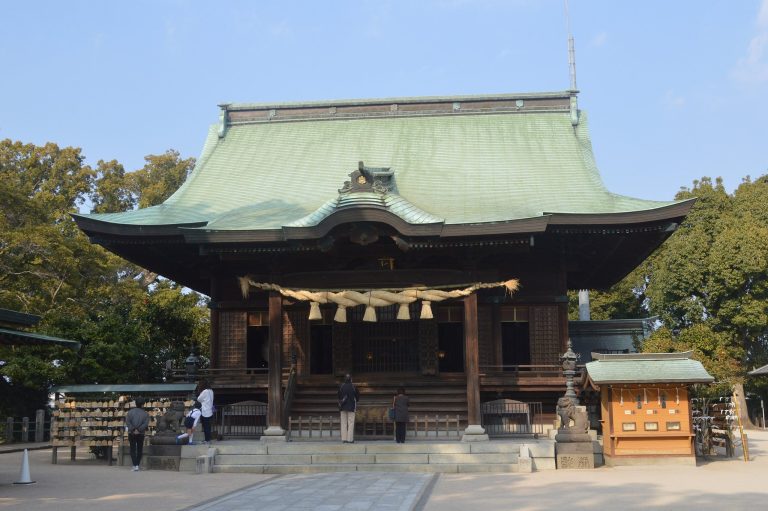
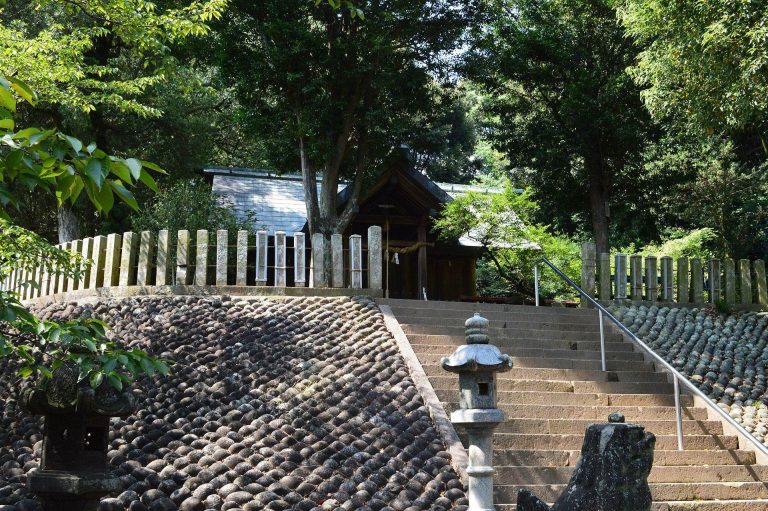
Chiriku Hachimangū occupies a hill in the eastern Saga Plain, across the Chikugo River from Kurume in Fukuoka Prefecture. The hill rises approximately 32 meters above surrounding lowland recorded at about 6 meters elevation. The area is thought to have once stood beside an ancient station route linking Kanzaki District with the provincial government center of Chikugo. The precinct has been measured at approximately 3,195 or 4,262 tsubo, equivalent to roughly 10,600–14,100 square meters. The main sanctuary covers approximately 21.5 tsubo, or 71 square meters, and has an irimoya-zukuri roof, a hipped-and-gabled form.
First Stone Torii
The First Stone Torii was donated by Nabeshima Naoshige on October 5, 1609. It retains an inscription and a calligraphic plaque, linking the entrance structure to the period of Naoshige’s rebuilding and patronage of the shrine.
Hizen komainu
The precinct contains paired stone Hizen komainu, or guardian figures, dating from the Azuchi-Momoyama period. Made of sandstone-like stone, the raised-mouth figure measures 57.5 centimeters high and 48 centimeters wide, while the closed-mouth figure measures 50 centimeters high and 50 centimeters wide. Their donor attribution remains uncertain.
Stone Stairs to Glory
The “Stone Stairs to Glory” are a flight of 146 stone steps rising 25 meters. Olympic judoka Koga Toshihiko used them for training and later won Olympic silver and gold medals. After his silver-medal victory, supporters erected a commemorative monument beside the steps.
Subsidiary shrines and festival spaces
Takeo Shrine
The precinct includes the subsidiary Takeo Shrine. Its enshrined deities are Takeo-no-Kokoro no Mikoto, Ame-no-Oshihomimi no Mikoto, Sugawara no Michizane, Izanagi no Mikoto, and Takagi no Kami.
Hatomori Inari Shrine
Hatomori Inari Shrine is associated either with Ukemochi no Kami or with the white dove regarded as Hachiman’s messenger. This association connects the subsidiary shrine with the bird in Chiriku Hachimangū’s foundation tradition.
Lower shrine
A lower shrine, functioning as a temporary sanctuary, stands in the Higashio district approximately two kilometers west of the main shrine. During the autumn festival, it serves as the procession’s temporary resting place before the return journey to the main precinct.
Okayu Matsuri
The Okayu Matsuri represents the former provinces of Chikuzen, Chikugo, Hizen, and Higo through four vessels of rice porridge. The porridge is prepared in mid-February with white rice and water, divided among the vessels, and placed in the sanctuary. On March 15, the color, shape, length, and moisture of the mold are examined to interpret the year’s weather, harvests, typhoons, floods, earthquakes, fires, and epidemics across the four regions. A written record is distributed to worshippers, and the vessels are displayed in the porridge hall.
Nagoshi Matsuri
During Nagoshi Matsuri on July 30, a large chinowa, a ring of woven cogon grass used for purification, is placed near the Second Torii in front of the worship hall. Participants pass through the ring three times in a left-right-left sequence, then proceed to the worship hall for purification prayers and offerings.
Autumn procession and Gyoretsu Furyu
The autumn procession travels from the main shrine to the lower shrine and back. It is led by Gyoretsu Furyu and includes sha-no-ke horsehair ornaments, drums, bells, flutes, two lion dances, and a portable shrine. The performance is offered first at nearby Inkeyaku Shrine and then before the main sanctuary.
Six local districts perform the procession on a rotating basis, with each district serving once every six years. Rhythms and movements differ by district, and some groups perform the complex “women’s float,” a male dance using stylized feminine movements. The participants include leaders and assistants, eight flute players, two male and two female lion dancers, large-drum players aged sixteen or seventeen, small-drum players aged seven or eight, thirty to forty young bell players, and younger bearers of the horsehair ornaments. Population decline in Chiriku District led Ishigai Danchi District to join it as a performance district. Women, formerly excluded from participation, have also been allowed to join in recent years.
During the autumn festival, a household selected by drawing lots with a sacred paper wand serves as the shime-moto, the temporary lodging place for the deity. The lot is caught with the wand, and the process is traditionally explained through static electricity. On some occasions, selecting the household can take an entire day.
The Chiriku Hachimangū origin picture scroll is a prefectural important cultural property. The First Stone Torii and the Hizen komainu are cultural properties of Miyaki Town.