Wakamiya Hachiman Shrine: Nagoya’s Principal Guardian Shrine


Site at a Glance
- Rating
- 4.2
- Popularity
- Medium
- Country
- Japan
- Primary era
- Early Modern
- External website
- Open
- Eras represented
- Medieval, Early Modern
- Civilizations
- Oda regime, Yamato
- Site type
- Religious
- Remains
- Sanctuary
On this page7 sections
History
Wakamiya Hachiman Shrine is a historic Shinto shrine in Japan, located in Nagoya, whose foundation tradition reaches back to the late seventh or early eighth century. Associated with the Hachiman tradition, which venerates a deity linked to Emperor Ōjin and regarded as a protector of communities and warriors, it is considered Nagoya’s principal guardian shrine.
Early origins and medieval rebuilding
The shrine’s beginnings are placed either in the reign of Emperor Tenmu or in the Taihō era, which lasted from 701 to 704. Another shrine tradition associates its foundation with the reign of Emperor Monmu and states that it was restored during the Engi era, from 901 to 923. Its original site was Imaichiba in Nagono Estate, an area now within the Sannomaru district of Nagoya Castle. Wakamiya Hachiman Shrine formerly stood beside Tenno Shrine, now called Nagono Shrine.
On March 11, 1532, the buildings were burned during Oda Nobuhide’s attack on Nagono Castle. Nobuhide rebuilt them in 1539. During the Azuchi-Momoyama period, Toyotomi Hideyoshi endowed the shrine with land producing 200 koku, an agricultural yield unit used in the premodern land and stipend system.
Tokugawa-era position
Wakamiya Hachiman Shrine was moved to its present location in 1610, when Nagoya Castle was constructed under Tokugawa Ieyasu, founder of the Tokugawa shogunate. During the Edo period, it became the ujigami shrine, or tutelary shrine, of the Owari Tokugawa family, one of the principal branch families of the Tokugawa house. It was revered as Nagoya’s principal guardian shrine.
In 1664, Tokugawa Mitsutomo, the second lord of the Owari domain, commissioned new shrine buildings. At that time, the Buddhist clerics attached to the shrine were abolished. In January 1689, Mitsutomo granted the shrine an estate producing 100 koku. Its annual Wakamiya Festival ranked among Nagoya’s three major festivals during the Edo period, together with those of Nagoya Toshogu, the shrine dedicated to Tokugawa Ieyasu, and Tenno Shrine.
Festivals and modern history
The Wakamiya Festival was once held on the same day as the Tenno Festival, and the two events were collectively known as the Gion Festival. Seven floats accompanied a mikoshi, a portable shrine carrying a deity symbolically during a procession, between Wakamiya Hachiman Shrine and Tenno Shrine in Nagoya Castle’s Sannomaru area. The procession followed the castle town’s principal street, now Honmachi-dori.
The shrine was elevated to the former prefectural-shrine rank on March 14, 1877, and became a Beppyo Shrine of the Association of Shinto Shrines on July 1, 1971. Its name also survives in Wakamiya Ōdōri, one of Nagoya’s major east-west avenues. The shrine buildings were destroyed in the Nagoya air raids of March 19, 1945, during the Pacific War, and the shrine was rebuilt in 1957.
The principal enshrined figures are Emperor Nintoku, Emperor Ōjin, and Takeuchi no Sukune, a legendary early imperial court figure associated with Japanese foundation traditions. The present Wakamiya Festival continues on May 15 and 16. One surviving float and a mikoshi travel between Wakamiya Hachiman Shrine and Nagono Shrine.
The Engishiki identification
One theory identifies Wakamiya Hachiman Shrine with the “Mago-waka-miko Shrine” listed for Aichi District in the Engishiki, a tenth-century compilation of court procedures, administrative regulations, and shrine registers. This interpretation notes that an early-sixteenth-century plan of Atsuta Shrine does not show the shrine and suggests that a later precinct structure may originally have been a distant worship site. It also draws on differences among manuscripts of the late-Heian Owari provincial register.
A competing interpretation identifies the shrine in the register with a precinct shrine at Atsuta Shrine. It argues that Atsuta’s offspring deity could not have had a shrine far from Atsuta and places the listed shrine near the site of present-day Minami-Shingu Shrine, partly on the basis of an entry from 835 in the Shoku Nihon Koki, a ninth-century imperial chronicle covering events from 833 to 850.
Remains
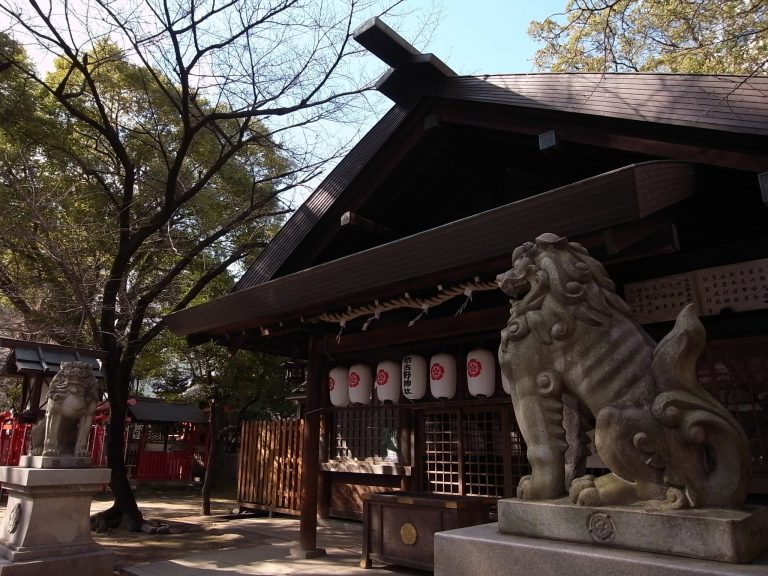
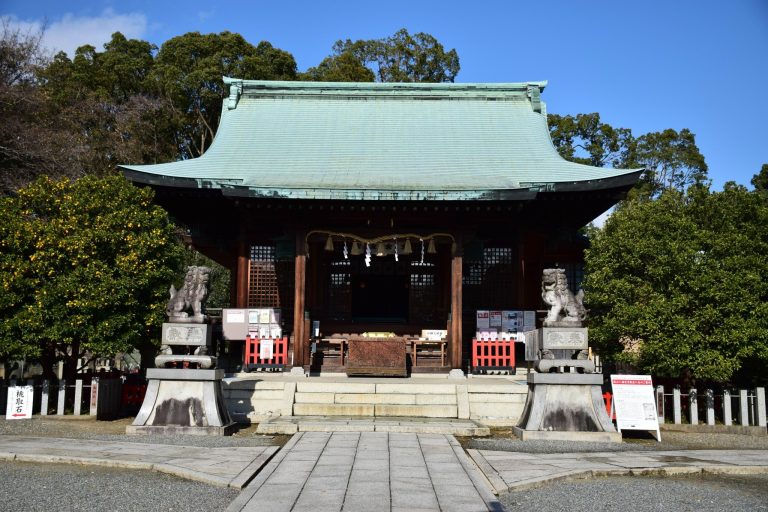
The present compound includes a main sanctuary, a worship hall, and a float storehouse. The main sanctuary follows the nagare-zukuri, or flowing-front style, in which the front slope of a gabled roof extends forward to create a covered entrance. These buildings form the surviving architectural setting of the shrine after its reconstruction in 1957.
Festival float
The float storehouse preserves the Fukurokuju-sha festival float, the surviving float associated with the present Wakamiya Festival. Named for Fukurokuju, one of the Seven Lucky Gods in Japanese popular religion, it is designated as a Nagoya City tangible folk cultural property. During the festival on May 15 and 16, the float travels with a mikoshi between Wakamiya Hachiman Shrine and Nagono Shrine, continuing the connection between the two historic shrines.