Erin-ji Temple: A Rinzai Zen and Takeda Memorial Temple in Japan


Site at a Glance
- Rating
- 4.2
- Popularity
- Medium
- Country
- Japan
- Primary era
- Early Modern
- External website
- Open
- Eras represented
- Medieval, Early Modern
- Civilizations
- Tokugawa
- Site type
- Religious
- Remains
- Monastery
On this page20 sections
History
Erin-ji Temple is a Buddhist temple in Kōshū, Yamanashi, Japan, founded in 1330 as a Rinzai Zen temple during the medieval period. Its mountain name is Kentoku-san, its principal image is Shaka Nyōrai, and its long association with Takeda Shingen and the Takeda clan made it their memorial temple.
Foundation and Medieval Zen
Erin-ji began when Nikaidō Sadatō, the shugo, or military governor, of Kai Province, donated his estate at Maki-no-shō upstream on the Fuefuki River. He invited the Zen master Musō Soseki to establish a temple there, and the original complex took shape through the conversion of the Nikaidō residence into a Zen foundation.
Musō Soseki was a major medieval Zen monk and garden designer. Under his influence, Erin-ji became a center for Rinzai teaching in Kai. The Rinzai school is a Zen tradition centered on disciplined meditation, teacher-disciple transmission, and methods such as kōan practice. Erin-ji initially belonged to the Enkaku-ji branch and held the rank of a Kantō quasi-Jissatsu temple, part of a recognized group of important Zen temples in and around the Kantō region.
Several monks served as abbots by imperial appointment, including Kosen Ingen, Seizan Jiei, Ryūshū Shūtaku, and Zekkai Chūshin. Ashikaga Yoshimitsu later granted Erin-ji a rank equivalent to that of the Kamakura Zen Jissatsu. This status reflects the temple’s institutional position and its role in transmitting Rinzai teaching beyond its immediate locality.
Decline and Takeda Restoration
Erin-ji declined during the Ōnin War, a late fifteenth-century conflict that intensified political and military disorder in Japan. It was later selected as the Takeda clan’s memorial temple and restored with the participation of eminent monks invited from Kyoto.
Takeda Harunobu, better known as Takeda Shingen, revived Erin-ji in 1541. In that year, the Myōshin-ji monk Minshuku Keishun became its twenty-eighth abbot. Keishun had previously served at Daien-ji in Mino and at Rinzai-ji in Suruga after being invited there by Imagawa Yoshimoto. Hōsei Genryō became the twenty-ninth abbot in 1544 and was the first abbot drawn from the temple’s founding lineage.
In 1563, Kian Genmitsu was invited to serve as abbot of Erin-ji and Keizoku-in. He transferred the abbacy of Erin-ji to his disciple Kaisen Jōki and returned to Daien-ji. The following year, the Takeda family donated temple estates, and Kaisen was invited from Sōfuku-ji in Mino to lead Erin-ji.
Kaisen formally established Erin-ji as the memorial temple of Takeda Shingen. He also took part in diplomatic relations between the Takeda and Saitō families. In 1575, Takeda Katsuyori presided at the funeral that marked the end of Shingen’s three-year period of concealed mourning, with Kaisen serving as the officiating master. Kaisen also acted in an advisory capacity during Katsuyori’s rule.
Destruction in 1582 and Reconstruction
The Takeda regime fell in 1582 during the Oda-Tokugawa invasion of Takeda territory. Erin-ji refused an order to surrender Sasaki Jirō, identified as Rokkaku Yoshisada, who had taken refuge at the temple. Forces sent by Oda Nobutada then burned the complex.
Kaisen Jōki is traditionally said to have died in the flames above the burning main gate after reciting a verse declaring that Zen practice does not depend on mountains or water and that, when the mind is extinguished, even fire is cool. The attribution is historically uncertain. One account connects the words with the monk Kōzan of Chōzen-ji, while the identification of the verse as Kaisen’s death poem became widespread only in later Rinzai compilations.
After the Takeda defeat, Tokugawa Ieyasu gained control of Kai during the struggle over the former Takeda territories. Ieyasu protected former Takeda retainers and invited Masshū Zuikatsu from Ungan-ji in Nasu, where he had been hiding from Oda forces, to rebuild Erin-ji. This reconstruction allowed the temple’s religious work and its connection with the Takeda legacy to continue under Tokugawa rule.
Markets and Regional Administration
Erin-ji stood at a regional transport and distribution junction where the Chichibu road crossed the Kogane road. Its lands contained two periodic markets known as the Third-Day Market and the Ninth-Day Market. They were probably established as temple-front markets between the foundation of Erin-ji in the late Kamakura period and the early Muromachi period. The Third-Day Market is documented by 1499.
In 1563, the two markets contained approximately 26.5 and 21.5 houses respectively. Fourteen dwellings in the first market and sixteen in the second were obliged to provide dues to the temple. These payments supported annual ceremonies, Buddhist services, and monthly and seasonal obligations.
The markets also included Takeda administrative residences and storehouses. Taxes and dues were collected there, exchanged for coin, and used to support Takeda finances. This arrangement continued under the Tokugawa regime. Market residents were tenants, while separate landholding households rented out the sites. Many residents probably farmed or pursued other work during ordinary periods and traded on market days. The population included people involved in temple administration, shrine-associated families linked with lower-ranking Takeda retainers, local warriors, and influential farmers, rather than only professional merchants.
Memorial Tradition in the Edo Period
Erin-ji’s role as a Takeda memorial center continued during the Edo period, the era of Tokugawa military rule from the early seventeenth century to the nineteenth century. In 1672, services commemorating the centenary of Takeda Shingen’s death were held at the temple. Descendants of Takeda retainers, including Magubuchi Yoshikashi and Saegusa Moritoshi, organized contributions from Takeda-related hatamoto, daimyo retainers, and rōnin. A hatamoto was a direct retainer of the Tokugawa shogun, while a rōnin was a samurai without a lord. A memorial monument to Shingen was erected at the same time.
Yanagisawa Yoshiyasu, later a close aide of Tokugawa Tsunayoshi and lord of Kōfu from 1704, used Erin-ji’s connection with Shingen to emphasize his own relationship with the Takeda legacy. On April 12, 1705, he held Shingen’s 133rd memorial service at the temple and donated a sword traditionally attributed to Shingen. He also presented a genealogy connecting the Yanagisawa family through the Kai Minamoto line and a waka, a traditional Japanese poetic form, commemorating the service.
Yoshiyasu’s son Yoshisato painted and presented a portrait of Takeda Shingen to Erin-ji. Yoshiyasu died in 1714 and was first buried at Eikei-ji in Kōfu. After the Yanagisawa family was transferred to Yamato-Koriyama in 1724 and Eikei-ji was moved there, Yoshiyasu was reinterred at Erin-ji.
Records, Restoration, and Modern Preservation
Erin-ji preserves its land-register records, known as the Erin-ji Estate Survey Registers. Its connection with the Takeda clan continued through the Edo period and the Meiji Restoration. During services for the three-hundredth memorial of Shingen in 1872, the former shogunal retainer Mashimo Banshin donated a painting of the Twenty-Four Takeda Generals by Matsumoto Fūko.
That same year, during a dispute over the proposed abolition of the Daishōgiri tax system, Yamanashi prefectural governor Doi Kenzō assembled village officials involved in the protest at Erin-ji and confiscated previously issued official seals. The protest later subsided, although Doi subsequently resigned after his dismissal.
A fire in 1905 destroyed most of the temple’s large halls and other Edo-period buildings. Erin-ji was rebuilt afterward, including the abbot’s quarters and the kitchen, and reconstruction was completed in 1913. The Four-Legged Gate and the garden survived as major historic elements. The gate became an Important Cultural Property of Japan in 1907, while the garden was designated a National Place of Scenic Beauty in 1994. The Rai Kunanaga sword and the Osafune Tomomitsu short sword received national designations in 1915. Erin-ji also has municipal cultural-property designations for its Founder’s Hall, documents, paintings, portraits, and statue of Yanagisawa Yoshiyasu.
Since 2021, a team from Tokyo University of the Arts has investigated and restored the Takeda Fudō statue because of progressive deterioration. The work includes material analysis and a planned publication of a three-dimensional model reconstructed from scanned imagery.
Remains
Erin-ji’s surviving complex combines a wooden entrance gate, rebuilt temple buildings, a garden behind the main hall, and memorial features associated with the Takeda and Yanagisawa families. The site’s material remains also include Buddhist images, portraits, paintings, documents, and swords that preserve its religious and commemorative history.
Gate and Rebuilt Temple Buildings
Four-Legged Gate
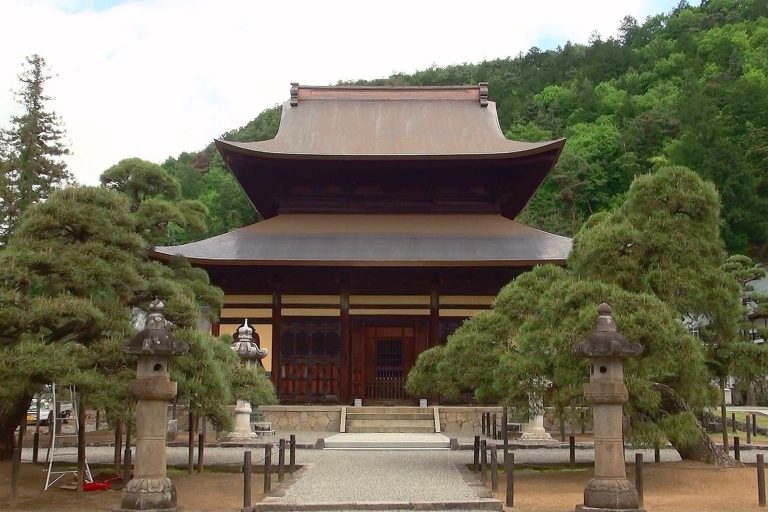
The Four-Legged Gate is a wooden structure supported by four pillars and covered with a cypress-shingle roof. Built in the Momoyama style, it is the oldest surviving structure at Erin-ji. The gate survived the 1905 fire that destroyed most of the temple’s large halls and other Edo-period buildings. Its rebuilt or remodeled structure carries plaques on both sides bearing the verse traditionally attributed to Kaisen Jōki.
Abbot’s Quarters and Kitchen
The abbot’s quarters and kitchen were rebuilt after the 1905 conflagration, as were most of the temple’s other large halls. Their present form therefore belongs to the reconstruction completed in 1913, while the Four-Legged Gate and the garden retain earlier elements of the complex.
Garden
Erin-ji’s Japanese garden lies behind the main hall and is traditionally attributed to Musō Soseki, who is said to have designed it at the age of 56. It covers approximately 2,270 square metres and includes large stones, a pond, a stream, and a small waterfall. The rear mountain forms part of the composition through the garden technique known as borrowed landscape, which incorporates a distant natural feature into the design.
The garden is regarded as a prototype for gardens associated with Musō Soseki at Saihō-ji and Tenryū-ji in Kyoto. Its surviving arrangement connects the temple’s medieval foundation with the garden-design tradition associated with its founding master.
Memorial Complex and Buddhist Images
Takeda Shingen Tomb and Myōō-den
The memorial complex includes the tomb of Takeda Shingen and the hall known as the Myōō-den. The hall is dedicated to a Myōō, or wisdom-king deity, and houses the Takeda Fudō with its two child attendants. Fudō Myōō is a Buddhist wisdom deity represented as a wrathful guardian who commonly carries a sword and a rope.
Takeda Fudō
The central Takeda Fudō is a seated image 92.9 centimetres high. It follows conventional Fudō iconography, holding a rope in the left hand and a sword in the right. The Takeda family’s hollyhock-shaped diamond crest is painted in gold pigment on the chest sash.
The sculpture is hollowed internally and has a cloth-covered, lacquered baseboard. An internal cavity could have held deposited objects, although X-ray imaging has not confirmed such contents. The surface has darkened through deterioration. Analysis indicates that the original finish used two layers of a blue pigment containing relatively little impurity and mixed with silver.
A tradition says that Shingen commissioned the Kyoto sculptor Kōsei, sat for the image, and had his own hair burned into its colouring. The statue’s facial expression and hand attributes, however, follow established representations of Fudō rather than portraying Shingen as a recognizable individual.
Yanagisawa Yoshiyasu Statue
The wooden seated statue of Yanagisawa Yoshiyasu is an eighteenth-century longevity portrait, an image made during a person’s lifetime to commemorate the sitter. The polychromed wooden figure has crystal eyes and is 85.0 centimetres high. An inscription inside the statue identifies it as Yoshiyasu at age 53 in November 1710 and names the sculptor as Ōshita Jōkei. Yoshiyasu is said to have made and donated the statue to Erin-ji in July 1711.
The figure wears court costume and a crown, holds a ritual tablet, and includes a sword inscribed “Yamashiro no Kami Kunishige.” Its form and dimensions closely resemble statues of Yoshiyasu and his wife formerly associated with Eikei-ji. It also shares features with portraits of Yoshiyasu, suggesting that painted images may have served as models. The hall housing the statue was reportedly modeled on the hall that contained the couple’s statues at Eikei-ji.
Swords, Paintings, and Documents
Rai Kunanaga Tachi
The tachi bearing the inscription “Rai Kunanaga” is approximately 79.5 centimetres long. A tachi is a Japanese sword traditionally worn with its edge facing downward. The sword is associated with Yanagisawa Yoshiyasu’s donation for Shingen’s 133rd memorial service in 1705 and is traditionally identified as Shingen’s sword.
Osafune Tomomitsu Short Sword
The short sword bearing the inscriptions “Bishū Osafune Tomomitsu” and a date corresponding to 1369 is 27.4 centimetres long, with a curvature of 0.1 centimetre. It was made by the Bizen swordsmith Osafune Tomomitsu during the Nanboku-chō period, an era marked by rival imperial courts in fourteenth-century Japan.
The blade has iris-groove carvings on both sides, a Kurikara dragon on one side, and Buddhist seed syllables on the other. A Buddhist seed syllable is a sacred written character representing a Buddhist deity or concept. Its former fittings included a white-sharkskin hilt, a black-lacquered scabbard, and a white textile bag, none of which survives.
Paintings and Written Records
Erin-ji’s cultural properties include the Founder’s Hall, eight temple documents, and a range of paintings and portraits. They include a monochrome ink painting of Bodhidharma on a reed, coloured portraits of Musō Soseki and Kaisen Jōki, an image of Masshū Zuikatsu, portraits of Takeda Shingen, a painting of Bodhidharma carrying one shoe, paintings of arhats, and paired landscapes by Soga Shōhaku.
The portrait of Kaisen bears his own inscription and dates to 1578. The Shingen portrait by Yanagisawa Yoshisato dates to 1723. The painting of Bodhidharma is a seventeenth- to eighteenth-century work by Kanō Tansetsu measuring 132.6 by 64.9 centimetres. Its seal and inscription identify its Kanō-school attribution.
The Bodhidharma painting was reportedly donated by Tsuchiya Masanao, lord of Tsuchiura in Hitachi and a descendant of the Takeda retainer Tsuchiya Masatsune. It is interpreted as an image made for the posthumous commemoration of Yoshiyasu. Together with the temple’s memorial buildings, sculptures, swords, and registers, these works preserve Erin-ji’s development from a medieval Rinzai foundation into a major center of Takeda remembrance.