Tanda Kofun: An Early Stone-Built Burial Mound in Japan
Site at a Glance
- Rating
- 4.5
- Popularity
- Very Low
- Country
- Japan
- Primary era
- Classical
- Eras represented
- Classical
- Civilizations
- Yamato
- Site type
- Burial
- Remains
- Burial Mound
On this page6 sections
History
Tanda Kofun is an early Kofun-period burial mound in Japan, located in Higashimiyoshi, Tokushima. It was probably constructed during the fourth century, when Japanese communities built large burial mounds for important individuals. The mound stands on the south bank of the middle reaches of the Yoshino River and represents an early form of the keyhole-shaped burial mound.
Early Kofun Period
The nearby Kamo Higashihara site contains pit dwellings from the end of the Yayoi period, the era of settled agricultural communities that preceded the Kofun period. This settlement is thought to have participated in constructing Tanda Kofun, linking the mound with local communities that had occupied the region before its construction.
The mound’s form is either a keyhole-shaped burial mound with a circular rear section or a mound with a square rear section. Its slightly fan-shaped front does not broaden fully, a characteristic of an early keyhole-mound style. The structure was built along an east-west axis, with its front facing west.
Recognition and Investigation
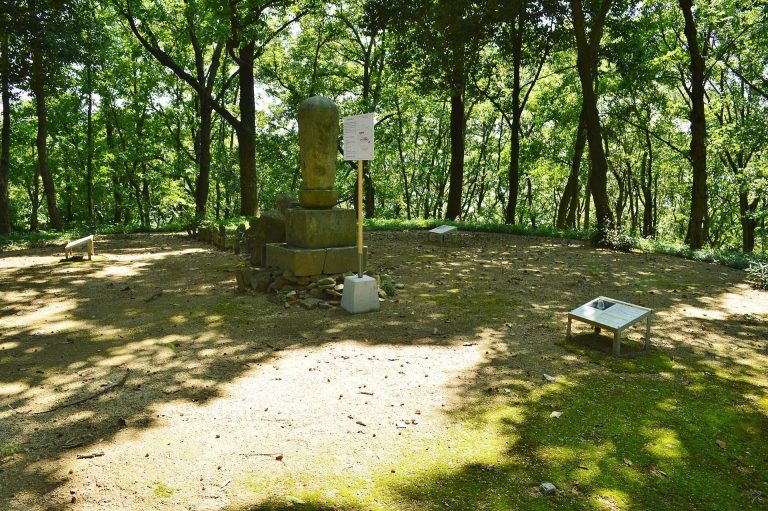
Tanda Kofun was initially mistaken for an ancient mound containing Buddhist sutras, and a small chapel dedicated to Kūkai stood on its summit. Kūkai was an early ninth-century Buddhist monk who founded the Shingon school of Buddhism. In 1958, the town cultural-properties committee identified the monument as an ancient kofun, or burial mound. By 1962, it was recognized as an entirely stone-built mound.
The Doshisha University Archaeological Research Laboratory excavated the site in March 1969 and reported its findings in 1971. Tanda Kofun was designated a Tokushima Prefectural Historic Site before becoming a National Historic Site of Japan on July 16, 1977.
Remains
Tanda Kofun occupies a ridge of Mount Kamo at approximately 460 metres above sea level in the Nishisho area of Higashimiyoshi. The mound is about 37 metres long and reaches roughly 3 metres in height at the rear section. It is formed directly on bedrock from angular pieces of crystalline schist, with no soil used in the tumulus. Early stone-built kofun are distributed across Tokushima and Kagawa, and Tanda Kofun is among the largest examples in Tokushima.
Mound Form
The rear circular or square section measures approximately 17.5 metres from north to south and 17 metres from east to west. The west-facing front section is about 18 metres long, 6.6 metres wide, and 1 metre high, while the connecting neck is approximately 10 metres wide. Together, these dimensions preserve the compact proportions of an early keyhole-mound design.
Burial Chamber
A pit-type stone burial chamber lies inside the rear section, aligned with the mound’s east-west axis. This type of chamber is sunk into or constructed within the mound rather than reached through a horizontal passage. The chamber is 4.51 metres long, 1.3 metres wide at the eastern end, 1.28 metres wide at the western end, and 1.2 metres high.
Small crystalline-schist blocks form the chamber walls, with their ends facing outward. The side walls rise vertically for about 0.4 metres before the courses incline inward to create a distinctive gable-like roof. This unusual early construction has parallels at Mesuriyama Kofun, Yamato-Tenjinyama Kofun, and Moto-Inari Kofun. Excavation recovered a bronze mirror, an iron sword, and an iron axe.