Kaiten-yama Kofun: A Fourth-Century Keyhole Burial Mound in Japan
Site at a Glance
- Rating
- 3.9
- Popularity
- Very Low
- Country
- Japan
- Primary era
- Classical
- External website
- Open
- Eras represented
- Classical
- Civilizations
- Unclassified
- Site type
- Burial
- Remains
- Burial Mound
On this page7 sections
History
Kaiten-yama Kofun is a large keyhole-shaped burial mound in Marugame, Japan, built around the middle of the fourth century during the latter half of the early Kofun period. A kofun was a monumental burial mound for an elite person or ruling group in ancient Japan, while the Kofun period, conventionally dated from about the third to the sixth centuries, was characterized by the construction of such tombs. Kaiten-yama was the largest burial mound in Shikoku when it was built, and it remains the second largest kofun in Kagawa Prefecture and the third largest in Shikoku.
Expansion of regional burial mounds
The mound represented a major increase in the scale of burial construction in the region. Earlier circular mound sections generally measured about 30 to 40 meters across, whereas Kaiten-yama’s circular rear section measures about 60 meters. The tradition of constructing large keyhole mounds continued in Sanuki, the ancient name for the area broadly corresponding to present-day Kagawa, with Mitani Ishifune Kofun and Tomita Chausuyama Kofun.
Kaiten-yama combines features associated with Sanuki-style keyhole tombs and others linked to elite tombs in the Kinai, the historical region around the ancient capitals of central Japan, including present-day Nara and Osaka. Its hollowed, split-bamboo-shaped stone coffins, and the later spread of this coffin form through Sanuki, the Kinai, and Kibi, an ancient region broadly corresponding to western Honshu and the Okayama area, have been interpreted as evidence of political connections with the Kinai.
Name and investigations
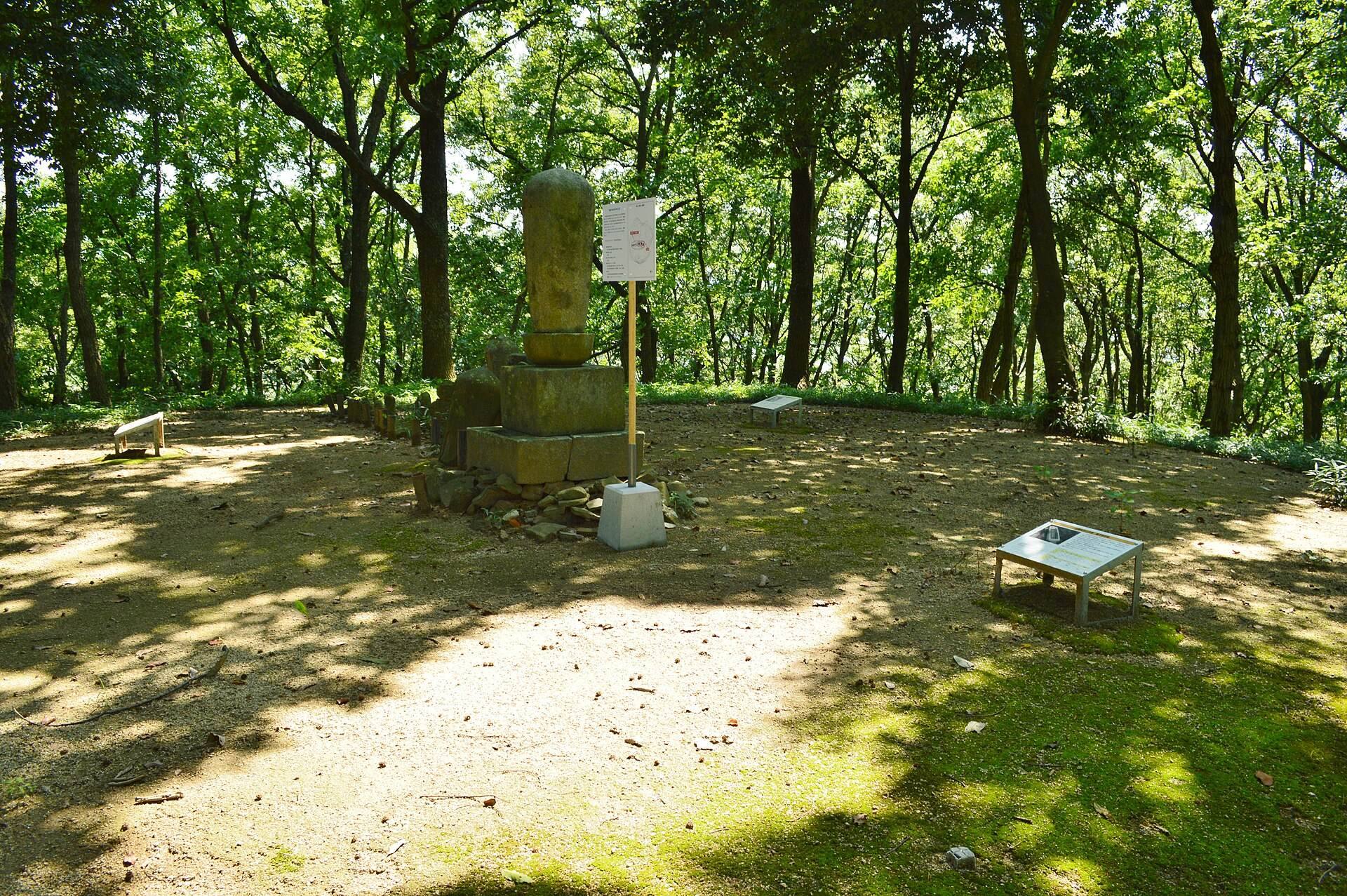
The name Kaiten-yama comes from three Edo-period tombs on the summit of the circular section. They belong to Buddhist monks from the nearby temple Enpuku-ji named Kaiten, Kaizan, and Yuga.
In 1950, a local junior high-school student discovered a stone coffin exposed at the mound. The Kagawa Prefectural Board of Education investigated the burial facilities that year, followed in 1951 by an examination led by archaeologist Sueji Umehara and the archaeology department of Kyoto University. The Kyoto University investigation was reported in 2002.
The former Ayauta Town Board of Education conducted a preliminary survey and the first through seventh investigations between 2001 and 2003, with the results reported in 2004. Marugame’s Board of Education undertook another excavation in 2017 during preparations for improving the site. Farmland development, road construction, and the creation of a poultry farm partly levelled the front section and cut through its middle portion. At least four additional box-shaped stone coffins in that area were destroyed during these changes.
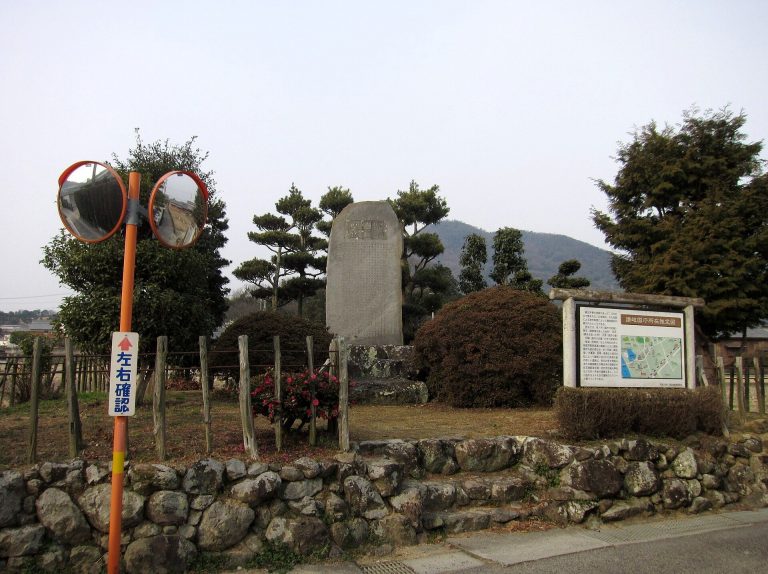
Kaiten-yama Kofun became an Ayauta Town Historic Site on February 5, 1999, and a National Historic Site of Japan on September 30, 2004. The protected area covers 16,355 square meters.
Remains
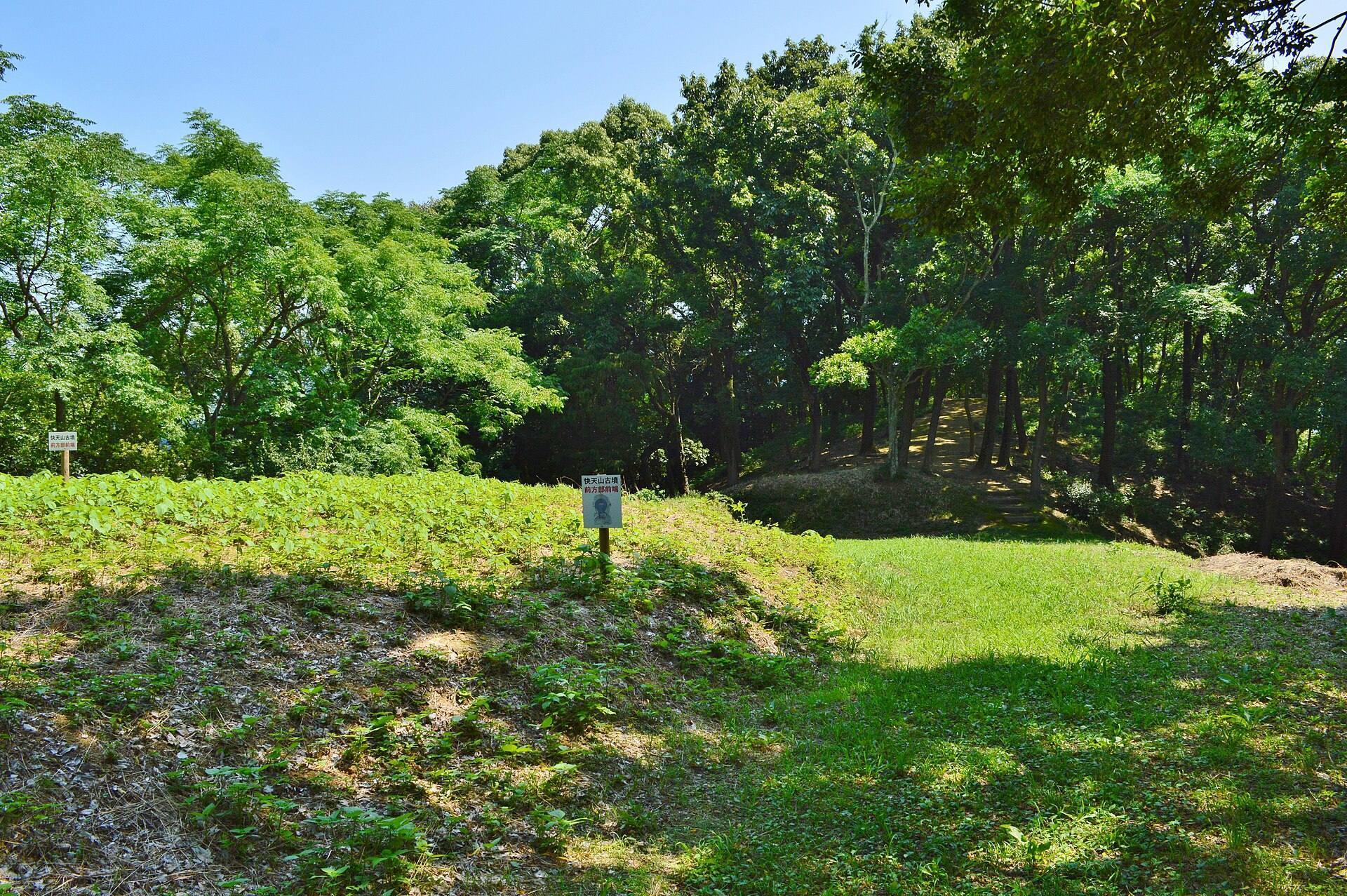
Kaiten-yama occupies the tip of a ridge extending south from the Yokoyama mountain range in central Kagawa. Viewed from above, the mound forms a circle joined to a rectangle, the shape known in Japanese archaeology as a keyhole mound. Its rectangular front points northward and upslope. The total length is 98.8 meters. The circular rear section measures 68.0 meters from north to south, 63.5 meters across from east to west, and 10.55 meters high. The front section is 35.6 meters long, at least 30 meters wide, and 4.35 meters high, while the connecting neck is 32.5 meters wide.
Mound construction
The rear section was formed in at least three tiers, and the front section also has three tiers. Builders cut the front section into the natural ground. The rear section combines this method with the addition of earth. Terraces about 1.5 meters wide were lined with cylindrical haniwa, clay objects placed on or around burial mounds. Some jar-shaped examples were also present. Stones known as fukiishi covered the slopes between the terraces, protecting and surfacing the earthworks.
Burial facilities and stone coffins
Three burial facilities were installed in the circular rear section. Two were pit-style stone chambers placed symmetrically to the east and west of the section’s center. The third was a pit-style clay coffin facility located north of the center, toward the front section. All three were aligned parallel to the mound’s main axis. Each contained a hollowed stone coffin shaped like a split length of bamboo, a form thought to have been adopted as a substitute for hollowed wooden coffins. These are among the earliest known hollowed stone coffins in Japan.
The three coffins are thought to have been installed in the order of the second, first, and third burial facilities. Their stone was weathered andesite quarried at Washinoyama in the Kokubunji area of Takamatsu. A coffin of similar form is known from Akayama Kofun in Sanuki, although that example was made from volcanic stone.
Burials and grave goods
Human bones and numerous burial goods came from the three burial facilities. The remains from the second facility belonged to a woman estimated to have been 30 to 35 years old. Those from the third belonged to a man estimated to have been 27 to 28 years old. Objects placed with the dead included bronze mirrors, iron swords, iron axes, iron tools, agricultural implements, cylindrical beads, and curved beads.
A fragmentary mirror with a beast design and a square-and-compass pattern was found outside the first coffin. It has four deities, measures 18.5 centimeters in diameter, and carries inscriptions meaning “long suitable for sons and grandsons” together with the Twelve Branches. The mirror is regarded as a product of China’s Eastern Han, the imperial dynasty that ruled from AD 25 to 220.
The second coffin contained a fragmentary mirror with an inner floral pattern, whose reconstructed diameter is estimated at 12 centimeters. Inside the third coffin was a complete example of the same pattern, measuring 9 centimeters across. A fragmentary imitative inner-floral-pattern mirror found outside that coffin is estimated to have measured 12 centimeters. Together with the stone coffins, haniwa rows, stone-covered slopes, and the three-part burial arrangement, these finds define the surviving physical character of this large fourth-century burial complex.