Unpen-ji Temple: A Shingon Buddhist Temple on Mount Unpenji


Site at a Glance
- Rating
- 4.4
- Popularity
- Medium
- Country
- Japan
- Primary era
- Modern
- External website
- Open
- Eras represented
- Modern
- Civilizations
- Japanese
- Site type
- Religious
- Remains
- Monastery
On this page16 sections
History
Unpen-ji Temple is a Shingon Buddhist temple in Japan, located near the summit of Mount Unpenji in Miyoshi, Tokushima Prefecture. Traditionally founded in 789 by Kukai, the monk who established the Shingon school, it is the 66th temple of the 88-temple Shikoku Pilgrimage and the 21st temple of the western Awa Thirty-Three Kannon pilgrimage. Its principal Buddhist figure is Senju Kannon, the thousand-armed form of Kannon associated with compassion and the protection of living beings.
Foundation and early religious history
Temple tradition states that Kukai, then known as Saeki no Mao, climbed Mount Unpenji while seeking timber for the construction of Zentsu-ji. He recognized the mountain as sacred and established a temple there in 789. He is said to have returned in 807 to perform an esoteric initiation rite, a ritual of instruction and entry into Shingon practice. In 818, Emperor Saga commissioned Kukai to carve the principal image and conduct rites honoring the Seven Buddhas.
Unpen-ji later became known as the “Koya of Shikoku” and served as a place of monastic training. During the Jogan era, it became an imperial prayer temple, a Buddhist institution connected with prayers sponsored by the imperial court, under the association of Emperor Seiwa. These traditions placed the mountain temple within both the religious networks of Shingon Buddhism and the institutional world of the imperial court.
Destruction and rebuilding
The entire temple complex was destroyed by fire in 1098. A tradition concerning its restoration tells of a hunter named Yonari, who entered the area while pursuing a deer. He was moved toward religious conversion by the imposing appearance of Kannon, which manifested itself in a tree, and rebuilt the temple buildings.
During the tenure of the priest regarded as the temple’s restorer in the late Heian period, the wooden seated Senju Kannon and wooden standing Bishamonten now preserved at Unpen-ji were produced. Their survival gives material form to the temple’s medieval revival and to its devotion to both compassionate and protective Buddhist figures.
Medieval organization and patronage
In the Kamakura period, Unpen-ji received the protection of Sasaki Tsunetaka, the military governor of Awa. Its seven-hall monastic complex was organized during this period. In 1311, the Saionji family of Kyoto, a prominent court aristocratic family, donated temple lands. In 1363, the Ashikaga family, a major medieval warrior ruling house, commissioned a complete reading of the Lotus Sutra.
In 1577, the Tosa warlord Chosokabe Motochika visited the temple and reportedly told its resident priest of his ambition to unify Shikoku. During the Edo period, the Hachisuka lords continued to support Unpen-ji. Despite periods of decline, the temple remained active within the Shikoku pilgrimage.
Pilgrimage traditions and modern recognition
Although Unpen-ji stands in Miyoshi, Tokushima Prefecture, pilgrimage organization traditionally places it within the former province of Sanuki, corresponding broadly to present-day Kagawa Prefecture. It is the first pilgrimage temple in the Sanuki “Nirvana” stage and the final barrier temple in that sequence. At approximately 912 meters above sea level, its precinct is the highest temple on the Shikoku Pilgrimage, close to the 927-meter summit of Mount Unpenji.
The Unpenji Ropeway connected the temple with the mountainside on the Kagawa side in 1987. The principal image was publicly displayed in the treasure hall in 2014 for the 1,200th anniversary of the founding of the Shikoku pilgrimage, and again in 2019 for Unpen-ji’s 1,230th anniversary. The Unpen-ji section of the Awa Pilgrimage Route, consisting of three surviving stretches of old pilgrimage road with a combined length of about 2.16 kilometers, received national historic-site designation in 2017.
Unpen-ji also remains associated with the Bishamonten pilgrimage of the Awa Hidden Iya Valley and the Oboke Seven Lucky Gods circuit, in which Bishamonten is venerated as a guardian deity linked with protection and martial power. The religious landscape of the temple includes summer hydrangeas, late-autumn foliage, and winter snow.
Remains
Unpen-ji occupies a high mountain precinct near the summit of Mount Unpenji. The mountain reaches 927 meters, while the temple grounds lie at approximately 912 meters. A second-order triangulation point named Unpenji Mountain, at 911 meters, stands about 0.6 kilometers to the northeast. The surviving complex follows the slope and includes stone steps, walking routes, halls, residences, shrines, images, and historic approaches leading toward the summit.
Approach and central buildings
Niomon and approach
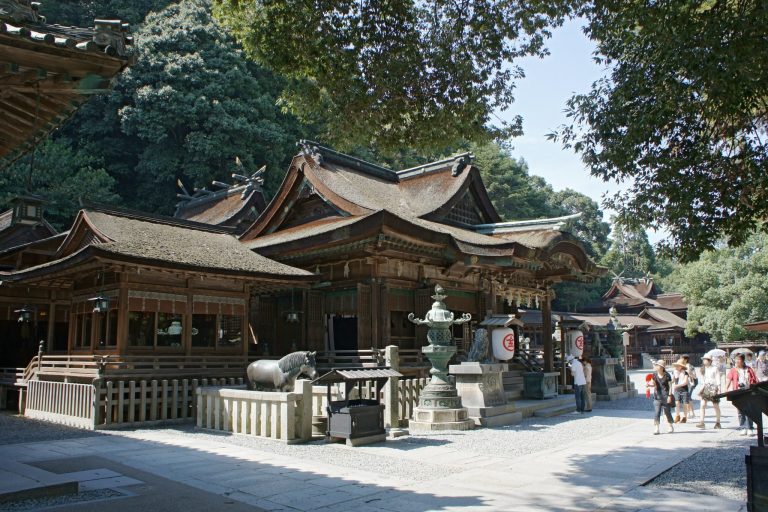
The approach enters through the Niomon, or Nio Gate, beside a pavilion used for water purification. Stone steps continue from the gate toward the bell tower and the Daishido, a hall dedicated to Kukai, who is honored in Shingon Buddhism as Kobo Daishi. The Goma-do, a hall used for the goma fire ritual in which offerings are placed in a consecrated fire, the main residence, and other buildings occupy the surrounding precinct.
Main hall
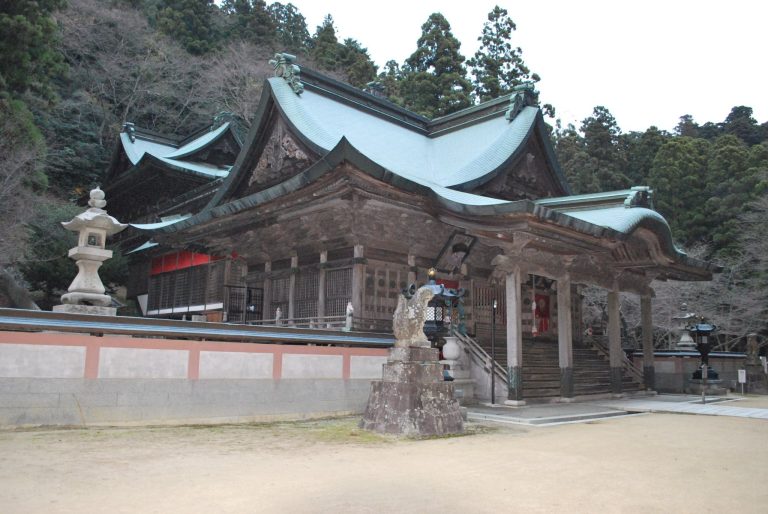
The Hondo, or main hall, was completed in 2009. A stone image of Senju Kannon stands at the center as the principal front image. A black standing Fudo Myoo, an immovable guardian of Buddhist teaching, is placed to its right, while a black standing Bishamonten is placed to its left. A standing Jizo image is positioned behind them.
Daishido and bell tower
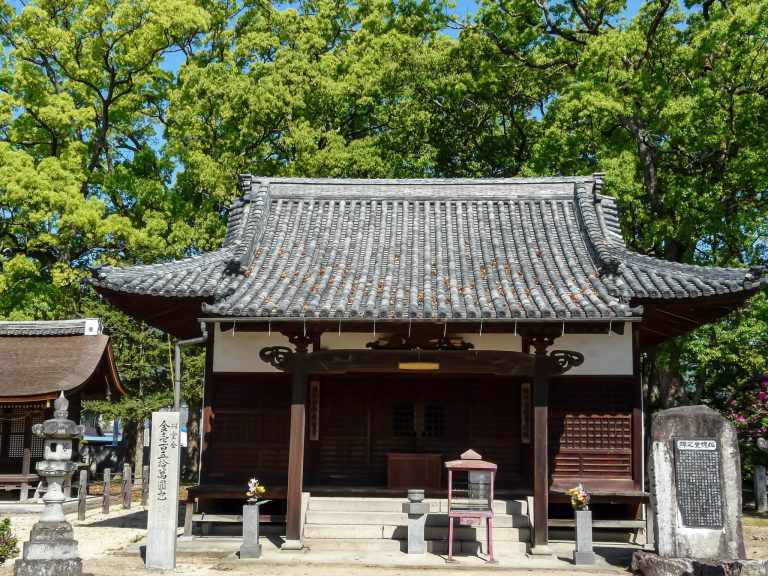
The Daishido has an outer worship hall and a rear inner hall. The inner hall is approached from behind by removing footwear and walking around the outer corridor. The bell tower, the main residence, and the shrine of the Five Great Gongen, Buddhist manifestations of kami in Japan’s tradition of religious syncretism, are additional components of the precinct. Unpen-ji also has a stone monument for written prayers, whose wording uses a play on words to express the hope that requests will be fulfilled, together with protective amulets associated with it.
Treasure-hall images
Senju Kannon
Two buildings on the slope behind the main hall form the treasure-hall area. The wooden seated Senju Kannon is carved from a single block of hinoki cypress and retains its unpainted wood surface. It has forty-two arms and measures 103.3 centimeters in height. Dating from the late Heian period and attributed to the sculptor Kyōjin, the image is designated an Important Cultural Property of Japan, a legal category for objects and structures judged to possess significant cultural value.
Bishamonten and Fudo Myoo
The treasure-hall buildings also preserve a wooden standing Bishamonten attributed to Keison. Made in 1184, the painted image measures 154.5 centimeters in height and is an Important Cultural Property of Japan. A wooden standing Fudo Myoo attributed to the same sculptor is housed in the treasure-hall building behind the Goma-do. It was added to the protected designation in 2018.
Dainichi Nyorai and surviving fragments
A cast seated image of Dainichi Nyorai of the Diamond Realm is preserved in the treasure hall. Dainichi Nyorai is a cosmic Buddha central to Shingon Buddhist thought. The image is thought to have been created as the principal image for a planned three-story pagoda considered during the Nanbokucho period. The treasure-hall area also contains the Four Heavenly Kings and a head and hands belonging to the temple’s first principal image. The size of these fragments indicates that the original was considered a six-shaku-high Buddhist image.
Stone images, trees, and summit features
Stone images of the Five Hundred Arhats, Buddhist disciples revered for their spiritual attainment, are distributed through the grounds alongside images of the reclining Buddha depicting the Buddha’s nirvana, Senju Kannon, Fudo Myoo, and other Buddhist figures. Three notable large trees are identified as a pair of married cedars, the “milk ginkgo of the Great Teacher,” and a sacred trinity tree composed of oak, alder, and maple.
The Bishamonten Observation Hall stands at the mountain’s 927-meter summit, the highest point of Mount Unpenji. Its roof provides a 360-degree panorama. Near the mountain station of the ropeway, two inscribed monuments carry verses by the poet Santoka. One refers to a stone Buddha wet with rain, while the other describes the autumn view of the Inland Sea from Unpen.
Historic pilgrimage routes
The temple precinct and its associated approaches preserve stone steps, slopes, walking routes, and sections of historic road ascending toward the mountain summit. Three stretches of the old Unpen-ji pilgrimage route retain a particularly strong historic character. They include sections rising from the Sano settlement, sections leading from roads toward the plateau road and toll road, and a short stairway section at a hairpin bend. Together, these surviving route fragments connect the mountain temple with the wider pilgrimage landscape.