Hashikura-ji Temple: A Mountain Worship and Pilgrimage Center in Japan


Site at a Glance
- Rating
- 4.3
- Popularity
- Low
- Country
- Japan
- Primary era
- Early Modern
- External website
- Open
- Eras represented
- Early Modern, Modern
- Civilizations
- Japanese, Tokugawa
- Site type
- Religious
- Remains
- Monastery
On this page21 sections
History
Hashikura-ji Temple in Miyoshi, Japan, is a special head temple of the Omuro School, a major branch of Shingon Buddhism, traditionally founded by Kūkai in 828 during the early Heian period. Its formal name is Hōjuzan Shinkō-in Hashikura-ji, and its principal deity is Konpira Daigongen, a Buddhist-Shinto deity associated with protection, maritime travel, and the Konpira religious tradition.
Traditional foundation and mountain worship
Temple tradition attributes the foundation to Kūkai, also known as Kōbō Daishi, the monk traditionally regarded as the founder of Shingon Buddhism. While traveling through Shikoku, Kūkai is said to have sensed sacred power on the mountain. He climbed the peak, received a revelation from Konpira Daigongen promising protection to those who lifted chopsticks, carved an image of the deity, and built a hall.
From the Heian period onward, Hashikura-ji developed as a center for mountain ascetic practice in Awa, the historical province corresponding broadly to part of present-day Tokushima Prefecture. Its religious identity was closely connected with the Konpira cult at present-day Kotohira-gu in Kotohira, Kagawa, in the former province of Sanuki.
The Inner Sanctuary of Konpira
Hashikura-ji was formerly regarded as Konpira Daigongen’s inner sanctuary. Before the early Meiji government separated Buddhism and Shinto, Matsuo-ji Konpoin served as the Buddhist administrative institution overseeing the Kagawa shrine-temple complex. After that separation, the Kagawa site became a shrine, while Hashikura-ji retained strong Buddhist-Shinto syncretic traditions and continued to be known as the “Inner Sanctuary of Konpira.”
According to tradition, Konpira Daigongen traveled day and night between Hashikura Mountain and Mount Zōzu in Sanuki with its attendants. A local legend gives the chopstick tradition a further explanation, saying that tengu living on Hashikura Mountain carried to the temple the chopsticks used at the festival of Konpira Daigongen on Mount Zōzu and deposited them there during the same night.
Fires, rebuilding, and renewed pilgrimage
A fire in 1677 destroyed many of the temple’s historical records. In 1769, a cleric from Kōyasan compiled an account of the temple’s origins and history. Another fire, in 1826, destroyed most of the precincts. Most of the buildings visible today were erected afterward, during the late Edo period.
From the late Edo period, Hashikura-ji prospered alongside the Konpira cult in Sanuki. Pilgrims undertook both the Konpira pilgrimage and the Hashikura pilgrimage, which were believed to bring doubled benefits. The temple is associated with several pilgrimage circuits: it is number 15 of the Shikoku 20 Sacred Sites outside the principal pilgrimage, number 4 of the Shikoku 36 Fudō Sites, number 28 of the Shikoku 33 Kannon Sites, and number 23 of the Awa Western Japan 33 Kannon Sites. It also represents the Vajra Song Bodhisattva in the Shikoku Awa Eight Offering Bodhisattvas circuit.
Continuing religious practices
Daily goma prayers take place in the Goma Hall every morning and evening. Goma is a consecrated fire ritual in Esoteric Buddhism, performed before a fire altar while offerings and prayer inscriptions are burned. At Hashikura-ji, this practice is said to have continued for approximately 1,200 years. The temple is also known for the ceremonial use of chopsticks in a baby’s first meal.
The annual Chopstick Memorial Service on August 4 includes a large outdoor goma rite and fire-walking. The Setsubun star rite follows an old tradition of continuing across midnight, during which thousands of amulets and talismans submitted from throughout Japan are consecrated.
Heritage and local setting
The Main Hall, Goma Hall, abbot’s quarters, Yakushi Hall, Bell Tower, and Tenjin Shrine form the temple’s principal nationally protected cultural-property group. The Kannon Hall is a prefecturally designated tangible cultural property. Hashikura-ji stands within Hashikura Mountain Prefectural Natural Park and remains associated with mountain worship. Its cherry blossoms and autumn foliage have also contributed to its local reputation.
Remains
Hashikura-ji occupies the southern slope of Hōjuzan, a peak about 633 metres high on a ridge extending southeast from 719.8-metre Hashikura Mountain. The abbot’s quarters stand at approximately 500 metres elevation, while the Main Hall precinct lies at about 545 metres. The approach rises through a steep sequence of stairs and terraces, linking the lower entrance, residential compound, ritual buildings, and upper precincts.
Approach and ascending route
The approach begins with a Niō Gate, a high lantern, a broad straight avenue, a large stone torii, and a red Sayabashi Bridge. A torii is a gate marking a Shinto sacred precinct, while a Niō Gate is a Buddhist entrance traditionally guarded by paired protective figures. From the bridge, 214 steps rise to a junction leading toward the abbot’s quarters and the upper precincts.
Niō Gate and high lantern
The Niō Gate is a double-roofed entrance built in 1880. Local historical research considers it to have been relocated from Kōchi Prefecture before 1908. In front of it stands the high lantern, erected in 1884. It formerly served as a landmark for boats traveling along the Yoshino River. Below the gate, a monument bears a poem by Noguchi Ujō about Kuradani’s “thousand-tatami spread” and water beneath wisteria roots.
Stairs and transitional buildings
There are 769 steps from the Niō Gate to the Main Hall. The 278 steps between the abbot’s quarters and the Main Hall are called the Hannya Heart Sutra Ascending Steps. Characters from the Heart Sutra, a short Mahayana Buddhist scripture concerning the teaching of emptiness, are attached one by one along the stairway.
The Middle Gate stands in front of the abbot’s quarters and was built during the early Meiji period, between 1868 and 1882. In front of the Main Hall, an ablution pavilion was built in 1896. Together, these structures form part of the steep architectural sequence connecting the lower and upper temple areas.
Abbot’s quarters and ritual buildings
Abbot’s quarters
The abbot’s quarters are the main residential compound and stand at approximately 500 metres above sea level. Behind the principal entrance is a black lacquered image of Kōbō Daishi. The building also houses the temple office and the sutra-registration office.
Goma Hall
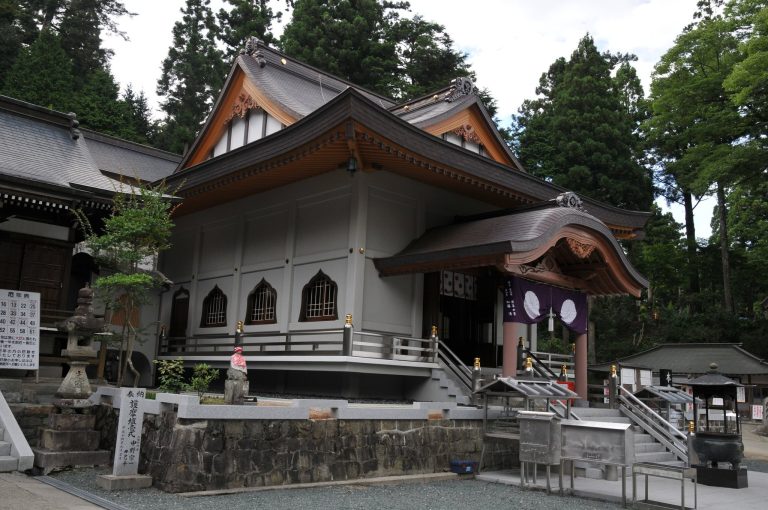
The Goma Hall has three connected parts, consisting of a worship hall, middle hall, and inner hall. The middle hall contains the goma altar, with a Red Fudō on the right and Daikokuten on the left. Fudō Myōō is a wrathful Buddhist deity associated with immovable wisdom and the destruction of spiritual obstacles. The inner hall houses Konpira Daigongen.
Two lanterns in front of the Goma Hall were donated during the late Edo period by Ichikawa Ebizō, the seventh Ichikawa Danjūrō. The names of his seven sons, including the eighth Danjūrō, are engraved on the lanterns. A viewing platform called the Principal-Image Enactment Viewing Platform was installed in front of the hall in November 2019.
Reiwa Hall and Kannon image
The Reiwa Hall enshrines the Vajra Song Bodhisattva, one of the Eight Offering Bodhisattvas, a group of Buddhist figures associated with offerings to a central Buddha or deity. The temple also planned to enshrine the Great Wish-Fulfilling Bodhisattva there. Near the Goma Hall stands a cast-metal Boke-Prevention Kannon statue associated with the Shikoku 33 Kannon and 108 Kannon pilgrimage circuits.
Main Hall precinct
Main Hall
The Main Hall stands within the upper precinct and houses the secret principal image of Konpira Daigongen. Its attendant figures are Fudō Myōō and the guardian figure known as the Deep-Sand General. The hall is accompanied by an ablution pavilion, which marks the ritual preparation area before worship.
Kannon Hall
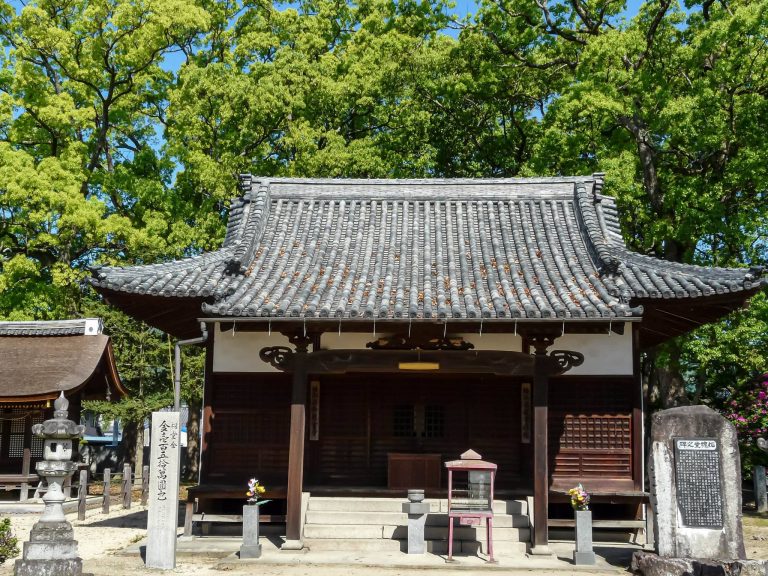
The Kannon Hall stands behind and to the right of the Main Hall. Its principal image is Batō Kannon, the horse-headed form of Kannon, a bodhisattva associated with compassion. The hall belongs to the Awa Western Japan 33 Kannon pilgrimage.
Daishi Hall and miniature pilgrimage
The Daishi Hall, also called the Hall of the Sacred Image, contains an image of Kōbō Daishi that can be viewed. Built in 1989, it serves as a substitute image for the older Kōbō Daishi image kept in the abbot’s quarters. Behind the hall lies a miniature Shikoku 88-site pilgrimage circuit created during the late Edo period.
Upper precinct structures
A Bell Tower stands in the upper precinct near the route to the Main Hall. A Yakushi Hall, a statue of the ascetic Kōbō Daishi, and a Tenjin shrine or small shrine structure also stand along this approach. These buildings and images form a series of religious landmarks within the upper mountain complex.
Outdoor goma ground
To the left of the Main Hall is a broad ground used for the large outdoor goma rite. A stone statue of Fudō Myōō associated with the Shikoku Fudō pilgrimage stands near the mountain edge, beyond which the Daishi Hall is visible.
Mountain connection
The temple is connected with the foothills by the Hashikura Mountain Ropeway. Its lower station lies at approximately 160 metres elevation, while the upper station beside the abbot’s quarters is about 342 metres higher. The journey between the stations takes approximately four minutes, linking the lower mountain landscape with the temple’s elevated residential and ritual precincts.