Take Shrine: A Meiji-Era Successor Shrine in Fuchu, Japan


Site at a Glance
- Rating
- 4.4
- Popularity
- Low
- Country
- Japan
- Primary era
- Early Modern
- External website
- Open
- Eras represented
- Early Modern
- Civilizations
- Tokugawa
- Site type
- Religious
- Remains
- Sanctuary
On this page9 sections
History
Take Shrine is a Shinto shrine in Fuchu, Japan, founded in 1873 during the early Meiji period as the successor to the former Take Shrine and the Aki Province Soja. The earlier Take Shrine had been listed as a Myojin Taisha, a shrine of especially high ritual status, in the Engishiki, a tenth-century compilation of government regulations and shrine rites. Take Shrine was designated a prefectural shrine in 1874.
Origins and Imperial Traditions
The shrine’s principal deities are Emperor Jimmu and Akitsu-hiko no Mikoto. Emperor Jimmu is the legendary first emperor in Japan’s traditional imperial genealogy, and his eastern expedition is a foundational narrative in the country’s earliest chronicles. The shrine’s alternative name, Enomiya, comes from its traditional association with the emperor’s residence during that journey.
Shrine tradition identifies the earlier Take Shrine with the place where Emperor Jimmu stayed for seven years during his eastern expedition. The Kojiki calls the palace Takiri-no-miya, while the Nihon Shoki calls it Enomiya. Another tradition places the earlier shrine at Nahari in Aki District, in present-day Kochi Prefecture.
Medieval Decline and Edo-Period Claims
The influence of the earlier Take Shrine declined during medieval conflicts among warriors, and knowledge of its location was eventually lost. During the Edo period, two institutions claimed to continue its tradition. One was Matsuzaki Hachimangu, which had a subordinate shrine called Takeisha. The other was the Aki Province Soja, a shrine where the principal deities of a province were worshipped collectively.
Reestablishment at Taresono-mori
In 1873, both claimant institutions were abolished and a new shrine was established at the present site, Taresono-mori. The deities formerly worshipped at the two institutions were brought together there. Their transmitted historical records were reportedly burned to prevent further disputes over the shrine’s succession.
The earlier shrine was also recorded as “Take-no-kami” in the Nihon Sandai Jitsuroku. On January 27, 859, its rank rose from Junior Fifth Rank, Lower Grade, to Junior Fifth Rank, Upper Grade. On April 27 of the same year, it was elevated again, to Junior Fourth Rank, Lower Grade.
Take Shrine’s treasure storehouse was designated a Hiroshima Prefecture Important Tangible Cultural Property on April 23, 1954. This recognition forms part of the shrine’s modern historical status, while the buildings and objects preserved there connect it with earlier religious and political institutions in the region.
Remains
The surviving shrine complex includes a main sanctuary, a worship hall, and a separate treasure storehouse. The principal shrine buildings follow established Shinto forms and use copper-sheet roofing, while the storehouse preserves a timber construction associated with a former Inari shrine in Hiroshima Castle.
Main Shrine Buildings
Main Sanctuary
The main sanctuary is a three-bay nagare-zukuri building, a shrine style in which the roof projects forward over the entrance. Its roof is covered with copper sheets. The present sanctuary replaced an earlier building transferred in the early Meiji period from the Inari shrine formerly located within the Sannomaru enclosure of Hiroshima Castle. That building was destroyed by fire in 1915, and the sanctuary was rebuilt in 1922.
Worship Hall
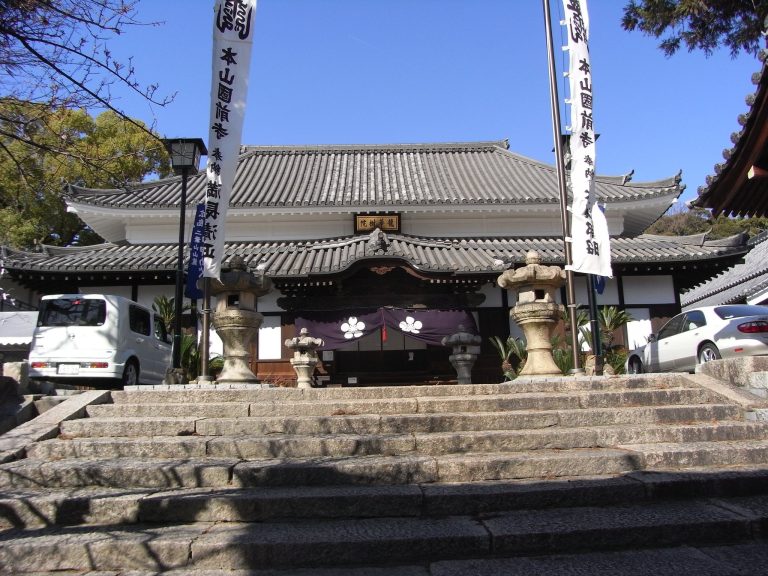
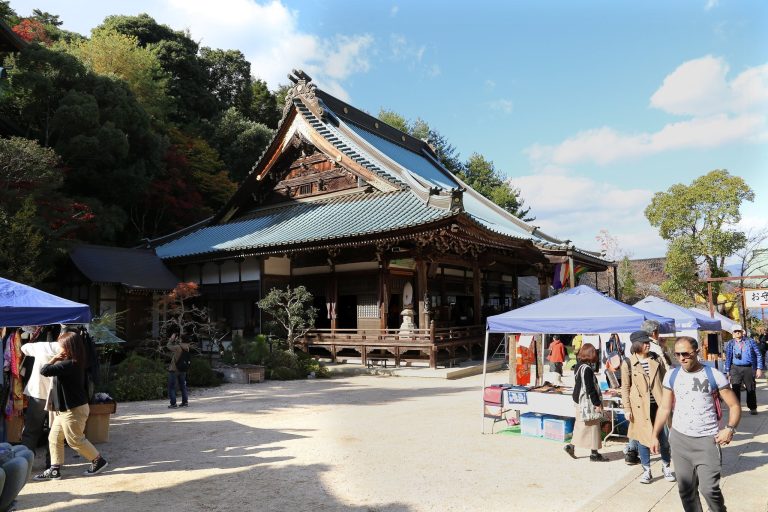
The worship hall is a five-bay-by-three-bay irimoya-zukuri structure. This form combines a gabled roof with hipped-roof sections, and the entrance is on the building’s long side, known as hirairi. A chidori-hafu, or decorative triangular gable, adorns the front. The roof is copper-sheeted. Like the main sanctuary, the present worship hall replaced a building transferred from the former Hiroshima Castle Inari shrine, and it was rebuilt in 1922 after the 1915 fire.
Treasure Storehouse
The treasure storehouse measures one bay by one bay and has an irimoya-zukuri roof with a hirairi entrance. Its roof is made of layered cypress bark, and a projecting canopy shelters the entrance. The building houses a mikoshi, a portable sacred palanquin used to carry a deity symbolically during Shinto processions.
The storehouse was transferred from the former Hiroshima Castle Inari shrine and survived the fire of 1915. It is described as the only surviving structure associated with Hiroshima Castle. Tradition dates its construction to the Genna era of the early seventeenth century, when the Asano clan established itself in Hiroshima. Its azekogumi construction is unusual: interlocking horizontal members in its kura-style timberwork form square shapes.