Saikō-ji Temple: A Jōdo Buddhist Temple in Nagano, Japan


Site at a Glance
- Rating
- 4.3
- Popularity
- Low
- Country
- Japan
- Primary era
- Modern
- External website
- Open
- Eras represented
- Modern
- Civilizations
- Japanese
- Site type
- Religious
- Remains
- Temple
On this page9 sections
History
Saikō-ji Temple is a Jōdo Buddhist temple in Nagano, Japan, traditionally established in 1199 by Karukaya Dōshin near Zenkōji. Jōdo Buddhism is centered on reliance on Amida Buddha and rebirth in the Pure Land, with recitation of the nenbutsu, or invocation of Amida’s name, as a central devotional practice. The temple’s formal name is Karukaya Mountain Jakushō-in Saikō-ji, and its history is closely connected with the Karukaya legend.
Karukaya Dōshin and the founding tradition
Karukaya Dōshin, also known as Jakushōbō Tōa, is traditionally identified as Katō Saemon-no-jō Shigeuji, who had served as governor of six provinces in Kyushu. After becoming a monk, he went to Mount Kōya, a major Buddhist monastic center associated with Shingon Buddhism. Tradition says that he later received a revelation from the Amida Buddha of Zenkōji, moved to Shinano, and established a hermitage that became Saikō-ji. He is said to have visited Zenkōji each day, lived in Shinano for 14 years, and died at the age of 83.
The story of Karukaya and his son Ishidomaru was spread through Noh drama and narrative preaching. According to the legend, Ishidomaru and his mother went to Mount Kōya in search of Karukaya. Because women were forbidden to enter the mountain, his mother remained at its foot. Karukaya concealed his identity from his son, who later returned to find that his mother had died. Ishidomaru then spent 34 years at Mount Kōya as Karukaya’s disciple, without knowing that Karukaya was his father.
Tradition further relates that Ishidomaru saw purple clouds over Shinano and traveled to Saikō-ji. He established Karukaya’s burial mound and died there on August 24, two years after his father’s death. Another traditional account places Ishidomaru’s arrival at Saikō-ji in 1214, when he realized that his father was approaching death. He continued Karukaya’s work at the temple and died two years later. These accounts of Karukaya and Ishidomaru are explicitly legendary.
Shinran and the medieval temple
In 1211, Shinran stayed at Saikō-ji for 50 days while traveling toward the Kantō region after his release from exile in Echigo. Shinran was an influential Japanese Buddhist teacher and the founder of the Jōdo Shinshū tradition. Tradition says that he wrote one copy of the “non-dual sacred name” each day during his stay and, after climbing Mount Togakushi, produced images of the Amida Triad together with Karukaya Dōshin.
In 1376, the monk Gakuen reorganized the neglected grounds, built a main hall, and revived Saikō-ji. The temple’s later identity also developed through its connection with the Karukaya story and with devotional practices centered on Amida and the nenbutsu.
Edo-period connections and visual preaching
In 1704, Koyamada Heidayū, a senior official of the Matsushiro Domain, designated Saikō-ji as his lodging while working under shogunate orders to restore Zenkōji’s main hall. Zenkōji’s rebuilt main hall was completed in 1707. Its temporary hall was then given to Saikō-ji and became the temple’s main hall.
From 1677 to 1779, Saikō-ji conducted about ten traveling public unveilings. Its illustrated account of Karukaya Dōshin and Ishidomaru was taken to temples and shrines, where the story was explained through picture-based preaching. This practice, known as etoki, communicates religious narratives while illustrated scrolls or paintings are shown to an audience.
In 1769, the two Okabe families and the Shimizu family of Saku District donated more than seven tan and seven se of land as an endowment for perpetual memorial services. Their donation helped revive continuous nenbutsu practice at Saikō-ji.
Modern transformations
In 1871, Ishizaka Shūzō, founder of the Nagano Coal-Oil Company, established what is described as Japan’s first petroleum refinery within the temple precincts. The refinery remained there until it was moved across the road to Minami-Ishidōchō in 1875.
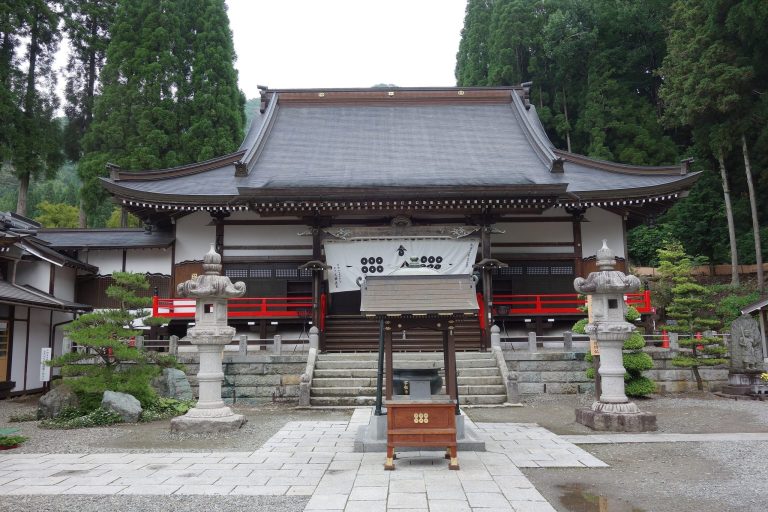
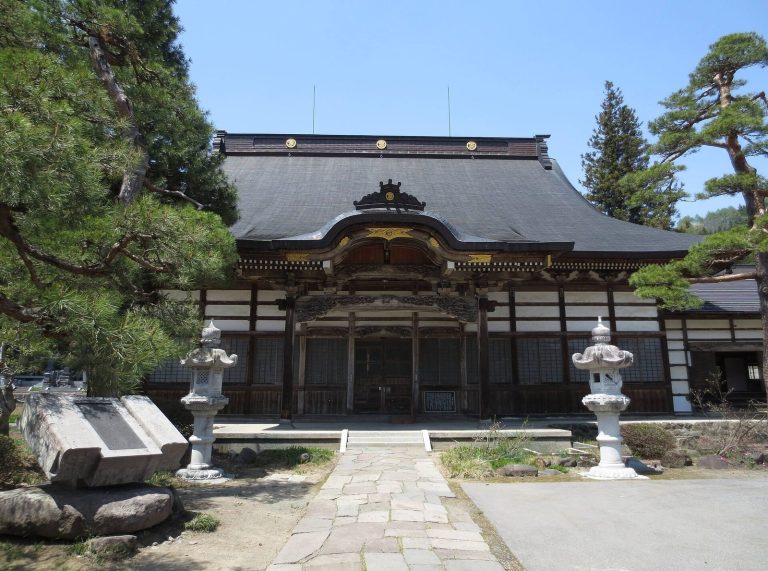
The former main hall, transferred from Zenkōji, was demolished in 1875 because of deterioration. The Founder’s Hall was then converted into Saikō-ji’s main hall. That building was replaced in 1938, forming the basis of the present main-hall structure.
From around the 1960s, the priest’s wife began explaining the early-Edo illustrated narrative of Karukaya Dōshin and Ishidomaru. A second version from the middle Edo period was later found, restored in 1989, and ritually consecrated. The two scrolls are now used together in a continuing picture-based preaching performance. Saikō-ji belongs to the Jōdo school and is the first station of the Zenkōji Seven Lucky Gods pilgrimage, representing Jūrōjin, the deity associated with longevity. The name Karukaya Mountain is also reflected in the nearby intersection and bus stop. The temple’s Karukaya parent-and-child Jizō images and wooden miniature pagoda are Nagano City Important Cultural Properties.
Remains
Saikō-ji stands in Kita-Ishidōchō in Nagano City. Its mountain name is Karukaya, and its institutional name is Jakushō-in. The present main-hall complex incorporates the history of earlier buildings, while the temple’s principal religious objects and illustrated materials preserve the traditions that shaped its identity.
Main hall and sacred images
The main hall contains the wooden pair of Karukaya parent-and-child Jizō statues, also called the Welcoming Jizō statues. A Jizō is a Buddhist bodhisattva associated with protecting beings, including children and travelers. The statues are regarded as images of Karukaya Dōshin and Ishidomaru, traditionally said to have been carved separately by father and son, and are dated to the middle of the Kamakura period.
The main hall also contains the Ten Kings statues, the judges who assess the dead in Buddhist accounts of the afterlife. Their presence is associated with oral explanations of their teachings. A sacred stone connected with conception and safe childbirth is enshrined there as well. Tradition says that Karukaya Dōshin was born through the miraculous power of a stone obtained by his father, Shigemasa, after he prayed at Kashii Shrine.
Among the temple’s preserved images is an agarwood standing figure of the Life-Prolonging Jizō. It is traditionally regarded as Karukaya Dōshin’s personal Buddhist image, said to have accompanied him as a guardian and to have originated in India. Saikō-ji also preserves an image of Idaten, a Buddhist guardian deity associated with protection and swift movement. The image is traditionally attributed to Ono no Takamura, an early-Heian court official and poet.
Scrolls and calligraphic works
Saikō-ji possesses two illustrated hanging scrolls depicting the story of Karukaya Dōshin and Ishidomaru. One dates from the early Edo period and the other from the middle Edo period. Used together for picture-based preaching, they continue the temple’s tradition of explaining the narrative through images and spoken interpretation.
A calligraphic work known as the “non-dual sacred name” is also preserved at the temple. It is attributed to Shinran and is traditionally understood as the sheets he wrote during his 50-day stay at Saikō-ji, one each day.
Wooden miniature pagoda and former halls
The wooden miniature pagoda known as the Hyakumantō was given to Saikō-ji by Hōryū-ji in May 1908 as one of the objects transferred to establish an endowment fund. A hyakumantō is a small wooden pagoda used in large numbers as a Buddhist devotional object. The type is also held by Kankeiji, Daihongan, and Ōjō-ji.
The former temporary hall of Zenkōji was transferred to Saikō-ji after Zenkōji’s rebuilt main hall was completed in 1707. It served as Saikō-ji’s main hall until its demolition in 1875. The Founder’s Hall then took over that role until the replacement building was constructed in 1938, which forms the basis of the present main hall.