Sakatsura Isosaki Shrine: A Shinto Shrine on Japan’s Pacific Coast


Site at a Glance
- Rating
- 4.4
- Popularity
- Medium
- Country
- Japan
- Primary era
- Modern
- External website
- Open
- Eras represented
- Early Modern, Modern
- Civilizations
- Japanese, Tokugawa
- Site type
- Religious
- Remains
- Sanctuary
On this page13 sections
History
Sakatsura Isosaki Shrine is a Shinto shrine in Japan, located in Hitachinaka, Ibaraki, and dedicated chiefly to Sukunahikona no Mikoto, a kami, or deity, associated with healing, medicine, and sake. Oonamuchi no Mikoto, also identified with Okuninushi, is worshipped alongside him. The shrine’s foundation is dated to 856, placing it within the religious and political developments of ninth-century Japan. Together with Oarai Isosaki Shrine across the Naka River, it forms part of a paired religious tradition often described as that of brother shrines.
Foundation and state recognition
The shrine’s foundation tradition begins with two unusual stones appearing on the coast after a salt maker saw a brilliant light over the sea. More than 20 smaller, brightly colored stones then appeared around them. A person believed to be possessed by a deity declared that Oonamuchi and Sukunahikona had returned from the eastern sea to help the people. In this tradition, Oonamuchi became the principal deity of Oarai Isosaki Shrine, while Sukunahikona was enshrined at Sakatsura Isosaki Shrine.
The Nihon Montoku Tenno Jitsuroku places the appearance of the deities in the area in early 857. On August 29 of that year, both shrines were admitted among the officially recognized state shrines. In October, they received the title “Yakushi Bosatsu Myojin,” combining a Buddhist savior figure with the term for a notable deity. The shrine later appeared in the Engishiki, a tenth-century compilation of court ritual regulations and shrine listings, as a Myojin Taisha, or high-ranking shrine, under the name Sakuretsu Isosaki Yakushi Bosatsu Shrine.
One interpretation sees the paired foundation as part of a reorganization of older religious authority connected with the Kashima region. It may also reflect the creation of official shrines that preserved earlier Kashima-related traditions. The shrine’s recorded rank rose from Senior Sixth Rank, Upper Grade, in 859 to Junior Second Rank by 1501.
Medieval traditions and decline
In 1191, Minamoto no Yoritomo, founder of Japan’s Kamakura shogunate, sent an offering envoy after hearing about an annual procession of 33 deities and ritual horse racing held on April 7. Strange events followed, including the killing of a hawk by a shrine pheasant. Yoritomo then established about 120 cho of land as shrine territory, dedicated 33 sacred horses, ordered repairs to the buildings, and granted the surname Isozaki to the priest Fujikuro.
This observance developed into the Keiba Festival, also called Yansamachi. Shrines from more than 40 villages in Naka District, or from 33 villages in another tradition, carried portable shrines and spears to the coast. Ritual horse racing took place between Muramatsu and Isozaki. The festival continued as a major expression of the shrine’s regional religious connections until it was discontinued in 1929.
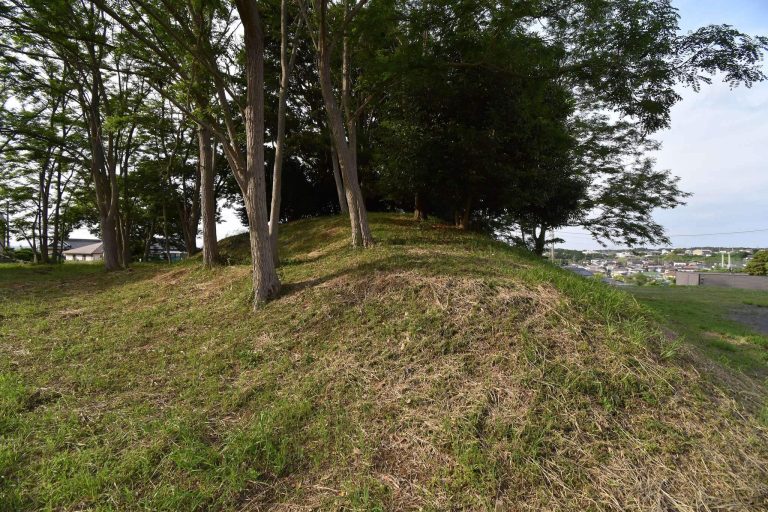
The shrine declined during the medieval period, and its main buildings eventually disappeared. Satake Sadayoshi, a medieval military governor, provided rice fields and building support in 1332, while Edo Shigemichi repaired the buildings in 1580. The shrine’s estate was confiscated during the Bunroku era, from 1593 to 1596. A local kofun, or ancient Japanese burial mound, discovered in 1663 contained grave goods, armor, flagstaffs, swords, spears, and pottery.
Revival under the Mito domain
Tokugawa Mitsukuni, the second lord of the Mito domain, began the shrine’s revival and restored the horse-racing festival in 1697. Under the third lord, Tokugawa Tsunaeda, the shrine buildings were reconstructed and the shrine was moved to its present elevated coastal site in 1702. Its earlier location is traditionally placed near the present first torii, where a small shrine survives.
The shrine’s names also changed over time. Earlier forms included “Yakushi Bosatsu,” but in 1791 the Mito domain changed the formal name from Sakuretsu Isosaki Daimyojin to Sakatsura Isosaki Daimyojin, using the characters associated with the current name. Later writings produced during the separation of Shinto and Buddhism omitted the reference to Yakushi Bosatsu. “Isosaki” refers to a rocky coastal cape or to the meeting place of land and sea. Interpretations of “Sakatsura” connect it with rows of bottles or jars used in worship and brewing, with a line of coastal rocks, and with a boundary intended to keep evil spirits away. The shrine is also popularly known as the Wet-Nurse Deity.
Tokugawa Nariaki donated about ten koku of land revenue in 1842. In the modern period the shrine was designated a village shrine in 1873, a prefectural shrine in 1874, and a National Shrine of the Middle Rank in 1885, a category in Japan’s prewar state shrine system. Since 1948 it has been included in the formal appendix category of the Association of Shinto Shrines.
Remains
The shrine occupies a plateau at a Pacific-facing cape on the Kashimanada coast. Its present grounds are arranged on the elevated site selected after the move of 1702, while the former grounds around the Hikan-tei area retain the small shrine associated with the earlier location. Reported figures for the precinct range from about 1,600 to 24,235 tsubo, with other records giving approximately 16,436 or 16,700 tsubo. The sacred grove covers about 38,837 square meters.
Approach and sacred grove
A wooded approach about 300 meters long leads through a landscape dominated by camellias and evergreen broad-leaved trees, including Machilus, sudajii, hisakaki, yuzuriha, and holly. Sudajii, Machilus, and camellia also grow beside and behind the main sanctuary. The Pacific-facing slope supports coastal plants such as Nippon daisy, Boehmeria biloba, and thick-leaved photinia, alongside zelkova, Japanese cedar, and black pine. Japanese juniper is also prominent within the precincts.
Main sanctuary and worship buildings
Main sanctuary
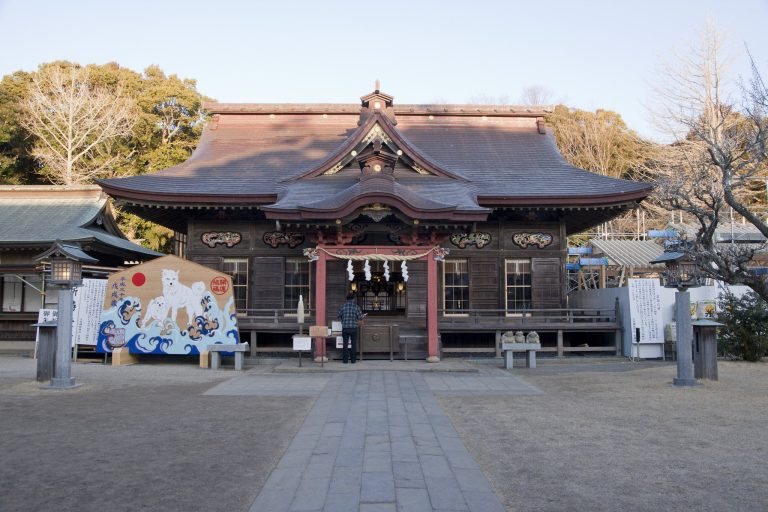
The present shrine buildings began construction in September 1933, followed by major repairs in 1948. The west-facing main sanctuary is built in nagare-zukuri, a shrine form whose roof extends forward to shelter the entrance. It measures about 1.5 bays in width by two bays in length and has a floor area of approximately three tsubo. An offering hall covers about four tsubo.
Worship hall
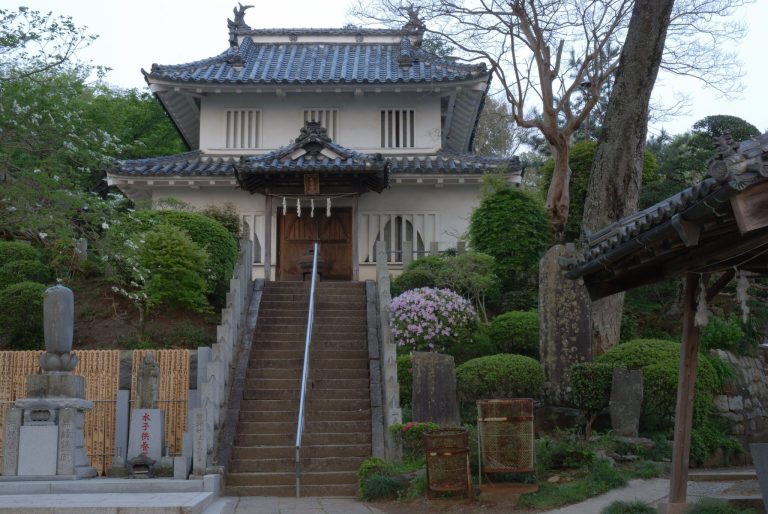
The worship hall covers about 21 tsubo and measures approximately six bays across the front by 3.5 bays in length. Its irimoya-zukuri roof combines a hipped roof with gabled sections. A chidorihafu, or triangular decorative gable, projects above the entrance, while a karahafu, or curved bargeboard gable, forms another roof feature. The front pediment carries carvings of squirrels and grapes traditionally attributed to the sculptor Hidari Jingoro.
Other precinct buildings
A surrounding fence measures about 23 bays. Other buildings include a kagura hall for sacred dances and musical performances, covering about 23 tsubo, an irimoya-zukuri temizuya, or ablution pavilion, covering about 1.5 tsubo, a sacred-horse stable of similar size, the Sakatsura Hall, and a purification or abstinence hall.
Torii, monuments, and former grounds
The first torii is a granite myojin torii erected in December 1943. The second is a granite shinmei torii dating from November 1900, with guardian-dog sculptures made by the Showa-period stonemason Iizuka Heikichi. Two plaques bearing the shrine’s name were produced by Katsura Taro and Prince Komatsu Akihito. Other features include a torii oriented toward the sea, the remains of a large lantern, a bronze statue of Isozaki Tokichi, a stone flagstaff from Maehama Village dated May 1833, and a stone monument marking the Mitarai road to Isozato from 1860.
Hikan-tei and coastal features
Hikan-tei was a pavilion built after Tokugawa Harumori visited the site in November 1790 and selected a scenic position overlooking Ajigaura beach and Isozaki Fishing Port. The pavilion was completed in 1791 on a plot about nine feet square. Tatehara Suiken wrote its name plaque, which was carved on a cherry-wood board. Nagakubo Sekisui was asked to compose an inscription, but misunderstood the commission as a request for a stele inscription and did not complete it. Fujita Yukoku supplied the finished text.
The coastal rocks associated with the shrine’s name form a line, generally sloping about 45 degrees toward the south, with some sections sloping northward. The sacred grove is an Ibaraki Prefecture cultural property and forms part of Oarai Prefectural Natural Park. The Hikan-tei ruins are designated by Hitachinaka City.
Subsidiary sanctuaries
The precinct includes three Inari shrines, Tenmangu, Kotohira Shrine, Fuji Shrine, Suijin Shrine, and Sakatsura Chinreisha. Their associated deities include Ukanomitama no Mikoto, Sugawara no Michizane, Omononushi no Mikoto, Konohanasakuya-hime, and Mizuhanome no Mikoto. Sakatsura Chinreisha stands north of the main sanctuary and enshrines war dead from the Russo-Japanese War through the Second World War. It was built on September 18, 1955, and its name plaque was written by Tomosue Yoji.