Imahie Jingū: A Historic Guardian Shrine in Kyoto


Site at a Glance
- Rating
- 4
- Popularity
- Low
- Country
- Japan
- Primary era
- Early Modern
- Eras represented
- Early Modern
- Civilizations
- Tokugawa
- Site type
- Religious
- Remains
- Sanctuary
On this page9 sections
History
Imahie Jingū is a Shinto shrine in Kyoto, Japan, founded in 1160 by retired Emperor Go-Shirakawa as the guardian shrine of his residential compound, Hojuji-dono. Its main sanctuary is built in the nagare-zukuri style, whose roof extends forward over the entrance in a flowing profile. The shrine was first established south of its present location as Imahie Shrine, after the seven Hie Sanno kami, sacred beings associated with Hie worship, were invited from Hie Taisha.
Foundation and religious network
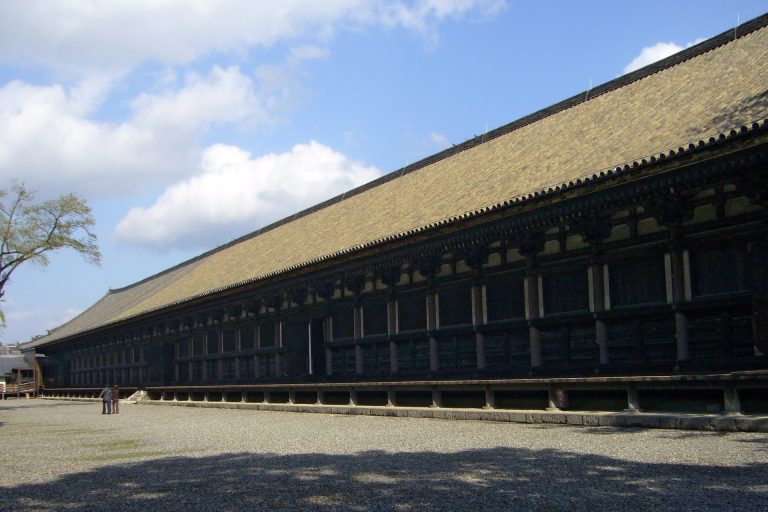
The foundation of Imahie Shrine formed part of a larger religious arrangement around Hojuji-dono. Myoho-in was moved from the Enryakuji complex on Mount Hiei to a site west of Gion Shrine, now Yasaka Shrine, to serve as the associated and supervisory temple of Imahie Shrine. Shin-Kumano Shrine and Rengeo-in, now Sanjusangen-do, were also established as the compound’s guardian shrine and guardian temple.
Go-Shirakawa, a Japanese emperor who later ruled as a retired sovereign while maintaining his own residential and religious institutions, was added to the shrine’s enshrined deities in 1958. The following year, the shrine adopted the name Imahie Jingū. It had previously been called Imahie Shrine and, from the Meiji period, Imahie Jinja.
Warfare, rebuilding, and Toyotomi memory
From the Muromachi period onward, warfare, including the Onin War, left the shrine almost completely abandoned. It was rebuilt in 1640 slightly northeast of its present site, on the approach to the abandoned Toyokuni Shrine and Toyokuni Mausoleum.
Because this reconstruction appeared to obstruct the approaches to the former Toyokuni sites, a theory arose during the Meiji period that the Edo shogunate had rebuilt Imahie Shrine to discourage visits there. No active shogunate involvement is established. Tradition instead connects the rebuilding with retired Emperor Go-Mizunoo and with a tonsured imperial prince of Myoho-in, the retired emperor’s younger brother. Go-Mizunoo was a seventeenth-century emperor who continued to exercise influence after abdication.
After Toyokuni Shrine ceased to exist, its sacred object was secretly enshrined at Myoho-in. From the middle of the Edo period, it was worshipped at Imahie Shrine. In 1785, a separate shrine was founded for it, with a deity identified with Juzenji and Kamo Tamayorihime newly invited and enshrined there. This shrine is now called Toyokuni Shrine and is dedicated to the posthumous memory of Toyotomi Hideyoshi, the sixteenth-century military ruler who unified much of Japan.
The rebuilding of Imahie Shrine has therefore been interpreted as a possible revival of Toyokuni Shrine. This interpretation is linked to the association between Hideyoshi’s former surname, Kinoshita, and the name Imahie, as well as between his childhood name, Hiyoshimaru, and Hie worship. When former daimyo families connected with the Toyotomi house revived the Toyokuni Mausoleum in 1897, Imahie Shrine was moved southwest to its present site because it stood on the mausoleum’s approach.
Later status and worship
Imahie Jingū formerly held the status of a prefectural shrine. It is now an independent Shinto shrine outside the Association of Shinto Shrines. Its principal deities are the seven Hie Sanno kami: Ōyamakui no Mikoto, Ōyamakui no Mikoto’s rough spirit, Ōkuninushi no Mikoto, Tamayorihime no Mikoto, Tamayorihime no Mikoto’s rough spirit, Tagorihime no Mikoto, and Kukurihime no Mikoto, together with Emperor Go-Shirakawa. Susanoo no Mikoto and Ōtoshi no Kami are enshrined as associated deities. The annual festival is held on October 16.
Remains
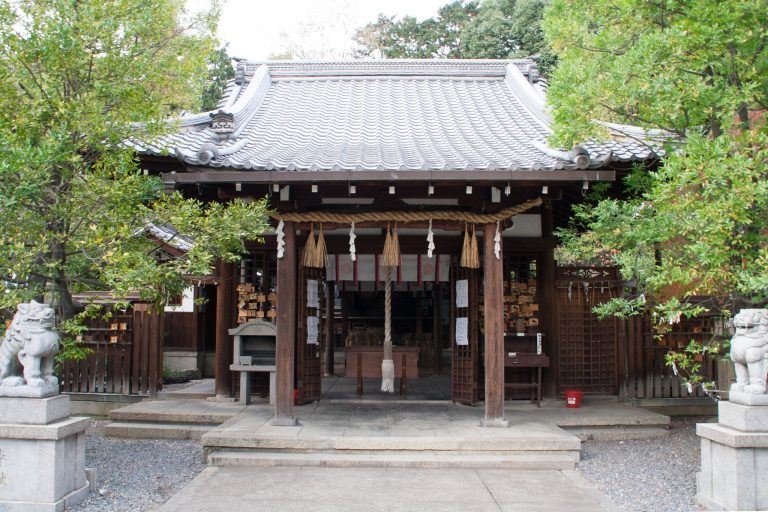
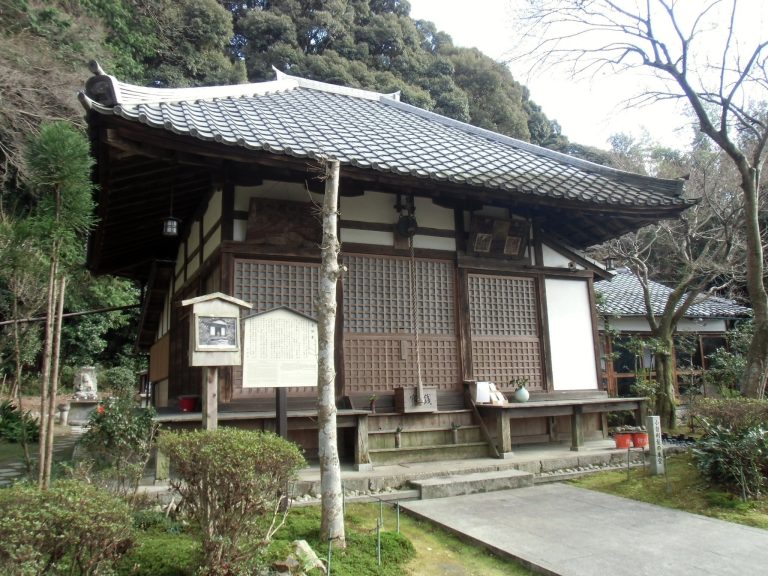
The present precinct lies in Kyoto’s Higashiyama Ward and contains the main sanctuary, a worship hall, and several subsidiary shrine buildings. The principal sanctuary uses nagare-zukuri construction, identified by its extended front roof, while the surrounding buildings form the surviving religious complex.
Sanctuary and subsidiary shrines
Main sanctuary
The main sanctuary is the central surviving building of Imahie Jingū. Its nagare-zukuri form gives the structure a roof that projects forward above the entrance, creating the characteristic flowing outline of this Shinto architectural style.
Subsidiary shrines
The precinct includes Tobiume Tenmangu, founded by Go-Shirakawa in 1160, together with Toyokuni Shrine, founded in 1785 and dedicated to Toyotomi Hideyoshi. Akiba Shrine and Atago Shrine also date from 1160, while Yamaguchi Inari Shrine was founded during the Edo period. Their buildings stand alongside the worship hall and main sanctuary within the present precinct.
Guardian monkeys
Statues of guardian monkeys stand beside the main sanctuary. These figures are komazaru, guardian-monkey images used in the religious imagery of shrines associated with Hie worship. Local belief holds that they move around at night, and wire mesh encloses them.