Manpuku-ji Temple: A Shingon Buddhist Temple in Tochigi, Japan

Site at a Glance
- Rating
- 4.1
- Popularity
- Very Low
- Country
- Japan
- Primary era
- Modern
- External website
- Open
- Eras represented
- Modern
- Civilizations
- Japanese
- Site type
- Religious
- Remains
- Monastery
On this page13 sections
History
Manpuku-ji Temple is a Chizan-branch temple of Shingon Buddhism in Tochigi City, Japan, founded in 1262 during the Kamakura period. Shingon is an esoteric Buddhist tradition centered on ritual practice, mandalas, and the Buddha Dainichi Nyorai. The temple’s formal name is Kyo-o-zan Henjo-ko-in Manpuku-ji. It is classified as a mid-level head temple and is the eighteenth pilgrimage site associated with Oku no Hosomichi.
Foundation and relocation
The ascetic priest Chokai founded Manpuku-ji at the foot of Mount Taihei in what is now Sonobe, Tochigi City. While practicing in the mountain forests, he prayed for peace throughout the realm and prosperity for the people. The temple was later moved during the Tensho era, when Minagawa Hiroteru, lord of Minagawa Castle, ordered its relocation to its present position in the Asahi district. The move took place during the construction of Tochigi Castle and its castle town, and the temple also guarded the town’s eastern gate.
In November 1591, Tokugawa Ieyasu used Manpuku-ji as a resting place during a falconry excursion. Pleased with the welcome given by the abbot, he granted the temple a five-koku stipend through a vermilion-seal grant. A koku was a historical Japanese assessment of rice-based land or income, so the grant represented officially recognized rice revenue rather than a cash payment.
Growth, destruction, and rebuilding
Manpuku-ji flourished during the Edo period, the era of the Tokugawa shogunate conventionally dated from 1603 to 1868. Its large temple complex was centered on a substantial main hall and included gates, halls, a pagoda, residences, and shrine buildings. A major fire in 1862 destroyed all the temple buildings, and the temple remained unoccupied for periods afterward.
Reconstruction began in 1897, when a priest from Toyama Prefecture took up residence. Progress was limited by the nineteenth-century anti-Buddhist movement, known as Haibutsu-kishaku, which involved the suppression of Buddhism and the destruction or confiscation of Buddhist institutions and property in many places. For a time, Manpuku-ji consisted only of a temporary house-like structure that served as the main hall, reception room, and priests’ quarters.
A new phase of restoration began in 1972 under the serving head priest, who rebuilt the main hall. A guest hall and priests’ quarters were added in 1985. For the temple’s 750th anniversary in 2011, a new main hall called the Great Vairocana Hall was constructed, the former main hall was converted into the Daishi Hall, and the grounds were extensively reorganized.
Religious traditions and memorial history
After the Second World War, festivals for the Three Demon Deities were held on the sixteenth day of January and August, coinciding with the festival day of King Enma, the Buddhist judge of the dead. The three figures are understood not as wardens of hell serving Enma, but possibly as mountain guardian deities venerated by ascetic practitioners traveling between Edo and Nikko. The statues are designated as a cultural property by Tochigi City.
Manpuku-ji also contains the grave of Tanaka Isson, a Japanese-style painter born in Tochigi City. Isson later worked on Amami Oshima after breaking with the central Japanese art world over artistic differences. In summer 2017, the Tanaka family grave was renewed and a new gravestone for Isson was erected. The memorial monument behind the Daishi Hall was removed at the same time.
Remains
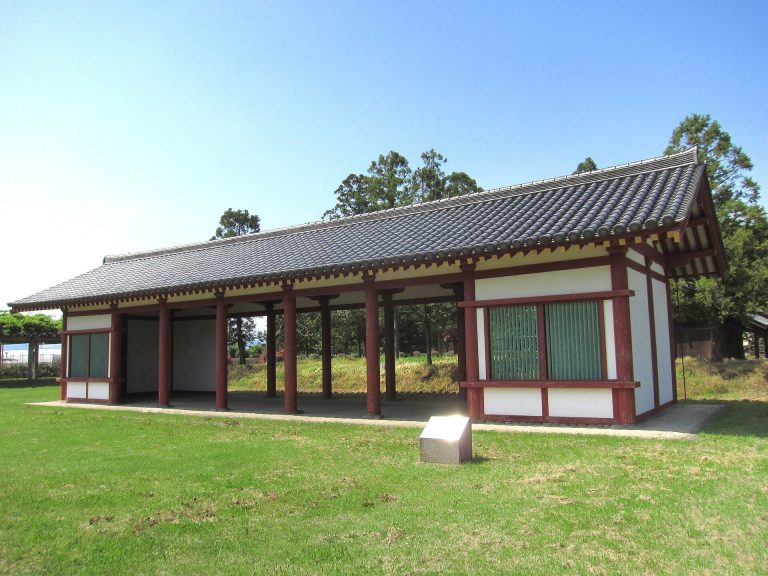
The present temple grounds combine the Great Vairocana Hall, the former main hall now called the Daishi Hall, religious images, and the Tanaka family grave. This arrangement reflects the major reorganization completed for the temple’s 750th anniversary in 2011, while also preserving the former main hall as part of the active temple complex.
Main buildings
Great Vairocana Hall
The Great Vairocana Hall is Manpuku-ji’s present main hall. Constructed in 2011, it is named for Dainichi Nyorai, the Japanese form of Mahavairocana, the central cosmic Buddha of Esoteric Buddhism. The temple’s principal object of worship is Dainichi Nyorai of the Diamond Realm, one of the two principal mandalas used in Shingon teachings.
Daishi Hall
The former main hall survives as the Daishi Hall after its conversion in 2011. It is associated with a Daishi, an honorific title for a great Buddhist teacher, whose image is connected with good fortune and protection from calamity.
Edo-period complex
The earlier complex was organized around a main hall measuring ten ken on each side. A ken is a traditional Japanese structural unit used for spacing and building dimensions. The complex also included a main gate, a formal entrance gate, a tahoto pagoda with a round upper story over a square lower story, a Yakushi Hall, a Fudo Hall, an Inari shrine, a Shoten Hall, a Three Demon Hall, a large reception hall, and priests’ quarters.
Religious images
Three Demon Deities
The Three Demon Deity image is a single group of three demon figures: one red, one blue or green, and one black. Its authorship remains uncertain, with attribution given either to the sculptor Hidari Jingoro or to Jocho, a major Buddhist sculptor of the Heian period. The group’s interpretation as possible mountain guardian deities connects it with the practices of mountain ascetics.
Other enshrined figures
Other religious images and objects at the temple include a Koyasu Kannon associated with childbearing, a deity associated with matchmaking, and a Substitute Jizo. Kannon is a bodhisattva associated with compassion, while Jizo is associated especially with protection and the care of the dead and children.
Tanaka Isson’s grave
The grave of Tanaka Isson stands with those of his grandparents, parents, and elder sister. The family grave was renewed in 2017, when a new gravestone for Isson was installed. The earlier memorial monument to the painter had stood behind the Daishi Hall before it was removed during the same work.