Niukawakami Shrine: A Shinto Water-Deity Sanctuary in Japan


Site at a Glance
- Rating
- 4.6
- Popularity
- Medium
- Country
- Japan
- Primary era
- Early Modern
- External website
- Open
- Eras represented
- Medieval, Early Modern, Modern
- Civilizations
- Japanese, Kamakura shogunate, Tokugawa
- Site type
- Religious
- Remains
- Sanctuary
On this page21 sections
History
Niukawakami Shrine is a Shinto shrine in Higashiyoshino, Nara Prefecture, Japan, traditionally founded in 675 as a sanctuary for Mizuhanome, a water deity associated with springs and rivers. The shrine was first established on the southern bank of the Mitarashi River, now called the Takami River, at the site of the present subsidiary Niu Shrine, before the deity was transferred to the present location. Its history centers on prayers for rain and for the end of prolonged rain, giving the shrine an enduring place in Japan’s traditions of water worship.
Origins and sacred traditions
A shrine tradition connects Niukawakami with the eastern campaign of Emperor Jimmu, the legendary first emperor in the traditional Japanese imperial genealogy. According to the tradition, divine instruction led him to sink ritual vessels made from earth taken from Mount Amanokagu. He then interpreted the behavior of fish in the river as an omen of victory and worshipped the deities of heaven and earth with 500 sacred sakaki trees.
Another tradition places the shrine’s manifestation in the reign of Emperor Tenmu, who ruled in the late seventh century, and describes it as a branch shrine of Oyamato Shrine in present-day Tenri, Nara. A record preserved in an edict of 895 quotes an oracle declaring that a shrine established in the remote mountains of Niukawakami would bring beneficial rain to the country and end excessive rainfall. In official records, the sanctuary was called the Niukawakami Deity rather than being assigned a single divine name. It was later identified with Mizuhanome and Okami, dragon-like water deities traditionally connected with rain.
Imperial rainmaking rites
Niukawakami became a principal setting for imperial prayers concerning the weather. Black horses were offered when rain was requested, while white or blue horses were presented when worshippers prayed for rain to stop. The symbolism associated black with rain clouds and white with clear weather.
The shrine took part in state rites for rain deities under the ritsuryo system, the classical Japanese government based on imperial law codes and centralized administration. Records describe 96 court offerings and prayers from 763 until the period around the Onin War, a fifteenth-century conflict that weakened established political and religious institutions. In 773, four households were assigned to the shrine. Offerings were made together with Kibune Shrine, and the chief priest of Oyamato Shrine traditionally accompanied the imperial envoy.
The shrine appeared in the Engishiki, a tenth-century compilation of court regulations and ritual procedures that includes the register of officially recognized shrines. It later became one of the Twenty-Two Shrines, a group of especially prestigious sanctuaries receiving direct imperial attention. Court patronage remained strong as the ritsuryo order weakened, although offerings gradually declined. After the Onin War, the location of the ancient shrine eventually became unknown.
Priests, administration, and rebuilding
From the medieval period through the Azuchi-Momoyama period, the Ogawa family inherited the office of chief priest. The family also ruled the surrounding Ogawa area and served as officials of an estate in Uda District, overseeing another Niu Shrine. Ogawa Hiromitsu, who was associated with the Northern Court during the Northern and Southern Courts period, took part in the recovery of the sacred imperial jewel in 1458.
The Ogawa family submitted to Tsutsui Junkei in 1578 and became extinct in 1587. Afterward, the affiliated Buddhist institution Manizan Daijoin administered the shrine throughout the Edo period. Manizan Daijoin was a subtemple of Kongobuji, a major Buddhist temple on Mount Koya, until the institution was abolished in 1872.
A construction inscription from 1650 records the rebuilding of Niu Shrine at its original location and the renaming of the main shrine in imitation of the practice of treating Kongobuji’s deity as a guardian deity. The sanctuary also underwent repeated construction and alteration from the medieval period onward.
Identifying the ancient shrine
Research into the location of the ancient Niukawakami Shrine began in the early modern period. The lower shrine was initially identified as the sanctuary listed in the Engishiki, and the upper shrine was identified during the Meiji period. In 1915, Moriguchi Narakichi argued that the present shrine, then classified as a village shrine, was the ancient sanctuary. Later investigations supported that identification.
In 1922, the shrine was renamed Niukawakami Shrine and became known as the Middle Shrine in relation to the upper and lower shrines. It also became the administrative center of the three-shrine institution under the designation Imperial Grand Shrine of Niukawakami. The word “Middle” refers to the existence of upper and lower shrines, not to geographical centrality or superior rank. The three shrines became independent in 1952 after the abolition of the state shrine system.
Niukawakami was classified as a Kanpei-taisha, the highest category of state-supported imperial shrine, from 1871 to 1946. It now belongs to the Association of Shinto Shrines and is designated as one of its special shrines. Its recorded court rank rose from Junior Fifth Rank, Lower Grade, in 818 to Senior Second Rank by 897, with further promotions recorded in 840, 850, 859, and 877.
Modern interpretation and worship
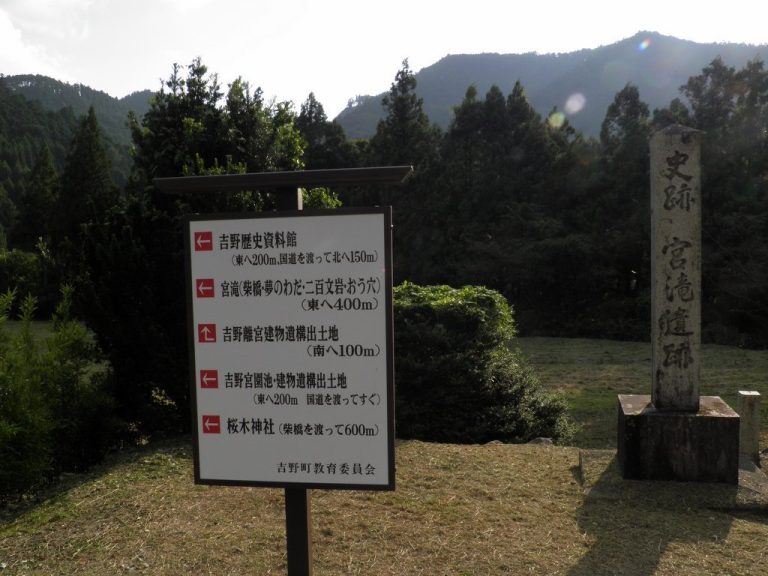
In 1940, the Ministry of Education identified the area near the former shrine grounds as the putative sacred site of Emperor Jimmu’s Niukawakami episode and erected a monument there. A local historical society placed another monument in 1966 to commemorate the area as the site of the Yoshino Detached Palace. Archaeological investigations have largely identified that palace with the Miyataki site in Yoshino, although the commemorative tradition remains part of the shrine precinct.
The arrangement of deities was revised in 1922. Mizuhanome is enshrined as the principal deity in the main sanctuary, together with Izanagi and Izanami, the primordial creator deities of Japanese mythology. The East Sanctuary enshrines Amaterasu, Omoikane, and Emperor Ojin. The West Sanctuary enshrines Emperor Kaika, Uwatsutsu-no-o, Okuninushi, Kotoshironushi, Watatsumi, and Sugawara no Michizane.
The ritual calendar includes the Water Deity Festival on June 4, attended by people connected with hydroelectric power, water supply, and other water-related industries. The Niu Shrine festival takes place on July 16, the Ogawa Festival on the second Sunday of October, and the main annual festival on October 16. Formerly held on the sixteenth day of the ninth lunar month, the Ogawa Festival was moved to its present date in 1922 and includes eight drum platforms carried from parish districts into the shrine grounds.
Remains
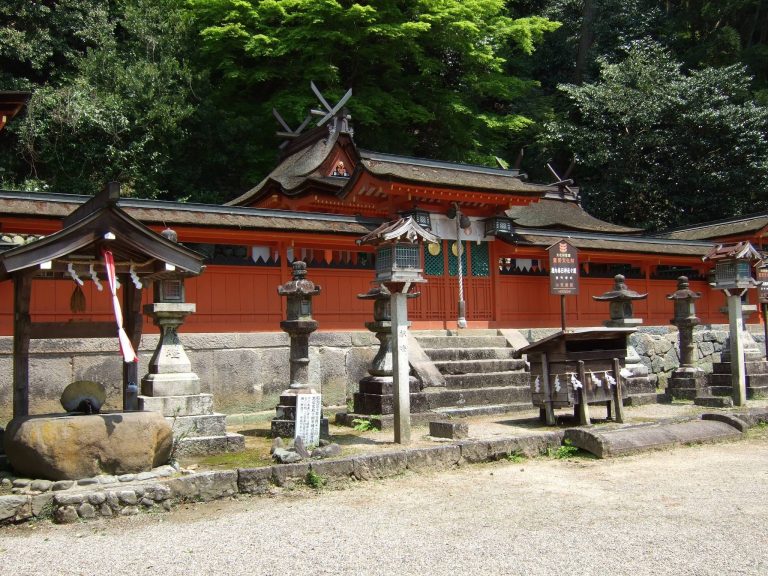
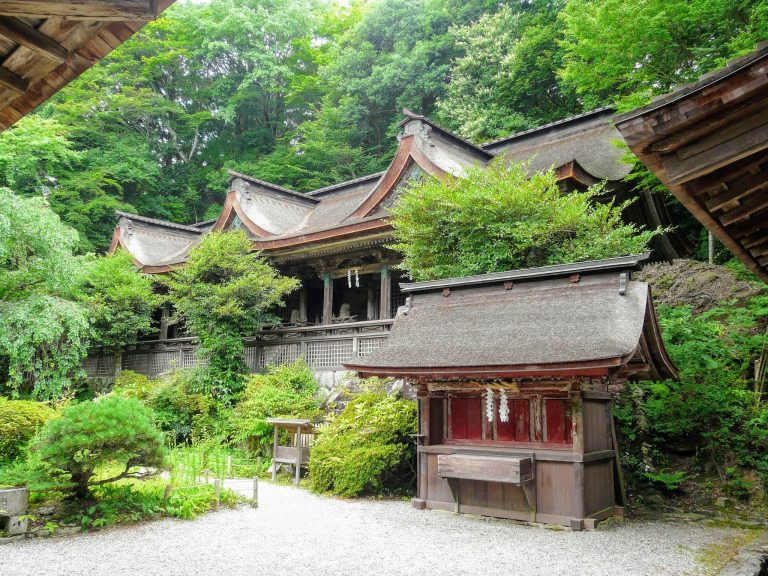
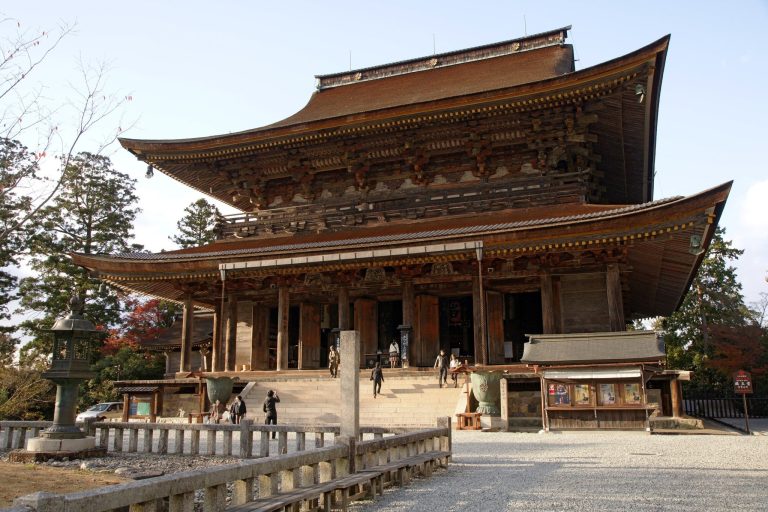
The shrine precinct contains a group of timber sanctuaries, subsidiary shrines, sacred water features, monuments, stonework, and old trees. The principal buildings stand within a landscape connected with the Takami River and Mount Komuro. Their surviving forms reflect repeated rebuilding, while the precinct’s water features and monuments preserve traditions concerning rain, purification, imperial legend, and local religious practice.
Main sanctuary group
Main Sanctuary
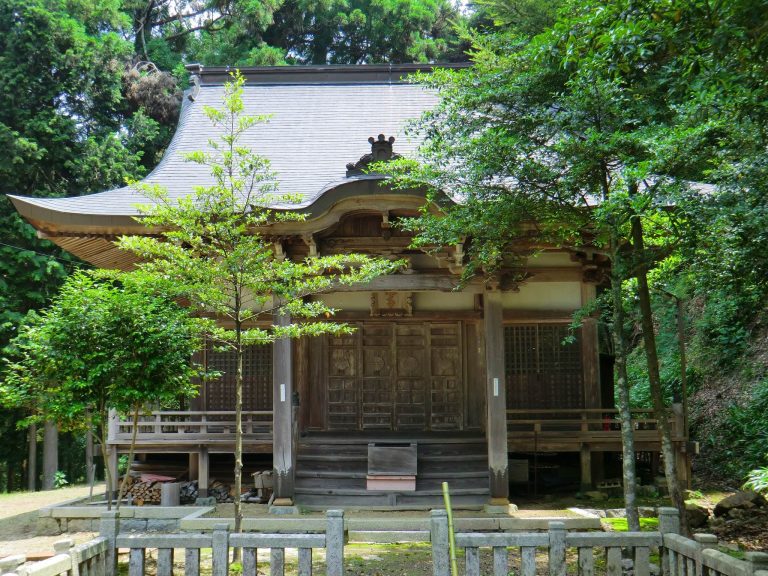
The main sanctuary was constructed over approximately twelve years beginning in 1828. It follows the three-bay nagare-zukuri style, a shrine form with a gracefully projecting curved roof over the front, and has a cypress-bark roof. Mizuhanome is its principal deity, with Izanagi and Izanami in association.
East Sanctuary
The East Sanctuary belongs to the same rebuilding phase beginning in 1828. It consists of three one-bay nagare-zukuri units joined by an intermediate space and covered by one roof, producing the appearance of a single five-bay sanctuary. Its roof is made of cypress bark, and it contains the shrines of Amaterasu, Omoikane, and Emperor Ojin. A stone lantern stands in front of it.
West Sanctuary
The West Sanctuary has the same unusual arrangement of three one-bay nagare-zukuri units joined under a single cypress-bark roof, giving the building the appearance of a five-bay sanctuary. It enshrines Emperor Kaika, Uwatsutsu-no-o, Okuninushi, Kotoshironushi, Watatsumi, and Sugawara no Michizane.
Worship Hall
The worship hall was built between 1829 and 1830 in the irimoya form, a roof design combining hipped and gabled sections. It belongs to the same period of rebuilding as the principal sanctuaries and forms part of the architectural core of the precinct.
Stone lantern and wooden deity statues
The stone lantern in front of the East Sanctuary is 2.6 meters high. Its inscription identifies the Niu Shrine, gives a date corresponding to 1264, and names a craftsman and donor, although several characters are difficult to read. The lantern is attributed to the son of a noted medieval stonemason whose family, known as the I school, worked on the restoration of Todai-ji and formed a major stoneworking lineage during the Kamakura period.
A group of twenty wooden seated deity statues is associated with the shrine. One is a 54-centimeter image of Mizuhanome carved from a single block of wood. It is regarded as the oldest known representation of the deity in Japanese-style clothing. The group also includes two female deity images in Chinese-style robes and four male deity images, all attributed to the later Fujiwara period, a late Heian-era phase of aristocratic court culture. The twenty statues became Nara Prefecture cultural properties in 2018.
Water shrines and sacred landscape
Water Deity Shrine
The Water Deity Shrine enshrines Takaokami, the deity of the upper shrine, and Kuraokami, the deity of the lower shrine. Kuraokami is a dragon-like water deity associated with rain. The shrine therefore gives physical expression to the relationship between the upper, lower, and present sanctuaries.
Wood-Spirit Shrine
The Wood-Spirit Shrine was founded in 1982 after a local forestry cooperative’s market commemorated its thirtieth anniversary. Its deity was invited from Itakiso Shrine in Wakayama. The precinct also includes Toshogu Shrine, a sanctuary dedicated to Tokugawa Ieyasu, founder of the Tokugawa shogunate.
Manai Spring
Manai is a sacred spring behind the main sanctuary. Groundwater from Mount Komuro flows beneath the sanctuary and emerges in a well. The water is associated with the blessings of Mizuhanome, linking the spring directly with the shrine’s principal water deity.
Dream Pool
Dream Pool is a deep pool at the meeting point of the Takami, Hiura, and Shigo rivers. It was formerly regarded as a place of purification and a sacred boundary associated with a water deity. The pool is also connected with the tradition that Emperor Jimmu sank a vessel containing sacred sake there. Intoxicated fish were said to drift downstream as an omen of victory, explaining the traditional association of the ayu fish with divination.
East Waterfall
East Waterfall, also called Akitsuno Waterfall and Dragon-God Waterfall, lies where the Hiura River joins the Takami River. Tradition holds that a dragon deity inhabits the waterfall. Its name refers to its traditional position east of the Yoshino Detached Palace.
Sacred trees, stones, and monuments
The Kan’ae Great Cedar is approximately 1,000 years old, rises 51.5 meters, and has a trunk circumference of 7.3 meters. The shrine associates placing both hands on its trunk and reciting a personal prayer with the granting of wishes. Nearby, the Touched Owl is carved into an approximately 200-year-old mountain cherry tree. It is said to represent an owl that settled in the great cedar, and touching the carving is associated with receiving blessings.
The Aioi Cedars are approximately 800-year-old trees with two trunks standing upright together. They are also called the husband-and-wife cedars. Beside the torii at the entrance to the West Approach stand the Grandparents’ Stones. Facing the torii, the stone on the left is the Grandfather Stone and the one on the right is the Grandmother Stone. Together they are also called the husband-and-wife stones and are traditionally said to have served as the gateposts of the Yoshino Detached Palace.
The Emperor Jimmu Sacred-Site Monument stands near the former shrine grounds at Mount Kisayama. Its inscription commemorates the making of ritual vessels, the worship of the deities of heaven and earth, and the sinking of a vessel in Niukawakami as a prayer for victory. Another monument, erected in 1966, commemorates the area as the site of the Yoshino Detached Palace.
Later facilities and protected natural features
The tea room called “Sweet Rain” is connected by a covered passage to the shrine office, completed in 1969. The precinct’s natural and cultural heritage also includes the habitat of the vine-like plant known as tsurumanyoryo on Mount Komuro behind the main sanctuary. This habitat is designated a nationally protected Natural Monument, while the stone lantern is a nationally designated Important Cultural Property.