Kitayama Honmon-ji Temple: A Head Temple of Nichiren Buddhism in Japan


Site at a Glance
- Rating
- 4.1
- Popularity
- Low
- Country
- Japan
- Primary era
- Early Modern
- External website
- Open
- Eras represented
- Medieval, Early Modern, Modern
- Civilizations
- Japanese, Kamakura shogunate, Tokugawa
- Site type
- Religious
- Remains
- Monastery
On this page18 sections
History
Kitayama Honmon-ji Temple is a Nichiren Buddhist temple in Fujinomiya, Japan, founded in 1293 by Nikkō, one of Nichiren’s principal disciples and the founder of the Fuji-school lineage. Its formal name is Fujisan Hokke Honmonji Kongen, and it is also known as Jūsu Honmon-ji. The temple belongs to Nichiren-shū, a Japanese Buddhist tradition centered on Nichiren’s teachings, the Lotus Sutra, and chanting its title. It is one of Nichiren Buddhism’s seven head temples, one of the Eight Head Temples of the Kōmon school, and one of the Fuji Five Temples.
Foundation and Nikkō’s succession
In 1293, Ishikawa Yoshitada provided a donation that enabled Nikkō to establish the Jūsu Lecture Hall at Kitayama. Nikkō began work on the Main Hall, Founder’s Hall, and Manifestation Hall, which were completed in 1298. On February 15 of that year, he moved into the Founder’s Hall, appointed six senior disciples, and began the final 36 years of his life at Jūsu. The Ishikawa family had kinship ties with the family of Nanjo Tokimitsu, a patron associated with Taiseki-ji.
Nikkō’s institutional and doctrinal succession developed at Jūsu during the early fourteenth century. In 1302, Nitchō left Hōkō-ji in Shimōsa after entrusting it to Niyō and became Nikkō’s disciple. That same year, Nikkō appointed Jakusenbō Nisshō as head of the lecture hall. Nitchō died at Jūsu in 1317, aged 66, and Sanmi Nichijun succeeded Nisshō.
Nichijun began lectures on Hokke Honmon Kenmon at Jūsu on January 8, 1318. On November 24, Nikkō established a doctrinal debate course there. Ishikawa Myōgen supported the Founder’s Hall in 1325, while the founding patron, Ishikawa Magosaburō Minamoto no Yoshitada, known by his religious name Myōgen Nichishin, died in 1328. Nikkō died at Jūsu on February 7, 1333, at the age of 88. In the same year, Iyo-bō Nichidai buried stone sutras at the precinct.
Doctrinal disputes and medieval patronage
After Nikkō’s death, Nichidai became the temple’s second head. A doctrinal conflict led local residents to expel him, and he subsequently founded Nishiyama Honmon-ji, becoming its first abbot. A debate between Jōrenbō Nissen and Nichidai took place at Jūsu in 1334, after which Nichidai temporarily lodged at Fujikibō at Taiseki-ji. Jūsu Nichimyō petitioned the imperial court in 1339. Ishikawa Sanetada reconfirmed the donation of land for the temple precinct in 1344, and Jūsu Nichimyō and others repaired the temple in 1347.
Teaching continued through the fourteenth century. Nichijun lectured on the Kaimoku-shō in 1355 and on the Kanjin no Honzon-shō in 1356. In 1417, Imagawa Norimasa issued a document confirming the temple’s rights. Disputes among adherents of Taiseki-ji, Jūsu, Hota, and Koizumi arose in 1482. Jūsu Nichijō transferred sacred texts and the object of worship to Nichikuni in 1494, and in 1495 the lecture-hall head Nichikyō transferred the former residence of Jakusenbō to Ichii-bō Nichichō.
The Imagawa family repeatedly confirmed Jūsu’s privileges. Imagawa Ujichika confirmed the temple’s title and documents in 1515 and its estate and exemption from labor obligations in 1522. In 1530, Imagawa Ujiteru granted protection from outside jurisdiction and exemption from public duties. During the winter of that year, a monk from Yōhō-ji visited Nikkō’s grave at Jūsu. Imagawa Yoshimoto exempted the temple from extraordinary duties and barred local land stewards and magistrates from entering it in 1536, issuing further confirmations in 1543 and 1544. Hōjō Ujitsuna confirmed its estate in 1538, while Imagawa Ujizane confirmed it in 1557 and again exempted it from duties in 1570.
War, destruction, and rebuilding
The temple’s sacred inheritance became the subject of disputes during the sixteenth century. In 1556, Nichitatsu of Yōhō-ji examined the sacred treasures and arranged for Nichiyō to copy the Nika Sōjō, a pair of succession documents traditionally associated with the transmission of Nikkō’s religious authority. In 1562, Jūsu Nichide issued a document concerning communications between Jūsu and Nishiyama. In 1565, Hyōbu-bō Nichigi, also called Nichiden, was excommunicated by his teacher after residing at Jūsu without permission.
On February 4, 1569, Takeda Shingen’s forces burned the temple buildings during an attack. The image of the temple’s principal religious figure was moved to Hon’nō-ji at Shizuura in Numazu. In 1574, Takeda Katsuyori issued regulations for Taiseki-ji and Jūsu and ordered measures to repair and promote both temples. The Jūsu Main Hall was rebuilt in 1578, while the Main Hall and Founder’s Hall were rebuilt again in 1579.
During the 300th memorial year of Nichiren’s death in 1581, Nishiyama adherents and Takeda retainers took valuable treasures, including the Nika Sōjō. Jūsu Nichiden petitioned Katsuyori for their return, and Katsuyori adjudicated the dispute on October 13. The Takeda authorities rejected Nichiden’s petition on February 6, 1582, and he died by fasting at the age of 57.
During Tokugawa Ieyasu’s campaign in Kai in February 1582, the resident Jūsu Nichide gave Ieyasu sacred texts and mandalas. They were returned after Ieyasu’s victory. In November, Ieyasu ordered Ide Jinsuke to construct a water channel for the temple and instructed Honda Yahachirō on December 2 to return 64 treasures from Nishiyama Honmon-ji. Further treasures were returned on February 26, 1583.
Tokugawa-period authority and repeated fires
Toyotomi Hideyoshi granted the temple an estate of 50 koku in 1590, a grant measured by assessed agricultural production, together with exemption from public duties. In 1611, the temple presented its roof plaque, which records construction or rebuilding history, and the Nika Sōjō to Tokugawa Ieyasu for inspection. A dispute over the relationship between Jūsu Honmon-ji and the Sanuki Honmon-ji lineage began in 1612, when Nichien of Sanuki arrived at the temple.
Jūsu Nichiyū brought the dispute before the Edo magistrate for temples and shrines in 1647. In 1648, Sanuki Honmon-ji lost the case, became subordinate to Jūsu Honmon-ji, and was required to use the name Hokke-ji. Tokugawa Iemitsu confirmed the 50-koku grant in 1641, and Tokugawa Ietsuna issued another vermilion-seal grant in 1665. Such a grant confirmed land or privileges under the shogunate’s official seal.
Repeated fires caused extensive losses in the later seventeenth century. Nine subordinate residences burned in 1666, followed by two in 1667, Gyōsenbō in April 1668, and Honshōbō in November of that year. The Guest Hall, monks’ quarters, and Manifestation Hall burned in 1670. After these disasters, the abbot Nichiyū left the temple in 1672. A bell tower, Two-Deva Gate, and front gate were built in 1673, but a fire in 1675 destroyed the Study Hall, five subordinate residences, and the mountain gate. The lecture-hall head Nichinen, identified as the arsonist, fled. Eight subordinate residences, the Black Gate, and the Three-Gate entrance burned in 1695.
Reconstruction continued over the following decades. The Main Hall was rebuilt in 1697, the Founder’s Hall in 1703, the Guest Hall in 1725, and the Treasure Repository in 1735. A five-story pagoda was built in September 1740. Further fires affected the lecture-hall residence in 1796, 1808, and 1812, the temple buildings in 1827, and the monks’ quarters in 1837. The Main Hall, monks’ quarters, and Study Hall burned in 1840. The bell was recast in 1841, the monks’ quarters were rebuilt in 1846, and the Main Hall was rebuilt in 1863.
Modern institutional history
In 1876, the temple and 36 subordinate temples joined the unified Fuji-school organization known as the Nichiren Buddhist Kōmon branch. The organization adopted the name Honmon branch in 1899. In 1941, the Honmon branch merged with the Unity and Superiority branches, including the Kempon Hokke school, to form Nichiren-shū. Kitayama Honmon-ji and its subordinate temples have belonged to Nichiren-shū since that merger.
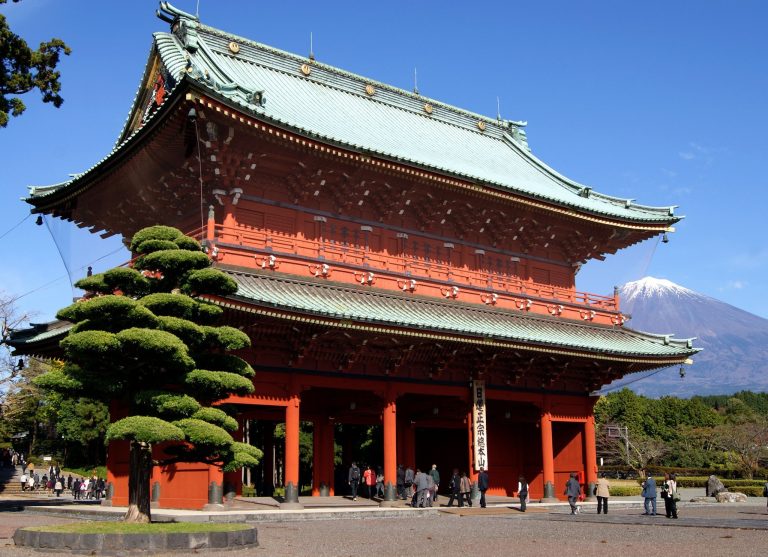
An accidental fire destroyed the five-story pagoda and Main Hall on December 15, 1910. In 1914, the Main Hall of Shimojō Myōren-ji was moved to Kitayama Honmon-ji and reused as the Founder’s Hall. The Main Hall was rebuilt in 1931, and the Niō Gate was erected on May 15, 1986. During the former Honmon-branch period, Kitayama served as the branch’s administrative headquarters. After the 1941 merger, it became one of Nichiren-shū’s seven head temples and the head temple of the Kōtō lineage association.
A tradition associated with the temple concerns the Saint Nisson’s Seat Stone. Nikkō is said to have expelled Nisson after becoming annoyed when Nisson was distracted by leaves falling outside a window. Nisson then traveled through the provinces and was credited with founding 36 temples. Although barred from entering the Main Hall, he was said to return for the annual Oeshiki memorial observance, which commemorates Nichiren’s death, and to sit secretly on the stone outside the gate.
Remains
The surviving precinct preserves the layout and memory of a large Buddhist temple complex whose principal buildings were accompanied by halls for teaching and worship, residences, gates, a bell tower, a repository, and a five-story pagoda. The complex developed through repeated rebuilding, with timber religious architecture repeatedly altered or reconstructed after fire. Its physical features also retain connections with Nikkō’s burial place, the temple’s early teaching tradition, and the institutional history of the Fuji school.
Principal halls and associated buildings
Founder’s Hall
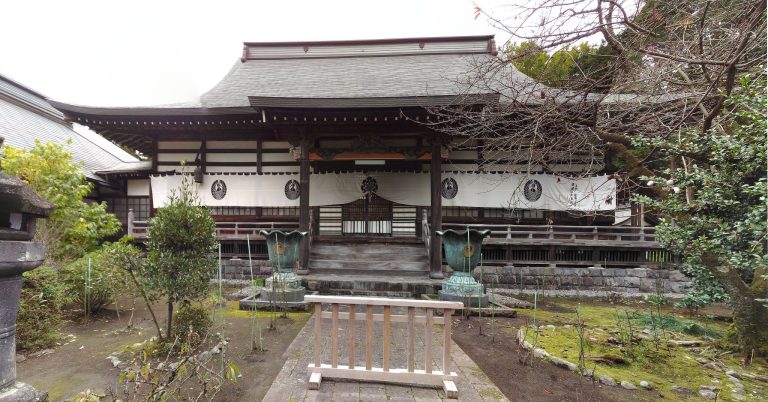
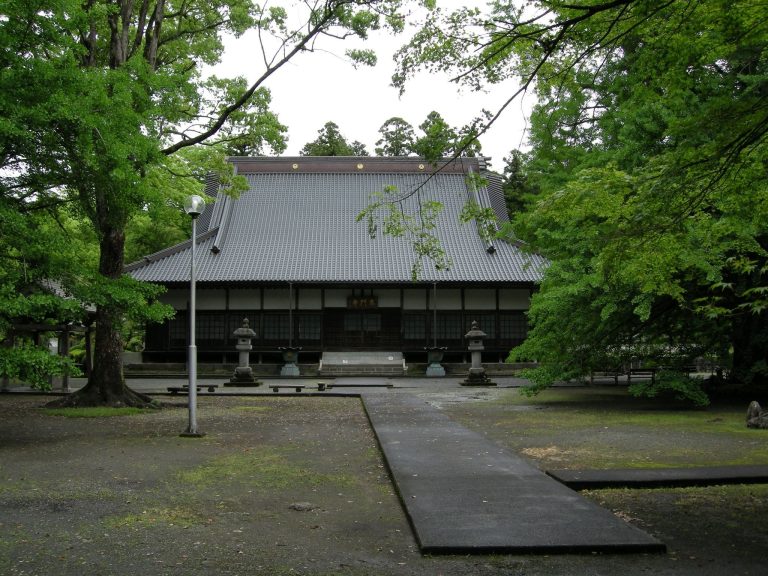
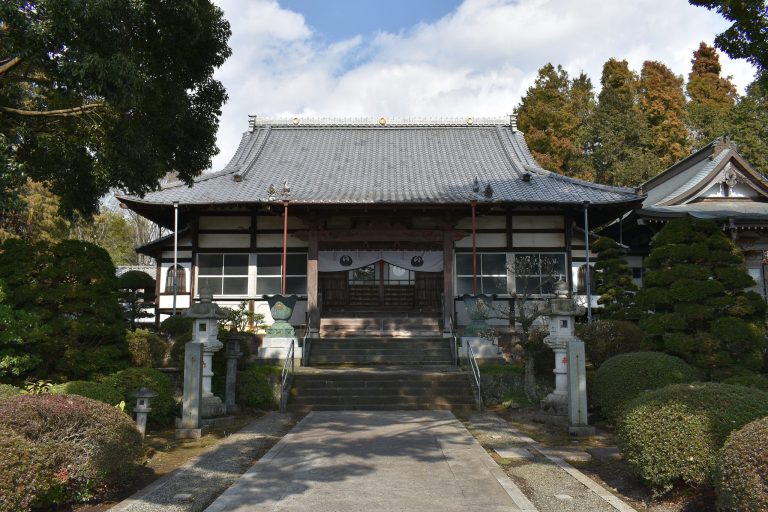
The Founder’s Hall was one of the three principal buildings begun by Nikkō in 1293 and completed in 1298. It was rebuilt in 1579 and again in 1703. The present hall incorporates the former Main Hall of Shimojō Myōren-ji, relocated to Kitayama Honmon-ji in 1914 and reused for this purpose.
Main Hall
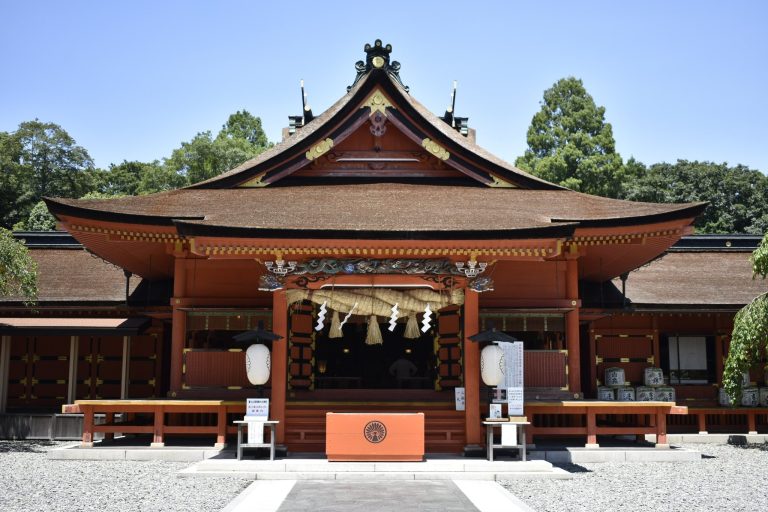
The Main Hall, another of Nikkō’s original principal buildings, was rebuilt in 1578, 1579, 1697, and 1863. An accidental fire destroyed it in 1910, and a replacement was completed in 1931. Its rebuilding history reflects the repeated renewal of the temple’s central worship space across several centuries.
Manifestation Hall and other halls
The Manifestation Hall, the third principal building begun in the foundation period, was rebuilt in September 1647. The Guest Hall was rebuilt in 1725, and the Treasure Repository in 1735. The historical complex also included monks’ quarters and a Study Hall, both of which were repeatedly affected by the fires and rebuilding campaigns of the early modern period.
Gates, bell tower, and pagoda
Gates and bell tower
A bell tower, Two-Deva Gate, and front gate were constructed in 1673. The bell was recast in 1673 and again in 1841. The Niō Gate was erected in 1986, and its paired guardian figures were carved from single blocks of Japanese cypress. The complex also included a mountain gate, Black Gate, and Three-Gate entrance. The former mountain-gate location survives as a ruin.
Five-story pagoda
The five-story pagoda was built in September 1740 as a tiered Buddhist monument traditionally associated with relics and Buddhist cosmology. The accidental fire of 1910 destroyed it, while its foundation stones remain at the site.
Burial places, traditions, and surviving evidence
Nikkō’s grave and stone sutras
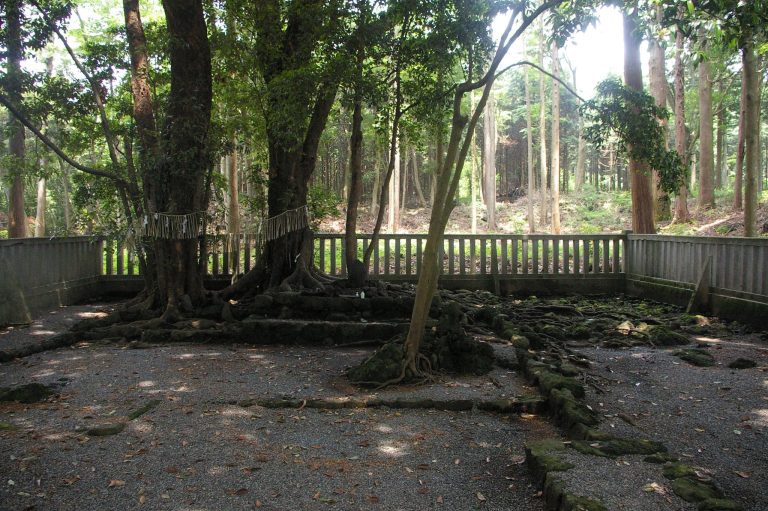
Nikkō’s grave is associated with the Jūsu precinct and was visited by a monk from Yōhō-ji in 1530. Stone sutras were buried at Jūsu in 1333 by Iyo-bō Nichidai. These features connect the physical precinct with the temple’s early succession and memorial practices.
Saint Nisson’s Seat Stone
The Seat Stone associated with the Saint Nisson stands outside the gate. It is linked to the tradition that Nisson, excluded from the Main Hall after his expulsion by Nikkō, continued to attend the annual Oeshiki observance while sitting on the stone.
Water channel and cultural properties
A water channel was ordered for the temple by Tokugawa Ieyasu in 1582. The temple is also associated with the important cultural properties Admonitions of Government, first scroll, and the Fine-Character Gold-Written Lotus Sutra. Their connection adds documentary and religious evidence to the architectural remains of the precinct.