Isonokami Jingū: An Ancient Shinto Shrine of Sacred Weapons in Japan


Site at a Glance
- Rating
- 4.5
- Popularity
- Medium
- Country
- Japan
- Primary era
- Medieval
- External website
- Open
- Eras represented
- Medieval, Modern
- Civilizations
- Japanese, Kamakura shogunate
- Site type
- Religious
- Remains
- Sanctuary
On this page17 sections
History
Isonokami Jingū is an ancient Shinto shrine in Japan, located in Tenri at the northern end of the Yamanobe-no-michi. Associated with the early Yamato polity, it was an important center of worship and military authority from the third to fifth centuries. The shrine is mentioned in the Kojiki and Nihon Shoki, eighth-century works, and is one of only two institutions called a jingū in the Nihon Shoki, a title traditionally associated with especially high religious or imperial standing.
Origins and Yamato power
Tradition assigns the shrine’s foundation to the seventh year of Emperor Sujin’s reign, conventionally dated to 91 BC. This early date belongs to legend, while a structure recognizable as a Shinto shrine probably emerged during the second or third century. Another tradition places its foundation during the reign of Emperor Nintoku. Archaeological finds from the restricted sacred area include Kofun-period ritual objects, such as curved magatama beads, necklaces, and ring-pommel swords. These finds indicate that worship began before the Asuka period, when centralized court institutions and major religious changes developed in Japan.
Isonokami worship was firmly established by the fourth century, when Yamato rulers adopted it. Between the third and fifth centuries, the shrine stood within an important center of emerging Yamato power. Yamato kings and nobles built increasing numbers of palaces and other structures nearby during the fourth century, while iron weapons belonging to the state were stored in the shrine’s storehouses. This military association connected the shrine with the Mononobe, an ancient aristocratic clan closely linked to weapons, military authority, and sacred armaments.
Sacred swords and the Mononobe
Shrine tradition relates that Ikagashikoo of the Mononobe transferred the sword Futsu-no-mitama to the present site by imperial command. The weapon was enshrined as the Great Kami of Isonokami, meaning the sacred presence associated with the sword. Futsu-no-mitama was traditionally connected with the pacification of Ashihara-no-Nakatsukuni by Takemikazuchi and Futsushinu, and with Emperor Jimmu’s eastern expedition.
A separate tradition says that the sword Susanoo used to kill the eight-headed serpent Yamata-no-Orochi was transferred to Isonokami Jingū from Isonokami Futsutama Shrine in present-day Akaiwa, Okayama Prefecture. Before the Meiji period, this sword was also transmitted there under the name Futsu-no-mitama. Another ancient tradition associates Isonokami with one thousand swords and sacred treasures deposited there in the thirty-ninth year of Emperor Suinin’s reign. The Nihon Shoki states that Prince Inishiki, Suinin’s eldest son, ordered one thousand swords to be made and was placed in charge of the shrine’s treasures.
Prince Inishiki became traditionally associated with the founding of the Mononobe clan, which patronized Isonokami for many generations. After the Mononobe collapsed, the clan was reconstituted as the Isonokami clan. The shrine’s principal deity is Futsu-no-mitama-no-Ōkami, regarded as the spirit inhabiting the Futsu-no-mitama Sword. Other enshrined kami, or sacred presences, include Furu-no-mitama-no-Ōkami, associated with the Ten Sacred Treasures; Futsushimitama-no-Ōkami, associated with the Heavenly Feather-Cutting Sword; Umashimaji-no-Mikoto; Inishiki-no-Mikoto; Emperor Shirakawa; and Ichikawaomi-no-Mikoto, regarded as an ancestor of the shrine’s hereditary priestly family.
Imperial patronage and medieval change
In 674, Emperor Tenmu sent Prince Osakabe to have the shrine’s treasures polished. In 804, the imperial government moved the shrine’s military stores to Yamashiro Province. The transfer required more than 157,000 person-movements and was followed by supernatural disturbances and illness affecting Emperor Kanmu. The treasures were subsequently returned. These events reflect the continuing importance attached to the shrine’s sacred and military resources during the Heian period, when imperial patronage of major shrines and temples expanded.
Isonokami received the rank of Senior Third Rank in 850, Junior First Rank in 859, and Senior First Rank in 868. The Engishiki, an early tenth-century register of state institutions and ritual regulations, lists it as Isonokami-zama Furu-mitama Shrine, a major shrine of Yamabe District. It was entitled to imperial offerings at monthly ceremonies, the Ainame and Niiname rites involving agricultural produce, and extraordinary observances. The register also states that the keys to the shrine buildings and gate were kept at the imperial palace, restricting access to the sacred precinct.
By the medieval period, Isonokami had become the tutelary shrine of Furu Township and flourished alongside Uchiyama Eikyūji, its associated temple. The shrine repeatedly came into conflict with Kofukuji, and uprisings occurred in Furu Township. During the Sengoku period, pressure from Oda Nobunaga’s forces led to the confiscation of much of the shrine’s landed domain, although parishioners continued their worship.
Ritual offices and modern transformation
The shrine maintained a hereditary Imibi office connected with the main line of the Mononobe clan. Members of the Mori family held this office through the Edo period. Imibi means sacred fire produced by drilling wood, and the office was linked to preparing offerings for the kami. In one ritual, the chief priest became imibi, a practice compared with the imperial Great Thanksgiving Ceremony and the Izumo fire-inheritance rite.
The Denden Festival historically carried the Seven-Branched Sword outside the shrine, where it occupied a central place in the ceremony. The regular Furumatsuri takes place on October 15, and the shrine also maintains the Chinkon-sai and other traditional observances.
Uchiyama Eikyūji, known during the Edo period as “the Nikko of the West,” was abolished during the Meiji period. Isonokami Jingū was designated a Kanpei-taisha, the highest rank in the prewar state-supported shrine system, in 1871 and was again permitted to use the title Jingū in 1883. It became a Beppyo Shrine in 1948.
The shrine’s worship originally centered on the enclosed sacred area behind the haiden, or worship hall, rather than on a separate honden, the principal sanctuary associated with the enshrined kami. This area was called Furu Takaniwa or Gohonchi, and two sacred treasures were traditionally believed to have been buried there. Excavation in 1874 produced a sword identified as the Futsu-no-mitama Sword, together with magatama and other treasures. A further excavation in 1878 produced the Heavenly Feather-Cutting Sword. A honden was then constructed for the recovered swords and treasures and completed in 1913.
In 1914, the former worship hall of Sumiyoshi Shrine, the guardian shrine of Uchiyama Eikyūji, was moved from the former temple precincts to Isonokami Jingū. It became the worship hall of the subsidiary Izumo-Takeo Shrine. The main haiden, the Izumo-Takeo worship hall, and the Seven-Branched Sword are National Treasures of Japan, while the main gate and several ancient and armor-related objects carry other cultural-property designations.
Remains
Isonokami Jingū occupies a wooded hillside at the northwestern foot of Mount Furu, among Japanese cedar trees. A poem in the Man’yōshū describes Isonokami as surrounded by sacred cedars. The precinct is arranged around the main worship hall, the enclosed sacred area behind it, the honden, and subsidiary shrines on adjoining elevated ground. A sacred mirror pond inhabited by wataka fish and a grove designated as a natural monument form part of the shrine’s protected landscape.
Main worship precinct
Haiden and Romon
The main haiden was built in the early Kamakura period, between 1185 and 1333. Its irimoya roof combines a central gable with hipped sections along the sides. The building is a National Treasure of Japan. The Romon, a traditional gate with an elevated upper story, serves as the shrine’s main gate and is designated an Important Cultural Property.
Sacred enclosure and honden
Behind the haiden, the restricted sacred area remains enclosed by a stone wall shaped like the tip of a sword. The inscription “Furu Shrine” appears on the wall. The enclosure is Furu Takaniwa or Gohonchi, the traditional center of worship associated with buried sacred treasures. The honden completed in 1913 follows the nagare-zukuri form, whose projecting front roof shelters the entrance.
Subsidiary shrines
Izumo-Takeo Shrine
Izumo-Takeo Shrine is listed in the Engishiki. Its gabled building is covered with cypress-bark shingles. The worship hall was originally built in 1300 and has a five-bay frontage, with the central bay forming an earthen passage. This arrangement is known as a split worship hall. Moved to Isonokami Jingū in 1914, the building is now a National Treasure.
The shrine stands on higher ground near the main precinct. Its position has led some specialists to regard it as the remnant or successor of an earlier religious structure associated with Izumo-taisha. This interpretation connects the present precinct with a possible predecessor that existed before the current shrine developed.
Sarutahiko, Tenjin, and Shichizasha shrines
Sarutahiko Shrine, Tenjin Shrine, Shichizasha, and another subsidiary shrine stand south of the haiden on adjoining raised ground above a stone stairway. From the courtyard before the haiden, the Romon can appear to serve visually as their gate. Tenjin Shrine faces west, while Shichizasha faces north. A site east of and directly behind these shrines is traditionally identified as the former location of a saikū, a residence for a priestess serving a major shrine.
Sarutahiko Shrine enshrines Sarutahiko-no-Ōkami, Sumiyoshi-no-Ōkami, and Takaokami-no-Ōkami. Sumiyoshi-no-Ōkami was formerly worshipped at the Sumiyoshi Shrine of Uchiyama Eikyūji. Tenjin Shrine enshrines Takamimusubi-no-Kami and Kamimusubi-no-Kami. Shichizasha houses seven kami: Musubi-no-Kami, Taru-musubi-no-Kami, Tama-tome-musubi-no-Kami, Ōmiyanome-no-Kami, Miketsu-no-Kami, Kotoshironushi-no-Kami, and Ōnaobi-no-Kami.
Sacred weapons and treasures
Seven-Branched Sword
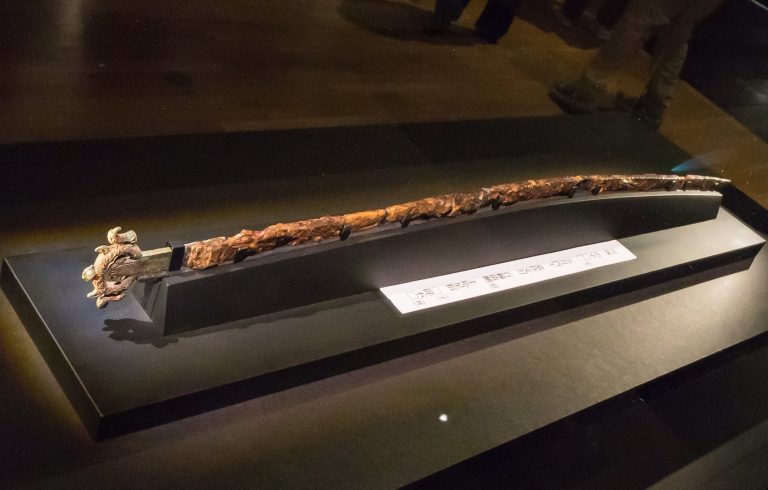
The Seven-Branched Sword is double-edged and has three branch-like projections on each side. Its gold-inlaid inscription contains a partly readable date interpreted by some scholars as the fourth year of Taiwa, or 369. The sword is generally attributed to production in Baekje around that period and was presented to a Yamato king by the crown prince of Baekje. It was rediscovered in 1873 and forms part of the shrine’s National Treasure collection.
Futsu-no-mitama and Totsuka swords
The Futsu-no-mitama Sword is a concealed sacred object associated with Futsu-no-mitama-no-Ōkami, the shrine’s principal kami. The Totsuka Sword is also traditionally associated with Isonokami. In mythology, it is the weapon Susanoo used against Yamata-no-Orochi and is linked with the tradition of the Kusanagi Sword.
Ten Sacred Treasures
The shrine is traditionally believed to house the Ten Sacred Treasures brought to Japan by Amenohiboko. They consist of two mirrors, one sword, four jewels, and three long scarf-like ritual objects. Their names are Okitsu-kagami, Hetsu-kagami, Yatsuka-no-tsurugi, Iku-tama, Makarukaheshi-tama, Taru-tama, Chikaheshi-no-tama, Orochi-no-hire, Hachi-no-hire, and Kusagusa-no-mono-no-hire.
Archaeological and military objects
Kofun-period materials associated with the shrine include magatama, necklaces, ring-pommel swords, and two iron shields. These objects belong to the period from approximately the third to sixth centuries, when monumental burial mounds were built for elite individuals. A large Sue ware jar found near the former Sakadono building has a body diameter of about 160 centimeters. The Sakadono building itself has not survived.
The black-lacquered, leather-made star helmet bowl probably dates from the early Kamakura period and is regarded as the oldest surviving example of its type. It was formed from at least two layers of cowhide soaked in glue, shaped into a hemispherical bowl, strengthened with iron wire and rivets, and finished with black lacquer. A four-centimeter opening at the crown allowed a topknot worn with an eboshi cap to pass through. The absence of decorative fittings suggests an association with a lower-ranking warrior.